GEO

Search documents
微盟集团20260317
2026-03-18 02:31
微盟集团 20260317 摘要 2025 年财务拐点显现:调整后净利润 4,200 万元首次扭亏,自由现金 流转正,销售成本下降 46.6%,资产负债率降至 64%。 AI 业务爆发式增长:2025 年营收 1.6 亿元,下半年环比增 137%;预 计 2026 年下半年环比增速有望翻倍,成为核心增长引擎。 商户解决方案量质齐升:收入同比增长 65%至 6.9 亿元,毛利率回升至 91%,主因客户结构优化及低毛利金融业务剥离。 订阅业务触底回升:受低质量业务退出及宏观环境影响,2025 年收入 同比微降 2.3%,但剔除干扰后下半年已实现连续环比增长。 AI 产品矩阵与技术升级:推出 Y、Weimi、GEO 等产品;底层架构升级 至 Agent Framework 2.0,强化垂直领域行业知识壁垒。 国际化战略提速:成立独立海外业务单元,采用"全包模式"支持名创 优品等出海,目标未来营收占比达 20%-30%。 2026 年业绩指引乐观:依托多渠道(抖音、小红书等)与 AI 战略,预 计整体营收增长 20%-50%,利润将稳步提升。 Q&A 公司 2026 年的核心战略是什么?在国际化扩张方面有何具体规划? ...
WEIMOB INC(02013) - 2025 Q4 - Earnings Call Transcript
2026-03-17 13:02
Weimob (SEHK:02013) H2 2025 Earnings call March 17, 2026 08:00 AM ET Company ParticipantsCao Yi - CFOSun Taoyong - Chairman of the Board and CEOYou Fengchun - Executive Director and PresidentConference Call ParticipantsLiao Yuan - AnalystXia Jun - AnalystOperatorThe event is for invited investors only. The audio recording transcript is for meeting for internal use by participants, not to be made public. Weimob Group has not authorized any media outlet to redistribute any content of this event. Any unauthori ...
WEIMOB INC(02013) - 2025 Q4 - Earnings Call Transcript
2026-03-17 13:02
Financial Data and Key Metrics Changes - Overall revenue grew by 80.9%, reaching CNY 1.592 billion, with a gross profit (GP) margin of CNY 1.2 billion, reflecting a 100% year-over-year increase [4][30] - GP margin rate increased by 31%, reaching 75.1%, indicating a successful high-quality development strategy [4] - Adjusted profit turned positive at CNY 42 million, with positive cash flows and free cash flow reaching CNY 300 million [6][38] Business Line Data and Key Metrics Changes - Subscription revenue was CNY 900 million, showing a slight decrease of 2.3% due to historical low-margin orders and economic pressures [30][33] - Merchant Solutions revenue grew by 65.1%, reaching CNY 690 million, with a GP margin for Merchant Solutions reaching 90% [5][30] - AI-related revenue reached CNY 160 million, contributing significantly to the overall revenue and indicating a new growth engine [5][31] Market Data and Key Metrics Changes - The retail industry spending on software continued to decline, impacting the SaaS business, but the company managed to optimize its customer base [8][29] - The overall market environment remains challenging due to deflation and tight merchant budgets, but the company is adapting through strategic transformation [29][30] Company Strategy and Development Direction - The company is focusing on an "All-in AI" strategy and high-quality growth, with plans to continue expanding into local life services and verticals like pets and fitness [3][9] - The international expansion strategy aims to support Chinese enterprises in global markets, leveraging AI for marketing and operational solutions [25][64] - The company is enhancing its multi-channel marketing strategy, including partnerships with platforms like Douyin and Xiaohongshu [12][70] Management's Comments on Operating Environment and Future Outlook - Management expressed confidence in achieving significant growth in 2026, driven by AI adoption and international expansion [40][66] - The company acknowledges the challenges posed by AI on the SaaS industry but believes that its vertical-specific solutions will remain relevant [54][58] - The management team is optimistic about the future, expecting overall revenue growth of 20%-50% in 2026 due to improved operational efficiency and reduced costs [70] Other Important Information - The company has optimized its client structure by reducing low-margin customers, which has positively impacted overall profitability [30][39] - The total assets of the group reached CNY 6.96 billion, with cash and cash equivalents at CNY 2.1 billion, indicating a solid financial position [32] Q&A Session Summary Question: Can the management team walk us through the AI business revenue and future outlook? - Management highlighted that AI-related revenue reached CNY 160 million, with various agent applications embedded into SaaS products, contributing to commercialization [42][45] Question: What are the challenges and opportunities for the SaaS industry in the face of AI? - Management noted that while AI impacts general SaaS tools, vertical-specific solutions remain essential due to the need for industry know-how [54][55] Question: Can the management elaborate on the overseas strategy and expected growth? - The company aims to provide a one-stop solution for Chinese merchants expanding internationally, with expectations for overseas business revenue to grow significantly [60][66]
重塑AI时代的搜索可见性与内容营销—2026年GEO生成式引擎优化行业研究报告
艾瑞咨询· 2026-03-04 00:05
Core Insights - GEO is an emerging marketing optimization strategy based on the information cognition and answer output principles of LLM (Large Language Model), aimed at making brand or product information more accessible to generative AI engines [1] - The core goal of GEO is to build a trust relationship between brands and AI, facilitating the visibility and trustworthiness of brands and products in AI-generated content [2] AI Industry Development Status - The Chinese AI industry has entered a phase of large-scale application centered around generative AI, evolving from an efficiency tool to a high-frequency information acquisition and decision-making entry point for users [3] AI Application Traffic Scale - Driven by ecological advantages and technological breakthroughs, the AI application user scale is expected to continue increasing, with a significant market expansion projected by 2025. However, there will be a notable divergence within the market, with certain applications experiencing explosive growth while others stagnate or decline [5] Changes in User Search Behavior - There is a paradigm shift in search behavior from traditional "link-oriented" to "answer-oriented" searches, with over 40% of users shifting their focus from traditional search engines to AI searches [7] Importance of AI Ecosystem Marketing Strategy for Brands - Structural changes in traffic entry points and user search behavior necessitate a shift in brand marketing strategies, as AI searches become a core information entry point influencing consumer choices [9] Misconceptions about GEO - Many brands mistakenly apply traditional search engine and performance advertising thinking to AI brand strategies, focusing on short-term results rather than building trust with consumers [11] Technical Principles of AI Search Engines and GEO Optimization - GEO's principle involves constructing an information cognition and priority output system based on LLM, optimizing brand knowledge assets to align with generative AI's indexing and citation mechanisms [13] GEO Industry Development Trends and Market Size - As the AI industry evolves, companies are shifting their GEO investments from experimental budgets to major marketing strategies, with the domestic GEO market expected to exceed 50 billion by 2030 [15] Industry Ecosystem - The industry ecosystem consists of upstream AI search platforms and corpus resource platforms providing foundational infrastructure, with GEO service providers at the core, supported by effect monitoring and independent teams [17] Content Engineering of GEO - GEO's content engineering focuses on semantic optimization to ensure accurate brand exposure and trust-building in the AI ecosystem, emphasizing the importance of content ownership [22] Implementation of GEO Content Optimization - The effectiveness of content distribution depends on its alignment with user semantic coordinates, requiring a focus on authoritative sources and structured content [24] GEO Effectiveness Evaluation Metrics - Current evaluation metrics for GEO effectiveness include visibility, content layer, technical layer, and business layer indicators, although attribution remains a technical challenge [25] Becoming an Indispensable Authority in AI - Future competition in the AI ecosystem will focus on understanding users better and delivering value, necessitating a shift from static visibility to dynamic competition [27] Future Development Trends of GEO Industry - The development of the GEO industry is heavily reliant on the commercialization of the AI ecosystem and the strategies of AI platforms, following ecological-driven and compliance characteristics [29] Challenges in GEO Industry Standardization - The rapid development of the GEO industry faces challenges from speculative behaviors and non-compliant operations, necessitating collaborative efforts for standardization [31] Case Studies - Various companies are leading the GEO service sector, employing innovative technologies and strategies to enhance brand visibility and credibility in AI-generated content [35][37][42][44][47][49][52][53]



易点天下 CEO 武莹:以 AI 驱动营销科技,助力中国品牌全球化
Sou Hu Cai Jing· 2026-02-13 12:31
Core Insights - The company, Yidian Tianxia, is a leader in marketing for Chinese brands going global, leveraging AI technology to enhance its service offerings and performance [2] - The strategic focus is on "overseas services and advertising technology," providing intelligent marketing and international digital services to major clients like Huawei, Alibaba, and ByteDance, achieving over 1.4 billion commercial effect conversions across 230+ countries [2] Career Transition and Management Accumulation - Wu Ying transitioned from Huawei to Yidian Tianxia in 2015, aligning her vision of leveraging technology for industrial value with the company's mission of aiding Chinese brands in global marketing [3] - Her decade-long experience at Huawei provided her with a global perspective and a customer-centric value system, which became foundational for her management approach at Yidian Tianxia [4] Organizational Innovation and Management Strategy - The company faced challenges in transitioning from business-driven to management-driven growth, leading to a significant restructuring of its organizational framework to enhance customer-centricity [5] - Key actions included aligning business and operational goals, establishing a customer segmentation system, and strengthening middle-platform capabilities to support sustainable customer service [5] Technological Strategy and Ecosystem Development - Yidian Tianxia has adopted a "dual-driven" strategy powered by AI, focusing on enhancing efficiency and optimizing outcomes through a fully integrated AI-driven marketing loop [6] - The company has been proactive in integrating generative AI technologies into marketing processes since the GPT-3 era, upgrading its technical capabilities and product architecture [6] Service Models and Client Engagement - The company offers personalized service models tailored to different client stages, utilizing automated systems for small clients and a hybrid AI-human approach for larger clients [8] - Yidian Tianxia has strategically positioned itself in innovative areas like Generative Engine Optimization (GEO) to help brands capture traffic in the new search landscape [8] Global Expansion and Future Outlook - The company has developed differentiated strategies for mature and emerging markets, focusing on brand building and operational efficiency in mature markets while emphasizing rapid user coverage in emerging markets [10] - Future growth in the overseas marketing sector is expected to be driven by the proliferation of global mobile internet, the advantages of Chinese supply chains, and innovations brought by AI technology [12] Vision and Strategic Focus - Yidian Tianxia aims to become a global leader in AI marketing technology, focusing on programmatic advertising, enhancing its AI product matrix, and establishing a robust compliance and risk management framework [13] - The company is committed to supporting the globalization of Chinese brands by leveraging AI technology for precise brand positioning and audience engagement [14]

重塑AI时代的搜索可见性与内容营销—2026年GEO生成式引擎优化行业研究报告
艾瑞咨询· 2026-02-11 00:02
Core Insights - GEO is an emerging marketing optimization strategy based on the information cognition and answer output principles of LLM (Large Language Model), aimed at making brand or product information more accessible to generative AI engines [1] - The core goal of GEO is to build a trust relationship between brands and AI, facilitating the visibility and trustworthiness of brands and products in AI-generated content [2] AI Industry Development Status - The Chinese AI industry has entered a phase of large-scale application centered around generative AI, evolving from an efficiency tool to a high-frequency information acquisition and decision-making entry point for users [3] AI Application Traffic Scale - Driven by ecological advantages and technological breakthroughs, the AI application user scale is expected to continue increasing, with a significant market expansion projected by 2025. However, there will be a notable internal differentiation, with some applications experiencing explosive growth while others stagnate or decline [5] Changes in User Search Behavior - There is a paradigm shift in search behavior from traditional "link-oriented" to "answer-oriented" searches, with over 40% of users shifting their focus from traditional search engines to AI searches [7] Importance of AI Ecosystem Marketing Strategy for Brands - Structural changes in traffic entry points and user search behavior necessitate a shift in brand marketing strategies, as AI searches become a core information entry point influencing consumer choices [9] Misconceptions about GEO - There is a misunderstanding of GEO as a traditional advertising strategy, whereas it should be viewed as a brand strategy focused on building trust with consumers and enhancing brand knowledge assets [11] Technical Principles of AI Search Engines and GEO Optimization - GEO's principle involves constructing an information cognition and prioritization output system based on LLM, optimizing brand knowledge content to align with generative AI's indexing and citation mechanisms [13] Industry Development Trends and Market Size - By 2030, the domestic GEO market is expected to exceed 50 billion, with a shift in marketing budgets towards GEO optimization as brands recognize the necessity of AI visibility [15] Industry Ecosystem - The industry ecosystem consists of upstream AI search platforms and corpus resource platforms, with GEO service providers at the core, supported by effect monitoring and independent teams [17] Content Engineering of GEO - GEO's content engineering focuses on semantic optimization to ensure accurate brand exposure and trust-building in the AI ecosystem [21] Implementation of GEO Content Optimization - The recommendation of content depends on its proximity to user semantic coordinates, with strategies for authority optimization and content distribution tailored to different AI platforms [23] Evaluation Metrics for GEO Optimization Effectiveness - Current evaluation metrics include visibility, content layer, technical layer, and business layer indicators, although attribution still faces technical challenges [24] Becoming an Indispensable Authority in AI - Future brand competition in the AI ecosystem will focus on understanding users better than competitors and delivering value, necessitating a shift from static visibility to dynamic competition [26] Future Development Trends of GEO Industry - The development of GEO is heavily reliant on the commercialization of the AI ecosystem and the strategies of AI platforms, following ecological-driven and compliance characteristics [28] Challenges in Standardization of GEO Industry - The rapid development of the GEO industry faces challenges from speculative behaviors and non-compliant operations, necessitating collaborative efforts for standardization [30] Case Studies - Various companies are leading the GEO service sector, employing unique strategies and technologies to enhance brand visibility and authority in AI-generated content [34][36][41][43][46][48][49][51][53]

关注软件ETF(515230)投资机会,市场关注技术迭代与行业变革
Mei Ri Jing Ji Xin Wen· 2026-01-20 06:51
Group 1 - The core viewpoint is that AI search is shifting from "list clicks" to "direct answers," leading to a decline in the marginal utility of traditional SEO in AI search scenarios. The concept of "GEO" is emerging as a new marketing technology paradigm focused on being "trusted by AI" [1] - GEO is fundamentally a "trust engineering" under the AI search/RAG architecture, with its core goal evolving from "increasing webpage click rates" to "enhancing brand trust and citation frequency in AI answers." The optimization logic now emphasizes "semantic relevance + structural readability + authoritative endorsement" [1] - The market potential is driven by both the replacement of existing SEO budgets and new budgets for AI search, with a forecast that the global market could exceed $100 billion by 2030 [1] Group 2 - The business model is transitioning from project-based to a hybrid model of "subscription-based SaaS + performance-based payment," with expectations of a significant increase in gross margin centrality [1] - The industry concentration ratio (CR3) is approximately 57.5%, aligning with the characteristics of the computer software industry, which is marked by "high technology + high concentration" [1] - Future traffic is expected to increasingly concentrate on AI tools, indicating a profound transformation in the marketing industry [1] Group 3 - The software ETF (515230) tracks the software index (H30202), which reflects the market performance of the software industry, covering various software development and service companies [1] - This index exhibits high growth potential and volatility, with industry allocation concentrated in the information technology sector, particularly in application software, system software, and internet services [1]
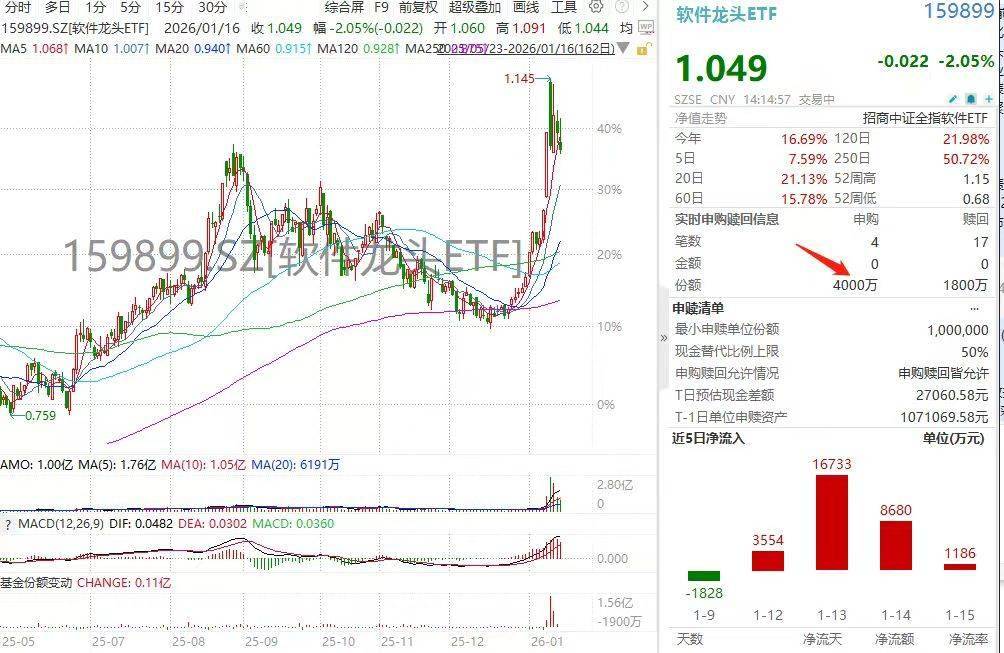
GEO熄火?软件龙头ETF(159899)获连续5日坚定增仓!用友网络、拓尔思跌幅居前
Sou Hu Cai Jing· 2026-01-16 06:32
Group 1 - The domestic GEO service market is expected to show a clear differentiated competitive landscape by 2026, with leading service providers establishing core advantages in various dimensions such as technical depth, resource breadth, content richness, and vertical precision [3] - Unlike traditional SEO, which focuses on optimizing keywords and rankings, GEO emphasizes whether brand content can be understood and recommended by AI large models, offering higher marketing efficiency and potentially shortening consumer decision-making cycles [3] - The rise of generative AI as a new traffic entry point and the improvement in marketing efficiency are expected to drive the transformation of GEO, with e-commerce operators likely to be the first to seize these changes and actively meet brand marketing demands [3]

AI搜索时代的流量新范式与计算机行业投资机会梳理:GEO: AI搜索时代的流量新范式-20260115
GUOTAI HAITONG SECURITIES· 2026-01-15 11:05
Investment Rating - The report assigns an "Overweight" rating for the industry [4]. Core Insights - The transition from traditional SEO to GEO (Generative Engine Optimization) represents a paradigm shift in how brands are perceived and trusted in AI-driven search environments. GEO focuses on enhancing the credibility and citation frequency of brands in AI-generated answers, moving beyond mere visibility to being actively referenced by AI [2][8]. - The market potential for GEO is projected to reach a "billion-dollar level," driven by the replacement of existing SEO budgets and new allocations for AI search [2][21]. Summary by Sections 1. Definition and Essence of GEO - GEO is defined as an optimization strategy that ensures brands and content are actively mentioned in AI-generated answers, contrasting with traditional SEO which focuses on ranking [8]. - The emergence of GEO is attributed to the rise of AI search, which bypasses traditional click-through processes, leading to a significant drop in natural click rates [10][11]. 2. Technical Principles: Trust Engineering on the RAG Link - The RAG (Retrieval-Augmented Generation) architecture is central to GEO, shifting the focus from keyword matching to semantic understanding and trust-building [14][15]. - GEO aims to enhance content visibility, retrievability, and trustworthiness, rather than simply improving rankings [15]. 3. Market Space: SEO Replacement and New AI Search Demand - The global SEO service market is estimated at approximately $80 billion in 2024, with GEO expected to capture 10-20% of this budget, alongside new AI search allocations, leading to a potential market size exceeding $100 billion by 2030 [16][19]. - In China, the GEO market is projected to grow from 2.9 billion yuan in 2025 to 24 billion yuan by 2030, reflecting a CAGR of about 52.4% [21]. 4. Business Model: Transition from Labor-Intensive Services to Technology Platforms - The current GEO service model is primarily project-based, but it is expected to evolve towards a subscription-based SaaS model combined with performance-based pricing [22][25]. - The anticipated gross margin for GEO services is expected to rise significantly, aligning with the characteristics of the high-tech, high-concentration software industry [25]. 5. Investment Recommendations: Mapping the Content-Knowledge-Retrieval-Computing Chain - The report identifies key investment targets across the GEO value chain, including companies like Mifus, Minglue Technology, and iFlytek, which are positioned to benefit from the shift towards AI-driven marketing and content creation [27][30].


尾盘视觉中国回封涨停,多只传媒ETF跌幅收窄
Mei Ri Jing Ji Xin Wen· 2026-01-15 07:14
Core Viewpoint - The financing ratio adjustment has led to significant pullbacks in high-position stocks within the AI application and commercial aerospace sectors, impacting trading sentiment and causing declines in multiple media ETFs [1] Group 1: Market Performance - Media ETF (512980) dropped nearly 6%, while Media ETF Huaxia (516190) fell by 3% [1] - At the end of the trading session, Media ETF Huaxia (516190) saw its holding stock Vision China hit the daily limit, resulting in a narrowing of its decline [1] Group 2: AI Application Developments - On January 15, Alibaba's AI application, Qianwen, announced integration with Taobao, Alipay, and Fliggy, marking the beginning of the "AI service era" [1] - The traditional marketing logic is undergoing a complete transformation in the AI era, evolving from "you might like" to "we give you what you want" [1] Group 3: Industry Insights - The Generative Engine Optimization (GEO) sector is expected to become a trillion-dollar blue ocean, with companies possessing technical and marketing capabilities likely to benefit first [1] - According to the China Academy of Information and Communications Technology's "2025 Generative Engine Optimization Industry White Paper," the customer conversion rate for businesses using AI recommendation scenarios has increased by 2.8 times compared to traditional search, and the user decision-making cycle has shortened by 40% [1] - GEO is anticipated to be a key direction for brand marketing transformation in the future [1] Group 4: Investment Strategy - For ordinary investors optimistic about the long-term prospects of AI marketing or applications but struggling to identify individual stocks, investing in related industry ETFs, such as Media ETF Huaxia (516190), which tracks the CSI Cultural and Media Index, is a viable option for risk diversification and capturing industry trends [1]