新能源转型

Search documents
一汽奔腾超85亿元增资正式落地 多元资本赋能新能源转型
Sou Hu Cai Jing· 2025-09-06 08:08
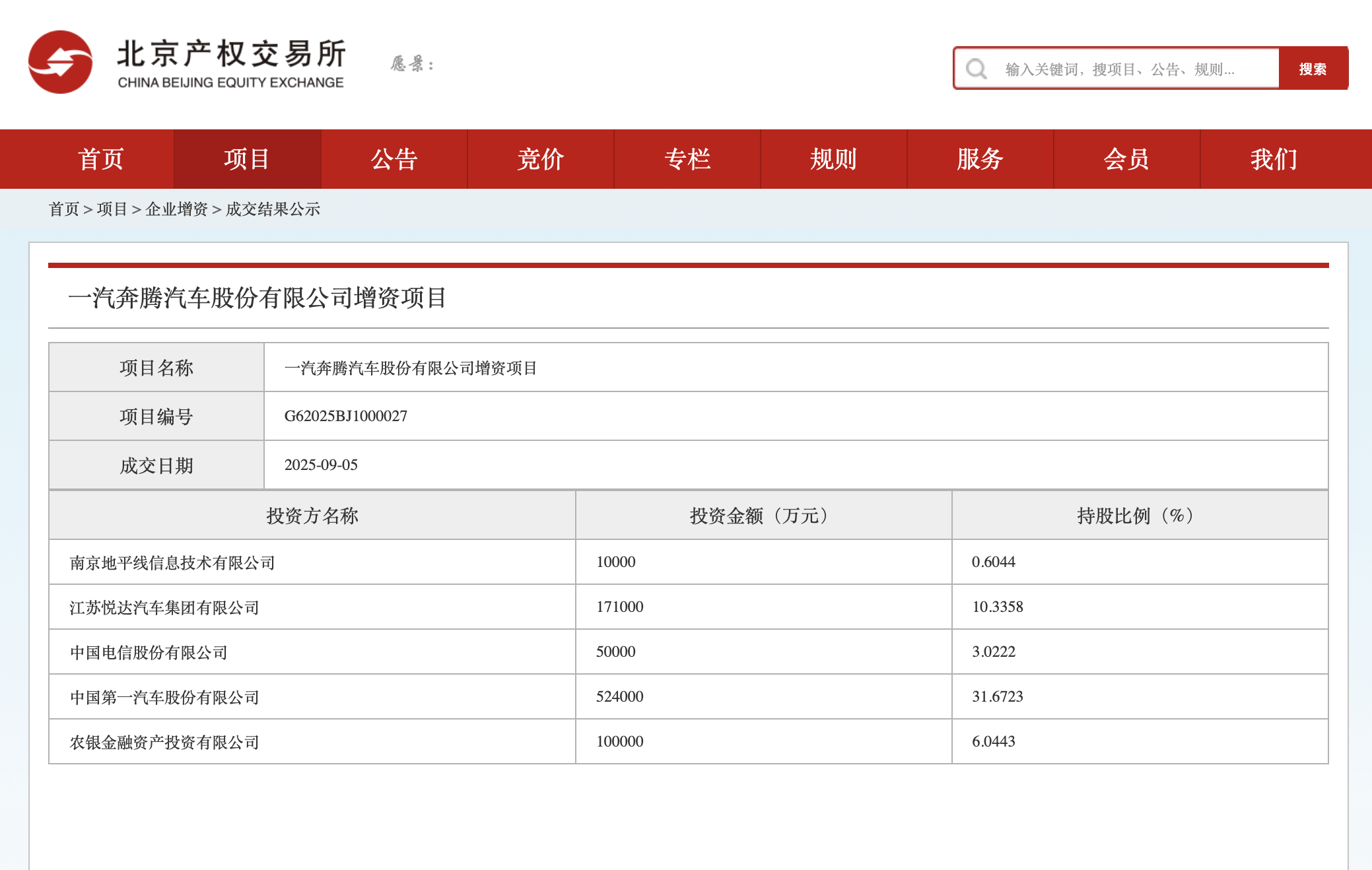
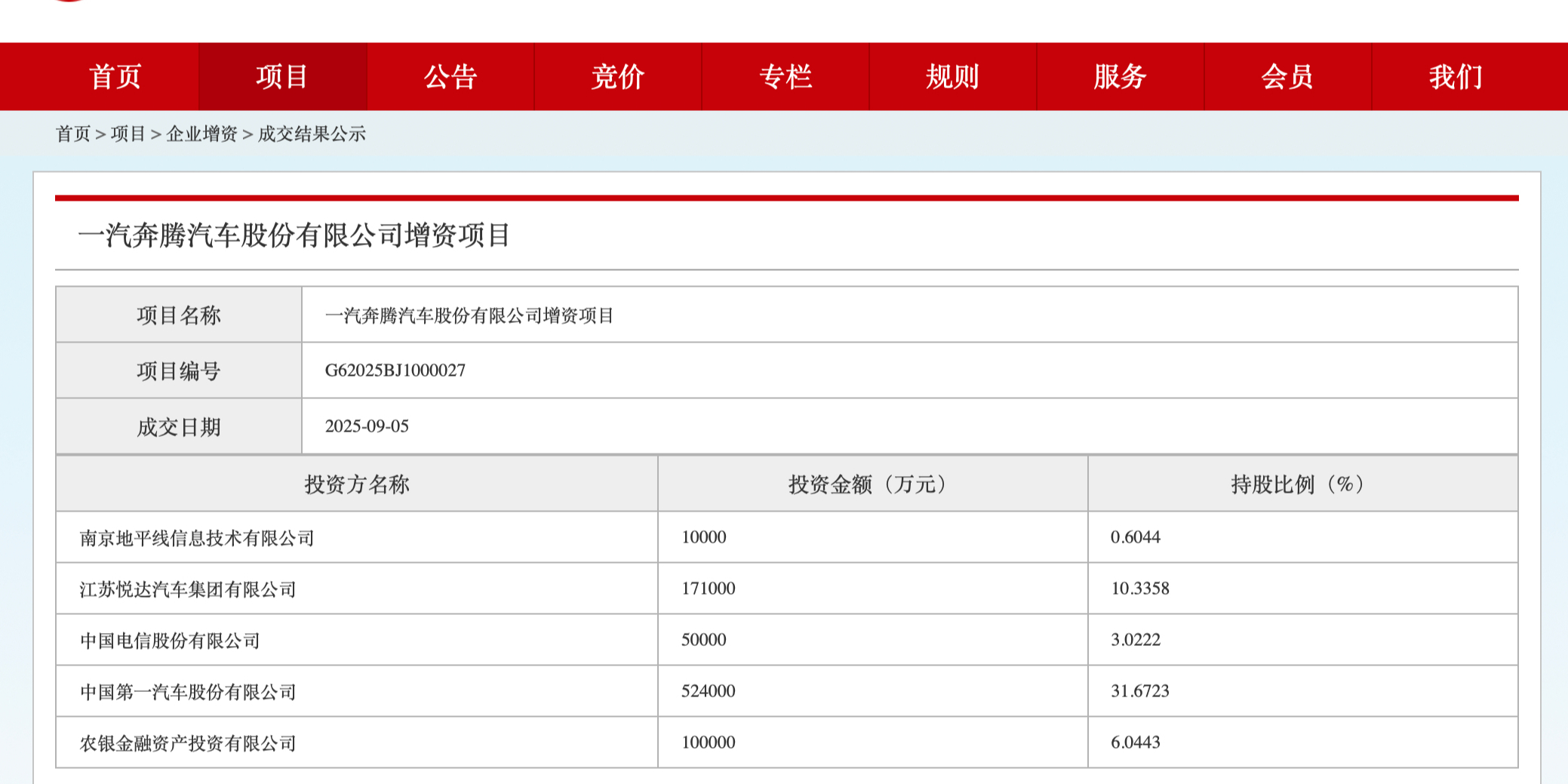
Core Viewpoint - China FAW Group has successfully raised a total of 8.55 billion yuan for its subsidiary, FAW Bestune, through a capital increase involving multiple strategic investors, aimed at enhancing its capabilities in new energy technology, smart manufacturing, and channel ecosystem development [1][2][5]. Investment Details - Four leading enterprises have collectively invested 3.31 billion yuan, with Jiangsu Yueda Automotive Group investing 1.71 billion yuan, Agricultural Bank of China's investment platform investing 1 billion yuan, China Telecom investing 500 million yuan, and Nanjing Diheng Information Technology investing 100 million yuan [1][2]. - The controlling shareholder, China FAW Group, has also increased its investment by 5.24 billion yuan, resulting in a total shareholding of 79.0394% in FAW Bestune [1][2]. Fund Utilization - The total raised funds of 8.55 billion yuan will primarily be allocated for research and development in new energy technologies, upgrades in smart manufacturing, and the construction of a channel ecosystem [1][5]. Recent Performance - In 2024, FAW Bestune achieved a record sales volume of 151,000 vehicles, with new energy vehicle sales reaching 83,000 units, marking a year-on-year growth of 214% and a penetration rate of 55% [4]. - From January to August 2024, the company continued its growth trajectory with total vehicle sales of 118,000 units, a year-on-year increase of 47.5%, and new energy vehicle sales of 101,000 units, reflecting a 233.9% increase [4]. Strategic Partnerships - The strategic investors will provide multi-dimensional support in industry, finance, and technology, enhancing FAW Bestune's capabilities [5]. - Jiangsu Yueda Automotive Group's continued investment reflects confidence in the partnership, while Agricultural Bank's investment will foster innovation in automotive finance and mobility services [5]. Future Plans - FAW Bestune plans to launch six new models under the Bestune Yuedi brand, covering A0 to B-class markets with various powertrain options [8]. - The company aims to optimize operations with a more market-oriented mechanism and innovate in collaboration with strategic investors to build a new development framework [8].

一汽奔腾增资85.5亿元,悦达汽车、地平线等参投
Jing Ji Guan Cha Wang· 2025-09-06 05:58
Core Viewpoint - The capital increase project of FAW Bestune has successfully raised a total of 8.55 billion yuan through investments from multiple leading enterprises, which will significantly enhance its capabilities in new energy technology and smart manufacturing [1][2]. Group 1: Investment Details - FAW Bestune received investments from four major companies totaling 3.31 billion yuan, including 1.71 billion yuan from Jiangsu Yueda Automobile Group, 1 billion yuan from Agricultural Bank of China's investment platform, 500 million yuan from China Telecom, and 100 million yuan from Nanjing Horizon Information Technology [1][2]. - The controlling shareholder, China FAW Group, also contributed 5.24 billion yuan, bringing the total funds raised to 8.55 billion yuan [2]. Group 2: Shareholding Changes - Following the capital increase, China FAW's shareholding in FAW Bestune decreased from 86.1568% to 79.0394%, while Jiangsu Yueda's stake increased from 1.9741% to 10.3358% [2]. - Nanjing Horizon holds 0.6044%, Agricultural Bank's investment platform holds 6.0443%, and China Telecom holds 3.0222% of the shares [2]. Group 3: Strategic Goals and Future Plans - The raised funds will primarily be used for new energy technology research and development, smart manufacturing upgrades, and channel ecosystem construction, aiming to empower key strategic initiatives [2]. - FAW Bestune plans to explore new business models in "automotive finance + mobility services" in collaboration with Agricultural Bank, and leverage 5G and big data technologies with China Telecom to develop next-generation smart vehicles [3]. - The company aims to launch six new models covering A0 to B-class markets, including various powertrain options such as pure electric, hybrid, and range-extended vehicles [4]. Group 4: Production Capacity and Sales Performance - FAW Bestune's production capacity is planned at 400,000 units annually, with the Yancheng plant already reaching full production capacity [3]. - In August, FAW Bestune sold 15,900 vehicles, a year-on-year increase of 49.5%, with new energy vehicle sales reaching 14,528 units, up 122.4% [3]. - From January to August, total sales reached 118,337 units, a 47.5% increase, with new energy vehicle sales hitting 100,989 units, marking a 233.9% year-on-year growth [3].
储能电芯市场再“爆单” 全球市场需求持续放量
Zheng Quan Ri Bao Wang· 2025-09-05 12:53
Core Viewpoint - The energy storage battery industry is experiencing significant demand growth, with a notable increase in both domestic and overseas markets, leading to supply challenges and heightened competition among leading manufacturers [1][2][3]. Group 1: Market Demand and Growth - In the first half of the year, global energy storage battery shipments reached 258 GWh, a year-on-year increase of 106%, with China leading at 252 GWh, up 109% [1]. - The demand for energy storage batteries is expected to see a global explosion by 2025, particularly driven by overseas markets, including the U.S., Europe, and the Middle East [2][3]. - Major companies like CATL reported energy storage business revenue of 28.4 billion yuan in the first half of the year, with a gross margin of 25.52%, while EVE Energy achieved 10.298 billion yuan, a year-on-year increase of 32.47% [2]. Group 2: Competitive Landscape - The energy storage battery industry is facing intensified competition, with domestic system prices declining while overseas orders offer higher profit margins [4]. - By the first half of 2025, the top five energy storage battery companies are projected to hold 75% of the global market share, indicating rising technical barriers and a shift towards higher energy density and lower costs [4]. - Companies are advised to focus on developing advantages in large capacity, long lifespan, and system safety to remain competitive [4][5]. Group 3: Technological Innovation and Product Development - Companies are innovating to meet the increasing demand for long-duration energy storage solutions, with products like high-capacity sodium-ion batteries and long-cycle batteries being developed [5]. - The industry is urged to avoid price wars and instead focus on "technology premium" and "value competition" to foster a healthy competitive ecosystem [5].


北京汽车上半年净利润3.6亿元创新低
Zhong Zheng Wang· 2025-09-05 05:47
Core Insights - Beijing Automotive's revenue for the first half of 2025 was 82.398 billion yuan, a year-on-year decrease of 12.6% [1] - The net profit attributable to shareholders was 360 million yuan, down 81.8% year-on-year, marking the lowest since its Hong Kong listing in 2014 [1] - The decline in revenue and profit is primarily attributed to price competition and a decrease in sales [1] Financial Performance - The automotive industry's profit margin for the first half of 2025 was 4.8%, while Beijing Automotive's profit margin was significantly below this average [1] - Total wholesale vehicle sales for the first half of 2025 were 421,000 units, and retail sales were 427,000 units, representing decreases of 6.44% and 10.29% compared to 2024 [1] Brand Contribution - The contribution of Beijing Benz to Beijing Automotive's sales dropped from 74.1% in the previous year to 68.7% [2] - Beijing Hyundai and Beijing brand saw slight increases in their contribution rates to 23.4% and 13.6%, respectively, but still lag behind competitors in the transition to new energy vehicles [2] Sales Performance - Beijing Benz's sales in the first half of 2025 continued to decline, with a 14% drop to 293,200 units, and electric vehicle sales fell by 14% to 87,300 units [2] - The main electric vehicle model, EQE SUV, experienced a dramatic sales drop of 78.69% [2] - Beijing Hyundai's sales remained stable at 100,000 units, primarily driven by traditional fuel models like Elantra and Tucson L, facing significant pressure in the competitive new energy vehicle market [2]
长安汽车旗下多个品牌开启人事调整 总裁一职已空缺近5个月
Mei Ri Jing Ji Xin Wen· 2025-09-04 12:11
Group 1 - Changan Automobile has initiated a personnel adjustment involving multiple brands shortly after the establishment of the new state-owned enterprise, China Changan [2][3] - Wang Hui has been appointed to oversee Avita Technology, while Yang Dayong and Wang Xiaofei will manage Changan Inertia and Changan Ford respectively [2][3] - The position of Changan Automobile's president has been vacant for nearly five months [2] Group 2 - Avita Technology is accelerating its overseas market expansion, collaborating with Momenta on a project for overseas models, with the first model expected to be tested by the end of September [3] - Wang Hui's previous experience in overseas market development is seen as beneficial for Avita's international strategy [3] - Avita plans to cover 50 countries and regions by 2025, targeting sales of 15,000 units, and aims to enter the European market by 2026 [3] Group 3 - Changan Inertia, a major contributor to Changan's total sales, is expected to play a crucial role in achieving the company's sales targets for 2024 [4] - In 2024, Changan's total sales target is set at 2.68 million units, with Inertia projected to contribute 1.21 million units [4] - Changan Ford is also expected to see a sales increase of 5.97% in 2024, achieving a net profit of 2.09 billion yuan [4] Group 4 - Wang Xiaofei's appointment to Changan Ford is linked to the company's new energy strategy, which is a key component of Changan's overall plan [5] - Avita Technology's sales are projected to reach 73,600 units in 2024, marking a 140% increase year-on-year [5] - Changan aims to achieve a total vehicle sales target of 5 million units by 2030, with over 60% being new energy vehicles [5]

长安汽车旗下多个品牌开启人事调整,总裁一职已空缺近5个月
Mei Ri Jing Ji Xin Wen· 2025-09-04 11:53
Group 1 - The core point of the article is the rapid personnel adjustments within Changan Automobile following the establishment of the new state-owned enterprise, China Changan, indicating a strategic shift towards enhancing overseas market operations and stabilizing domestic sales [1][2][3]. Group 2 - Wang Hui has been appointed to oversee Avita Technology, which is accelerating its overseas market expansion, particularly targeting the Middle East with a new model developed in collaboration with Momenta [2][3]. - The personnel changes also involve Yang Dayong managing Changan's brands, including the significant contribution of the "Inertia" series, which is crucial for achieving the company's annual sales target of 2.68 million vehicles in 2024 [3][4]. - Changan Ford is set to play a vital role in the company's new energy strategy, with plans for electric vehicle development and a target of 3 million total sales by 2025, including significant contributions from its new energy vehicles [4][5]. Group 3 - Avita Technology aims to cover 50 countries by 2025, with a sales target of 15,000 units, and plans to enter the European market by 2026, ultimately targeting 60,000 units by 2027 [2][3]. - Changan Automobile's overall sales strategy includes a goal of 5 million units by 2030, with over 60% expected to be new energy vehicles and more than 30% from overseas markets [5].
第一上海予中国石油股份(00857)买入评级料公司经营情况将持续改善
Xin Lang Cai Jing· 2025-09-04 07:37
Core Viewpoint - China Petroleum & Chemical Corporation (00857) is experiencing a decline in revenue and net profit for the first half of 2025, attributed to business structure optimization and a shift towards renewable energy [1] Financial Performance - The company achieved an operating revenue of 1.5 trillion yuan, a year-on-year decrease of 6.7% [1] - Gross profit stood at 117.5 billion yuan, while net profit attributable to shareholders was 84.01 billion yuan, reflecting a year-on-year decline of 5.4% [1] Operational Changes - The company is implementing a strategy of reducing oil production while increasing chemical output, leading to record high production levels in both oil and renewable energy [1] - Crude oil production reached 476 million barrels, showing a year-on-year increase of 0.3% [1] - Marketable natural gas production was 26.8 trillion cubic feet, indicating a robust operational performance [1] Future Outlook - The company is expected to benefit from the elasticity of natural gas, which will help mitigate the impact of oil price fluctuations, leading to improved operational conditions [1] - Revenue projections for 2025-2027 are estimated at 2.8732 trillion yuan, 2.88 trillion yuan, and 2.9366 trillion yuan respectively [1] - Net profit forecasts for the same period are also anticipated to show gradual improvement [1]

汽车图谱⑲|8月比亚迪销量37万辆领跑,小鹏刷新交付纪录
Bei Ke Cai Jing· 2025-09-04 00:12
Group 1 - The core viewpoint of the articles highlights that the sales data for August shows significant growth for eight domestic car manufacturers, with BYD leading the sales at 373,626 units, marking an 8.5% increase year-on-year [1][4] - The new energy vehicle (NEV) transition is accelerating across various car manufacturers, with NEV sales becoming a crucial growth driver [1] - Among new forces in the automotive sector, companies like Leap Motor, Xpeng Motors, and NIO have achieved record monthly delivery volumes, while Li Auto has seen a decline in deliveries for three consecutive months [2][4] Group 2 - Leap Motor has raised its annual sales target, and Xpeng Motors' CEO expressed confidence in achieving quarterly profitability in Q4, aiming for monthly deliveries to exceed 40,000 units starting September [2] - Li Auto's CEO stated that 2025 will mark the company's entry into the pure electric SUV market, with a goal to rank among the top five in the high-end pure electric segment by the end of this year [2] - The sales figures for various manufacturers in August include: SAIC Group at 363,371 units (7.7% increase), China FAW at 277,800 units (10.1% increase), and Geely Auto Group at 250,167 units (5.2% increase) [4]



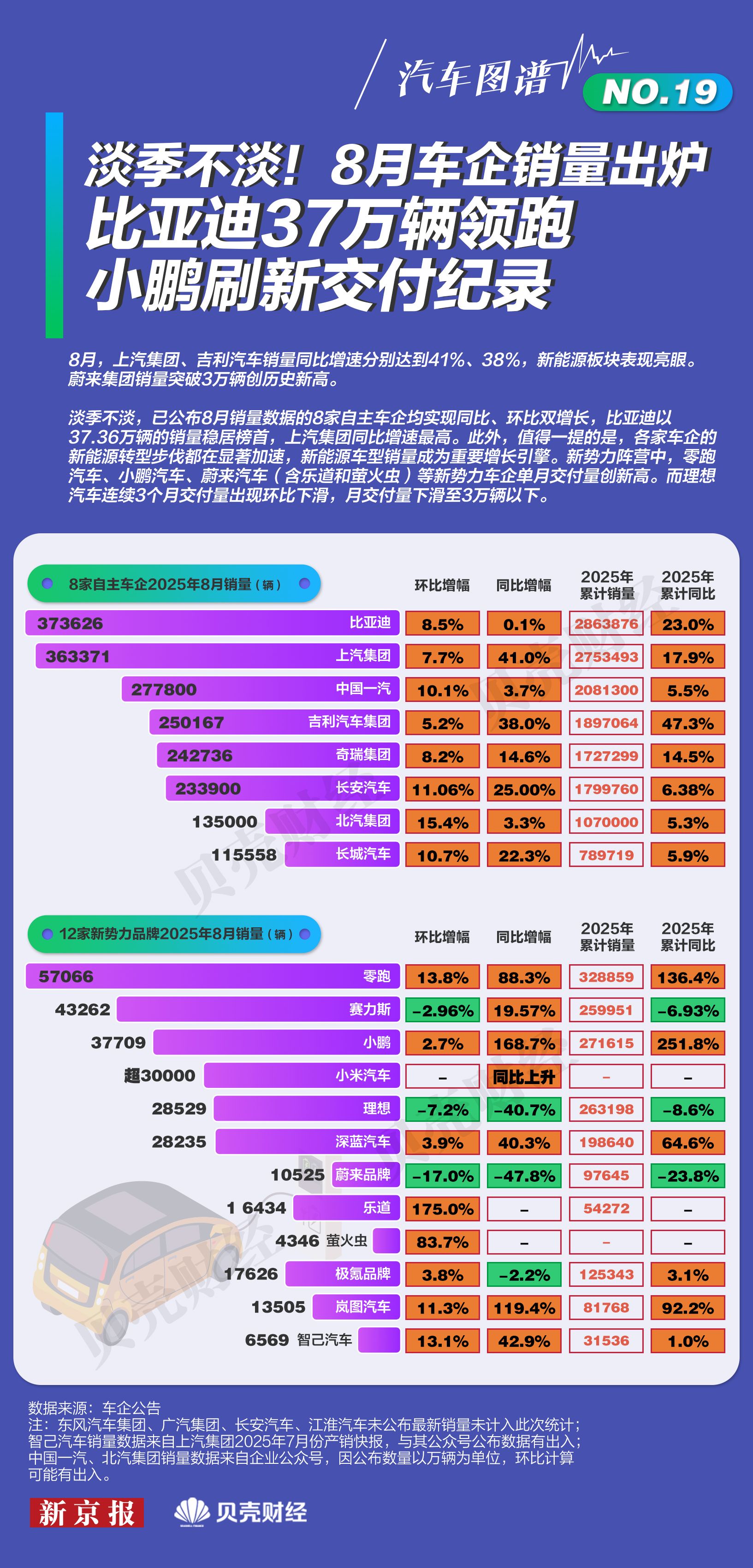
8月比亚迪销量37万辆领跑,小鹏刷新交付纪录
Xin Jing Bao· 2025-09-04 00:08
Core Insights - The article highlights that eight domestic car manufacturers reported significant sales growth in August, with BYD leading the market with 373,626 units sold, marking a year-on-year increase of 23% [1][3]. - The shift towards electric vehicles (EVs) is accelerating, with new energy vehicle sales becoming a crucial growth driver for these companies [1]. - Among new energy vehicle manufacturers, Leap Motor, Xiaopeng Motors, and NIO achieved record monthly delivery numbers, while Li Auto experienced a decline in deliveries for three consecutive months [1]. Sales Performance of Domestic Car Manufacturers - BYD: Sold 373,626 units in August, with a month-on-month increase of 8.5% and a year-on-year increase of 23% [3]. - SAIC Motor: Sold 363,371 units, showing a month-on-month increase of 7.7% and a year-on-year increase of 41% [3]. - China FAW: Sold 277,800 units, with a month-on-month increase of 10.1% and a year-on-year increase of 3.7% [3]. - Geely: Sold 250,167 units, reflecting a month-on-month increase of 5.2% and a year-on-year increase of 38% [3]. - Chery: Sold 242,736 units, with a month-on-month increase of 8.2% and a year-on-year increase of 14.6% [3]. - Changan: Sold 233,900 units, showing a month-on-month increase of 11.06% and a year-on-year increase of 25% [3]. - BAIC: Sold 135,000 units, with a month-on-month increase of 15.4% and a year-on-year increase of 3.3% [3]. - Great Wall: Sold 115,558 units, reflecting a month-on-month increase of 10.7% and a year-on-year increase of 22.3% [3]. Sales Performance of New Energy Vehicle Manufacturers - Leap Motor: Achieved sales of 57,066 units in August, with a month-on-month increase of 13.8% and a year-on-year increase of 88.3% [4]. - Xiaopeng Motors: Sold 37,709 units, marking a month-on-month increase of 27% and a year-on-year increase of 168.7% [4]. - NIO: Reported sales of 10,525 units, with a year-on-year decrease of 47.8% [4]. - Li Auto: Experienced a decline in sales, with monthly deliveries dropping below 30,000 units [1]. - The overall trend indicates that several new energy vehicle manufacturers are optimistic about achieving sales growth in the latter half of the year, with Leap Motor raising its annual sales target and Xiaopeng Motors aiming for over 40,000 monthly deliveries starting September [1].

丰田,快不行了?
36氪· 2025-09-03 23:50
Core Viewpoint - Toyota has reported a significant decline in net profit for the first quarter of the 2025 fiscal year, down 36.9% year-on-year to 841.3 billion yen (approximately 41 billion RMB), leading to a downward revision of its annual profit forecast by 44% to around 2.66 trillion yen [4][6]. Group 1: Financial Performance - Toyota's net profit for the 2024 fiscal year was approximately 4.8 trillion yen (about 247 billion RMB), a decrease of 3.6% year-on-year [13]. - The company's profit is reported to be 1.94 times greater than the combined profits of over ten Chinese listed car companies [14]. - In North America, which is Toyota's largest overseas market, the U.S. market contributed 23% to Toyota's global sales in 2024 [15]. Group 2: Sales Performance - Despite profit declines, Toyota maintained its position as the world's largest car seller for five consecutive years, with global sales reaching 5.545 million units in the first half of 2025, a 7.4% increase year-on-year [6][8]. - In the first half of 2023, Toyota's global sales increased by 5.5% to 5.1 million units, with hybrid models accounting for 43% of total sales [24]. Group 3: Market Strategy and Product Development - Toyota plans to introduce a 5.0-liter V8 engine in its Supra model by 2026, indicating a commitment to traditional combustion engines alongside its push for hybrid and hydrogen technologies [9][10]. - The company has adjusted its global production targets upwards, aiming for approximately 10 million units in 2025, and 10.2 million and 10.5 million units in 2026 and 2027, respectively [17]. - Toyota's hybrid models are gaining market traction, with significant sales in China, where hybrid vehicles accounted for 48% of total deliveries [26]. Group 4: Competitive Landscape - The profitability of Toyota, with a profit of 2.3 million RMB per vehicle sold, contrasts sharply with the average profit of less than half that for domestic brands in China [20]. - The automotive industry is experiencing a shift towards electric and hybrid vehicles, with predictions that by 2030, these will account for 60% to 70% of global sales [31]. - Toyota's strategy of maintaining a diverse energy portfolio, including hybrid and hydrogen vehicles, positions it well against competitors in a rapidly changing market [33].