债务重组

Search documents
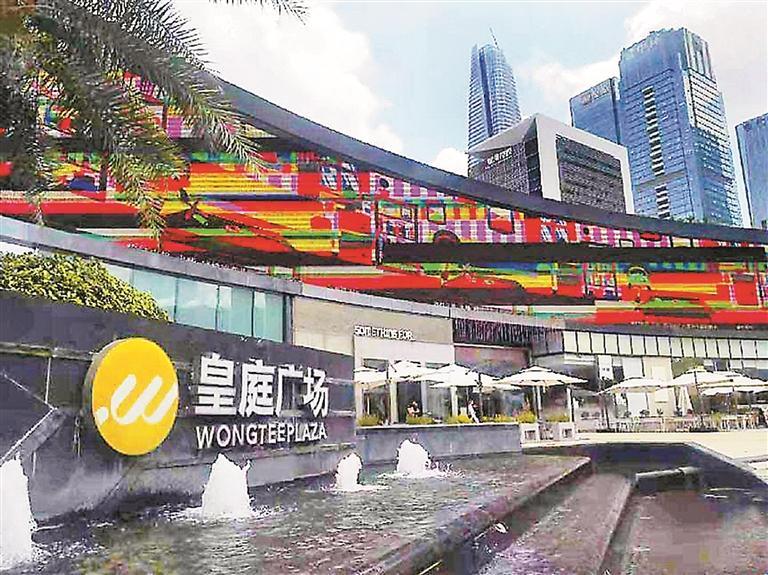
无人出价 深圳皇庭广场流拍
Zheng Quan Ri Bao Zhi Sheng· 2025-09-11 04:09
Core Viewpoint - Shenzhen Huating International Enterprise Co., Ltd. has temporarily retained its core asset, Shenzhen Huating Plaza, after a failed auction where no bids were placed despite significant interest [1][2]. Group 1: Auction and Legal Proceedings - The auction for Shenzhen Huating Plaza, with a starting price of 3.053 billion yuan and an assessed value of 4.361 billion yuan, attracted over 800 interested parties but ultimately resulted in no bids, leading to a failed auction [1]. - If judicial enforcement continues, the company risks losing ownership of Shenzhen Huating Plaza, which could trigger a significant asset restructuring and impact its financial stability, potentially leading to a warning of forced delisting under Shenzhen Stock Exchange rules [2]. Group 2: Debt and Financial Challenges - The debt issues trace back to a 3 billion yuan loan taken by the company's subsidiary, Rongfa Investment, from CITIC Trust in 2016, which has led to financial difficulties since 2020, culminating in overdue payments of 2.75 billion yuan in principal and interest [2]. - Prior to the auction, the company attempted to find buyers for its assets, including two unsuccessful attempts to sell 100% of Rongfa Investment, with the asking price dropping from 7.493 billion yuan to 5.620 billion yuan [3]. - The company reported a revenue of 290 million yuan for the first half of 2025, a year-on-year decrease of 18.48%, and a net loss attributable to shareholders of 185 million yuan [4].

富力地产推动债务二次重组,向债券持有人提供现金购回、以物抵债等选项
Sou Hu Cai Jing· 2025-09-11 03:29
9月10日,广州富力地产(02777.HK)发布公告,鉴于公司整体经营现状,公司拟初步为公司境内公司债 券持有人提供整体境内债券重组方案,包括现金购回、以物抵债、应收账款信托份额抵债、资产信托份 额抵债、股票经济收益权兑付和全额留债长展期,具体如下: (一)现金购回:公司拟对债券分三次进行折价(每张债券剩余面值的20%)购回,预计购回总金额不超过 人民币6亿元。 (二)以物抵债:公司拟以实物资产偿付债券,每人民币100元剩余面值的债券可申报登记可抵债价值为 人民币30元的实物资产,本次拟进行以物抵债的未偿还债券本金余额合计不超过人民币66亿元。 (三)应收账款信托份额抵债:公司拟以人民币3亿元应收回购款作为基础资产,设立应收账款信托,每 人民币100元剩余面值的债券可申报登记价值为人民币30元的信托份额。本次拟进行应收账款信托份额 抵债的未偿还债券本金余额合计不超过人民币10亿元。 (四)资产信托份额抵债:公司拟以实物资产收益权作为资产信托的基础资产,设立服务型信托,每人民 币100元剩余面值的债券可申报登记价值为人民币35元的资产信托份额。本次拟进行资产信托份额抵债 的未偿还债券本金余额合计不超过人民币57 ...

深圳皇庭广场超30亿元起拍
Shen Zhen Shang Bao· 2025-09-10 18:03
Core Viewpoint - The auction of the Royal Court Plaza in Shenzhen, with an estimated value of approximately 4.36 billion yuan, ended in failure, attracting only one bidder despite over 47,000 views [2][3]. Group 1: Auction Details - The auction took place from September 9 to September 10, with a starting price of approximately 3.05 billion yuan, which is about 70% of the estimated value [2]. - The Royal Court Plaza has a land area of 42,348.37 square meters and a total building area of 136,895.89 square meters, with a land use period of 40 years [2]. Group 2: Financial Obligations - The property has outstanding management fees of approximately 16.32 million yuan and utility fees of about 7.40 million yuan, totaling around 23.72 million yuan that the buyer would need to cover in addition to the auction price [3]. Group 3: Company Background - Royal Court Plaza is a key asset of Royal Court International, which has been facing financial difficulties, including a lawsuit related to a 2.75 billion yuan loan dispute [4]. - Royal Court International reported a loss of 185 million yuan in the first half of the year, and its stock price has significantly declined, currently valued at about one-tenth of its historical peak from ten years ago [4]. Group 4: Debt Restructuring Efforts - The company has been in negotiations for debt restructuring for nearly three years, but has yet to reach a viable agreement despite signing a framework agreement and receiving a deposit of 10 million yuan [4].
富力地产推动债务二次重组,涉122亿元境内债
Di Yi Cai Jing· 2025-09-10 12:58
第六个选项为全额留债长展期,若本次境内债券重组经全部持有人会议通过得以顺利推进落地,上述选 项完成后的剩余境内公司债券本金将全部展期至2035年9月16日。自2031年3月16日起每张债券每半年以 现金支付1元本金,于最后一期到期日支付全部剩余本金及利息。过往及长展期期间内的利息部分统一 降低至1%,单利计息、不计复利。 富力此次境内债重组也转向削债。 早在2022年底就完成境内外债券全部展期的富力地产(02777.HK),历经过去两年的动荡后,决定重 新推动境内债务的全面重组。 9月10日晚,富力地产公告称,鉴于当前公司的整体经营现状,拟初步为境内公司债券持有人提供整体 境内债券重组方案,包括现金购回、以物抵债、应收账款信托份额抵债、资产信托份额抵债、股票经济 收益权兑付和全额留债长展期等6种选择。据悉,富力此次境内债重组涉及6只债券,未偿还剩余本金余 额逾122亿元。 具体来看,第一个选项为现金购回,富力拟对债券分三次进行折价(每张债券剩余面值的 20%)购 回,预计购回总金额不超过6亿元。 第二个选项为以物抵债,富力拟以实物资产偿付债券,每100元剩余面值的债券可申报登记可抵债价值 为30元的实物资产, ...
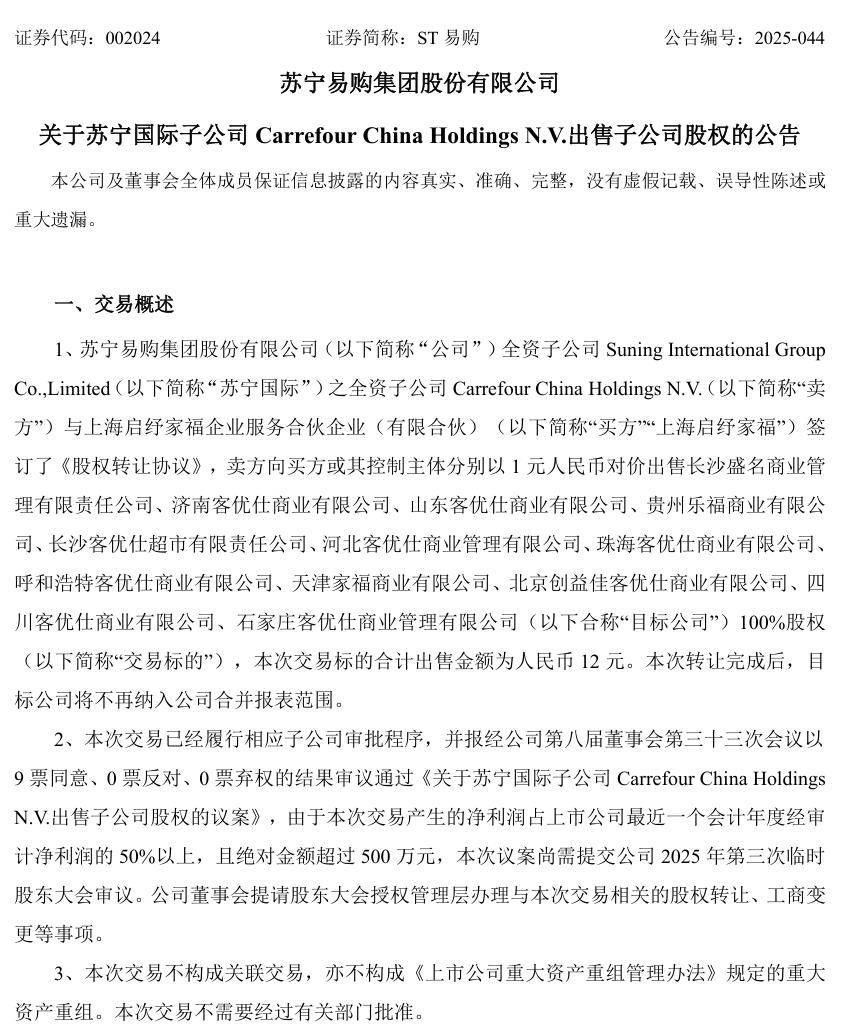
苏宁易购 12 元出售 12 家家乐福中国子公司股权
Sou Hu Cai Jing· 2025-09-10 11:05
Core Viewpoint - Suning.com announced the sale of 12 Carrefour China subsidiaries for a total of 12 RMB, with each subsidiary sold for 1 RMB, which will no longer be included in Suning's consolidated financial statements [1] Group 1: Transaction Details - The transaction involves the sale of 100% equity stakes in 12 subsidiaries, with each subsidiary valued at 1 RMB despite negative valuations [4][7] - The subsidiaries have been facing operational challenges, leading to their closure and the decision to sell them to alleviate financial burdens [5][6] Group 2: Financial Impact - The transaction is expected to positively impact Suning's financial status, with an estimated increase in net profit attributable to shareholders of approximately 383 million RMB by June 30, 2025 [5] - The sale is part of Suning's strategy to focus on its core business in home appliances and consumer electronics while reducing debt levels [5]

【环球财经】巴西政府拟投放至多120亿雷亚尔信贷助农户化解债务
Xin Hua Cai Jing· 2025-09-06 01:33
Group 1 - The Brazilian government announced an agricultural credit support plan ranging from 10 billion to 12 billion reais to help farmers restructure debts accumulated due to natural disasters [1] - The plan targets farmers who have experienced at least two emergency disasters in the past five years, with agricultural losses exceeding 30% [1] - Loan interest rates will be subsidized in tiers: 6% for family farmers, 8% for medium-sized farmers, and 10% for large farmers, with a grace period of 1 to 2 years and a total repayment period of up to 8 years [1] Group 2 - This initiative is seen as a timely intervention to restore agricultural production following nationwide droughts and a once-in-a-century flood in Rio Grande do Sul in 2024 [1] - All farmers across the country can apply for the program, not just those in the hardest-hit southern states [1] - The plan is expected to alleviate the crisis in the Brazilian banking system, particularly for the main agricultural lender, Banco do Brasil, which is facing increased default rates [1]
加纳可可局清偿20亿塞地到期票息
Shang Wu Bu Wang Zhan· 2025-09-05 17:28
Group 1 - The Ghana Cocoa Board has paid 20 billion cedis in interest to investors participating in the cocoa bond restructuring plan [1] - The restructuring involves converting existing notes into bonds, primarily affecting commercial banks, aimed at debt repayment and financial strengthening [1] - Market analysis suggests that this move will enhance the Cocoa Board's financing capacity and credit rating, facilitating cocoa procurement for the new production season [1] Group 2 - The Central Bank Governor indicated that the Cocoa Board is expected to secure a cash inflow of 4 billion USD through new pre-sale agreements for cocoa procurement and currency stabilization [1]
上海七批次土拍5宗地收金111亿元;花样年境外债务重组获78%债权人支持 | 房产早参
Mei Ri Jing Ji Xin Wen· 2025-09-04 23:17
Group 1: Real Estate Market Activity - Shanghai completed its seventh batch of land sales, with 5 residential plots sold for a total of 111.16 billion yuan, reflecting market activity and confidence among real estate companies [1] - The land sales included 3 plots sold at a premium and 2 at the base price, indicating a competitive bidding environment [1] Group 2: Housing Financing Initiatives - The Agricultural Development Bank in Fujian issued the province's first 49 million yuan loan for the acquisition of affordable housing, aimed at increasing the supply of rental housing [2] - An additional loan of 63.45 million yuan was provided to support the acquisition of 671 unsold residential units, further enhancing the local housing supply structure [2] Group 3: Corporate Governance and Shareholding Changes - Zhu Guang Group acquired 30.58% of the voting rights in Shijian Hang through a transfer of state-owned equity, which may lead to resource integration and improved performance for the company [3] - Red Star Holdings reduced its stake in Red Star Macalline from 23.51% to 19.95%, potentially allowing for new capital influx and governance optimization [5] Group 4: Debt Restructuring Developments - A significant 78.43% of creditors supported the debt restructuring plan for Huayang Nian, which may alleviate debt pressure and enhance operational certainty [4]
佳兆业境外债务重组9月底生效;建发房产完成发行10亿元中期票据 | 房产早参
Mei Ri Jing Ji Xin Wen· 2025-09-03 00:17
Group 1 - The "宜居岳阳·畅购好房" initiative aims to stimulate housing demand in Yueyang by offering a 2% subsidy on home purchases, with a cap of 20,000 yuan per unit, from September 1 to November 15 [1] - Families with three or more children can receive additional rewards based on the contract price, ranging from 100,000 to 200,000 yuan, if they pay the deed tax within seven working days [1] - This policy is expected to accelerate project liquidation and improve cash flow for local real estate companies, potentially serving as a model for other cities [1] Group 2 - Kaisa Group's overseas debt restructuring plan is set to take effect by the end of September, aiming to reduce debt by approximately 8.6 billion USD and extend the average debt maturity by five years [2] - The new notes will have an interest rate between 5% and 6.25%, lower than previous debt rates, which may help Kaisa regain financing channels and stabilize operations [2] - Successful restructuring could positively impact the real estate sector by alleviating risks and restoring confidence [2] Group 3 - Nanjing has announced the auction of five plots of land, including three residential and one mixed-use site, with a total starting price of 2.599 billion yuan [3] - The total area of the land is approximately 13.58 hectares, located in popular districts, which is expected to enhance low-density housing supply in the market [3] Group 4 - Jianfa Real Estate has issued 1 billion yuan in medium-term notes with a maturity of 3+3 years and an interest rate of 2.78%, effective from September 1 [4] - The funds raised will provide the company with a competitive edge, allowing for business expansion and improved product quality and service levels [4] Group 5 - Longfor Group announced the results of its bond repurchase, totaling 450 million yuan, with a distribution ratio of 25.86% [5] - The repurchase reduces the company's debt principal balance, demonstrating its commitment to addressing debt issues and enhancing investor confidence [5]

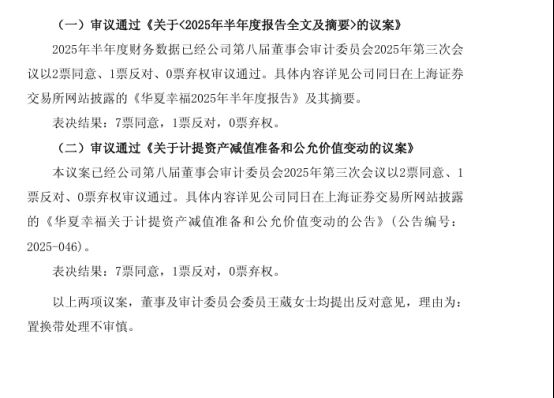
平安系对华夏幸福半年报议案投反对票 业内:债务重组需公平
Nan Fang Du Shi Bao· 2025-09-02 08:21
Core Viewpoint - The financial performance of Huaxia Happiness has significantly deteriorated, leading to a loss of shareholder confidence, particularly from its largest shareholder, the Ping An Group, which has raised concerns regarding the company's asset management and debt restructuring strategies [1][5][6]. Financial Performance Summary - Huaxia Happiness reported a revenue of approximately 2.903 billion yuan for the first half of 2025, a year-on-year decrease of 50.9% [1]. - The net profit attributable to shareholders was a loss of about 6.827 billion yuan, down 40.79% year-on-year [1]. - Total assets amounted to 278.118 billion yuan, a decline of 8.63% compared to the end of the previous year [1]. - The net assets attributable to shareholders were -1.82 billion yuan, a decrease of 144.44% year-on-year [1]. Board Opposition Summary - The board member Wang Wei, representing the Ping An Group, opposed two key proposals related to the half-year report and asset impairment provisions, citing concerns over the prudence of debt replacement handling [2][4]. - Wang Wei's opposition reflects deeper issues regarding the company's asset management and the appropriateness of the impairment provisions during a period of financial stress [4]. Debt Restructuring and Strategic Transition - Huaxia Happiness is undergoing a critical phase of debt restructuring and strategic transformation from a traditional real estate developer to an "industrial new city service provider" [5]. - The company has reported a cumulative debt repayment failure amounting to 23.11 billion yuan as of July 31, 2025 [5]. - Ping An Group plans to reduce its holdings by up to 117.4 million shares, representing no more than 3% of the total share capital, indicating a potential shift in investment strategy due to ongoing financial pressures [5]. Shareholder Dynamics - The Ping An Group, as the largest shareholder, holds 25.1444% of Huaxia Happiness, with Ping An Asset Management holding an additional 0.0421% [3]. - The relationship between Huaxia Happiness and the Ping An Group has evolved since 2018 when Ping An acquired a significant stake, marking the beginning of a capital partnership [3].