国家粮食安全

Search documents
新华社权威快报|我国首次专门立法加强耕地保护和质量提升
Xin Hua She· 2025-10-24 09:18
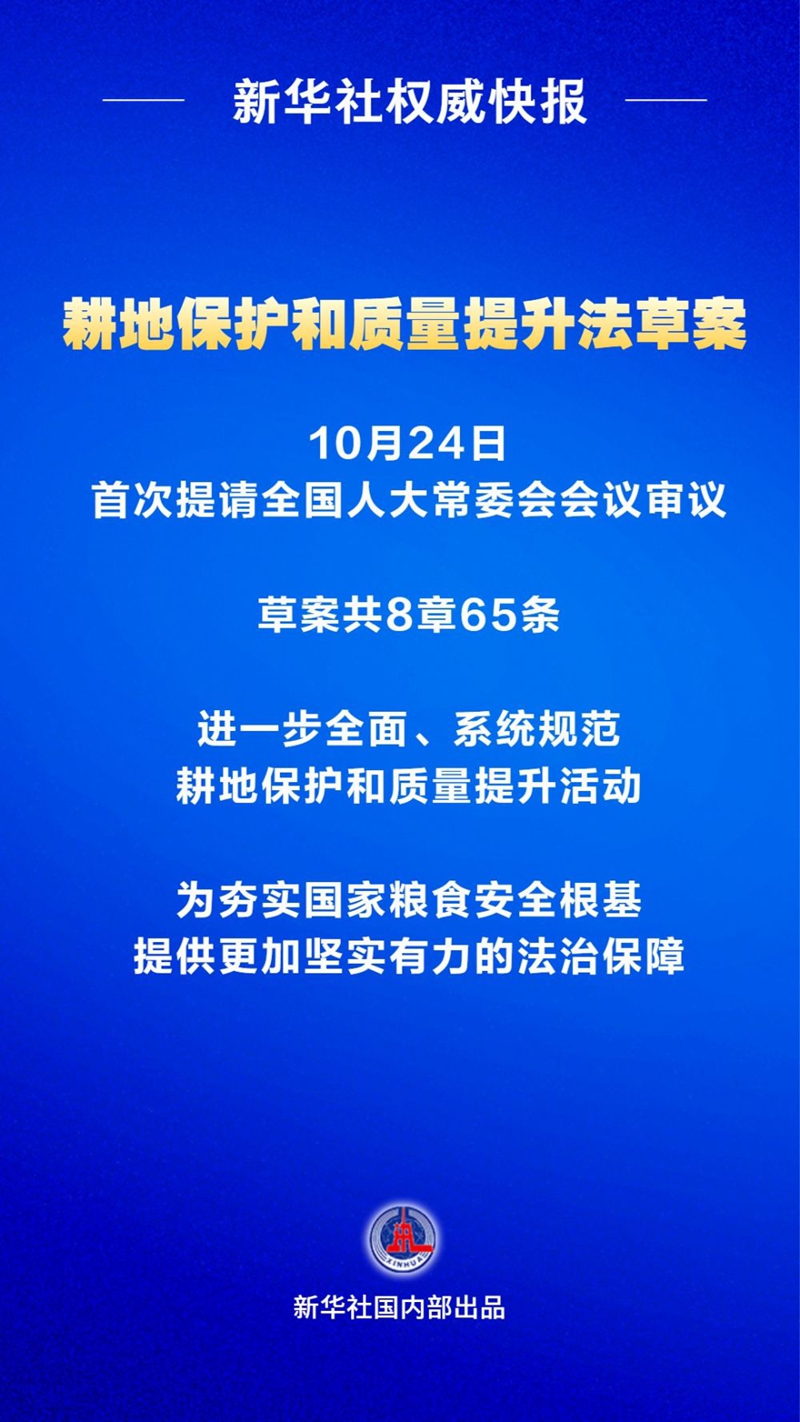
Core Viewpoint - The draft law on farmland protection and quality improvement was submitted for review to the Standing Committee of the National People's Congress on October 24, aiming to provide a stronger legal guarantee for national food security through comprehensive and systematic regulation of farmland protection and quality enhancement [2][4]. Summary by Relevant Sections Overall Requirements - The draft law outlines the overall requirements for farmland protection, emphasizing the need to strengthen target constraints and improve protection layout [4]. Control Measures - It includes strict controls on the occupation of farmland, addressing issues such as the non-agricultural and non-grain use of farmland, which are significant concerns given China's population density and limited land resources [4]. Quality Improvement - The law aims to enhance the quality of farmland, ensuring a three-pronged approach to protect quantity, quality, and ecological aspects of farmland [4]. Legal Framework - This draft law is designed to complement existing laws such as the Land Management Law and the Food Security Guarantee Law, establishing a dedicated legal framework for farmland protection and quality improvement activities [4].

守护好“食”光!世界粮食日话“饭碗”
Xin Hua Wang· 2025-10-17 02:45
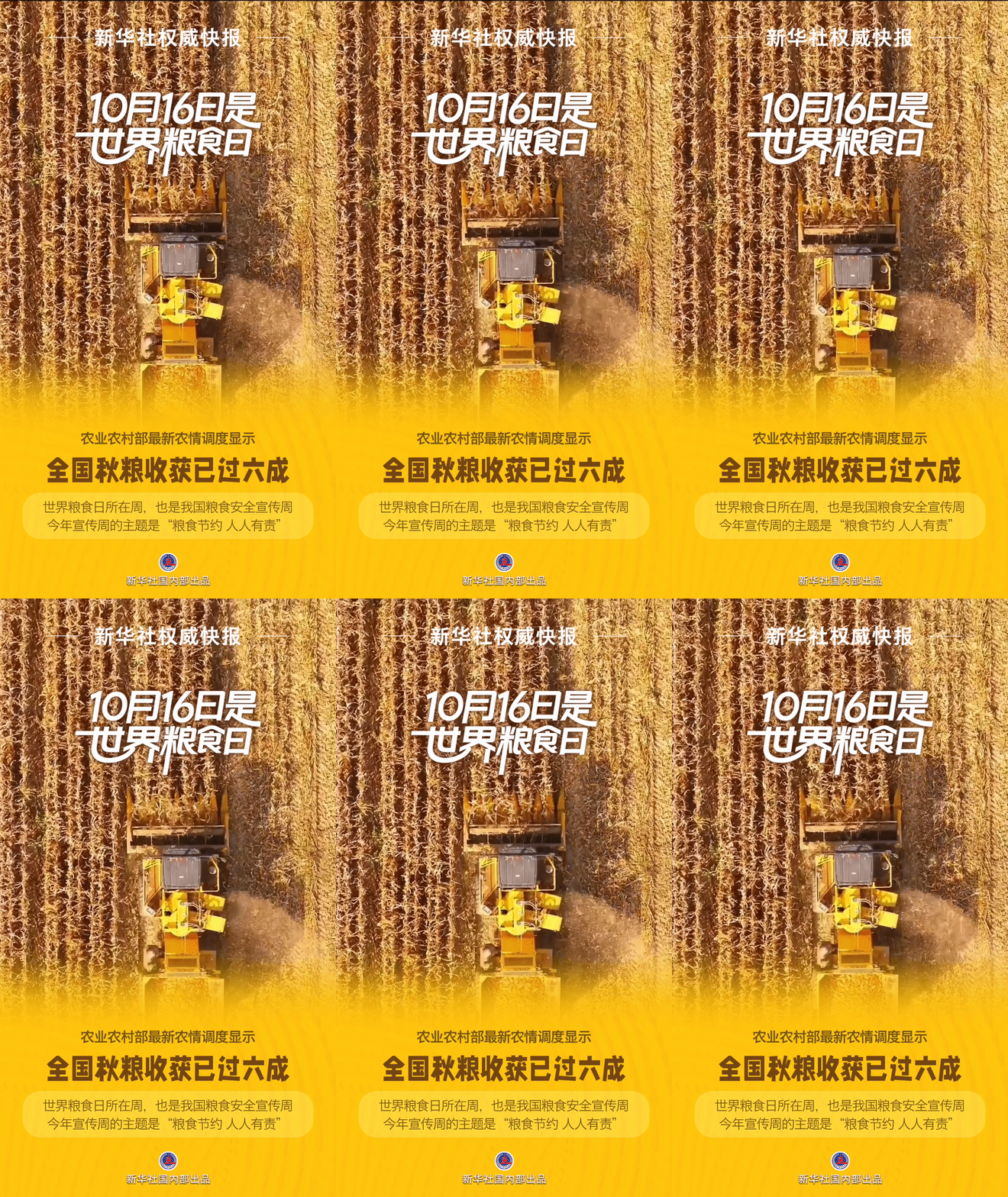
Core Points - The theme of this year's World Food Day is "Hand in hand to advocate for diverse cuisine, gathering strength to create a better future" [1] - China's grain security is emphasized as a top priority, with a current per capita grain availability of 500 kg, surpassing the international safety line of 400 kg [3] - Continuous grain production has been maintained above 1.3 trillion jin, with a record of over 1.4 trillion jin last year [4] Grain Production and Security - The recent harvest progress shows over 60% of autumn grain has been collected, despite adverse weather conditions affecting some regions [3][4] - Technological advancements in grain storage, such as temperature control and CO2 storage techniques, are being implemented to enhance grain quality and reduce losses [6][8] Food Waste Reduction Initiatives - The theme for the food security awareness week is "Food Saving is Everyone's Responsibility," promoting the importance of reducing food waste [8][10] - Restaurants are adopting practices to minimize waste, such as portion size guidance and repurposing unsold food into animal feed [10][11] Diverse Food Supply System - The total output of livestock products reached 175 million tons by the end of 2024, marking an 18.8% increase since 2020, while aquatic products reached 73.58 million tons, a 12.3% increase [11]
学习进行时丨总书记引领筑牢国家粮食安全
Xin Hua Wang· 2025-10-16 13:23
Core Viewpoint - Ensuring national food security is a fundamental and ongoing priority for China, emphasized by President Xi Jinping's repeated statements on the importance of self-sufficiency in food production and the need to adapt to changing food demands of the population [2][11][17]. Group 1: Food Security Importance - Food security is described as a "national priority," with the necessity to ensure that the population's basic needs are met being paramount [5][12]. - The responsibility for food security lies heavily on agricultural provinces, which must prioritize the stability and safety of food supply [7][8]. Group 2: Self-Sufficiency and Production Capacity - China, with a population exceeding 1.4 billion, must rely on its own agricultural capabilities to ensure food security, advocating for a focus on both quantity and quality of food production [11][13]. - The emphasis is placed on maintaining and enhancing food production capacity to ensure that food can be produced and supplied when needed [9][11]. Group 3: Diverse Food Supply - There is a call to adopt a "big food concept," which includes not only grain but also a variety of food types such as meat, vegetables, fruits, and seafood to meet the diverse dietary needs of the population [16][17]. - The shift towards a more comprehensive view of food security reflects the changing demands of consumers, necessitating a broader approach to food resource development [17]. Group 4: Food Waste Reduction - Reducing food waste is highlighted as a critical strategy for alleviating supply pressures and conserving resources, with initiatives aimed at promoting food-saving practices across various sectors, including schools and households [20][21].

信长星会见中粮集团董事长李国强
Xin Hua Ri Bao· 2025-10-15 23:30
李国强表示,中粮集团与江苏有着深厚合作基础,未来将立足江苏良好的营商环境和区位优势,加 大全产业链布局,拓展双方合作的广度和深度,更好助力江苏高质量发展。 省委常委、常务副省长马欣参加会见。 10月15日,省委书记信长星在南京会见中粮集团党组书记、董事长李国强。 信长星对李国强一行表示欢迎,对中粮集团给予江苏发展的大力支持表示感谢。他说,当前,江苏 正按照习近平总书记重要指示精神,扎实做好"三农"工作,推动农业增效益、农村增活力、农民增收 入,加快建设新时代鱼米之乡,努力在推进农业现代化上走在前。希望中粮集团加大在江苏的投资和业 务布局,进一步深化互利合作,共同为保障国家粮食安全、建设农业强国作出更大贡献。 ...
推进粮食节约减损 保障国家粮食安全
Ren Min Ri Bao· 2025-10-15 22:17
Core Viewpoint - The article emphasizes the importance of food security and the need for a collective effort to promote food conservation and reduction of waste, highlighting the theme "Everyone is Responsible for Food Conservation" during the National Food Security Awareness Week [1]. Group 1: Food Security and Conservation Efforts - Food security is a national priority, requiring simultaneous efforts in increasing production and reducing losses [1][3]. - The Chinese government has implemented various policies and regulations to promote food conservation, including the "Food Conservation Action Plan" and the upcoming "Food Security Law" [1][4]. - The overall food loss rate has decreased, with farmers' storage loss rate dropping to approximately 3%, a 5 percentage point reduction from a decade ago [4]. Group 2: Technological Innovation and Standards - Technological innovation is crucial for enhancing food conservation efforts, with significant advancements in storage and preservation technologies [5][6]. - The application of green storage technologies has increased, with low-temperature storage capacity reaching 220 million tons and controlled atmosphere storage capacity exceeding 67 million tons [6]. - The establishment of national standards for food conservation and waste reduction is underway, aiming to improve the efficiency of food resource utilization [6]. Group 3: Social Participation and Cultural Foundation - There is a growing societal awareness and participation in food conservation initiatives, supported by various educational campaigns and activities [7]. - Traditional Chinese culture emphasizes the importance of food conservation, providing a solid cultural foundation for ongoing efforts [7]. - Future initiatives will focus on continuous public education regarding food storage, green storage practices, and healthy eating habits [7].
国家粮食安全得到有效保障 5年来全国粮食年产量稳定在1.3万亿斤以上
Jing Ji Ri Bao· 2025-10-15 22:11
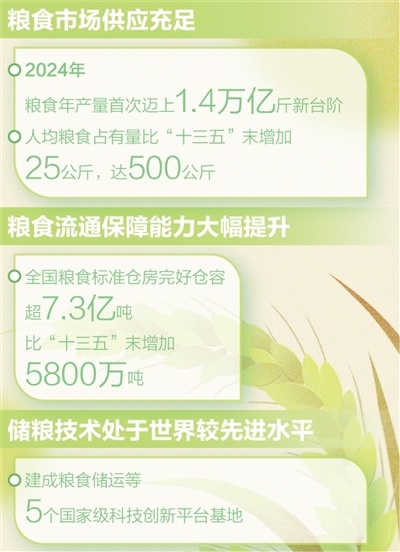
Core Insights - The "14th Five-Year Plan" period has seen significant advancements in China's grain circulation reform and development, effectively ensuring national food security and supporting high-quality economic and social development [1] Group 1: Grain Production and Security - National grain production has remained stable at over 1.3 trillion jin annually, with a projected increase to 1.4 trillion jin in 2024, marking a significant milestone [1] - Per capita grain availability has increased by 25 kg compared to the end of the "13th Five-Year Plan," reaching 500 kg, surpassing the internationally recognized safety line of 400 kg [1] - The grain storage capacity has improved, with over 730 million tons of standard grain storage facilities, an increase of 5.8 million tons from the end of the "13th Five-Year Plan" [1] Group 2: Grain Loss Reduction and Quality Management - Significant achievements in grain loss reduction have been noted, with annual losses in storage, transportation, and processing averaging about 2% of annual production [2] - The loss rate for household grain storage has decreased by 5 percentage points over the past decade, now at approximately 3% [2] - The grain quality management system has been continuously improved, with over 100 national standards and 50 industry standards revised since 2021 [2] Group 3: Legal and Regulatory Framework - Major breakthroughs in grain legal system construction have been achieved, including the implementation of the Grain Security Guarantee Law, which is the first foundational law in China's grain sector [3] - Continuous strengthening of grain regulatory enforcement has been observed, with initiatives like the "Iron Fist Action" to address grain-related violations [3] - A digital regulatory system for grain purchasing, sales, and storage has been established, ensuring comprehensive information coverage for government grain reserves [3]
10月15日晚间央视新闻联播要闻集锦
Yang Shi Xin Wen Ke Hu Duan· 2025-10-15 14:01
Group 1 - Xi Jinping congratulated Patrick Herminie on his election as President of Seychelles [7] - Xi Jinping's keynote speech at the Global Women's Summit received positive responses, emphasizing the pursuit of gender equality and women's development [8] - The English version of "Xi Jinping: The Governance of China" Volume V was successfully launched in Frankfurt [9] Group 2 - The State Council's sixteenth special study focused on enhancing standardization to promote high-quality economic development [11] - The National People's Congress Standing Committee's 51st chairman meeting decided to hold the 18th meeting from October 24 to 28 in Beijing [12] Group 3 - During the 14th Five-Year Plan period, China's grain circulation reform and development tasks progressed as expected, ensuring national food security [14] - The light industry economy in China continued to grow steadily during the 14th Five-Year Plan, with enhanced market advantages and brand competitiveness [15] Group 4 - The national autumn grain harvest has surpassed 60% completion [18]
【“十四五”高质量发展答卷】“十四五”时期国家粮食安全得到有效保障
Yang Shi Wang· 2025-10-15 12:26
Core Insights - The "14th Five-Year Plan" period has seen significant progress in China's grain circulation reform and development, ensuring national food security effectively [1] - China's grain market supply is abundant and operates smoothly, with annual grain production stabilizing above 1.3 trillion jin, expected to exceed 1.4 trillion jin in 2024, and per capita grain availability increasing by 25 kg to 500 kg, surpassing the international safety line of 400 kg [3] - The grain circulation guarantee capacity has significantly improved, with national grain standard storage capacity exceeding 730 million tons, an increase of 5.8 million tons from the end of the "13th Five-Year Plan," and the industrial output value of grain enterprises expected to exceed 4 trillion yuan in 2024 [4] Summary by Categories Grain Production and Supply - Annual grain production is stable at over 1.3 trillion jin, with a projection to reach 1.4 trillion jin in 2024 [3] - Per capita grain availability has increased by 25 kg compared to the end of the "13th Five-Year Plan," reaching 500 kg, which is above the international recognized safety line of 400 kg [3] Grain Storage and Circulation - The capacity of national grain standard storage has surpassed 730 million tons, marking an increase of 5.8 million tons from the end of the "13th Five-Year Plan" [4] - The industrial output value of grain enterprises is anticipated to exceed 4 trillion yuan in 2024 [4] Emergency and Regulatory Measures - The grain reserve system has been further improved, with sufficient regulatory resources available at all government levels [4] - Emergency grain supply capabilities have been enhanced, with 36 major cities maintaining a supply of finished grain and oil for over 15 days [4]

粮食年产量稳定在1.3万亿斤以上,高标准粮仓仓容逐年增加——国家粮食安全得到有效保障
Ren Min Ri Bao· 2025-10-15 06:37
Core Viewpoint - The "14th Five-Year Plan" period has seen significant progress in China's grain circulation reform and development, ensuring national food security and supporting high-quality economic and social development [1][2]. Group 1: Grain Production and Supply - During the "14th Five-Year Plan" period, China's annual grain production has stabilized above 1.3 trillion jin, with a projected increase to 1.4 trillion jin in 2024, and per capita grain availability has risen by 25 kg to 500 kg, exceeding the international safety line of 400 kg [2]. - The average annual grain purchase volume has exceeded 400 million tons, with improvements in the grain purchase and storage management system [2]. Group 2: Grain Storage and Management - The national grain storage capacity has increased significantly, with over 730 million tons of standard grain storage capacity, an increase of 58 million tons compared to the end of the "13th Five-Year Plan" [2]. - The application of advanced storage technologies has improved, with a notable increase in the use of green storage techniques [4]. Group 3: Emergency Grain Supply - A comprehensive grain emergency response system has been established at national and local levels, with the number of emergency processing enterprises increasing by 26% to 6,872, and daily processing capacity rising by 48% to 1.78 million tons [5]. - The number of emergency supply points has grown by 37% to 59,000, enhancing the emergency supply capacity of finished grain and oil [5]. Group 4: Quality Standards and Consumer Safety - Over 100 national standards and 50 industry standards related to grain quality have been revised since 2021, focusing on green, high-quality, and nutritious food [6]. - The grain quality inspection system has been strengthened, ensuring the overall quality of stored grain and oil [6]. Group 5: Industry Development and Investment - Since 2021, the Ministry of Finance and the National Grain and Reserves Administration have invested 46.2 billion yuan, attracting over 84 billion yuan in social investment for more than 8,400 projects, enhancing the development level of the grain industry [7]. - The promotion of healthy food consumption is emphasized, with initiatives to increase the understanding and consumption of whole grains among the public [7].
权威发布·高质量完成“十四五”规划丨国家粮食安全得到有效保障
Ren Min Ri Bao· 2025-10-15 02:57
Core Insights - The "14th Five-Year Plan" period has seen significant advancements in China's grain circulation reform and development, ensuring national food security and supporting high-quality economic and social development [1][2] Grain Production and Supply - During the "14th Five-Year Plan" period, China's annual grain production has stabilized above 1.3 trillion jin, with projections for 2024 to exceed 1.4 trillion jin, marking a 25 kg increase in per capita grain availability compared to the end of the "13th Five-Year Plan," reaching 500 kg, which is above the internationally recognized safety line of 400 kg [2][4] - The average annual grain purchase volume has remained above 400 million tons, with improved channels for farmers to sell grain and enhanced services for agricultural enterprises [2][4] Grain Storage and Management - The grain storage capacity has significantly improved, with the total capacity of standard grain warehouses exceeding 730 million tons, an increase of 58 million tons from the end of the "13th Five-Year Plan" [2][4] - The implementation of advanced storage technologies has led to a shift towards high-quality development in grain storage management, focusing on green storage and quality preservation [5] Emergency Response and Supply Chain - The grain emergency response system has been established at national, provincial, municipal, and county levels, with the number of emergency processing enterprises increasing from 5,448 to 6,872, a growth of 26% [6] - Daily processing capacity for emergency grain has risen from 1.2 million tons to 1.78 million tons, an increase of 48%, ensuring sufficient supply for emergencies [6] Quality Standards and Industry Development - Over 100 national standards and 50 industry standards related to grain quality have been revised since 2021, emphasizing green, high-quality, nutritious, and healthy food [7] - Financial investments in quality grain projects have reached 46.2 billion yuan, attracting over 84 billion yuan in social investment, leading to the implementation of over 8,400 projects and the development of 897 quality enterprise brands [7]