
宏观经济不确定性

Search documents
7月17日电,台积电表示,资本支出规划会充分考虑宏观经济的不确定性,资本支出突然大幅下降的可能性不大。
news flash· 2025-07-17 06:59
Core Viewpoint - TSMC indicates that its capital expenditure planning will take into account macroeconomic uncertainties, and the likelihood of a sudden significant decrease in capital expenditure is low [1] Group 1 - TSMC is considering macroeconomic uncertainties in its capital expenditure planning [1] - The company believes that a sudden large decline in capital expenditure is unlikely [1]

台积电表示,在资本支出规划方面,会充分考虑宏观经济的不确定性。
news flash· 2025-07-17 06:59
Group 1 - The company, TSMC, indicates that it will take into account macroeconomic uncertainties in its capital expenditure planning [1]
台积电(TSM.N):在资本支出规划方面,我们会充分考虑宏观经济的不确定性。
news flash· 2025-07-17 06:57
Group 1 - The company, TSMC, emphasizes that its capital expenditure planning will take into full consideration the uncertainties in the macroeconomic environment [1]
华尔街三大巨头罕见共同“唱多”:买黄金就对了!
Jin Shi Shu Ju· 2025-07-16 07:36
Group 1 - Morgan Stanley, Goldman Sachs, and UBS suggest that gold is one of the best investment options following the recent tariff announcements by the Trump administration [1] - Morgan Stanley's analysts expect a weaker dollar to benefit commodities and rising US inflation to attract funds into precious metals, with Chinese policies potentially acting as a bullish factor [1][2] - Morgan Stanley has raised its fourth-quarter gold price target to $3,800 per ounce, citing support from central bank and investment demand, a weaker dollar, ETF inflows, and ongoing geopolitical and macroeconomic uncertainties [3] Group 2 - Goldman Sachs reaffirms its forecast that gold prices will reach $3,700 per ounce by the end of the year and rise to $4,000 by mid-2026, supported by central bank and ETF inflows [3][4] - UBS recommends buying gold as a hedge against policy risks, despite viewing the recent tariff increases as a negotiation tactic [4] - UBS analysts predict that the effective US tariff rate will stabilize around 15%, which is less than the recently announced rates of 30% to 35%, supporting continued gains in the S&P 500 [4]


巴斯夫,净利润下降81%!
DT新材料· 2025-07-12 13:58
Core Viewpoint - The European chemical industry is facing significant challenges due to rising energy costs and taxes, leading to major companies taking actions to minimize losses as they approach 2025 [1][2]. Group 1: Company Forecasts - Covestro has lowered its EBITDA forecast for 2025 to between €700 million and €1.1 billion, down from a previous estimate of €1 billion to €1.4 billion, reflecting ongoing global economic weakness [2][3]. - BASF has revised its EBITDA forecast for 2025 to between €7.3 billion and €7.7 billion, down from an earlier projection of €8 billion to €8.4 billion, citing macroeconomic and geopolitical uncertainties [4][7]. Group 2: Market Conditions - The anticipated growth in chemical market demand for 2025 is expected to be below previous expectations, compounded by an oversupply of products in the market, which continues to pressure profit margins [4][9]. - A significant factor affecting the market is the announcement of a 30% tariff on EU imports to the U.S. starting August 1, 2025, which is expected to create substantial market uncertainty [5][6]. Group 3: Financial Performance - BASF's projected sales for Q2 2025 are expected to decline by 2.1% to €15.77 billion, compared to €16.11 billion in Q2 2024 [8]. - The company's EBITDA for Q2 2025 is forecasted to be €1.77 billion, down from €1.96 billion in the same period last year [9]. - BASF's net profit is expected to reach €80 million, a significant drop of 81.4% compared to €430 million in Q2 2024 [11]. Group 4: Strategic Moves - BASF has been divesting various business units, including its Brazilian decorative coatings business and wind farm stakes, as part of its strategy to streamline operations [12]. - The company is increasing its investment in the Chinese market, indicating a strategic pivot towards regions with growth potential [13][14].


金银涨势动人,33吨金银精矿在墨西哥被劫
news flash· 2025-07-11 06:38
Group 1 - The article highlights a significant robbery in Mexico where armed thieves hijacked a truck carrying 33 tons of gold and silver concentrate, belonging to Grupo Minero Bacis [1] - Although the truck was recovered, the trailer containing the precious metals remains missing, indicating a serious security issue in the region [1] - The incident underscores a rising trend in highway robberies in Mexico, with a robbery occurring every 50 minutes, reflecting broader concerns about safety and crime in the mining sector [1] Group 2 - The backdrop of this robbery is the increasing prices of gold and silver driven by global economic uncertainty, which may attract more criminal activity targeting precious metals [1] - Grupo Minero Bacis, as a mining company, faces heightened risks associated with transporting valuable resources in a volatile security environment [1]
FDX财报:利润创新高,股价却大跌?各种利空横飞
Jin Rong Jie· 2025-06-26 00:18
Core Viewpoint - FedEx reported record profits in its latest financial results, but the stock price fell nearly 6% in after-hours trading due to concerns over future guidance and macroeconomic uncertainties [1][2]. Financial Performance - For Q4 of fiscal year 2025, FedEx achieved revenues of $22.2 billion, a year-on-year increase of approximately 1%, slightly above market expectations [1]. - GAAP earnings per share (EPS) were $6.88, while non-GAAP adjusted EPS was $6.07, both exceeding analyst expectations of $5.81 to $5.96 [1]. - The operating profit margin improved to 9.1%, indicating enhanced operational efficiency [1]. - The company saved $2.2 billion through its DRIVE cost control program in fiscal year 2025 and plans to cut an additional $1 billion in operating costs in fiscal year 2026 [1]. Market Reaction - Despite strong financial data, FedEx's stock price declined significantly after the earnings report due to the cancellation of the full-year earnings outlook for fiscal year 2026 and a conservative Q1 EPS forecast of $3.40 to $4.00, below market expectations of $4.10 [2][4]. - Concerns were raised regarding the company's international business performance, particularly in air freight, due to a notable decline in low-value e-commerce shipments from China, linked to recent U.S. tariffs [2][3]. Management Commentary - FedEx CEO Raj Subramaniam emphasized the need for caution in operational planning due to global macroeconomic uncertainties and rapid changes in the market environment [3]. - The CFO reiterated the focus on cost optimization, network efficiency, and disciplined capital expenditure to mitigate macro pressures [3]. Shareholder Returns - FedEx announced a 5% increase in its quarterly dividend and continued its stock buyback program, reflecting confidence in its cash flow situation [3]. Competitive Landscape - Compared to UPS, which reported a revenue of $21.5 billion with a year-on-year decline of 0.7% but maintained its full-year guidance, FedEx's lack of long-term outlook has raised concerns about its transparency and investor confidence [3][4]. Future Focus Areas - Investors should monitor three key aspects: the ability to meet the conservative Q1 EPS guidance, the stability of U.S.-China trade policies and the international air freight business, and the progress of FedEx Freight's business split and its impact on overall valuation and profit structure [4].

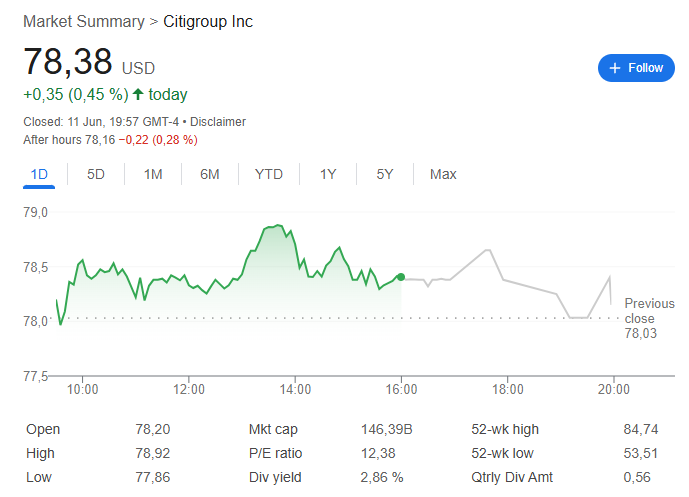
华尔街看到了什么?花旗大幅上调信贷坏账准备
Hua Er Jie Jian Wen· 2025-06-12 03:16
Core Viewpoint - Citigroup has significantly increased its loan loss reserves, indicating a preparation for potential economic deterioration, contrasting with market expectations of a slight decrease in provisions [1][2]. Group 1: Loan Loss Reserves - Citigroup's credit costs are expected to rise by hundreds of millions compared to the previous quarter, driven by an increase in credit reserves [1]. - The total loan loss provisions for the first quarter were $2.72 billion, with analysts predicting a slight decrease to $2.69 billion for the second quarter [1]. - The bank's internal assessment appears more pessimistic than market sentiment, suggesting a proactive stance against potential economic challenges [1]. Group 2: Credit Risk and Corporate Exposure - Approximately 80% of Citigroup's corporate exposure is to high-rated issuers, with an even higher percentage outside the U.S. [2]. - Despite the increase in provisions, Citigroup's executives express confidence in the overall credit quality of their corporate client portfolio [1][2]. Group 3: Performance Expectations in Different Business Lines - Citigroup's trading divisions for equities and fixed income are expected to show strong performance, with projected year-over-year revenue growth in the mid-to-high single digits for the second quarter [4]. - Investment banking fees are anticipated to grow at a moderate single-digit rate, although this sector faces "further uncertainty" [4][5]. Group 4: Broader Economic Concerns - The cautious approach of Citigroup reflects wider macroeconomic uncertainties, particularly regarding the impact of U.S. trade policies and tax legislation [6]. - Other major Wall Street firms, including Goldman Sachs and JPMorgan, are also issuing warnings about the economic outlook, indicating a collective concern among financial institutions [7][8]. Group 5: Sentiments from Industry Leaders - Goldman Sachs emphasizes the urgency of addressing the growing deficit, labeling it unsustainable [8]. - JPMorgan's CEO has criticized previous government spending and monetary policies as potentially leading to a bond market crisis [8]. - BlackRock's CEO has expressed a belief that the economy may already be in a recession, highlighting the need for investors to reassess optimistic market perceptions [9].
Why PVH Stock Tumbled Today
The Motley Fool· 2025-06-05 17:55
Core Viewpoint - PVH reported solid first-quarter earnings but lowered its full-year outlook, leading to a significant drop in its stock price by 17.7% [1][8] Financial Performance - Revenue increased by 2% to $1.98 billion, surpassing guidance which anticipated flat to a 2% decline, and exceeding estimates of $1.93 billion [3] - Revenue growth was 5% in the EMEA region and 7% in the Americas, while it fell by 13% in Asia-Pacific due to a challenging consumer environment in China [3] - Gross margin decreased from 61.4% to 58.6% due to a shift from direct-to-consumer to wholesale and a more promotional environment [4] - Adjusted earnings per share (EPS) fell from $2.45 to $2.30, beating the company's guidance of $2.10-$2.25 and consensus estimates of $2.25 [4] Impairments and Inventory - PVH recorded a $480 million goodwill impairment charge attributed to a significant increase in discount rates [5] - Inventory rose by 19%, as the company invested in core product inventory to enhance availability and support projected sales growth for the second quarter [5] Management Insights - CEO Stefan Larsson noted that the company capitalized on global consumer interest in Calvin Klein and Tommy Hilfiger, achieving revenue growth compared to the previous year and exceeding guidance [6] Future Outlook - Management acknowledged macroeconomic uncertainties impacting the business, leading to a second-quarter guidance that fell short of expectations [7] - For the current period, management anticipates low single-digit revenue growth but adjusted EPS to decline to $1.85-$2.00 from $3.01 in the same quarter last year [7] - Estimated tariffs are expected to negatively impact operating profit by $65 million, equating to a $1.05 per share reduction [7] Valuation - Despite the challenges, PVH is considered to offer attractive value with a price-to-earnings ratio of less than 7 [8]


Dow (DOW) FY Conference Transcript
2025-06-05 13:30
Summary of Dow Inc. FY Conference Call (June 05, 2025) Company Overview - **Company**: Dow Inc. (DOW) - **Industry**: Chemicals Key Points and Arguments Macroeconomic Environment - The company continues to face a prolonged downturn in the chemicals industry, with slower global growth and increasing macro uncertainty due to tariffs and geopolitical tensions [3][4] - Trade negotiations between the US and China remain volatile, impacting economic conditions in both nations and globally [4] - The global manufacturing PMI fell into contraction in April, indicating a decline in new orders, particularly in durable goods markets [5] Market Performance - Demand for packaging remains solid despite a sluggish start to Q2, with a $0.05 per pound price increase for polyethylene announced for June [5][6] - Infrastructure and housing demand are persistently soft, with US building permits at their lowest since May 2024 [6] - Consumer spending in electronics and pharmaceuticals shows stability, while building and construction markets are experiencing below-normal seasonal demand [7][21] Strategic Actions - Dow has finalized a strategic partnership with Macquarie Asset Management, resulting in $2.4 billion in initial cash proceeds from the sale of a minority equity stake in US Gulf Coast infrastructure assets [8][9] - The company expects to generate over $1 billion from the resolution of damages related to a jointly owned ethylene asset in Canada [10] - Dow aims to achieve $1 billion in targeted annual cost savings by 2026, with $300 million expected by year-end 2025 [10][11] Growth Initiatives - Two growth projects in the US Gulf Coast are set to come online, enhancing production capacity in packaging and specialty plastics [12][13] - The company is transitioning to higher-value ethylene oxide derivatives, which are expected to deliver significantly higher margins [14] - Recent divestitures have generated approximately $200 million, supporting Dow's balanced capital allocation approach [15] European Market Strategy - Dow is reviewing its European asset footprint, identifying upstream assets for potential idling or shutdown due to demand challenges [16][17] - The company is focused on optimizing its operations in higher-cost regions like Europe, where demand remains about 20% below pre-COVID levels [43] Financial Outlook - Dow's EBITDA guidance for Q2 is approximately $950 million, with more headwinds than tailwinds anticipated [34] - The company maintains a healthy dividend policy, with a payout of around $1.9 to $2 billion annually, while considering the impact of ongoing macroeconomic conditions [36][37] Long-term Strategy - Dow is open to M&A opportunities, particularly in packaging, specialty plastics, and industrial solutions, while evaluating strategic partnerships in Europe [40][41] - The company aims to achieve a mid-cycle EBITDA of $9 billion by 2030, contingent on market recovery and strategic asset management [49][50] Sustainability Initiatives - Dow's Transform the Waste initiative aims for a target of 3 million metric tons of recycled materials by 2030, with ongoing demand for low-emission products [66][67] Additional Important Insights - The company is closely monitoring ethane prices and their impact on integrated polyethylene margins, with a focus on maintaining competitive pricing [26][60] - Dow's nuclear ambitions are progressing, with a construction permit filed for a small modular nuclear facility in Texas [62][64] - The demand for recycled materials is strong, although price competition with virgin plastics remains a challenge [67][68]
