
IT硬件

Search documents
未知机构:强劲的AI驱动需求以及供应商的自律行动应能在未来约2年-20260210
未知机构· 2026-02-10 02:00
Summary of Conference Call Notes Industry Overview - The conference call discusses the **DRAM and NAND memory market**, highlighting the impact of **AI-driven demand** and supplier self-discipline on supply and pricing dynamics [1][3][4]. Key Points - **Supply Tightness and Pricing**: Strong AI-driven demand and supplier self-discipline are expected to maintain tight DRAM supply and high prices for approximately the next two years [1][3][4]. - **Increased Costs for AI Infrastructure**: Buyers of AI infrastructure may incur higher memory costs to ensure timely GPU delivery [1][3][4]. - **Order Backlogs**: Multiple critical components for data center physical infrastructure are facing order backlogs ranging from months to years, exacerbating supply constraints [1][5]. - **Delivery Cycle Extension**: The delivery cycles for DRAM and NAND have extended to several months, reminiscent of the COVID-19 pandemic period [2][4]. - **Structural Shortage in IT Hardware**: The IT hardware industry is entering a structural shortage phase due to severe supply-demand imbalances in the memory sector driven by AI infrastructure needs [4]. - **High Bandwidth Memory (HBM) Supply Issues**: HBM is particularly constrained due to packaging complexity and yield learning curve issues, impacting availability [4]. - **Long-term Agreements Preferred**: Memory buyers are increasingly favoring long-term agreements over spot pricing, focusing on production commitments, priority access, and quota guarantees [4]. - **Cost Sharing by OEMs**: Companies like Dell are expected to pass on increased component costs to customers by raising deployment service prices or financing rates, distributing higher costs over 3-5 year contracts [5]. - **Component Shortages**: The industry faces order backlogs for several key components, including turbines, transformers, advanced packaging, power supplies, liquid cooling components, fans, optical switches and fibers, network interface cards (NICs), and racks [5]. - **Chinese Suppliers' Role**: Some manufacturers are considering certifying Chinese suppliers like Changxin Memory Technologies (CXMT) and Yangtze Memory Technologies (YMTC) for low-end markets, but high-end AI ecosystems will still rely on leading suppliers due to the lack of competitive HBM products from these Chinese firms [5]. Additional Important Insights - **Cost Mitigation Opportunities**: There are potential opportunities to offset rising memory costs through "de-specing" AI infrastructure, which includes redesigning power systems, optimizing cooling infrastructure, and network architecture [4].
摩根士丹利对板块转持谨慎态度 美股IT硬件股应声下跌
Xin Lang Cai Jing· 2026-01-20 11:56
Core Viewpoint - The IT hardware sector in the US stock market experienced a decline due to Morgan Stanley's downgrade of the industry rating, citing a slowdown in corporate demand and rising component costs, which may lead companies to significantly cut their spending budgets [1][4]. Group 1: Company Ratings and Stock Performance - Morgan Stanley downgraded Logitech and NetApp from "Neutral" to "Underweight," resulting in stock price drops of 6.2% and approximately 3.8%, respectively [1][4]. - CDW's rating was lowered from "Overweight" to "Neutral," leading to a 2.1% decline in its stock price [2][5]. - Dell Technologies, HP, and HPE also saw stock declines ranging from 2% to 3% [3][6]. Group 2: Industry Outlook and Economic Indicators - Morgan Stanley's analysts indicated that multiple factors, including demand slowdown, rising input costs, and high valuations, are creating a "perfect storm," prompting a more defensive investment strategy for 2026 [3][6]. - The North American IT hardware industry's rating was downgraded from "In Line with the Market" to "Cautious," with indications that corporate technology leaders are beginning to reduce hardware spending plans, which is a new warning signal [3][6]. - According to Morgan Stanley's latest survey, the expected year-on-year growth in hardware budgets for 2026 is only 1%, marking the lowest growth rate in about 15 years, excluding the COVID-19 pandemic period [3][6]. - The survey also revealed that due to rising component costs leading to product price increases, value-added distributors expect 30% to 60% of customers to cut their spending plans on PCs, servers, and storage devices [3][6]. Group 3: Profitability Risks - Morgan Stanley noted that rising costs combined with changes in demand elasticity will significantly increase the risk of downward revisions in corporate profit expectations for 2026 [4][7].
摩根士丹利对板块转趋谨慎 美股IT硬件股应声下跌
Xin Lang Cai Jing· 2026-01-20 11:56
Core Viewpoint - Morgan Stanley downgraded the IT hardware sector rating, warning that corporate demand is slowing and component costs are rising, which may lead to significant budget cuts by companies [1][3]. Group 1: Rating Changes - Morgan Stanley downgraded Logitech and NetApp from "Neutral" to "Underweight," resulting in pre-market stock declines of 6.2% and approximately 3.8%, respectively [1][4]. - The rating for Xpeng was also downgraded from "Overweight" to "Neutral," causing a stock drop of 2.1% [2][5]. Group 2: Market Trends and Predictions - Dell Technologies, HP, and HPE also experienced stock declines ranging from 2% to 3% [3][6]. - Analysts indicated that slowing demand, cost inflation, and high valuations are creating a "perfect storm," prompting a more conservative investment strategy for 2026 [3][6]. - The North American IT hardware sector rating was lowered from "In Line with the Market" to "Cautious," with indications that corporate tech leaders are beginning to cut hardware spending plans, which is seen as a "new warning signal" [3][6]. - According to recent survey data, analysts expect a mere 1% year-over-year increase in hardware budgets for 2026, marking the lowest growth rate in nearly 15 years, excluding the pandemic period [3][6]. - The survey also revealed that 30% to 60% of customers are expected to reduce their purchasing budgets for PCs, servers, and storage devices due to price increases driven by rising component costs [3][6]. - Morgan Stanley noted that in the context of high costs and elastic demand, the risk of downward revisions to corporate earnings expectations for 2026 will significantly increase [3][6].
大摩:2026年美股硬件板块面临严峻考验 但仍有结构性机会 看好苹果、西部数据等五大核心标的
Zhi Tong Cai Jing· 2025-12-18 06:43
Group 1 - Morgan Stanley raised target prices for several companies, including Apple, emphasizing the outlook for the North American IT hardware industry until 2026 [1] - The hardware sector is expected to see a net profit growth of 17% over the next 12 months, with a historical high valuation rebound of nearly 6 times since April [1] - Analysts predict a 52% outperformance of the hardware sector compared to the market in 2025, although this is lower than the early cycle average of 83% [1] Group 2 - Structural opportunities remain in 2026, with Western Digital, Seagate Technology, Apple, TD Synnex, and Teradata identified as core overweight stocks [2] - Concerns are raised regarding Dell Technologies and HP due to significant exposure to memory chip risks, which may lead to increased product prices and pressure on hardware procurement budgets [2] - Target prices for several companies were adjusted, with Apple raised from $305 to $315, Seagate from $270 to $337, Western Digital from $188 to $228, and Teradata from $30 to $35 [2]


德银深度研究:2026年科技硬件行业七大核心主题与投资机会
Zhi Tong Cai Jing· 2025-12-11 14:19
Group 1: Semiconductor Market Trends - Severe memory shortages are driving a reevaluation of semiconductor equipment targets, with DRAM spot prices soaring by 300%-400% in the past three months, reaching $17 per GB for DDR4 and $13-14 per GB for DDR5 [2] - NAND flash market is experiencing similar trends, with core benchmark products seeing a 200% price increase over the last three months, and contract prices rising by 20%-60% [2] - The memory shortage is expected to continue until at least 2027, leading to significant increases in wafer fab equipment spending, particularly benefiting companies like ASML, VAT Group, and SUSS MicroTec [3][4] Group 2: AI and Component Supply Challenges - AI investments are crowding out supply for non-AI components, leading to potential shortages in memory, passive components, and optical components, which could impact consumer electronics, smartphones, PCs, and automotive electronics [4] - The automotive electronics sector is less affected due to dedicated production lines for automotive-grade products [5] Group 3: Optical and Testing Innovations - AI data centers are driving a surge in bandwidth demand, leading to advancements in optical components and the transition to higher-speed pluggable optical devices [3] - The testing sector is undergoing a structural transformation due to increased chip complexity and rising failure costs, with companies like Technoprobe expanding testing coverage to improve quality [6] Group 4: GaN and Power Semiconductor Opportunities - The shift to 800V architecture in AI data centers, driven by Nvidia, is creating opportunities for GaN technology, similar to the impact of SiC in Tesla applications [8] - AI processor power consumption is projected to grow from 7GW in 2023 to over 70GW by 2030, creating significant market opportunities for suppliers addressing power challenges [9] Group 5: Edge AI and Local Processing - Edge AI is gaining traction, with companies like AMD noting its growth potential, although it remains in the experimental phase [10] - Ambarella anticipates that its defined "edge AI" market will account for 80% of its total revenue by 2025, covering various applications [10] Group 6: Localization of Semiconductor Production in China - There is a significant shift in China's semiconductor capabilities, with local manufacturers facing increased pressure for domestic procurement and improving their scale and quality [11] - The year 2026 is expected to be pivotal as the market recognizes the potential shrinkage of Western companies' market size in China [11][12]
多领域呈积极态势!大摩IT硬件行业数据追踪:苹果(AAPL.US)App Store增长超预期 云资本支出强势反弹
智通财经网· 2025-08-21 07:01
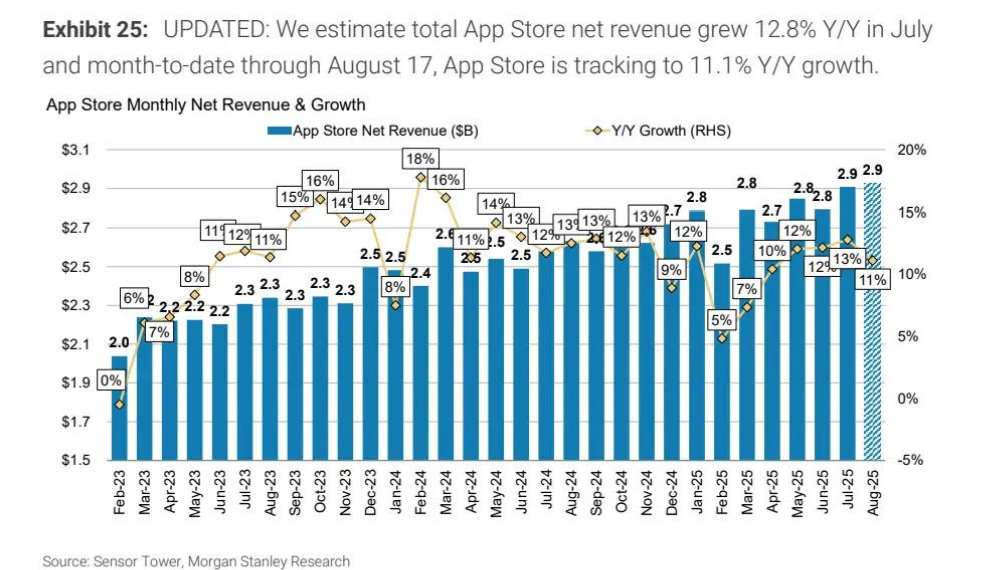
Group 1: App Store Performance - The App Store's net revenue continues to exceed expectations, with a year-over-year growth of 12.2%, unaffected by external link risks [1][2] - In August, the App Store's net revenue grew by 11.1% year-over-year, slightly down from July's 12.4% [2] - The U.S. App Store revenue growth aligns with trends, showing an 8% year-over-year increase in net revenue per download, indicating strong monetization capabilities [3] Group 2: Notebook Production and Market Outlook - Notebook ODM production forecasts have been raised, with expected production reaching 33.6 million units in Q3, a 1% increase quarter-over-quarter [4] - However, there are warnings about potential pressure in Q4 due to conservative growth outlooks from ODMs [4] Group 3: IBM Consulting and Cloud Spending - IBM's consulting job postings have dropped significantly, with a 26% decrease compared to the end of Q2, indicating potential demand weakness [7] - In contrast, cloud capital expenditures are projected to grow by 58% to $451 billion in 2025, driven by consensus adjustments from major cloud service providers [7] Group 4: iPhone 16 Delivery and Market Demand - iPhone 16 delivery times have shortened to 2 days for all models, with varying trends observed across different models [9] - In the Chinese smartphone market, iPhone shipments saw a year-over-year decline of 10% in May, while domestic brands experienced a 24% drop [10] Group 5: Other Key Data - Apple Vision Pro models have a delivery time of 3 days, indicating stable demand [17] - The proportion of AI-related positions at Apple has increased from 10% six years ago to 26%, with deep learning roles making up 60% of AI positions [17]

小摩:收购瞻博网络显著提升盈利可见性 予慧与科技(HPE.US)“增持”评级
智通财经网· 2025-07-18 06:53
Core Viewpoint - Morgan Stanley upgraded Hewlett Packard Enterprise (HPE.US) to "Overweight" with a target price of $30, citing stronger earnings visibility and upside potential following the acquisition of Juniper Networks [1][2] Group 1: Acquisition Impact - The acquisition of Juniper Networks enhances HPE's market position, solidifying its status among large networking companies [1] - HPE currently leads in campus switching, wireless LAN, and enterprise data center switching, with a broad product portfolio including switches, wireless access points, and routers [1] - The acquisition strengthens HPE's networking business, providing a higher margin and less cyclical revenue stream compared to broader IT hardware [1] Group 2: Financial Projections - Analysts project that HPE could achieve at least $2.70 in earnings per share by fiscal year 2027, highlighting significant upside potential for the stock [1] - By fiscal year 2027, the networking business is expected to account for over 50% of the company's profits, up from 35% in fiscal year 2024 [1] Group 3: Valuation and Market Sentiment - Despite a more optimistic scenario suggesting a target price above $35, a conservative 11x P/E ratio was used to calculate the $30 target price due to integration execution risks and recent weakness in HPE's server business [2] - Market concerns regarding the company's execution may lead investors to adopt a cautious approach while monitoring key integration milestones [2]

七彩虹BW2025硬核破圈,次世代体验燃炸全场!
Sou Hu Wang· 2025-07-15 12:14
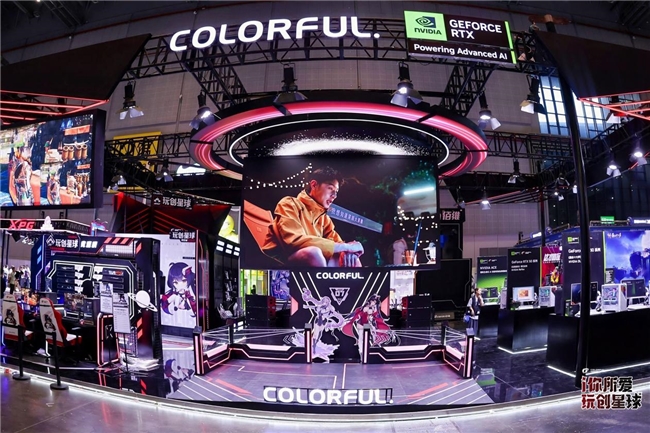
Core Viewpoint - The event "Bilibili World 2025" showcased QICHAIN's innovative hardware and AI technology, emphasizing the integration of gaming culture and advanced technology in their product offerings [1][26]. Group 1: Product Launches and Innovations - QICHAIN introduced the new "iGame GeForce RTX 5070 Advanced OC Senna" graphics card, along with the "iGame C25A Senna" chassis and "iGame X870 Senna V14" motherboard, featuring a vibrant design and RGB lighting [3]. - The "iGame影II DDR5" memory was launched with a performance benchmark of 6400MHz frequency, C28 timing, and 1.4V low voltage, optimized for AMD Ryzen 9000 platforms [9][10]. - The "自在星球" hardware control software includes an AI desktop pet, "柒小希," which will evolve to perform various interactive tasks, enhancing user engagement with the hardware [5]. Group 2: Interactive Experiences - An AI-generated 3D resin figurine experience was introduced, allowing players to create personalized collectibles on-site, showcasing QICHAIN's commitment to AIGC applications [7]. - The RTX Super Player Experience Zone featured high-performance gaming setups demonstrating the capabilities of the Blackwell architecture graphics cards, achieving frame rates nearly four times higher than traditional rendering [15][17]. Group 3: Market Positioning and Strategy - QICHAIN's product matrix aims to cater to both gaming and creative needs, with a focus on high-performance laptops and desktops that appeal to younger consumers [12][19]. - The collaboration with the renowned esports team "TES" at the event highlighted QICHAIN's deep ties with the esports community, enhancing brand visibility and engagement [24]. - The overall theme of the event, "玩转AI,创意出彩," reflects QICHAIN's strategy to leverage AI and innovative hardware to redefine user experiences in gaming and creative industries [26].
关税冲击来袭!惠普(HPQ.US)业绩预警 分析师紧急调降预期
智通财经网· 2025-05-30 04:31
Group 1 - HP's stock price fell over 8% following its second-quarter performance and future outlook, raising concerns among investors and analysts [1] - Morgan Stanley downgraded HP's target price from $29 to $26, reflecting the impact of tariffs, execution challenges, and conservative management strategies [4] - Analysts from Evercore maintained an "outperform" rating but lowered the target price from $32 to $29, indicating that the guidance cut is a cautious response to tariffs and macroeconomic conditions [3] Group 2 - Morgan Chase maintained an "overweight" rating but reduced the target price from $30 to $27, citing short-term tariff uncertainties and economic headwinds affecting market enthusiasm for HP stock [1] - The management has prudently lowered the demand forecast for the second half of fiscal year 2025 due to macroeconomic uncertainties and price increases across all product categories [2] - Analysts expect HP's earnings forecast for fiscal year 2025 and revenue/profit expectations for fiscal year 2026 to be adjusted downward based on cautious assessments of the PC and printing business outlook [2]

BERNSTEIN:亚洲半导体 & IT 硬件 & 全球内存
2025-04-08 05:58
Summary of Key Points from the Conference Call Industry Overview - The discussion primarily revolves around the **semiconductor and IT hardware industry**, with a focus on the implications of increasing U.S. content in products to mitigate tariffs [1][2]. Core Insights and Arguments - **U.S. Content Requirement**: To qualify for tariff exemptions, products must contain at least **20% U.S. content**. This necessitates significant production shifts to the U.S., which is challenging for companies like Apple [2][3]. - **Impact on iPhone Production**: The iPhone 16 Pro Max's Bill of Materials (BOM) shows that **SoC (14%)**, **memory (7%)**, and other components account for approximately **50%** of the BOM. Transitioning production to the U.S. could take several years, with estimated tariff increases of around **50%** due to the high percentage of assembly in China [3][19]. - **AI Server Production**: Unlike iPhones, the production of AI servers can be more easily shifted to the U.S. due to their assembly primarily in Mexico, which is exempt from new tariffs. This transition is seen as economically viable due to the higher profit margins associated with AI servers [4]. - **Intel's Position**: Intel's CPUs, primarily produced in the U.S., may benefit from lower tariffs, while companies like TSMC and AMD could face negative impacts due to their reliance on assembly in China [5][41]. - **MediaTek's Resilience**: MediaTek is less affected by tariffs as its supply chain is primarily based in Asia, allowing it to maintain market share despite the ongoing tariff disputes [5][14]. Additional Important Insights - **Cost Implications**: The cost of producing components in the U.S. could rise significantly, potentially exceeding **50%**, which may not justify the fixed costs of relocating production [3][4]. - **Supply Chain Dynamics**: The supply chain for camera modules and other components is heavily concentrated in Asia, with a transition to U.S. production expected to take around **two years** [24]. - **Investment Ratings**: Various companies in the semiconductor space received ratings, with **MediaTek** rated as outperform with a target price of **NT$1,820**, and **TSMC** also rated outperform with a target price of **NT$1,430** [7][13][14]. Conclusion - The semiconductor and IT hardware industry is navigating complex challenges related to tariffs and production shifts. Companies are assessing the feasibility of increasing U.S. content in their products while managing cost implications and supply chain logistics. The competitive landscape is influenced by these dynamics, with varying impacts on different players in the market.