开源大模型

Search documents
阿里千问:与ChatGPT展开全面竞争
Zhong Guo Xin Wen Wang· 2025-11-17 06:36
Core Insights - Alibaba has officially launched its AI project "Qianwen," targeting the consumer AI market, marking its full entry into AI to C [1] - The Qianwen App's public beta version has been released, integrating the top-performing open-source model Qwen3, and aims to compete directly with ChatGPT [1] - Alibaba's management views the Qianwen project as a critical battle for the future of AI, leveraging the open-source advantages of the Qwen series models [1] Investment and Infrastructure - Alibaba has committed 380 billion RMB (approximately 53.5 billion USD) to AI infrastructure development, with a long-term goal to increase cloud data center energy efficiency tenfold by 2032 [1] - The Qwen series models have surpassed competitors like Llama and Deepseek, achieving over 600 million downloads globally, establishing a strong reputation in the industry [1] Market Position and Competition - The Qwen series models are rapidly gaining traction in Silicon Valley, with Airbnb's CEO stating that the company heavily relies on Qwen due to its superior performance compared to OpenAI's models [2] - NVIDIA's CEO noted that Qwen has captured a significant share of the global open-source model market, showing continuous growth [2] - The Qianwen App is set to launch an international version soon, aiming to compete with ChatGPT for global users [2] Product Features and Future Plans - The Qianwen App aims to integrate various life service scenarios such as maps, food delivery, ticket booking, and shopping to enhance its task handling capabilities [3] - The app has demonstrated practical capabilities, such as generating a research report and creating a polished PowerPoint presentation within seconds [3] - Alibaba's ultimate goal for the Qianwen App is to become a core entry point for AI in daily life, providing both conversational and task execution functionalities [2][3]

月之暗面:登顶全球“K2”背后的北京AI攀登者
Xin Jing Bao· 2025-11-14 13:12
"K2"发布后很快成为最受国际关注的国产开源大模型,其不仅登顶全球开源模型榜单,还被《自然》杂志评价为 世界迎来"又一个DeepSeek时刻"。今年9月,K2更新了0905版本,进一步提升了其在真实编程任务中的表现,11 月 6 日,其推出并开源了K2 Thinking。 从2025年初和DeepSeek发布"撞车",到7月以K2模型重回舞台中心,再到9月带来更高编程能力并推出智能体服 务,月之暗面的这一年犹如坐过山车。这家曾经的"中国最受期待的大模型公司",在经历了用户增长失速、市场 竞争加剧的困境后,正在通过战略调整和产品创新为自己赢得下一次叙事机会。而这家诞生于北京的AI企业,其 发展历程也折射出北京在全球AI产业浪潮中正扮演着越来越重要的角色。 新京报贝壳财经记者探访这家总部位于北京海淀的公司得知,"K2"由创始人杨植麟命名。事实上,这个名字也代 表了月之暗面当前所面临的挑战以及他们所做出的决定——攀登者需直面险峰,而创新者需直面未知的暗面。 聚焦基础研发,Kimi"重回牌桌" 2025年初,当DeepSeek以惊人的速度席卷市场时,月之暗面或许是最受冲击的AI公司之一。不仅是模型发布时 间"撞车", ...

游戏ETF(516010)昨日资金净流入近6000万元,行业需求与新品节奏受关注
Mei Ri Jing Ji Xin Wen· 2025-11-14 03:22
Group 1 - The core viewpoint is that 2023 is expected to be a year of explosive growth and reshaping of the application landscape for China's open-source large models, progressing in three steps: public cloud value reshaping, platform enterprises empowering large models, and C-end scenario implementation [1] - The gaming sector maintains strong fundamentals with low valuation levels, focusing on new product launches and IP derivative commercialization [1] - Continuous advancements in the AI field are noted, with marginal innovations in multimodal and reasoning directions, such as the Kimi-k2 model supporting long text processing and tool invocation [1] Group 2 - The game ETF (516010) tracks the anime and gaming index (930901), which selects listed companies involved in game development, operation, anime production, and derivative sales to reflect the overall performance of related securities [1] - The anime and gaming index focuses on the cultural and creative industry, covering anime, gaming, and related industry chains, effectively reflecting the development trends and market characteristics of China's anime and gaming industry [1]
Kimi杨植麟称“训练成本很难量化”,仍将坚持开源策略
第一财经· 2025-11-11 12:04
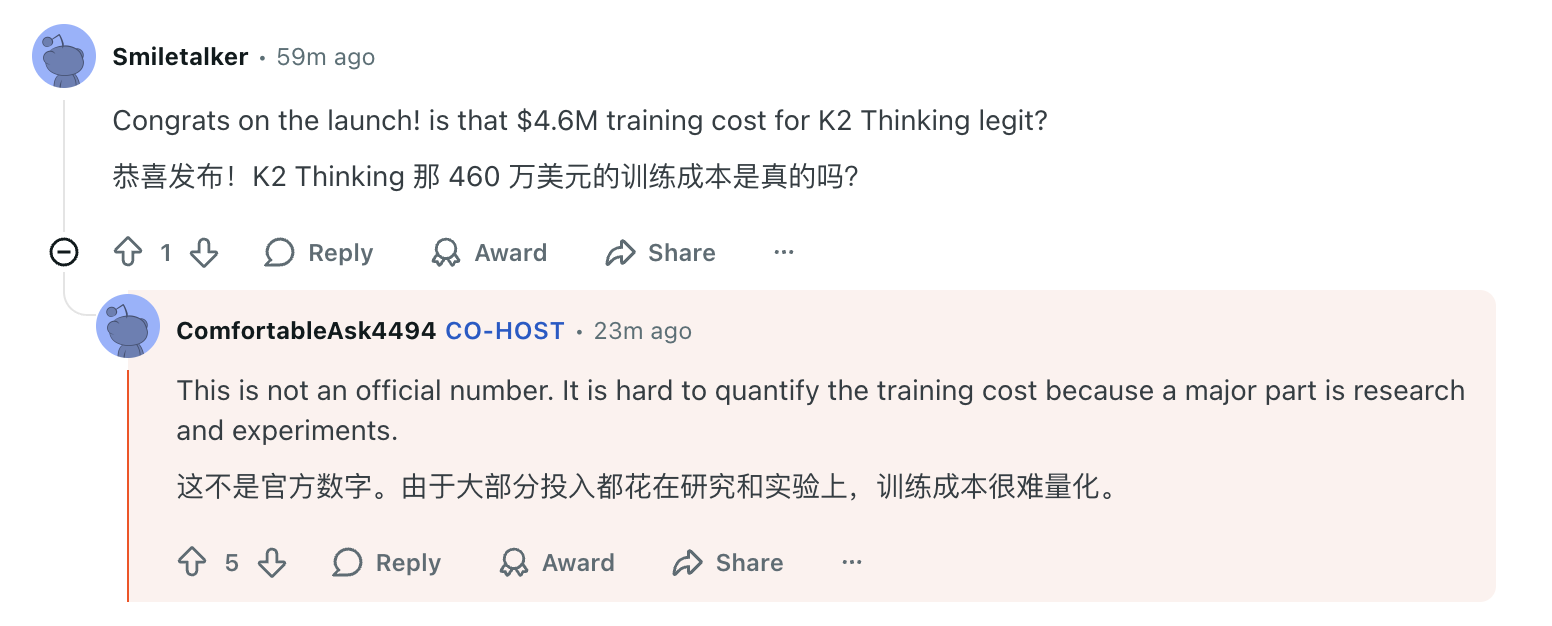
Core Viewpoint - Kimi, an AI startup, is focusing on open-source model development, with the recent release of Kimi K2 Thinking, which has a training cost of $4.6 million, significantly lower than competitors like DeepSeek V3 and OpenAI's GPT-3 [3][4][6] Summary by Sections Model Development and Costs - Kimi has invested heavily in open-source model research and updates over the past six months, releasing Kimi K2 Thinking on November 6, with a reported training cost of $4.6 million, lower than DeepSeek V3's $5.6 million and OpenAI GPT-3's billions [3][4] - CEO Yang Zhilin clarified that the $4.6 million figure is not official, as most expenses are on research and experimentation, making it difficult to quantify training costs [4][6] Model Performance and Challenges - Users raised concerns about the reasoning length of Kimi K2 Thinking and discrepancies between leaderboard scores and actual performance. Yang stated that the model currently prioritizes absolute performance, with plans to improve token efficiency in the future [4][7] - The gap between leaderboard performance and real-world experience is expected to diminish as the model's general capabilities improve [7] Market Position and Strategy - Chinese open-source models are increasingly being utilized in the international market, with five Chinese models appearing in the top twenty of the OpenRouter model usage rankings [7] - Kimi currently can only be accessed via API due to interface issues with the OpenRouter platform [7] - Kimi plans to maintain its open-source strategy, focusing on the application and optimization of Kimi K2 Thinking while balancing text and multimodal model development, avoiding direct competition with leading firms like OpenAI [6][8]
Kimi杨植麟称“训练成本很难量化” 仍将坚持开源策略
Di Yi Cai Jing· 2025-11-11 10:45
Core Insights - Kimi, an AI startup, has released its latest open-source model, Kimi K2 Thinking, with a reported training cost of $4.6 million, significantly lower than competitors like DeepSeek V3 at $5.6 million and OpenAI's GPT-3, which costs billions to train [2][3] - The company emphasizes ongoing model updates and improvements, focusing on absolute performance while addressing user concerns regarding inference length and performance discrepancies [2][3] - Kimi's models are gaining traction in the international market, with five Chinese open-source models listed among the top twenty on the OpenRouter platform [3][5] Company Strategy - Kimi plans to maintain its open-source strategy and prioritize the application and optimization of the Kimi K2 Thinking model, while also developing multimodal models [5] - The company aims to differentiate itself from leading competitors like OpenAI by focusing on architectural innovation, open-source strategies, and cost control, avoiding direct competition in specific AI browser markets [5] Technical Aspects - Kimi utilizes H800 GPUs with InfiniBand technology for high-performance computing and AI training, despite having fewer and less powerful chips compared to U.S. counterparts [3] - The training cost and resource allocation for Kimi K2 Thinking are primarily directed towards research and experimentation, making precise cost quantification challenging [2]
Kimi-k2thinking模型发布;关注年末AI、IP边际催化:传媒行业周观察(20251103-20251107)
Huachuang Securities· 2025-11-10 07:51
Investment Rating - The report maintains a "Recommended" investment rating for the media industry, expecting the industry index to rise more than 5% over the next 3-6 months compared to the benchmark index [52]. Core Insights - The media sector experienced a slight increase of 0.16% last week, underperforming the CSI 300 index, which rose by 0.82%, resulting in a relative underperformance of 0.66% [9]. - The report emphasizes the need for both sharpness and allocation in the media sector, highlighting the potential for significant growth in AI and IP applications as catalysts for the industry [6]. - The gaming market remains strong, with notable performances from Tencent's products, while the film market is expected to see a boost from the upcoming release of several high-profile imported films [6][21]. Market Performance Review - The media sector's overall market capitalization is approximately 1,959.53 billion yuan, with 140 listed companies [3]. - The absolute performance of the media index over the past month is 3.1%, 28.2% over six months, and 72.0% over the past year [4]. - The gaming market continues to show resilience, with Tencent's titles dominating the iOS sales rankings [16]. Industry Highlights - The report notes that the film market has recovered approximately 76% of its total box office compared to 2019, with a total box office of 40.31 billion yuan and 1.06 billion viewers as of November 7, 2025 [21]. - Upcoming films such as "Demon Slayer: Infinity Castle" and "Now You See Me 3" are expected to drive box office growth in November and December [30]. - The AI sector is highlighted for its ongoing advancements, with the launch of the Kimi-k2 thinking model, which enhances AI capabilities in complex problem-solving [33]. Company Announcements - ST Huatuo announced its application to revoke risk warnings, indicating a positive shift in its operational status [37]. - Damai Entertainment expects a significant increase in net profit for the first half of 2025, projecting a net profit of no less than 500 million yuan, up from 337 million yuan in the same period last year [39]. - Fubo Group reported a record high revenue of over 800 million HKD for Q3 2025, marking a 27% year-on-year increase [41].
陶冬:买芯片成为维稳股价刚需,科技企业闭眼砸钱“续命”
Di Yi Cai Jing· 2025-11-10 03:49
Core Insights - The profitability model of companies may face challenges due to the competition from open-source large models [1][2] - Recent market events reflect investor caution towards risk, particularly in the AI sector, leading to significant sell-offs in major tech stocks [1] - The unsustainable nature of AI investments is highlighted by OpenAI's substantial order contracts compared to its cash reserves [2] Group 1: Market Reactions - The financial market experienced a significant sell-off, with major tech companies losing nearly $1 trillion in market value [1] - Concerns over liquidity shortages and potential government shutdowns have contributed to market volatility [1] - The dollar index initially rose above 100 but quickly softened, while U.S. Treasury yields remained stable [1] Group 2: AI Investment Concerns - Major tech companies collectively invested $112 billion in AI during the third quarter, raising concerns about the sustainability of such investments [1][2] - OpenAI's sales are approximately $13 billion, with available cash between $3 billion to $5 billion, yet it has signed contracts worth $1.3 trillion, indicating a risky financial strategy [2] - The reliance on capital markets for funding AI initiatives raises questions about the long-term viability of these investments [2] Group 3: Economic Outlook - Despite short-term market turbulence, there is an expectation that funds will eventually return to the market due to ongoing low-interest rates and a large amount of capital chasing limited assets [3] - Upcoming economic indicators, such as the UK's GDP data and U.S. government budget negotiations, are anticipated to influence market sentiment [3]
国产模型新盛况!王座易主:Kimi K2 Thinking开源超闭源
机器之心· 2025-11-07 04:26
Core Insights - The article discusses the launch of the Kimi K2 Thinking model by Moonshot AI, which has sparked significant online discussion due to its advanced capabilities that surpass leading closed-source models like GPT-5 and Claude Sonnet 4.5 [2][3][5] - Kimi K2 Thinking is positioned as a major advancement in open-source AI, marking a potential turning point for domestic large models in the industry [10][42] Model Performance - Kimi K2 Thinking has demonstrated superior performance in various benchmark tests, achieving a score of 44.9 in the Humanity's Last Exam (HLE), surpassing models such as Grok4 and GPT-5 [11][42] - The model excels in multi-turn tool invocation and continuous reasoning, achieving state-of-the-art (SOTA) levels in several tests, including autonomous web browsing and adversarial search reasoning [10][30] Cost Efficiency - Despite its trillion-parameter scale, Kimi K2 Thinking operates at a low cost, with API pricing significantly lower than that of GPT-5, at $0.15 for cached input and $2.5 per million tokens output [15][16] - The training cost for the Kimi K2 Thinking model was reported to be $4.6 million [34] Technical Innovations - The model utilizes INT4 quantization and is designed for continuous interaction, allowing it to perform up to 200-300 consecutive tool calls without human intervention [32][38] - Kimi K2 Thinking's architecture includes more experts and less human intervention, enhancing its reasoning capabilities [35] Open Source and Licensing - Kimi K2 Thinking is open-source and available on Hugging Face under a modified MIT license, granting broad commercial and derivative rights, making it one of the most permissively licensed advanced models [47] - A limitation is imposed that requires prominent labeling of "Kimi K2" if the software exceeds 100 million active users or $20 million in monthly revenue [48]
Cursor“自研”模型套壳国产开源?网友:毕竟好用又便宜
量子位· 2025-11-02 04:23
Core Viewpoint - The article discusses the rapid advancement of Chinese open-source AI models, highlighting that they have caught up with leading AI products from the U.S. [2] Group 1: New AI Models - AI programming applications Cursor and Windsurf have recently released new models, with Cursor promoting its "first coding model" and Windsurf claiming to set a new speed benchmark [3][8] - Cursor's Composer-1 model is designed for low-latency coding tasks, completing most tasks within 30 seconds [9] - Windsurf's SWE-1.5 model, developed in collaboration with Cerebras, boasts a speed of 950 tokens per second, significantly outperforming competitors [11] Group 2: Open-Source Model Influence - There are indications that both Cursor and Windsurf's new models are based on Zhiyuan's GLM, although official confirmations are lacking [6][14] - The discovery that Cursor's model can generate Chinese text has led to discussions about the implications of using Chinese open-source models [4][15] - The article notes that Chinese open-source models dominate various performance rankings, with Qwen3 being one of the most downloaded models on HuggingFace [21] Group 3: Market Dynamics - The article suggests that for many startups, leveraging existing open-source models is a more rational choice than investing hundreds of millions in training new models from scratch [29][30] - The growing strength and affordability of Chinese open-source models position them as central players in the AI landscape [30][31]

中国工程院院士倪光南:中国已成为全球开源大模型创新引领者
Xin Lang Cai Jing· 2025-11-01 01:52
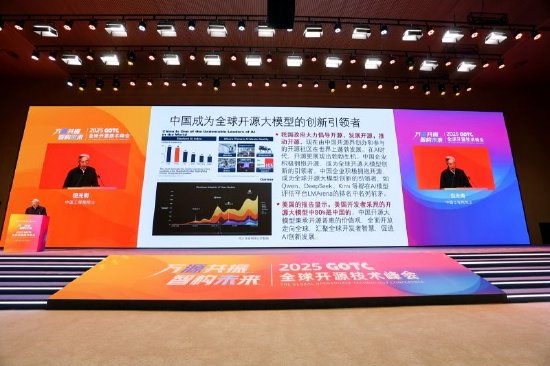
Core Insights - Open source plays a significant role in the AI era, with Chinese companies leading in this domain, establishing China as a global innovator in open source large models [1][3] - According to a U.S. research report, 80% of the open source large models adopted by American developers are from China, highlighting the global reach and collaborative nature of Chinese open source initiatives [3]