数字金融

Search documents
徽商期货在中期协联合研究计划(第十八期)中斩获佳绩
Xin Lang Cai Jing· 2026-02-11 08:29
作为扎根安徽、辐射全国的综合性期货经营机构,徽商期货始终将产学研一体化作为发展战略,构建了 多层次、常态化的校企合作体系,形成"实践实训、课题研发、人才共育"的协同育人模式。依托高校合 作平台,徽商期货将产业一线的实际需求转化为科研课题,让高校的智力资源对接行业发展痛点,实现 了"教学有靶向、科研有落地、产业有支撑"的良性循环。 本次获奖课题紧扣行业高质量发展脉搏,聚焦人工智能、交易咨询、数字金融等核心领域,充分展现理 论与实践深度融合的创新价值。其中,徽商期货作为申报单位与合肥工业大学计算机与信息学院联合申 报的《基于人工智能的高风险期货交易预警机制研究》,作为合作单位与安徽大学经济学院联合申报的 《数字金融赋能期货交易咨询业务高质量发展研究》均斩获"良好"评议;公司部分员工作为课题组成 员,与合肥工业大学经济学院联合开展的《"保收入"导向的"保险+期货"常态化运行机制研究》课题获 评"优秀"。 产学研深度融合结硕果 ——徽商期货在中期协联合研究计划(第十八期)中斩获佳绩 近日,中国期货业协会联合研究计划(第十八期)课题评审结果正式揭晓,徽商期货与高校联合攻关的 多项课题喜获佳绩。此前,公司与安徽大学合作申 ...


广东金融“惠”企业!去年新发放企业贷款平均利率创新低
Nan Fang Du Shi Bao· 2026-02-11 08:12
Core Insights - Guangdong's banking sector continues to lead nationally in key metrics such as assets, liabilities, and loans, with total loan balance reaching 19.64 trillion yuan, a year-on-year growth of 6.23% [2] - The sector has achieved both quantitative growth and qualitative improvements, particularly in manufacturing, strategic emerging industries, and infrastructure loans, which have outpaced average loan growth rates [2] Group 1: Financial Performance - By the end of 2025, Guangdong's banking sector reported a total loan balance of 19.64 trillion yuan, with an increase of 1.15 trillion yuan in new loans, representing a year-on-year increase of 179.4 billion yuan [2] - Loans to manufacturing, strategic emerging industries, and infrastructure reached 3.04 trillion yuan, 2.07 trillion yuan, and 3.15 trillion yuan respectively, with growth rates of 7.89%, 16.06%, and 7.42% [2] Group 2: Sectoral Developments - The sector has seen significant growth in technology loans, inclusive loans, green loans, digital economy loans, and elderly care loans, with respective balances of 3.64 trillion yuan, 2.97 trillion yuan, 3.14 trillion yuan, 876.4 billion yuan, and 9.2 billion yuan, reflecting year-on-year growth rates of 11.12%, 8.65%, 15.45%, 4.2%, and 53.2% [2] - Over 200 technology branches have been established, with loans to tech enterprises reaching 276.3 billion yuan, a year-on-year increase of 24.9% [3] Group 3: Digital and Green Finance - Guangdong is advancing its digital finance initiatives, with a focus on integrating digital technology into financial services and enhancing service quality in key areas [4] - Green finance initiatives have led to significant growth in loans for energy transition, infrastructure upgrades, and green consumption, with year-on-year increases of 10.79%, 14.55%, and 19.13% respectively [3] Group 4: Inclusive Finance - The county-level loan balance reached 1.83 trillion yuan, with a loan-to-deposit ratio of 78.22%, an increase of 4.29 percentage points year-on-year [5] - Loans to small and micro enterprises totaled 6.12 trillion yuan, while loans to private enterprises reached 6.8 trillion yuan [5] Group 5: Economic Support Measures - The average interest rate for newly issued corporate loans has decreased by 48 basis points, marking the lowest level on record [6] - Measures to support foreign trade have been implemented, with loans to foreign trade enterprises exceeding 1.8 trillion yuan, a year-on-year increase of 12.43% [6] Group 6: Regulatory and Safety Measures - The Guangdong Financial Regulatory Bureau has imposed penalties on 354 institutions, with fines increasing by 15.5% year-on-year [7] - The bureau has implemented a comprehensive risk prevention framework, particularly in the real estate sector, with significant credit support for "white list" projects [7] Group 7: Industry Restructuring - The province is actively promoting the consolidation of small financial institutions, with 15 village banks either dissolved or entering merger processes [8] - Efforts to curb "involution" competition in the banking sector have been initiated, focusing on self-regulation and market order [8]

上海:加快构建全周期、多元化、接力式科技金融服务体系
Sou Hu Cai Jing· 2026-02-11 07:47
Core Viewpoint - Shanghai aims to enhance financial services for the real economy during the 14th Five-Year Plan period, focusing on supporting domestic demand, technological innovation, green development, small and micro enterprises, and public welfare through five key initiatives [1][2]. Group 1: Financial Services for Economic Development - The city will accelerate the establishment of a comprehensive, diversified, and relay-style technology financial service system, promoting the development of the Sci-Tech Innovation Board and bond market "technology board," and supporting market-oriented merger funds and venture capital [1]. - High-quality financial supply will be provided for the comprehensive green transformation of economic and social development, expanding the functions of Shanghai's green financial service platform and optimizing the green financial standard system [1]. Group 2: Inclusive and Sustainable Financial Systems - A multi-level, widely covered, and sustainable inclusive financial system will be improved, increasing support for first-time and renewed loans, and enhancing financing connections for small and micro enterprises using technologies like blockchain [1]. - A pension financial system that aligns with the aging population will be established, supporting the design and investment management of savings, wealth management, funds, trusts, and insurance products with pension functions [1]. Group 3: Digital Financial Development - The development of digital finance will be promoted, with steady progress in the digital renminbi and support for the establishment of a digital renminbi international operation center in Shanghai, alongside the digital transformation of financial institutions [2].
融业技之智 聚技术之力 做实金融“五篇大文章”
Jin Rong Shi Bao· 2026-02-11 01:43
Core Viewpoint - The Central Financial Work Conference emphasizes the importance of focusing on five key areas: technology finance, green finance, inclusive finance, pension finance, and digital finance, highlighting the interconnected roles of technology and finance in supporting the real economy [1][2]. Group 1: Technology and Finance Integration - The conference theme "Technology Bridges, Finance Foundations" illustrates the relationship between technology and finance, where technology acts as a bridge to overcome development obstacles and connect innovative resources, while finance serves as a foundation to support the real economy [1]. - The continuous innovation in financial technology is evident from recent awards and applications, showcasing the vibrant development of technology within the financial sector [1]. Group 2: Promotion and Sharing of Financial Technology Achievements - Effective promotion and sharing of financial technology achievements will rely on authoritative channels and industry consensus, with a focus on leveraging professional financial media for deep reporting and case studies [2]. - Establishing a collaborative ecosystem for the effective transformation and sharing of financial technology results is crucial, particularly for small and medium-sized institutions, to reduce costs and foster a culture of collaboration [2]. Group 3: Serving the Real Economy - The value of financial technology achievements will increasingly be measured by their ability to meet the real needs of the economy, such as addressing financing challenges for tech enterprises and enhancing the accessibility of inclusive finance [2]. - The commitment to ensuring that technological innovations serve the core business and enhance service coverage, accessibility, and satisfaction is essential to prevent a disconnect from the real economy [2].
以金融科技为桥 筑金融强国发展之基
Jin Rong Shi Bao· 2026-02-11 01:43
Core Insights - The integration of finance and technology is now essential for the high-quality development of the financial industry, serving as a core driver for addressing practical challenges and establishing a strong foundation for a financial powerhouse [1] - The Central Financial Work Conference has identified fintech and green finance as key tasks, with fintech acting as a crucial link among various sectors, enhancing service precision, financial inclusivity, efficiency in green finance accounting, and overall ecosystem improvement [1] Group 1 - The Financial Times has been a mainstream financial media outlet since 1987, committed to serving the development of the financial sector and maintaining the party's leading voice in finance [1] - The media has developed an integrated communication matrix, including WeChat, which has gathered 12 million users, and has produced several viral multimedia reports [2] - The company aims to facilitate industry collaboration and policy-market connections through various events and discussions planned for 2025, focusing on innovative practices in fintech [2][3] Group 2 - The recent exchange meeting is a practical response to industry needs and a step towards promoting collaborative development, featuring representatives from major banks sharing successful fintech applications [3] - The Financial Times will leverage its multimedia capabilities to comprehensively report on the exchange meeting, aiming to promote innovative practices and advanced experiences within the industry [3] - The industry is encouraged to embrace change and collaborate to overcome challenges, with the Financial Times committed to providing a professional and open platform for fintech discussions [4]
《善本金融白皮书》发布 描绘金融高质量发展“浙江实践”
Zhong Zheng Wang· 2026-02-10 11:52
Group 1 - The core concept of the event is the integration of "good capital" finance, which combines allocative finance and social value finance, aiming to use AI technology to address resource misallocation and anchor development direction with social value [1][2] - The "good capital" finance has led to practical outcomes in Zhejiang, including the establishment of a financial advisor system, good capital trusts, credit engineering, and comprehensive financial ecosystem construction in counties [1] - Currently, there are 5,200 financial advisors nationwide, with a target to help solve over 30,000 financing difficulties for enterprises by 2025, involving an amount exceeding 200 billion yuan [1] Group 2 - The "Qiantang River Financial Bay Core Area Action Plan" was also released, which aims to develop a spatial layout centered around Hangzhou's Qiantang New City and Qiantang Century City, inspired by global financial bay construction experiences [2] - The Qiantang River Financial Bay Core Area has attracted 169 licensed financial institutions at the provincial level or above, with the Yuhuangshan South Fund Town managing assets totaling 1.5 trillion yuan [2] - Future development of the Qiantang River Financial Bay will focus on "digital finance" and "good capital" finance, promoting AI and financial innovation, and establishing a financial data sharing platform [2]
西南首笔!兴业银行成都分行以数字金融破解链上企业融资难题
Sou Hu Cai Jing· 2026-02-10 07:23
出品|中访网 此次落地的系统直联供应链商票贴现业务,以SaaS技术架构实现银行核心系统与川投供应链平台无缝对 接,打通银企数据壁垒,构建起全流程线上化、高效协同的数字金融服务体系。相较于传统模式,链属 企业无需往返银行网点提交材料、线下办理,仅需在川投供应链平台发起票据融资申请,在线完成合同 签署,银行系统自动完成信息校验、风控审核与资金投放,最快实现"T+0"当日放款。全流程线上化操 作大幅压缩业务办理时长,显著提升结算与融资效率,真正实现数据"多跑路"、企业"少跑腿",为产业 链上下游企业提供一站式、全品类、便捷化的综合票据服务体验。 效率提升的同时,兴业银行成都分行始终坚守安全底线,将数字化风控嵌入业务全流程。通过系统直联 实现票据信息自动核验、贸易背景交叉验证、资金流向实时管控,以技术手段筑牢风险防线,保障融资 合规与资金安全。此外,该系统深度对接企业司库管理需求,为集团型企业提供全流程票据可视化管 理、资金统筹运营、风险智能预警等功能支撑,助力企业提升资金使用效率、强化财务管控能力,实现 金融服务与企业数字化管理深度融合。 供应链票据是优化产业链支付结算、缓解中小微企业融资压力的重要工具。系统直联模 ...


银行为何开始发射卫星了?
Jing Ji Ri Bao· 2026-02-10 07:15
Core Viewpoint - The successful launch of "Zhaoyin Jinkui" and "Puyin Shuzhi" satellites by China Merchants Bank and Pudong Development Bank marks a significant step in the integration of banking and commercial aerospace, highlighting the banks' strategic move to leverage satellite technology for enhancing digital financial infrastructure and supporting the commercial aerospace industry [2][10]. Group 1: Satellite Launch and Collaboration - The "Zhaoyin Jinkui" and "Puyin Shuzhi" satellites are part of the "Tianqi Constellation" low-orbit narrowband satellite IoT network, showcasing banks' involvement in satellite launches [2][3]. - This is not the first instance of banks collaborating with commercial satellite companies; previous launches include "Zhaoyin 1" and "Zhaoyin 2" by China Merchants Bank and "Ping An 1" and "Ping An 2" by Ping An Bank [3][4]. - Banks are adopting various paths to utilize satellite technology, including direct satellite launches and purchasing processed data from satellite companies for financial applications [3][4]. Group 2: Applications and Benefits of Satellite Technology - The integration of low-orbit satellites enhances banks' capabilities in financial asset management, risk control, and emergency communication, extending their digital infrastructure into space [3][6]. - Banks are increasingly moving from merely purchasing satellite data to actively participating in satellite launches, driven by the need for improved risk management and business continuity [6][7]. - The use of satellite technology allows banks to overcome geographical and environmental limitations, thus expanding their business reach, especially in remote areas [7][10]. Group 3: Cost and Market Dynamics - The cost of launching commercial satellites is expected to decrease due to technological advancements and economies of scale, making customized commercial applications more feasible [8][9]. - Current costs for launching a commercial satellite range from tens of millions to over a billion yuan, with significant potential for reduction as the industry matures [8][9]. - By 2030, the cost of satellite launches could drop to below 10,000 yuan per kilogram, further encouraging financial institutions to invest in satellite technology [9]. Group 4: Financial and Industrial Synergy - The collaboration between banks and satellite companies represents a deeper financial and industrial synergy, enabling banks to expand their service offerings and support the development of the commercial aerospace ecosystem [10][14]. - Banks are innovating financial products and services, such as satellite leasing and industry-specific funds, to meet the unique needs of the aerospace sector [14][15]. - The integration of satellite data into financial services is expected to enhance credit assessments and risk management, aligning financial services more closely with the real economy [10][15].





农民工工资支付迎创新保障 数字人民币智能合约场景落地成都
2 1 Shi Ji Jing Ji Bao Dao· 2026-02-10 03:02
Core Insights - The first digital RMB smart contract for wage payment to migrant workers has been successfully implemented in Chengdu, Sichuan, under the guidance of the People's Bank of China, marking a new model for digital finance and inclusive finance [1] Group 1: Digital RMB Smart Contract Implementation - The digital RMB smart contract utilizes a digital ecosystem service platform to automate and enforce wage payments, eliminating human intervention and supporting cross-institutional interoperability [1] - As of January 2026, the digital RMB smart contract has been piloted in areas such as prepaid fund management, supply chain finance, corporate group financial management, and subsidy distribution, with a total of 486,400 contracts signed and a cumulative transaction amount of 316 million yuan [1] Group 2: Future Developments - The Digital RMB Operations Management Center plans to continuously enhance system services and promote existing models while collaborating with member banks to innovate applications of digital RMB smart contracts [2] - The initiative aims to provide more intelligent services for industry development and social governance, supporting the construction of the financial "five major articles" [2]

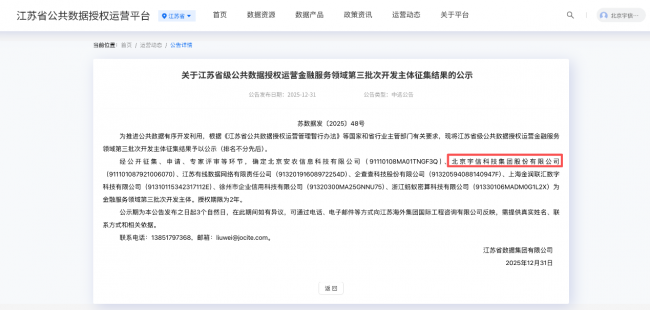
宇信科技入选江苏省级数据运营开发主体
Jin Tou Wang· 2026-02-10 01:34
Group 1 - The core viewpoint of the article highlights that Yuxin Technology has been officially recognized as a key player in the public data operation for financial services in Jiangsu Province, marking its significant role in the market-oriented reform of data elements and contributing to the high-quality development of the financial industry [1][3][4] - Yuxin Technology's selection is a response to national strategies aimed at developing digital finance and cultivating a data element market, showcasing the company's integration into the evolving landscape of the industry [1][3] - The company has developed the "Star Link" data service platform, which supports various financial scenarios such as credit risk control and marketing services, establishing a solid foundation for participating in public data operations [3][4] Group 2 - Yuxin Technology's competitive advantage lies in its ability to combine cutting-edge technology with a deep understanding of financial business and a strict compliance framework, which is essential for gaining trust in the data element market [4][6] - The company aims to address challenges in data application by providing standardized data products and services that lower the cost for financial institutions to access high-quality data, thereby enhancing the coverage of inclusive finance [4][6] - Yuxin Technology is committed to ensuring data security and compliance, adhering to relevant policies and regulations, and establishing a trust mechanism throughout the data lifecycle to facilitate the effective release of data value [4][6] Group 3 - The company plans to leverage its new role to empower the financial sector across three dimensions: scenario, data, and ecosystem [5][6] - In scenario empowerment, Yuxin Technology will focus on integrating public data with diverse social data to create precise credit profiles for banks, addressing financing challenges for small and micro enterprises [6][7] - The company aims to build a high-quality financial data product library, ensuring data accuracy and timeliness while providing tailored solutions to meet the diverse needs of financial institutions [6][7] Group 4 - Yuxin Technology will act as a connector and catalyst, collaborating with government departments, financial institutions, and partners to create a healthy and prosperous data element financial ecosystem [7] - The company seeks to promote cross-entity and cross-industry data compliance and innovation, expanding new application scenarios and strengthening regional financial security [7] - With the ongoing improvement of the data element market system, Yuxin Technology is positioned to lead the transformation and upgrading of China's financial industry through data elements, contributing to the high-quality development of Jiangsu Province's digital economy [7]