
盘活存量

Search documents
2025地市半年报:供应“缩量提质”,存量仍是重点难点
Di Yi Cai Jing· 2025-07-01 04:11
Core Viewpoint - The real estate market in China is undergoing a "reduction in quantity and improvement in quality" as it accelerates inventory reduction, with a focus on optimizing existing policies to stabilize the market [1][7][11] Land Market Performance - In the first half of 2025, the transaction volume of operating land in 300 cities decreased by 8% year-on-year, with an average premium rate of 9.2%, an increase of 4.8 percentage points compared to the previous year [1][2] - Major cities like Chengdu and Hangzhou have seen land auction premium rates exceeding 50%, indicating a strong demand for quality land despite overall reduced supply [2][3] Inventory Reduction Efforts - The State Council has emphasized the need to assess existing land and ongoing projects to further optimize policies aimed at reducing inventory and stabilizing the real estate market [7][8] - As of May 2025, the narrow inventory of residential properties in 100 cities was 4.63 billion square meters, showing a downward trend, while the broad inventory remains a concern due to many undeveloped land parcels [5][6] Role of Local Government and State-owned Enterprises - Local governments are controlling land supply while enhancing quality, with state-owned enterprises playing a significant role in land acquisition, particularly in second and third-tier cities [3][11] - The proportion of land acquired by local investment platforms has remained above 50% from 2021 to 2024, peaking at 64% in 2024 [3] Policy Measures for Land Utilization - The Ministry of Natural Resources has introduced measures to address challenges related to idle land, including policies for reasonable adjustments and support for enterprises facing financial difficulties [8][10] - The use of special bonds for land storage has been reintroduced, allowing local governments to recover idle land effectively [10][11]
黑马金茂,又杀回来了!
3 6 Ke· 2025-05-23 02:34
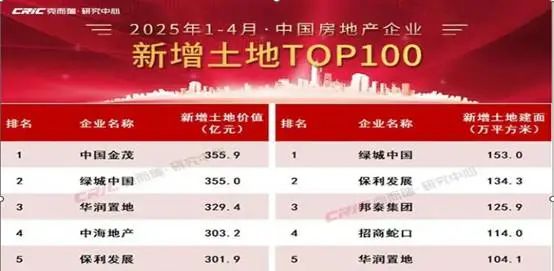
Core Viewpoint - China Jinmao is transitioning from a loss-making state to a proactive land acquisition strategy, aiming to leverage new land to improve cash flow and profitability amidst a challenging real estate market [1][5][30]. Group 1: Company Strategy - The new chairman, Tao Tianhai, has initiated comprehensive reforms in organization, investment, product, and operations, summarized as the "three axes" of Jinmao's turnaround: organizational streamlining, aggressive land acquisition, and product optimization [2][5]. - Jinmao's land acquisition strategy has seen it become the top acquirer in the industry, with a reported land acquisition value of 356 billion yuan from January to April 2025, surpassing major competitors [3][4][20]. - The company aims to create a positive feedback loop where increased land acquisition leads to new cash flow and profits, which in turn supports further land purchases [2][5]. Group 2: Financial Performance - In 2023, Jinmao reported a significant loss of 6.9 billion yuan, but turned around to achieve a profit of 1.07 billion yuan in 2024, indicating a successful recovery [5][8]. - The company’s sales figures have shown a downward trend over the past four years, dropping from 235.6 billion yuan in 2021 to 98.3 billion yuan in 2024, highlighting the challenges faced [8][9]. - Jinmao's land acquisition intensity has been notably high, with a ratio of 1.4 in early 2025, indicating a strong commitment to expanding its land bank despite previous losses [4][5]. Group 3: Market Context - The real estate market is currently in a downturn, but Jinmao is focusing on core first- and second-tier cities where demand remains relatively strong, providing opportunities for growth [21][22]. - The company is strategically shifting away from lower-tier cities, which have higher inventory and lower sales rates, to focus on more profitable markets [23][24]. - Jinmao's approach to land acquisition is supported by recent policy changes that have lifted price restrictions, allowing the company to leverage its high-end product capabilities [22][30].

做优增量与盘活存量(评论员观察)
Ren Min Ri Bao· 2025-05-12 22:10
Group 1 - The core viewpoint emphasizes the importance of both incremental and stock optimization in driving economic growth in China [2][4] - The logistics industry is experiencing significant improvements, with delivery efficiency increasing fourfold due to the integration of drones and autonomous vehicles [1] - The express delivery volume has surpassed 50 billion packages, indicating a robust growth trajectory in the logistics sector [1] Group 2 - The silver tourism sector is evolving, with a 30% year-on-year increase in railway tourism train operations, reflecting a shift towards quality and comfort to attract older travelers [2] - The integration of new technologies, such as AI and robotics, is creating new consumer experiences and driving market demand [3] - The potential of dormant assets, such as unused patents and vacant buildings, is being recognized, with initiatives in Shanghai and Fujian aimed at revitalizing these resources for economic growth [3]