
贸易逆差

Search documents
美国四季度GDP初值公布在即 市场普遍预计经济增速将显著低于上一季度
Zhi Tong Cai Jing· 2026-02-19 23:25
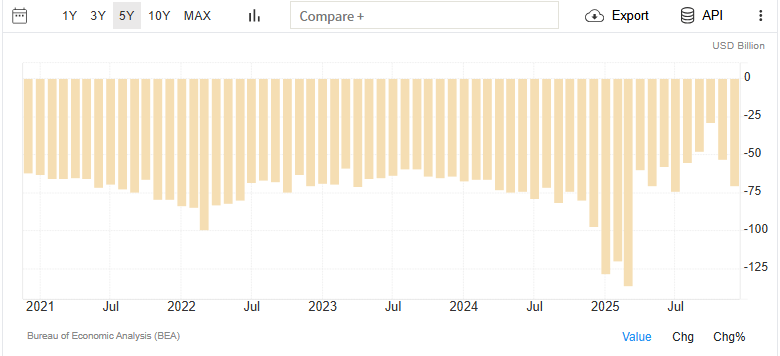
Group 1 - The U.S. economy is expected to show resilience by the end of 2025, but the GDP growth rate for Q4 is anticipated to slow significantly compared to Q3 [1] - The consensus forecast for Q4 real GDP growth is 1.9%, down from 4.4% in Q3, while media predictions are slightly more optimistic at 2.8% [1] - Discrepancies in predictions are attributed to differing assessments of trade flows and the impact of the recent government shutdown, which lasted 43 days and suppressed federal spending [1] Group 2 - Consumer spending remains the primary driver of economic growth in Q4, but momentum is slowing, with an expected annualized growth rate of 2.5%, down from 3.5% in Q3 [2] - Economists project that the overall GDP growth for 2025 will stabilize around 2%, indicating a healthy growth range [2] - Private fixed investment is expected to grow moderately in Q4, but government spending and residential investment are under pressure, with government spending projected to decline by 17.5% due to the shutdown [2] Group 3 - Trade factors are exerting pressure on Q4 economic growth, with the trade deficit widening to $70.3 billion in December, influenced by increased imports and decreased exports [3] - Net exports decreased by approximately $5 billion in December, primarily due to the normalization of gold exports, which may negatively impact GDP contributions [3] - It is anticipated that trade activities will return to a more predictable rhythm in 2026, reducing macroeconomic data disturbances as the peak impact of tariffs may have passed [3]
US Runs Annual Trade Deficit Up to $901 Billion, One of Biggest Since 1960
Youtube· 2026-02-19 22:46
Trade Data Analysis - The trade deficit has widened due to increased imports and a slight decline in exports, indicating resilient domestic demand [3][4] - The normalization of trade data is observed after significant volatility in 2025, with the deficit narrowing in the first half of the previous year [2][1] - The widening trade deficit is expected to negatively impact GDP calculations, although it may be offset by inventory building [5][4] Inflation Outlook - There is a divergence between CPI and PCE measures of inflation, with CPI trending lower while PCE has shown stronger performance [7][8] - The Federal Reserve targets PCE inflation, and the recent firmness in PCE reports suggests a hold on interest rates until leadership changes at the Fed [8][9] - Employment data has remained strong, reinforcing the expectation of maintaining interest rates in the near term [9] Economic Resilience - The U.S. economy has demonstrated resilience despite significant interest rate increases and trade policy volatility since 2022 [10] - Financial conditions have eased, and there is an increase in capital expenditure (CapEx) expected in 2026, along with consumer tax cuts anticipated in late Q1 and Q2 [11]


关税难奏效 美国2025年商品贸易逆差创新高
Jin Rong Jie· 2026-02-19 19:54
Core Viewpoint - The U.S. merchandise trade deficit is projected to reach a record $1,240.9 billion in 2025, reflecting a $25.5 billion increase from the previous year, with a growth rate of 2.1% [1] Group 1: Trade Deficit Insights - The increase in the trade deficit indicates that tariffs imposed by the Trump administration have had a minimal impact on reducing the overall deficit levels [1] - U.S. companies are adjusting to changes in tariffs, which distorts monthly trade flows [1]
美国2025年贸易逆差录得9015亿美元,较去年仅下降20亿美元,对此你怎么看?
Sou Hu Cai Jing· 2026-02-19 16:24
Core Insights - The article discusses the complexities of the U.S. financial system, emphasizing that it operates more under the influence of Wall Street than the White House, leading to a persistent trade deficit driven by global investment in the U.S. economy [1][3] - The U.S. economy is characterized by high consumption and low savings, making it reliant on imports to meet domestic demand, which complicates efforts to reduce the trade deficit [6][7] - The article outlines the impact of tariffs introduced by the Trump administration, which, despite increasing revenue, have had limited success in significantly reducing the trade deficit [11][12] Group 1: U.S. Financial System and Trade Deficit - The U.S. financial market is primarily influenced by Wall Street, which prefers a system that allows for speculative trading rather than returning to a manufacturing-based economy [1] - The persistent trade deficit is attributed to strong foreign investment in the U.S., allowing global investors to benefit from American consumption and expansion [1][3] - The U.S. dollar's status as a global reserve currency keeps it strong, making imports cheaper and exports less competitive, thus reinforcing the trade deficit [7] Group 2: Economic Structure and Consumption Patterns - The U.S. economy has shifted towards a service-oriented structure, with manufacturing declining, leading to a reliance on imports for consumer goods [6][9] - The high consumer spending rate (over 65%) indicates a deep-rooted consumption-driven economic model that is difficult to change in the short term [6] - The manufacturing index is projected to remain below pre-2017 levels, indicating a lack of capacity to meet domestic demand through local production [6] Group 3: Tariff Policies and Their Effects - The introduction of high tariffs on key imports has not significantly reduced the trade deficit, as imports have shifted to countries with lower tariffs [11][12] - Tariffs have primarily affected high-demand goods, but the overall import levels have remained stable due to the low elasticity of demand for essential goods [11] - Despite increased tariff revenues, the trade deficit has only marginally decreased, highlighting the limitations of tariff policies in addressing structural trade imbalances [11][12] Group 4: Future Strategies for Trade Deficit Reduction - The article anticipates that the U.S. will adopt a mixed strategy of fiscal and monetary easing, tariff adjustments, and supply chain localization to address the trade deficit in the coming years [17][19] - There is an expectation of targeted interventions to manage inflation and support domestic consumption, particularly for low-income households [19] - Continued investment in key industries, such as semiconductors and rare earths, is seen as essential for reducing reliance on imports and improving the manufacturing sector [19]
美国录得1960年以来最大年度贸易逆差之一
Xin Lang Cai Jing· 2026-02-19 16:06
美国 12 月贸易逆差扩大,为关祱政策反复无常的动荡一年画上句号。 美国商务部周四公布的数据显示,商品和服务贸易逆差较上月扩大至703 亿美元。全年逆差累计达9015 亿美元,仍是 1960 年有记录以来规模最大的逆差之一。 "尽管 2025 年关祱新闻不断、数据波动剧烈,但全年贸易逆差几乎没有变化。" 全美金融市场经济学家 奥伦・克拉奇金在报告中表示,"随着关祱的最大拖累效应可能已过去,我们预计贸易将进入更可预测 的节奏。" 2025 年美国月度贸易数据波动尤为剧烈,原因是美国进口商对特朗普总统持续发布的关祱公告做出反 应。黄金和药品进口波动尤其明显,企业纷纷赶在加征更高关祱前完成进口。 12 月逆差高于彭博社经济学家调查中除一项预估外的所有预期,反映出进口额增长 3.6%,其中电脑配 件和汽车进口增幅明显。商品和服务出口下降 1.7%,主要因黄金出口减少。 数据公布前,亚特兰大联邦储备银行的 GDPNow 模型预测,净出口将为第四季度经济增长贡献约 0.6 个百分点,当时预计第四季度 GDP 增速为 3.6%。但报告发布后,多位经济学家预测,在周五公布第四 季度 GDP 数据前,贸易对经济的提振作用将减弱 ...
加拿大2025年贸易逆差扩大至313亿加元,创近年最高水平
Sou Hu Cai Jing· 2026-02-19 15:35
Core Insights - Canada's trade deficit for 2025 is projected to reach 31.3 billion CAD, marking the highest annual deficit since 1988, excluding the pandemic year of 2020 [1] - Overall exports from Canada are expected to decline by 0.2% year-on-year, with most product categories experiencing varying degrees of decline [1] - The strong performance of precious metals, particularly unrefined gold, silver, and platinum group metals, has somewhat masked the true impact of trade tensions on Canadian exports, with this category seeing a significant increase of 41.7%. Excluding this category, the actual decline in exports would be 3% [1] Trade Relations - The trade relationship between Canada and its largest trading partner, the United States, has been notably disrupted, with Canadian exports to the U.S. decreasing by 5.8% and imports from the U.S. down by 2.9% [1] - This reciprocal contraction has led to a reduction in Canada's trade surplus with the U.S. from 101.3 billion CAD in 2024 to 81.6 billion CAD in 2025, a decrease of nearly 20% [1] Monthly Data - In December 2025, Canada's exports amounted to 65.63 billion CAD, while imports were 66.93 billion CAD, resulting in a trade deficit of 1.31 billion CAD, which is a narrowing from the 2.2 billion CAD deficit recorded in November [1]
尽管特朗普征关税,2025年美国贸易逆差仍高达9010亿美元
Xin Lang Cai Jing· 2026-02-19 15:01
核心要点 美国 12 月贸易逆差大幅扩大,尽管特朗普政府试图缩小这一巨大缺口,但全年贸易失衡状况基本未 变。 美国商务部周四公布,2025 年收官之际,12 月商品与服务贸易逆差达703 亿美元,较 11 月增加 173 亿 美元,远超道琼斯共识预期的 555 亿美元。 全年来看,美国贸易逆差为9015 亿美元,较 2024 年仅微降 0.2%(21 亿美元),也略低于 2022 年创纪 录的 9237 亿美元逆差。 为规避关祱,企业在 2025 年第一季度提前集中进口。这一趋势在年初后有所缓和,10 月录得 2009 年 以来最低月度逆差。 美国对欧盟商品贸易逆差最大,达2188 亿美元;其次是中国(2021 亿美元)、墨西哥(1969 亿美 元)。 2025 年美国出口总额为3.43 万亿美元,较 2024 年增加 1998 亿美元;进口总额为 4.33 万亿美元,增加 1978 亿美元。 责任编辑:郭明煜 核心要点 2025 年全年,美国贸易逆差达9015 亿美元,较 2024 年仅微降 0.2%(21 亿美元)。 该报告发布前一年,特朗普总统实施了一系列激进关祱政策,旨在平衡全球贸易格局。 美国对欧盟 ...

加拿大2025年贸易逆差创历史新高 金价上涨掩盖了关税的真正冲击
Ge Long Hui A P P· 2026-02-19 14:37
Group 1 - Canada's trade deficit expanded to 31.3 billion CAD last year, marking the largest annual trade deficit since the COVID-19 pandemic [1] - The trade deficit in 2025 is projected to be the largest since data collection began in 1988 [1] - Annual exports from Canada decreased by 0.2%, with most product categories experiencing a decline [1] Group 2 - The strong increase in gold prices masked the true damage caused by the trade war with the United States on Canadian exports [1] - Exports of unrefined gold, silver, platinum group metals, and their alloys surged by 41.7% last year [1] - Excluding this category, Canadian export values would have significantly decreased by 3% [1]
美国2025年贸易逆差为9015亿美元 2024年为逆差9035亿美元
Mei Ri Jing Ji Xin Wen· 2026-02-19 14:02
每经AI快讯,2月19日消息,美国2025年贸易逆差为9015亿美元,2024年为逆差9035亿美元。 (文章来源:每日经济新闻) ...
美国2025年贸易逆差为9015亿美元,2024年为逆差9035亿美元
Mei Ri Jing Ji Xin Wen· 2026-02-19 14:00
每经AI快讯,2月19日消息,美国2025年贸易逆差为9015亿美元,2024年为逆差9035亿美元。 ...