
粮食安全

Search documents
山东工行:信贷资金精准直达 全力护航“三秋”生产
Qi Lu Wan Bao· 2025-10-16 02:51
Core Viewpoint - The article emphasizes the importance of the "Three Autumns" production in ensuring a bountiful harvest and completing annual grain tasks, highlighting the financial support provided by Shandong Industrial and Commercial Bank (ICBC) to facilitate this process [1] Group 1: Strengthening Credit Support - Shandong ICBC is closely integrating short-term financial support for the "Three Autumns" with long-term rural revitalization strategies, increasing agricultural credit to solidify agricultural infrastructure [2] - As of the end of September, the bank's agricultural loan balance exceeded 360 billion yuan, an increase of 42 billion yuan since the beginning of the year, providing robust support for "Three Autumns" production and sustainable agricultural development [2] Group 2: Innovative Financial Products - To address the diverse and frequent financing needs of "Three Autumns" production entities, Shandong ICBC has launched over 40 specialized financing solutions, including "Farming Quick Loan," "Agricultural Input Loan," "Grain Purchase and Sale Loan," and "Agricultural Machinery Loan" [4] - The bank has promoted online products like "Planting e-loan," covering over 100 types of crops with a maximum limit of 3 million yuan, effectively solving issues related to financing difficulties and delays [4] - By the end of September, the balance of inclusive agricultural financing solutions exceeded 7 billion yuan, reflecting a growth of 2.8 billion yuan and a 61% increase [4] Group 3: Integrated Service Channels - Shandong ICBC is innovating service formats to extend financial service reach in rural areas, creating an integrated service network that combines online and offline resources [6] - Utilizing a service model that includes county outlets, service points, mobile banking vehicles, and the "ICBC Rural Service" app, the bank aims to make financial services easily accessible for agricultural operators [6] - The bank is exploring partnerships with grassroots cooperatives to enhance service coverage and accessibility in rural markets [6] Group 4: Future Plans - Shandong ICBC plans to continue engaging with rural communities to understand their needs, focusing on the subsequent phases of "Three Autumns" production and future agricultural development [8] - The bank aims to establish a comprehensive financial service system that includes pre-research, in-process support, and post-tracking to contribute to national food security and rural revitalization efforts [9]


省农信联社:当好百姓丰收的“金”助手
Qi Lu Wan Bao· 2025-10-16 02:51
Core Insights - The articles highlight the significant role of financial institutions in supporting agricultural development and ensuring food security in China, particularly during the harvest season. Group 1: Financial Support for Agriculture - The provincial agricultural credit union has guided local rural commercial banks to enhance their focus on agricultural financing, launching 85 credit products to support rural revitalization, with agricultural loan balances reaching 942.85 billion yuan by the end of August, an increase of 42.515 billion yuan since the beginning of the year [1] - Rural commercial banks have introduced innovative financial products like "Agricultural Machinery Interest Subsidy Loans" to assist farmers in purchasing essential equipment, thereby facilitating smoother harvest operations [2] - The financial support has enabled farmers to enhance their operational capabilities, such as increasing drying capacity to prevent crop spoilage due to adverse weather conditions [3] Group 2: Enhancing Food Security - The agricultural credit union has emphasized the importance of food security, guiding banks to expand loans for grain production and high-standard farmland construction to meet financing needs across various agricultural sectors [4] - Financial institutions have actively supported the development of specialty industries, such as the "June Yellow" crab, with microloans totaling 737 million yuan benefiting over 2,537 aquaculture households [5] - Local banks have provided targeted loans to support the cultivation of high-quality fruit varieties, contributing to the growth of local agricultural sectors [6] Group 3: Digital Transformation in Agriculture - The agricultural credit union has implemented digital platforms to streamline agricultural transactions, with over 1365 vegetable cooperatives and 68,300 farmers utilizing the "Production and Sales Service Platform," facilitating transactions exceeding 7.043 billion yuan [8] - The focus on modernizing agricultural machinery has led to the introduction of advanced equipment, with financial institutions providing timely loans to farmers for purchasing new machinery, significantly improving operational efficiency [9] Group 4: Targeted Marketing and Customer Engagement - The agricultural credit union has encouraged rural banks to conduct targeted marketing activities based on local agricultural characteristics, resulting in an increase of 36,000 loan users by the end of August compared to the beginning of the year [7]
秋粮收获进入高峰期 多地“干”字当头守住粮食安全底线
Yang Shi Wang· 2025-10-16 02:47
央视网消息:农业农村部最新农情调度显示,目前全国秋粮收获进入高峰期,进度过六成。 东北秋粮产量形势喜人 东北地区秋粮面积、产量占全国秋粮近四成,今年产量形势是近几年较好的一年。在内蒙古扎鲁特旗玉米单产提升行动地块,专 家组实地测产,得出了亩产2546斤的好成绩,刷新东北地区玉米千亩高产纪录。 受持续降雨天气影响,山西多地农田水分饱和、土地泥泞,常规轮式收割机无法正常作业。对此,山西大同市农业部门成立农机 调度专班,监测各地墒情与天气变化,一旦出现晴朗天气、地块达到作业条件,立即组织农机进入适宜区域开展收割。在山西晋城市 泽州县,目前,全县13个粮食烘干机械已全部开放,每天可烘干粮食约2000吨,全力满足农户的粮食烘干需求。 山东:党员奋战助农一线 全力抢收守粮安 黄淮海秋粮面积、产量占占全国秋粮1/4左右。农业农村部正指导各地抢抓降雨间隙,抢收抢烘,进度已过六成。在山东,连日 阴雨让秋收面临严峻考验。9月份以来,菏泽市平均降水量较常年同期偏多三倍以上,田间土壤水分饱和、积水难排,玉米面临发芽 霉变风险,秋收工作陷入"抢收窗口期短、机械下地难、存储保障弱"的三重困境。面对田间积水和成熟待收的玉米,菏泽市快速组 ...
强社会治理、守粮食安全,河南准备这么做
Zheng Zhou Ri Bao· 2025-10-16 01:03
Core Viewpoint - The implementation of the "Henan Provincial Social Governance Regulations" and the "Henan Provincial Food Security Guarantee Regulations" on December 1 aims to enhance governance efficiency and ensure food security in the province [1] Group 1: Social Governance Regulations - The "Henan Provincial Social Governance Regulations" consists of 9 chapters and 75 articles, covering public service guarantees, grassroots infrastructure, conflict resolution, and social security prevention, aiming to improve governance effectiveness at the grassroots level [2] - A dedicated chapter on "Basic Public Service Guarantee" outlines specific provisions for enhancing social service systems, social security systems, and public legal service systems, ensuring a more substantial sense of gain, happiness, and security for the populace [2] - The regulations emphasize grassroots governance, proposing a "Party Building + Grid + Big Data" governance model to strengthen grassroots party organizations and governance mechanisms [3] - The regulations detail measures for conflict resolution, social security prevention, and risk management, establishing a comprehensive social security prevention system [3] - A chapter on "Integrity Construction" focuses on building a social credit system and establishing mechanisms for joint incentives and penalties for trustworthiness [4] Group 2: Food Security Regulations - The "Henan Provincial Food Security Guarantee Regulations" consists of 10 chapters and 65 articles, establishing a comprehensive food security guarantee system covering production, storage, circulation, and industry development [5] - The regulations emphasize the importance of high-standard farmland construction and seed resource protection, including a compensation mechanism for major grain-producing counties to enhance their production motivation [5] - The regulations outline the management of food reserves, requiring the separation of reserve operations from commercial activities to improve management levels [6] - The regulations highlight Henan's role as a key grain production area, focusing on enhancing grain circulation through the establishment of trading platforms and logistics systems [7] - Specific provisions for food market stabilization and emergency response mechanisms are included to ensure effective management during crises [7]
人多地少为何还能年净调出40亿斤粮?
Xin Hua Ri Bao· 2025-10-16 00:09
Core Insights - Jiangsu province ranks 8th in total grain production in China, contributing approximately 4 billion jin annually to national food security [1] - The province faces challenges in balancing its large population and limited land resources while ensuring food supply [1] Grain Purchase and Sales - Jiangsu maintains a stable grain purchase and sales system, with annual grain acquisition around 55 billion jin over the past three years [2] - The province's wheat and rice purchase volumes rank 4th and 2nd nationally, respectively, benefiting local farmers [2] - Policies such as the grain joint guarantee fund and the role of state-owned enterprises enhance market stability and farmer income [2][3] Storage and Emergency Response - The province's grain storage capacity is robust, with over 90% of finished grain oil reserves maintained [3] - A comprehensive emergency supply network has been established, including 3,288 emergency guarantee enterprises and 2,738 supply points [3] - The number of local storage facilities has been streamlined from 424 to 204, improving management and safety [3] Modern Storage and Logistics - Jiangsu has invested significantly in modern grain storage facilities, achieving a storage capacity of 49 million tons and a drying capacity of 15.8 tons per day [4][5] - The province's logistics capabilities are enhanced by a network of dedicated grain terminals and rail lines, facilitating efficient grain distribution [6] Technological Advancements and Branding - Innovative storage technologies, such as the "six-sided active temperature control" system, are being implemented to improve grain preservation [7] - The "Water Rhythm Su Rice" brand has gained recognition, with significant increases in high-quality rice production and sales [8][10] - Jiangsu has established a provincial-level grain technology innovation research institute, leading in national grain technology advancements [9]
自觉行动实现“粮食节约人人有责”
Jing Ji Ri Bao· 2025-10-16 00:07
Core Viewpoint - The importance of food waste reduction is emphasized as a collective responsibility, urging individuals to integrate food conservation into their daily lives for a sustainable future [2][4][6] Group 1: Food Waste and Loss - Food loss occurs at every stage from production to consumption, with significant waste observed during events like business banquets and family gatherings, where social pressures lead to over-ordering and food disposal [3] - Households often waste food due to poor planning and excessive purchasing, leading to spoilage and disposal [3] - The restaurant industry lacks adequate management and guidance, with menu designs often promoting excessive consumption and insufficient options for smaller portions [3] Group 2: Food Security and Sustainability - Reducing food loss is crucial for food security and environmental sustainability, as China's grain production has reached 1.4 trillion jin in 2024, yet structural supply-demand imbalances persist [4] - Every grain produced consumes significant land and water resources, highlighting the need for sustainable practices to mitigate environmental impacts [4] Group 3: Agricultural Modernization - The "14th Five-Year Plan" emphasizes the importance of food conservation actions and the transition from extensive agricultural practices to modernized methods, achieving significant reductions in food loss across storage, processing, and transportation [5] - Recent data indicates that average annual losses in these areas account for about 2% of total grain production, with specific loss rates for storage, transport, and processing being 3%, 0.8‰, and 0.8% respectively [5] Group 4: Behavioral Change and Responsibility - Changing perceptions around food consumption is essential, promoting balanced diets and responsible purchasing and cooking habits among consumers [6] - Restaurants are encouraged to take social responsibility by optimizing menu designs and providing options for smaller portions, while regulatory bodies should enhance laws and monitoring to curb food waste [6]

习言道|粮食安全是战略问题
Zhong Guo Xin Wen Wang· 2025-10-15 23:48
悠悠万事吃饭为大。党的十八大以来,习近平总书记高度重视粮食安全,多次作出重要论述。他强调, 粮食多一点少一点是战术问题,粮食安全是战略问题。 [ 责编:袁晴 ] ...
新华网三评之二:“仪式感”不是浪费的遮羞布
Bei Jing Ri Bao Ke Hu Duan· 2025-10-15 23:44
Core Viewpoint - The article highlights the issue of food waste during festive celebrations, emphasizing that the desire for perfection and social status leads to excessive food ordering and waste, contradicting the true spirit of gatherings [1]. Group 1: Consumer Behavior - Consumers often order excessive dishes to achieve a "perfect" dining experience, leading to significant food waste [1] - The trend of showcasing lavish meals on social media encourages ordering more food than can be consumed, resulting in untouched dishes [1] Group 2: Marketing Practices - Some restaurants promote high-priced set menus under the guise of enhancing social status, which contributes to food waste [1] - The marketing strategies employed by businesses, such as promoting "value" in large set meals, often conflict with the message of food conservation [1] Group 3: Cultural Reflection - The article suggests that true celebration should focus on the joy of togetherness rather than the quantity of food, indicating a need for a cultural shift towards valuing meaningful interactions over ostentatious displays [1]

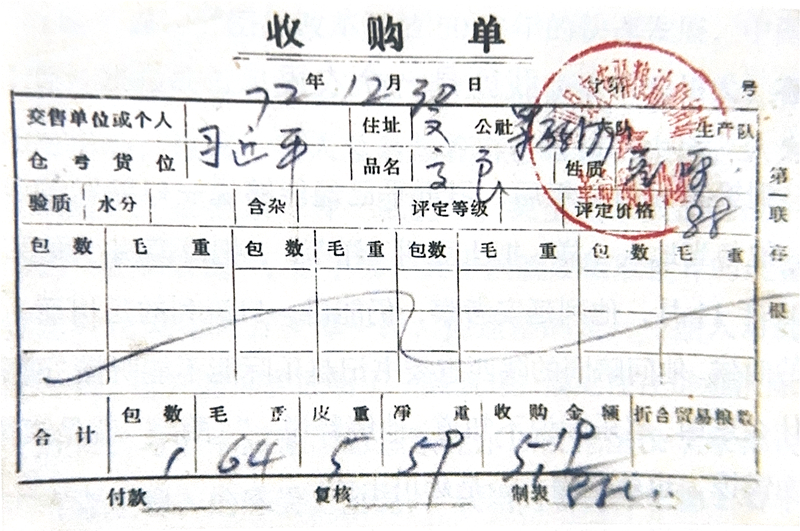
人民领袖|这张交粮凭证 交售人是习近平
Yang Shi Wang· 2025-10-15 23:07
Core Viewpoint - The article highlights Xi Jinping's experiences as a farmer in Liangjiahe during the 1960s and 1970s, emphasizing his commitment to agricultural development and food security, which continues to influence his policies today [1][2][10]. Group 1: Personal Experience and Leadership - Xi Jinping worked alongside villagers in Liangjiahe, engaging in various agricultural tasks and quickly becoming a strong labor force [1]. - In December 1972, he sold 59 jin (approximately 29.5 kg) of sorghum for 5.19 yuan, reflecting the challenging agricultural conditions of the time [2][3]. - After joining the Communist Party in 1974, he led efforts to build an irrigation dam, increasing arable land and grain production from 109,465 jin in 1971 to 179,946 jin in 1974 [2][6]. Group 2: Emphasis on Food Security - Xi Jinping's experiences as a farmer instilled a deep respect for food and the labor of farmers, leading to a strong advocacy for reducing food waste [6][8]. - He has consistently highlighted the importance of food security, noting that despite improvements, there are still significant issues with food loss at various stages of the supply chain [10][11]. - National statistics indicate that China's grain production has exceeded 1.4 trillion jin in 2024, marking a significant achievement in food security [9]. Group 3: Advocacy for Reducing Food Waste - Xi Jinping has raised awareness about food waste, citing that over 22.7% of food is lost annually, equating to approximately 9.2 billion jin, which could feed 190 million people for a year if recovered [11]. - He has initiated campaigns like the "Clean Plate Campaign" to promote food conservation and has emphasized the need for a culture of frugality [11][12]. - His personal anecdotes about food conservation reflect a broader commitment to instilling values of thriftiness and respect for agricultural labor within society [7][12].
让粮食供应链更有韧性更安全
Ren Min Ri Bao· 2025-10-15 22:22
Group 1 - Food security is a national priority, and stable supply chains are essential for ensuring food security. COFCO Group is accelerating the construction of a modern food logistics supply chain system to enhance the resilience and safety of food supply chains [1] - The grain terminal at Nansha Port in Guangzhou, designed by COFCO Technology, is the largest grain port logistics facility in South China, achieving a single silo unloading capacity of 2,000 tons per hour and a berth unloading capacity of 8,000 tons per hour, with an annual throughput capacity of nearly 16 million tons [1] - COFCO Technology has developed advanced equipment such as a non-destructive multi-point grain unloading device and a self-cleaning low-damage elevator, which reduce transportation losses and improve grain circulation efficiency. The automated control system enhances unloading efficiency by 20% and enables real-time information linkage with rail and road transport [1] Group 2 - Grain depots are critical nodes in the grain transportation chain. A new grain storage project in Huangpu District, Guangzhou, designed by COFCO Technology, utilizes next-generation tubular chain technology to address issues of low capacity and high material loss in traditional systems, filling a domestic technology gap [2] - The new tubular chain system has increased grain unloading efficiency from 50 tons per hour to 300 tons per hour, allowing for flexible layout and rapid transportation of grain to designated locations, thus improving the efficiency of the entire grain transportation network [2] - The project transforms traditional grain depots from static nodes into dynamic circulation hubs, facilitating seamless connections for subsequent transportation and creating a high-efficiency, clean, and coherent logistics loop [2] Group 3 - COFCO Group is driving the transformation of traditional industries towards high-end, green, and intelligent development. Innovations in storage include the development of six-sided active temperature control and autonomous temperature control smart storage technologies for precise and eco-friendly grain storage [3] - In processing, COFCO has developed an intelligent milling machine that overcomes key industry challenges such as automatic gap adjustment and online data monitoring [3] - The company is also exploring new growth avenues, including the launch of a new generation of healthy sugar substitute D-allohexose, which supports the Healthy China strategy, and is engaging in cutting-edge research in synthetic biology for future health industry applications [3]