多元化资产配置

Search documents
六大行集体下架5年期大额存单,部分3年期产品已售罄
21世纪经济报道· 2025-12-03 12:24
Core Viewpoint - The recent collective removal of 5-year large denomination time deposits by major banks indicates a strategic shift in banks' approach to interest margin management and a potential reduction in the supply of long-term fixed-rate deposits [1][15]. Group 1: Market Changes - Major state-owned banks have collectively removed 5-year large denomination time deposits from their mobile banking platforms, with current offerings limited to terms of 3 years or less, and interest rates ranging from 1.20% to 1.55% [1][3]. - Some banks have labeled their 3-year large denomination time deposits as "available," but many are already sold out, reflecting a significant departure from the traditional year-end deposit attraction strategies [1][13]. Group 2: Historical Context - The development of 5-year large denomination time deposits spans nearly 40 years, with their initial introduction in 1986 and a significant revival in 2015 after a long hiatus [6][7]. - The peak popularity of these deposits occurred around 2022, where they were highly sought after, often selling out quickly and leading to phenomena like "setting alarms to purchase" [7][9]. Group 3: Financial Implications - The decline in the attractiveness of 5-year large denomination time deposits is attributed to the narrowing net interest margins faced by banks, which have led to a reduction in the issuance of long-term deposits [8][15]. - As of the third quarter, the net interest margin for commercial banks was reported at 1.42%, indicating ongoing pressure on banks' profitability due to high deposit costs amidst declining loan rates [15]. Group 4: Strategic Adjustments - Banks are expected to adopt a differentiated supply model for long-term deposits, with only a few banks with strong liability demands likely to continue offering such products [1][15]. - The minimum investment thresholds for large denomination time deposits have changed, with current offerings showing minimal interest rate differences across various investment amounts, indicating a shift in product positioning [16]. Group 5: Investor Behavior - In response to the changing landscape, investors are shifting from a focus on high-interest deposits to a more diversified asset allocation strategy, with a notable increase in interest in non-principal guaranteed financial products [19][20]. - A significant portion of the population is now inclined to explore various investment options, reflecting a broader change in financial attitudes and strategies among retail investors [19].








首次突破7万亿!私募基金狂飙突进,百亿机构持续加仓
2 1 Shi Ji Jing Ji Bao Dao· 2025-12-03 00:01
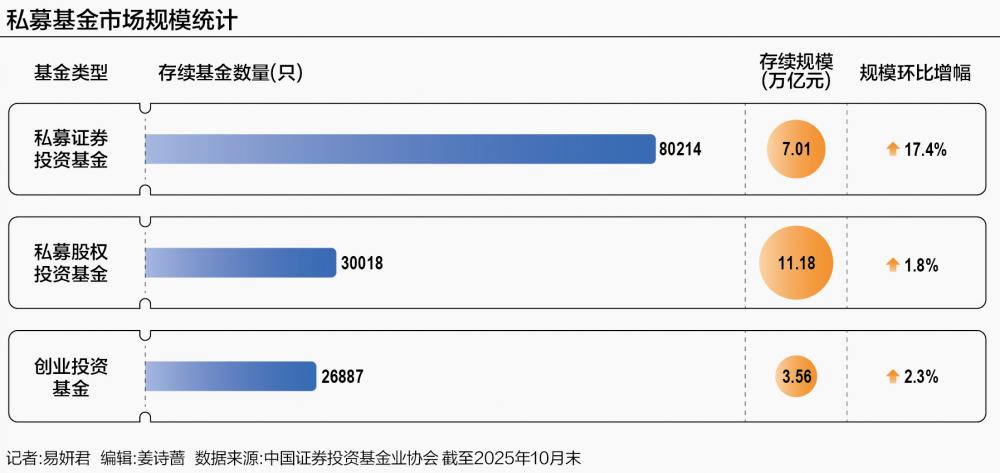
Core Insights - The private securities investment fund market in China has reached a significant milestone, with the total number of funds surpassing 80,000 and the total scale exceeding 7 trillion yuan as of October 2025, marking a substantial increase of over 1 trillion yuan from the previous month [1][4][13] - There is a strong bullish sentiment among private equity funds towards the A-share market, as indicated by a record high in the stock private equity position index [1][8][14] Fund Growth and Market Dynamics - As of October 2025, the total number of private funds in China has increased to 137,905, with a total scale of 22.05 trillion yuan, reflecting a month-on-month increase of 1.31 trillion yuan [4][18] - The growth in private securities investment funds is primarily driven by existing funds rather than new registrations, with only 995 new funds registered in October 2025, contributing 42.92 billion yuan to the total scale [4][19] - The surge in private securities investment funds is attributed to three main factors: the explosive growth of quantitative strategies, a favorable market environment highlighting structural opportunities in A-shares, and supportive policies that simplify registration processes [5][19] Industry Trends and Concentration - The number of private fund managers has decreased to 19,367 as of October 2025, indicating a trend towards quality over quantity in the industry, with a significant number of smaller managers exiting the market [6][20] - The concentration of assets in larger private equity firms is increasing, with the top ten firms capturing a larger share of the market, reflecting a "winner takes all" dynamic [7][20] Investor Sentiment and Positioning - The stock private equity position index reached 82.97% as of November 21, 2025, with a notable increase of 1.84% from the previous week, indicating a strong bullish sentiment among private equity funds [8][21] - The proportion of fully invested private equity funds has risen to 68.99%, while the shares of moderately and low-invested funds have decreased [9][22] - Factors driving the increased positions include positive policy developments, year-end performance considerations, and expectations of economic recovery and structural opportunities [9][22] Performance and Activity Levels - The average return of large private equity funds has been high this year, attracting more institutional investments from banks and insurance funds [5][19] - The number of new registrations for private securities investment funds has surged by 100.76% year-on-year, indicating heightened market activity and interest [12][23] - Private equity firms are increasingly engaging in research activities, with over 1,100 firms participating in investment research in a single month, reflecting a proactive approach to identifying investment opportunities [12][23]
股票私募大幅加仓A股,百亿级梯队仓位逼近90%
21世纪经济报道· 2025-12-02 14:42
Core Viewpoint - The private equity fund market in China has achieved significant growth, with the total number of private securities investment funds exceeding 80,000 and the total scale surpassing 7 trillion yuan for the first time, indicating a strong bullish sentiment towards the A-share market [1][3]. Group 1: Market Growth - As of the end of October 2025, there are 80,214 private securities investment funds with a total scale of 7.01 trillion yuan, marking an increase of over 1 trillion yuan from September [1][3]. - The overall private fund market has expanded to 137,905 funds with a total scale of 22.05 trillion yuan, reflecting an increase of 660 funds and 1.31 trillion yuan from the previous month [3]. - The growth in private securities investment funds is primarily driven by existing funds rather than new registrations, with only 995 new funds registered in October, contributing 429.20 billion yuan [3][5]. Group 2: Factors Driving Growth - The surge in private securities investment fund scale is attributed to three main factors: explosive growth in quantitative strategies, a favorable market environment highlighting structural opportunities in A-shares, and supportive policies that simplify registration processes [5][6]. - The demand for diversified asset allocation has increased, leading to a rise in the registration of multi-asset strategies and derivatives products [5]. - Regulatory improvements have enhanced operational transparency and investor trust, further contributing to the growth of private securities investment funds [5][6]. Group 3: Market Sentiment and Positioning - As of November 21, 2025, the stock private equity position index reached 82.97%, a significant increase of 1.84% from the previous week, indicating a strong bullish sentiment [8][9]. - The proportion of fully invested private equity funds (over 80% allocation) has risen to 68.99%, while lower allocation categories have seen a decline [8][9]. - The optimism among private equity funds is reflected in their high positions across various scales, with the largest funds showing the most confidence, as evidenced by a position index of 89.23% for funds over 100 billion yuan [9].

股票私募大幅加仓A股,百亿级梯队仓位逼近90%
2 1 Shi Ji Jing Ji Bao Dao· 2025-12-02 14:23
Group 1 - The core viewpoint of the article highlights the significant growth of private equity funds in China, with the total number of private securities investment funds reaching 80,214 and a total scale of 7.01 trillion yuan as of October 2025, marking a historic milestone [2][5] - The private equity fund market has accelerated its expansion since October 2025, with a total of 137,905 private funds and a total scale of 22.05 trillion yuan, reflecting an increase of 660 funds and 1.31 trillion yuan compared to September 2025 [4] - The growth in private securities investment funds is primarily driven by existing funds rather than new registrations, with 995 new funds registered in October 2025, contributing only 42.92 billion yuan to the total scale [6] Group 2 - The increase in private securities investment fund scale is attributed to three main factors: explosive growth in quantitative strategies, a favorable market environment highlighting structural opportunities in A-shares, and supportive policies that simplify registration processes [6] - The "Matthew Effect" is becoming more pronounced in the private fund industry, with funds increasingly concentrating in leading institutions, while smaller firms face challenges, leading to a reduction in the number of fund managers and funds [7] - The stock private equity funds exhibit a strong bullish sentiment towards the A-share market, with the stock private equity position index reaching 82.97% as of November 21, 2025, marking a new high for the year and indicating a significant increase in positions among large private equity firms [9][10]

突破7万亿!私募基金狂飙突进 百亿机构持续加仓
2 1 Shi Ji Jing Ji Bao Dao· 2025-12-02 12:53
证券类私募基金又有新突破。 中国证券投资基金业协会(以下简称"中基协")最新发布的数据显示,截至2025年10月末,存续私募证 券投资基金共80214只,存续规模达到7.01万亿元,环比9月暴增超1万亿元。这也是私募证券投资基金 市场首次突破7万亿元大关。 在规模持续增长的同时,近期,股票私募逆势加仓,展现出对A股中长期走势的坚定看多情绪。 私募排排网数据显示,截至2025年11月21日,股票私募仓位指数达82.97%,在前一周的基础上大涨 1.84%,再次刷新年内新高的同时,创下近185周新高。 其中,在各规模梯队中,百亿私募最为乐观,其仓位指数高达89.23%,已连续两周大幅提升。 10月证券类私募基金规模大增1万亿 10月以来,私募基金市场加速扩容。 据中基协统计,截至2025年10月末,存续私募基金共137905只,存续基金规模22.05万亿元;较2025年9 月末的137245只、20.74万亿元分别增加了660只、1.31万亿元。 在本轮扩张中,私募证券投资基金为最重要的助推器。 截至2025年10月末,存续私募证券投资基金80214只,存续规模7.01万亿元;存续私募股权投资基金 30018只, ...
突破7万亿!私募基金狂飙突进,百亿机构持续加仓
2 1 Shi Ji Jing Ji Bao Dao· 2025-12-02 12:52
Core Insights - The private equity fund market in China has reached a significant milestone, with the total number of existing private securities investment funds surpassing 70 trillion yuan for the first time, reaching 7.01 trillion yuan as of October 2025, marking a substantial increase of over 1 trillion yuan from September 2025 [1][4] Group 1: Market Growth - As of October 2025, the total number of private funds has increased to 137,905, with a total scale of 22.05 trillion yuan, reflecting an increase of 660 funds and 1.31 trillion yuan compared to September 2025 [3] - The growth in private securities investment funds is primarily driven by existing funds, as new registrations contribute relatively limited scale increments [5][6] - The significant increase in private securities investment fund scale is attributed to three main factors: explosive growth in quantitative strategies, a favorable market environment highlighting structural opportunities in A-shares, and supportive policies that simplify registration processes [6] Group 2: Investor Sentiment - The stock private equity sentiment is notably optimistic, with the stock private equity position index reaching 82.97% as of November 21, 2025, marking a 1.84% increase from the previous week and a new high for the year [9][10] - The proportion of fully invested (over 80%) private equity funds has risen to 68.99%, indicating a strong bullish sentiment among private equity managers [10][11] - The optimism among private equity firms is further reflected in their increased activity in market research and the participation of listed companies in private equity product subscriptions, creating a synergy between industrial and financial capital [12] Group 3: Industry Dynamics - The number of private fund managers has decreased to 19,367 as of October 2025, down from 20,025 at the beginning of the year, indicating a trend towards quality over quantity in the industry [7] - The concentration of the industry has increased, with the number of large private equity firms rising, leading to a stronger focus on firms with robust research capabilities and risk management [8] - Investors are increasingly prioritizing long-term performance sustainability, compliance, and research investment over short-term returns, reflecting a more regulated and transparent market environment [8]
混合类理财产品业绩亮眼 年内最高单位净值增长率接近36%
Zhong Guo Ji Jin Bao· 2025-12-01 06:36
Core Insights - The performance of mixed financial products has been outstanding this year, with the highest unit net value growth rate approaching 36% [1][2] - The recovery of the equity market and the emergence of structural opportunities in specific sectors have contributed to the strong performance of mixed financial products [2] - There is significant growth potential for mixed financial products as deposit interest rates continue to decline, prompting financial institutions to enhance their equity research capabilities and innovate product offerings [1][4] Performance Metrics - As of November 27, over 90% of mixed financial products have positive unit net value growth rates this year, with 11 products exceeding 20% growth, the highest being 35.97% [2] - The average annualized returns for mixed financial products over the past week and month are 13.21% and 6.62%, respectively, showing significant increases from the previous quarter [2] - The total market size of mixed financial products reached 749.19 billion yuan, accounting for 2.37% of bank wealth management products, with an increase of nearly 160 billion yuan since the end of January [3] Market Trends - Financial institutions are actively developing mixed financial products to meet diverse investor needs, especially in a declining deposit interest rate environment [4] - The competition among mixed financial products is intensifying due to product homogeneity and stricter regulatory requirements, necessitating innovation and diversification in asset allocation [4] - Analysts suggest that financial companies should focus on technology growth sectors, cross-border asset allocation, and alternative fixed-income assets to expand their mixed product offerings [4]
从跨省赚息到无利可逐 “存款特种兵”偃旗息鼓
Bei Jing Shang Bao· 2025-11-30 15:43
Core Insights - The phenomenon of "deposit special forces" has faded, with depositors no longer actively seeking high-interest deposits across provinces, marking the end of a trend that began in 2023 [1][2][3] Group 1: Market Trends - The rise of "deposit special forces" was driven by significant interest rate differentiation in the banking sector, where smaller banks offered higher rates compared to state-owned banks [2][3] - A downward trend in deposit rates has been observed since 2025, with major banks and smaller institutions alike reducing their rates, leading to a decrease in the appeal of high-interest deposits [1][4] Group 2: Changes in Deposit Products - Long-term deposit products are disappearing from the market, with several banks announcing the removal of 5-year and even 3-year fixed deposit options [5][6] - The reduction in long-term deposit offerings is attributed to banks facing pressure on their net interest margins, which have reached historical lows [6][7] Group 3: Implications for Depositors - Depositors are now challenged to shift from a single deposit strategy to a diversified asset allocation approach, balancing safety and returns in a low-interest environment [1][4] - The cost of pursuing high-interest deposits across regions has become less justifiable as the interest rate differentials narrow, reducing the incentive for depositors to travel for better rates [4][7]
这类理财,业绩亮眼
Zhong Guo Ji Jin Bao· 2025-11-30 13:59
Core Insights - The performance of mixed financial products has been outstanding this year, with the highest unit net value growth rate approaching 36% [1][2] - The recovery of the equity market and the emergence of structural opportunities in various sectors have contributed to the strong performance of mixed financial products [2] - There is significant growth potential for mixed financial products as deposit interest rates continue to decline, prompting financial institutions to enhance their equity research capabilities and innovate product offerings [1][4] Performance Metrics - As of November 27, over 90% of mixed financial products have shown positive unit net value growth this year, with 11 products exceeding a 20% growth rate, the highest being 35.97% [2] - The average annualized returns for mixed financial products over the past week and month are 13.21% and 6.62%, respectively, reflecting increases of 112.44 and 35.32 percentage points compared to the previous quarter [2] Market Position - The total outstanding scale of mixed financial products reached 749.19 billion yuan, accounting for 2.37% of the total bank wealth management market, with an increase of nearly 160 billion yuan since the end of January [3] Strategic Development - Financial institutions are actively developing mixed financial products to meet diverse investor needs, especially in a declining deposit interest rate environment [4] - Challenges include increasing product homogeneity, stricter regulatory requirements, and conservative risk preferences among bank wealth management investors [4] - Recommendations for financial institutions include promoting diversified asset allocation, enhancing research capabilities, and focusing on sectors like technology growth and alternative fixed-income assets [4]
从跨省赚息到无利可逐!“存款特种兵”偃旗息鼓
Bei Jing Shang Bao· 2025-11-30 12:46
Core Viewpoint - The phenomenon of "deposit special forces" has faded as the high-interest deposit rates that attracted savers have diminished, leading to a shift towards a low-interest era in wealth management [1][5][8]. Group 1: Market Trends - In 2023, there was a significant differentiation in deposit rates, with state-owned banks lowering rates while some regional and small banks maintained higher rates to attract deposits [3][4]. - By 2025, a new wave of interest rate cuts began, with many banks, including state-owned and small banks, reducing their deposit rates, leading to a decline in the popularity of "deposit special forces" [4][5]. - The disappearance of long-term deposit products, such as 5-year and 3-year fixed deposits, has been noted, with several banks announcing the removal of these products from their offerings [6][7]. Group 2: Impact on Savers - Savers are now faced with the challenge of wealth preservation and growth in a low-interest environment, necessitating a shift from a single deposit strategy to a diversified asset allocation approach [8][9]. - Recommendations for savers include prioritizing liquidity and safety for short-term needs, while considering structured deposits and insurance products for medium-term goals, and exploring higher-risk investments for long-term growth [8][10]. - The data indicates a growing interest in net value-based financial products, which offer a risk-return profile between deposits and stocks, reflecting a shift in asset allocation strategies among residents [9]. Group 3: Financial Literacy - It is emphasized that savers should enhance their financial literacy, carefully reviewing product details and understanding risk levels and investment strategies before making decisions [10]. - A balanced approach to risk and return is advised, with a focus on aligning investment choices with individual risk tolerance and financial goals [10].