
成本削减

Search documents
Local Bounti Corporation's Financial Performance and Strategic Growth
Financial Modeling Prep· 2025-11-13 10:06
Core Insights - Local Bounti Corporation is a significant player in the U.S. indoor agriculture sector, focusing on innovative farming techniques for sustainable produce [1] - The company reported an earnings per share (EPS) of -$0.001, significantly better than the estimated EPS of -$1.42, indicating effective expense management [2][6] - Revenue for the company was $12.2 million, a 19% year-over-year increase, although it fell short of the estimated $15 million [3][6] - Local Bounti has reduced year-to-date annualized expenses by nearly $8 million and plans to cut an additional $1.5 to $2 million in Q4 2025 [4][6] - The company's current ratio of 1.29 indicates reasonable liquidity, while a debt-to-equity ratio of -3.98 suggests more liabilities than equity [5] Financial Performance - The reported EPS of -$0.001 is a notable improvement over the estimated EPS of -$1.42, reflecting effective expense management [2][6] - Revenue of $12.2 million represents a 19% increase year-over-year, despite being below the estimated $15 million [3][6] - The price-to-sales ratio of 1.32 indicates a moderate valuation, with investors paying $1.32 for every dollar of sales [3] Cost Management - Local Bounti has successfully reduced annualized expenses by nearly $8 million and aims for an additional reduction of $1.5 to $2 million in Q4 2025 [4][6] - The enterprise value to operating cash flow ratio of -16.76 highlights challenges in generating positive cash flow from operations [4] Liquidity and Debt - The current ratio of 1.29 suggests that the company has a reasonable level of liquidity to meet short-term obligations [5] - The debt-to-equity ratio of -3.98 indicates that Local Bounti has more liabilities than equity, which may pose long-term challenges [5]



Stanley Black & Decker (NYSE:SWK) FY Conference Transcript
2025-11-12 19:35
Summary of Stanley Black & Decker FY Conference Call Company Overview - **Company**: Stanley Black & Decker (NYSE: SWK) - **Industry**: Tools and Building Products - **Key Brands**: DeWalt, Stanley, Craftsman Core Points and Arguments 1. **Cost Reduction and Margin Goals**: The company is on track to achieve a $2 billion cost-out target by year-end, aiming for a margin goal of over 35% with margin expansion observed in the latest quarter despite previous setbacks due to tariffs [2][3][4] 2. **Balance Sheet Strengthening**: Plans to prune the aerospace fastening business to improve the balance sheet, targeting a debt to EBITDA ratio of 2.5 times [3][4] 3. **Organizational Changes**: Transitioning from a product-centric to a brand-centric approach, establishing General Managers for key brands to enhance customer engagement and innovation [6][7][8] 4. **Centralized Engineering**: Moving from a fragmented engineering structure to a centralized one to leverage scale and improve product development efficiency [9][12] 5. **Platform Product Strategy**: Defining platform products as those with over 70% common components, which enhances speed and productivity in product development [15][18] 6. **AI Utilization**: Implementing AI tools for customer feedback analysis and improving customer service efficiency, allowing sales teams to focus more on selling rather than administrative tasks [20][24][25] 7. **Field Resources Investment**: Increased field resources by over 600 in key growth areas, resulting in a doubling of conversion pipeline velocity compared to the previous year [28][29] 8. **Battery System Strategy**: Emphasizing the importance of battery platforms, with over 80% of customers purchasing tools within the same battery ecosystem, creating a competitive moat [36][37][38] 9. **Brand Revitalization**: Initiatives to revitalize the Stanley brand, focusing on product updates and targeting small residential contractors, while also leveraging Craftsman for international growth [41][44][45] Additional Important Insights - **Customer-Centric Focus**: The company is shifting towards understanding and solving customer problems rather than just focusing on product features [10][11] - **Operational Efficiency**: Efforts to reduce G&A costs while increasing sales and marketing investments, aiming for a more efficient organizational structure [33][34] - **Market Positioning**: DeWalt is positioned strongly in the pro market, with strategies in place to drive growth through targeted investments and field resources [39][40] - **Craftsman Brand Strategy**: Craftsman is viewed as a reclamation project, with expectations for growth to begin in late 2026 or early 2027 as new products are launched [45]

Paramount employees get even more bad news following $8 billion merger
Yahoo Finance· 2025-11-11 22:33
Core Insights - Paramount and Skydance have completed an $8 billion merger, with Paramount projecting full-year revenue of $30 billion for fiscal 2026 [1] - The company anticipates profitability growth next year, aided by a planned price increase for its streaming service, Paramount+ [3] Financial Performance - Paramount+ experienced a 17% year-over-year revenue increase, while TV media revenue declined by 12% due to reduced advertising and affiliate revenue [3] - The company has engaged in significant spending, including a $7.7 billion deal with TKO Group for exclusive U.S. broadcast rights to the Ultimate Fighting Championship [3] Cost-Cutting Measures - New CEO David Ellison announced a $2 billion cost reduction plan, which includes job cuts, with expectations that the layoffs will be "swift and painful" [4][7] - CBS News has already laid off employees as part of a broader reduction of over 1,000 positions [5] Industry Context - Other streaming services, such as Disney and Apple TV+, have also raised subscription prices, indicating a trend in the industry towards increasing revenue through higher consumer costs [6]

动力电池制造商如何应对成本压力
科尔尼管理咨询· 2025-11-11 09:40
Core Insights - The automotive industry is facing significant challenges due to economic pressures, geopolitical uncertainties, and inflation-driven cost increases, leading to a projected 23% decrease in electric vehicle production for 2024 [2] - Manufacturers are under pressure to reduce material costs and maximize capital expenditure utilization to remain competitive and maintain profitability [19] Cost Reduction Strategies - Direct materials account for approximately 64% of total production costs, driven primarily by the prices and supply of key components such as lithium, nickel, and cobalt [4] - Capital expenditure for battery cell production ranges from $70 million to $110 million per GWh, while combined production of cells and battery packs can reach $95 million to $150 million per GWh, necessitating high utilization rates of production lines [3][7] Production Capacity and Investment - Building a battery production facility with a capacity of 20 GWh requires an investment of $2 billion to $3 billion, highlighting the importance of depreciation and amortization in the cost structure [7] - Battery manufacturers are advised to avoid rapid capacity cuts and instead focus on improving profitability at existing production sites without relying on new customers or higher output [3] Optimization of Material Costs - Tailored approaches are necessary to achieve maximum savings in material costs throughout the battery project lifecycle, with significant savings possible through early-stage adjustments [10][12] - In the development phase, specific component design modifications can yield additional savings, although potential savings may decrease as the project progresses [13] Capital Expenditure Management - Effective capital expenditure management is crucial for battery manufacturers, with strategies including prioritizing projects, leasing equipment, and extending asset life through maintenance and upgrades [14] - Long-term strategies should focus on structural changes to ensure flexibility in adapting to market conditions and technological advancements [14] Innovative Processes - The battery market is highly innovative, with promising cost-saving processes such as low-solvent coating and dry coating, which reduce costs and environmental impact [15] - Optimizing cell formation and aging processes can also lead to significant reductions in capital expenditure [15] Understanding Production Processes - A deep understanding of the manufacturing process is essential for successfully applying cost reduction methods, as different electrode materials and battery types have unique requirements [16][17] - Customization of formation protocols is increasingly necessary to optimize the electrochemical performance of various battery designs [17]

Dividends or brands: New Diageo CEO faces cost-cutting dilemma in tackling debt problem
Reuters· 2025-11-10 19:40
Core Viewpoint - Diageo's incoming CEO Dave Lewis, recognized for his significant cost-cutting measures, will face challenges in applying his turnaround strategies at the company [1] Group 1: Leadership Transition - Dave Lewis, known as "Drastic Dave" in financial circles, is set to take over as CEO of Diageo [1] - His reputation for implementing sweeping changes in businesses will be tested in his new role [1] Group 2: Cost-Cutting Focus - The new CEO's approach will likely emphasize cost-cutting as a primary strategy for improving Diageo's performance [1] - Lewis's history of successful turnarounds suggests a potential for significant operational changes within the company [1]


日产汽车预计财年亏损2750亿日元 股价创两个月最大跌幅
Xi Niu Cai Jing· 2025-11-07 12:39
Core Insights - Nissan Motor Company has issued a financial warning, projecting an operating loss of 275 billion yen (approximately 1.8 billion USD) for the fiscal year ending March 2026, alongside aggressive cost-cutting measures including layoffs and plant closures [2] - For the first half of the fiscal year (April to September), Nissan expects a loss of 30 billion yen, which is an improvement from the previously forecasted loss of 180 billion yen [2] - Following the announcement, Nissan's stock price fell by 6.1% in early trading on the Tokyo Stock Exchange, marking the largest drop since August 26, with a year-to-date decline of approximately 27% [2] Financial Performance - Nissan is currently facing its most severe financial crisis in over 20 years, reminiscent of a previous crisis where it was on the brink of bankruptcy and received assistance from Renault [2] - The company is experiencing significant profit declines and high debt levels, compounded by frequent management changes and a weak product lineup [2] - Global sales in September amounted to 278,157 vehicles, a year-on-year decrease of 3.6%, despite slight growth in production and sales in the Chinese market [2] Strategic Measures - To address the ongoing crisis, Nissan's CEO Ivan Espinosa has committed to implementing a series of cost-cutting measures, including laying off 20,000 employees and reducing the number of global production bases from 17 to 10 to control excess capacity [3] - The future of Nissan remains uncertain and challenging, particularly in the context of increasing competition in the automotive market and growing external adverse factors [3]


ENS Q3 Deep Dive: Data Centers, Cost Initiatives, and Segment Shifts Guide Outlook
Yahoo Finance· 2025-11-07 00:06
Core Insights - EnerSys reported Q3 CY2025 revenue of $951.3 million, exceeding analyst expectations of $890.3 million, reflecting a year-on-year growth of 7.6% [1][6] - The company’s non-GAAP profit per share was $2.56, surpassing analysts' consensus estimates by 8.8% [1][6] - EnerSys raised its revenue guidance for Q4 CY2025 to $940 million at the midpoint, which is 1.4% above analyst estimates [1][6] Financial Performance - Adjusted EBITDA for the quarter was $146 million, with a margin of 15.3%, beating analyst estimates of $132.3 million [6] - Operating margin decreased to 9.7% from 11.2% in the same quarter last year [6] - Sales volumes increased by 3% year on year, compared to a decline of 3% in the same quarter last year [6] Market and Strategic Insights - The positive performance was attributed to growth in data center and aerospace and defense markets, along with strength in the Energy Systems segment [3] - Management emphasized operational improvements from the EnerGize strategic framework, focusing on reallocating resources to high-impact projects [3] - Anticipated benefits from ongoing cost reductions and expanding data center demand are expected to drive future growth [4] Future Outlook - The company expects continued margin improvement in Energy Systems and a targeted ramp-up in lithium battery production [4] - CFO noted that while lithium-related costs may temporarily pressure margins, ongoing improvements in gross margin are anticipated [4] - Management is optimistic about restructuring benefits and new product introductions driving operating leverage despite mixed end market conditions [4]

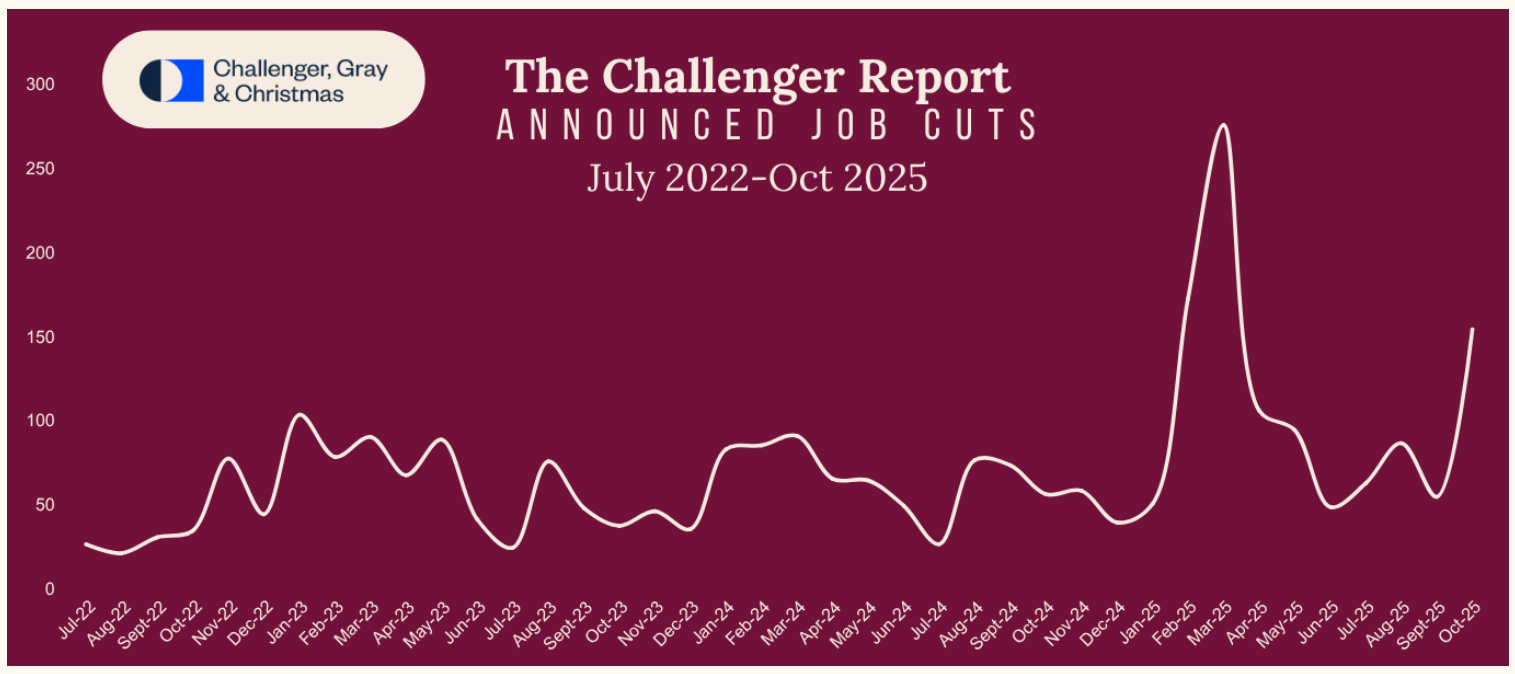
美国10月挑战者企业裁员报告全文:同比激增175%!
Jin Shi Shu Ju· 2025-11-06 09:37
Core Insights - In October, U.S. employers announced layoffs of 153,074, a 175% increase from the same month in 2024 and an 183% increase from the previous month [1][3] - Cumulatively, layoffs for the year reached 1,099,500, a 65% increase compared to the same period in 2024, marking the highest level since 2020 [1][3] Layoff Trends - Nearly 450 independent layoff plans were tracked in October, up from just below 400 in September [3] - October's layoffs were the highest for the month since 2003, with a record of 171,874 layoffs at that time [3] - The trend of announcing layoffs in the fourth quarter has changed, with companies now more willing to disclose layoffs in October, contrary to past practices [3] Industry-Specific Layoffs - The technology sector led private sector layoffs with 33,281 announced in October, a significant increase from 5,639 in September [4] - The retail sector announced 2,431 layoffs in October, a slight decrease from 2,577 in September, but still facing significant challenges [4] - The warehousing industry saw the highest number of layoffs in October, with 47,878, reflecting ongoing restructuring due to overcapacity and automation [4] Reasons for Layoffs - Cost-cutting was the primary reason for layoffs in October, affecting 50,437 individuals, followed by layoffs due to artificial intelligence integration, impacting 31,039 individuals [9] - Market and economic conditions led to 21,104 layoffs in October, with cumulative layoffs for the year reaching 229,331 [9] Recruitment Plans - Employers announced plans to hire 488,077 individuals by October, a 35% decrease from the same period in 2024, marking the lowest level since 2011 [10] - The average monthly recruitment announcement was 48,808, also the lowest since 2011 [10]
Westlake(WLK) - 2025 Q3 - Earnings Call Transcript
2025-10-30 16:02
Financial Data and Key Metrics Changes - For Q3 2025, the company reported EBITDA of $313 million on net sales of $2.8 billion, with a loss of $38 million or $0.29 per share, reflecting a decrease in sales and EBITDA compared to Q2 2025 [8][14][22] - The loss in Q3 2025 was $26 million higher than in Q2 2025, primarily due to lower average sales prices, especially in PVC resin [14][22] - A non-cash impairment charge of $727 million was recorded for goodwill associated with the North American chlorovinyls business unit [4][11] Business Line Data and Key Metrics Changes - The Housing and Infrastructure Products (HIP) segment delivered EBITDA of $215 million on $1.1 billion of sales, with sales volumes 6% lower compared to Q2 2025 [16][17] - The Performance and Essential Materials (PEM) segment saw sales of $1.7 billion, down $46 million from Q2 2025, driven by a 4% decline in average sales price [20][21] - HIP's EBITDA margin declined to 20% due to lower sales volume and period-related expenses, while PEM's EBITDA fell to $90 million compared to $297 million in Q3 2024 [17][22] Market Data and Key Metrics Changes - North American residential construction demand has softened in 2025, impacting HIP sales volume, although total sales remained comparable to 2024 [8][9] - The global demand for PEM products, particularly PVC resins, has softened, contributing to a challenging macroeconomic environment [10][21] - The company expects total capital expenditures for 2025 to be approximately $900 million [23] Company Strategy and Development Direction - The company is focused on a three-pillar strategy to improve PEM's performance: enhancing plant reliability, reducing costs, and optimizing the manufacturing footprint [12][26] - The HIP segment aims for long-term organic sales growth of 5%-7% per annum, supported by new product innovations and strategic acquisitions [24][25] - The acquisition of ACI is expected to expand the global compound business and enhance access to new markets [10][20] Management Comments on Operating Environment and Future Outlook - Management remains positive about the long-term growth outlook for HIP despite current affordability challenges in the housing market [9][20] - The company anticipates that the global supply-demand imbalance will improve over the next few years, benefiting both the HIP and PEM segments [34][36] - Management highlighted the importance of addressing operational issues that negatively impacted PEM's EBITDA in 2025, with expectations for improvement in 2026 [27][66] Other Important Information - The company has achieved approximately $115 million towards its 2025 structural savings target of $150 million-$175 million, with plans for an additional $200 million in cost reductions by 2026 [23][98] - Cash and investments as of September 30, 2025, were $2.1 billion, with total debt at $4.7 billion [22] Q&A Session Summary Question: Impact of weakening polyethylene market on Q4 earnings - Management acknowledged a slight weakening in polyethylene prices but expects stable operating efficiency and demand [31][32] Question: Commitment to current business portfolio structure - Management believes in the synergy of the combined business model and expects improvements in the PVC business as market conditions stabilize [33][34] Question: Near and mid-term outlook for PVC - Management indicated ongoing challenges in the chlorovinyl chain but is focused on cost reductions and improving reliability to enhance profitability [39][40] Question: Details on ACI acquisition and its impact - The ACI acquisition is expected to bring strong margins and synergies with existing businesses, enhancing overall profitability [41][42] Question: Revision of HIP guidance and its implications for 2026 - Management noted a shift in product mix and period-related costs affecting guidance but remains optimistic about construction activity in 2026 [46][49] Question: Caustic soda market outlook - The caustic soda market is well supplied, with stable pricing expected [50] Question: Opportunities in PVC compounding and building products - Management sees ongoing opportunities for expansion in both sectors, focusing on synergistic acquisitions [53][55] Question: Period-related expenses in HIP - Management clarified that the $20 million in period-related expenses were non-recurring and primarily administrative [74][75] Question: Operating rates in polyethylene - Management expects operating rates to be slightly lower than industry averages but will adjust based on market conditions [78][79]

Huntington Ingalls Industries(HII) - 2025 Q3 - Earnings Call Transcript
2025-10-30 14:02
Financial Data and Key Metrics Changes - The company reported record third quarter sales of $3.2 billion, representing a 16.1% increase year-over-year [14] - Diluted earnings per share for the quarter were $3.68, up from $2.56 in the same period last year [17] - Shipbuilding sales grew by 18% year-over-year, driven by increased throughput in shipyards [5][14] - Mission Technologies saw an 11% sales growth, reaching $787 million [15] Business Line Data and Key Metrics Changes - Ingalls revenues reached a record $828 million, increasing by 24.7% compared to the third quarter of 2024, primarily due to higher material volume and surface combatants [14] - Newport News revenues were $1.6 billion, up 14.5% year-over-year, driven by higher volumes in submarine and aircraft carrier programs [14] - Shipbuilding revenue totaled $2.4 billion, exceeding guidance due to higher than expected material receipts [15] Market Data and Key Metrics Changes - The company secured $2 billion in contract awards during the third quarter, with a backlog of $56 billion, of which $33 billion is funded [6] - The demand for products and services remains strong, particularly in areas such as C5ISR, cyber electronic warfare, and unmanned systems [5][15] Company Strategy and Development Direction - The company is committed to accelerating shipbuilding construction to meet customer requirements and is focusing on increasing throughput across shipbuilding programs [5][9] - Strategic partnerships have been formed to enhance capabilities in unmanned systems and autonomy solutions [7][50] - The company is also pursuing a $250 million annualized cost reduction initiative [10] Management's Comments on Operating Environment and Future Outlook - Management expressed confidence in achieving approximately 15% throughput improvement for the full year 2025, supported by investments in workforce and infrastructure [9] - The company is closely monitoring the impact of federal government appropriations on operations, with shipbuilding being a priority area [11][12] - Future contract awards, particularly for Virginia-class Block IV and Columbia-class submarines, are critical for maintaining guidance [21] Other Important Information - The effective tax rate for the quarter was 28.9%, higher than initial expectations due to a reduction in estimated research and development tax credits [17] - Free cash flow for the quarter was $16 million, with updated guidance for 2025 free cash flow set between $550 million and $650 million [22] Q&A Session Summary Question: Impact of government shutdown on Virginia Block IV and Columbia negotiations - Management indicated that furloughs are not impacting negotiations and that efforts are ongoing to finalize contracts by year-end [26][27] Question: Wage increases at Ingalls - Discussions are ongoing with the union at Ingalls regarding wage increases, expected to be resolved by early next year [30] Question: Shipbuilding revenue growth and guidance - Management explained that while Q3 saw significant growth, guidance for Q4 remains cautious due to the need for consistent performance [35][36] Question: Unmanned vessels partnership strategy - The company is leveraging open-source software for autonomy in unmanned vessels and forming partnerships to enhance capabilities [49][50] Question: Future cash flow expectations - Management provided insights on maintaining a conservative cash flow guidance, with expectations for incremental profitability as new contracts are executed [70][71]
