
新会计准则

Search documents
Strategy 的投资者已于周四撤回对该公司的集体诉讼
Xin Lang Cai Jing· 2025-08-29 17:54
Core Viewpoint - Investors have withdrawn a collective lawsuit against Strategy, which previously accused the company of making false and misleading statements regarding its Bitcoin investment strategy [1] Group 1 - The lawsuit alleged that Strategy failed to adequately disclose the impact of adopting new accounting standards (i.e., measuring crypto assets at fair value) on its financial statements [1] - The lawsuit also claimed that the company downplayed the volatility risks associated with Bitcoin [1] - Defendants named in the lawsuit included co-founder Michael Saylor, CEO Phong Le, and CFO Andrew Kang [1]
险资持续扫货银行股
Zheng Quan Shi Bao· 2025-08-29 04:36
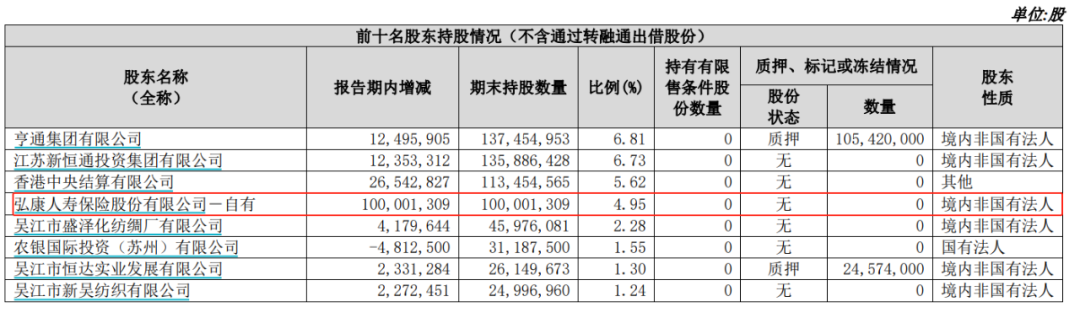
Core Viewpoint - Insurance capital has shown a sustained enthusiasm for increasing holdings in bank stocks since 2025, with notable examples including Su Nong Bank and Wuxi Bank, indicating a trend of insurance companies focusing on regional banks [1][5][14]. Group 1: Insurance Capital Involvement - Hongkang Life Insurance has become one of the top ten shareholders of Su Nong Bank, holding over 100 million shares, which is approximately 4.95% of the total shares, nearing the threshold for a significant stake [1][2]. - In 2023 and 2024, Wuxi Bank was also a target for insurance capital, with Changcheng Life Insurance increasing its stake to 4.95% by the end of 2023 [6][7]. - In 2025, Hongkang Life has been actively increasing its stake in Zhengzhou Bank, with its holdings exceeding 20% after multiple rounds of purchases [9][10]. Group 2: Financial Performance of Su Nong Bank - For the first half of 2025, Su Nong Bank reported a slight revenue increase, achieving an operating income of 2.28 billion yuan, a year-on-year growth of 0.21%, and a net profit of 1.178 billion yuan, up 5.23% [8]. - As of June 30, 2025, Su Nong Bank's total assets reached 223.249 billion yuan, reflecting a growth of 4.33% since the beginning of the year, with a non-performing loan ratio stable at 0.90% [8]. - The bank's mid-year profit distribution plan includes a cash dividend of 0.09 yuan per share, totaling approximately 182 million yuan, which represents 15.42% of the net profit attributable to shareholders [8]. Group 3: Market Trends and Valuation - The banking sector has become a popular investment target for capital markets, particularly for insurance capital, due to its high dividend yield and stable operational characteristics [14][15]. - As of August 26, 2025, the banking sector's dividend yield was 3.69%, making it an attractive investment compared to other high-dividend sectors [15]. - The implementation of new accounting standards allows insurance funds to account for profits when they acquire bank stocks above certain thresholds, further incentivizing investments in undervalued bank stocks [16].


险资持续扫货银行股
证券时报· 2025-08-29 04:34
Core Viewpoint - Insurance capital has shown a strong interest in increasing holdings in bank stocks since 2025, particularly in regional banks, indicating a shift in investment strategies within the financial sector [1][16]. Group 1: Insurance Capital Involvement - Hongkang Life Insurance has recently become one of the top ten shareholders of Sunong Bank, holding over 100 million shares, which is approximately 4.95% of the total shares, nearing the threshold for a significant stake [1][3]. - In 2023 and 2024, Wuxi Bank was also a target for insurance capital, with Changcheng Life Insurance increasing its stake multiple times, reaching 4.95% by the end of 2023 [6][9]. - As of August 28, 2025, Sunong Bank's stock has increased by 14.32% year-to-date, reflecting positive market sentiment towards the bank [5]. Group 2: Financial Performance of Sunong Bank - For the first half of 2025, Sunong Bank reported a slight increase in revenue, achieving 2.28 billion yuan, a year-on-year growth of 0.21%, and a net profit of 1.178 billion yuan, up 5.23% [8]. - The bank's total assets reached 223.249 billion yuan by the end of June 2025, marking a 4.33% increase from the beginning of the year, with a non-performing loan ratio stable at 0.90% [8]. Group 3: Broader Market Trends - In 2025, seven listed banks have been targeted for significant stake increases by insurance capital, primarily in the Hong Kong market, including major banks like Postal Savings Bank and China Merchants Bank [9][17]. - The insurance sector's interest in bank stocks is driven by the low interest rate environment and the appeal of high dividend yields, with the banking sector offering a dividend yield of 3.69% as of August 26, 2025 [17]. - The implementation of new accounting standards allows insurance funds to account for bank stock purchases under equity method, potentially leading to significant paper profits, especially as many bank stocks are trading below their net asset values [18].
险资持续扫货银行股!又一家上市农商行获增持
Zheng Quan Shi Bao Wang· 2025-08-29 00:27
Core Viewpoint - Insurance capital has shown a sustained enthusiasm for increasing holdings in bank stocks since 2025, particularly in regional banks, with significant recent activity in the Hong Kong stock market [1][9]. Group 1: Insurance Capital Activity - Hong Kong-based Hongkang Life Insurance has become a major shareholder in Su Nong Bank, holding over 100 million shares, which is approximately 4.95% of the bank's total shares, nearing the threshold for a formal stake increase [1][2]. - In 2023 and 2024, Wuxi Bank was also a target for insurance capital, with Changcheng Life Insurance increasing its stake to 4.95% by the end of 2023 [4]. - In 2025, insurance capital has accelerated its acquisition of bank stocks, particularly in the Hong Kong market, with regional banks like Zhengzhou Bank also receiving attention from Hongkang Life [1][7]. Group 2: Financial Performance of Su Nong Bank - Su Nong Bank reported a slight increase in revenue for the first half of 2025, with operating income reaching 2.28 billion yuan, a year-on-year growth of 0.21%, and a net profit of 1.178 billion yuan, up 5.23% year-on-year [4][5]. - As of June 30, 2025, Su Nong Bank's total assets amounted to 223.249 billion yuan, reflecting a growth of 4.33% since the beginning of the year, with a non-performing loan ratio stable at 0.90% [5]. - The bank plans to distribute a cash dividend of 0.09 yuan per share, totaling approximately 182 million yuan, which represents 15.42% of its net profit for the first half of 2025 [6]. Group 3: Market Trends and Valuation - The banking sector has become a popular investment area, particularly for insurance capital, due to its high dividend yields and stable performance, with a current dividend yield of 3.69% [9]. - Insurance capital has been actively acquiring shares in major banks, with significant increases in holdings in banks like China Postal Savings Bank and Agricultural Bank of China, indicating a trend of increased investment in the banking sector [9]. - The new accounting standards allow insurance funds to account for bank stock purchases under the equity method, potentially leading to substantial paper profits, especially as many bank stocks are trading below their net asset values [10].
险资,持续扫货银行股!
券商中国· 2025-08-28 23:34
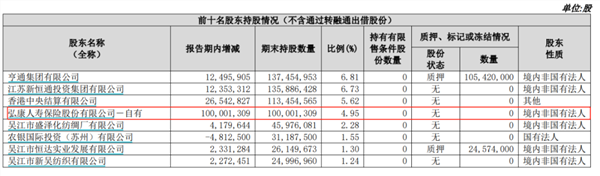
Core Viewpoint - Since 2025, insurance capital has shown a strong enthusiasm for increasing holdings in bank stocks, particularly in regional banks, indicating a shift in investment strategies within the financial sector [1][2][13]. Group 1: Insurance Capital Involvement - Recently, Hongkang Life Insurance has become one of the top ten shareholders of Sunong Bank, holding over 100 million shares, which is approximately 4.95% of the total shares, nearing the threshold for a stake increase [1][3]. - This trend of insurance capital significantly increasing its holdings in A-share listed rural commercial banks is exemplified by the case of Wuxi Bank, which received continuous increases from Great Wall Life Insurance from 2023 to 2024 [2][5]. - In 2025, Great Wall Life Insurance further increased its stake in Wuxi Bank, raising its holding from 6.97% at the end of 2024 to 7.17% by the end of the first quarter [6]. Group 2: Financial Performance of Sunong Bank - Sunong Bank reported a slight increase in revenue for the first half of 2025, achieving an operating income of 2.28 billion yuan, a year-on-year growth of 0.21%, and a net profit attributable to shareholders of 1.178 billion yuan, up 5.23% year-on-year [8]. - As of June 30, 2025, Sunong Bank's total assets reached 223.249 billion yuan, reflecting a growth of 4.33% since the beginning of the year, with a non-performing loan ratio remaining stable at 0.90% [8]. - The bank's mid-year profit distribution plan includes a cash dividend of 0.09 yuan per share, totaling approximately 182 million yuan, which represents 15.42% of the net profit attributable to shareholders for the first half of 2025 [8]. Group 3: Broader Market Trends - The insurance capital's interest in bank stocks has intensified, with seven listed banks being targeted for stake increases this year, primarily in the Hong Kong stock market [9][13]. - Hongkang Life Insurance has notably increased its stake in Zhengzhou Bank, reaching over 20% after multiple rounds of purchases, marking its fourth stake increase within two months [10][11]. - The overall trend indicates that bank stocks have become a popular investment choice for insurance capital, driven by their high dividend yields and stable operational characteristics, with the banking sector's dividend yield at 3.69% as of August 26, 2025 [13][14].

保险业上半年保障水平提升
Jing Ji Ri Bao· 2025-08-25 03:03
Core Viewpoint - The insurance industry in China has shown resilience and progress in the first half of 2025, with significant growth in asset utilization and premium income, while maintaining a stable solvency capacity [1][10]. Group 1: Asset and Premium Growth - As of the end of Q2 2025, the total investment balance of insurance companies exceeded 36 trillion yuan, reaching 36.23 trillion yuan, a year-on-year increase of 17.4% [2]. - The original insurance premium income for the first half of 2025 was 3.7 trillion yuan, reflecting a growth of 5.1% compared to 2024, indicating a recovery in the life insurance sector [2]. - The number of new insurance policies issued in the first half of 2025 reached 524 billion, marking an 11.1% increase year-on-year [2]. Group 2: Investment Strategies - Bonds remain the primary investment for insurance funds, with a bond investment balance of 17.87 trillion yuan as of Q2 2025, where life insurance companies hold 16.92 trillion yuan, accounting for 51.9% of their total investments [3]. - Stock investments have also gained traction, with insurance companies' stock investments surpassing 3 trillion yuan, showing a quarterly increase of 8.9% [3]. - The shift towards equity investments is seen as a long-term strategic choice, driven by the need for higher returns in a low-interest-rate environment [3][4]. Group 3: Claims and Coverage - Claims and benefits paid by insurance companies reached 1.3 trillion yuan in the first half of 2025, a 9% increase, indicating a deepening of the insurance protection function [5]. - Health insurance and long-term care insurance have emerged as the main contributors to claims growth, driven by an aging population and rising healthcare costs [6]. - The insurance industry has demonstrated its commitment to social responsibility through rapid response to claims during natural disasters, showcasing its role in public welfare [7]. Group 4: Solvency and Regulatory Environment - The overall solvency adequacy ratio for the insurance industry was 204.5% at the end of Q2 2025, significantly above regulatory requirements [8]. - Among 60 life insurance companies, six maintained an AAA rating, with solvency ratios exceeding 200%, indicating strong capital strength and risk management capabilities [8]. - The regulatory environment remains challenging, with some smaller companies facing solvency pressures, necessitating improvements in capital management and risk strategies [10].



经济日报:保险业上半年保障水平提升
Sou Hu Cai Jing· 2025-08-25 00:39
Core Insights - The insurance industry in China has shown resilience and progress in the first half of 2025, with total assets exceeding 39.2 trillion yuan and premium income growing by 5.1% year-on-year [3][10] - The industry is navigating challenges posed by low interest rates, stringent regulations, and new accounting standards, which present both risks and strategic opportunities for structural adjustments [2][10] Asset Management - As of the end of Q2 2025, the total investment balance of insurance companies surpassed 36 trillion yuan, marking a 17.4% increase year-on-year [3] - Bonds remain the primary investment choice for insurance funds, with a bond investment balance of 17.87 trillion yuan, while stock investments have also gained traction, reaching over 3 trillion yuan [4] Premium Income and Claims - The insurance sector's original premium income for the first half of 2025 reached 3.7 trillion yuan, with significant contributions from life insurance products such as dividend, annuity, and health insurance [3][6] - Claims and benefits paid by insurance companies amounted to 1.3 trillion yuan, reflecting a 9% increase, indicating a deepening of the insurance protection function [6][10] Solvency and Regulatory Environment - The overall solvency adequacy ratio for the insurance industry stood at 204.5% as of Q2 2025, well above regulatory requirements [8] - The regulatory environment remains challenging, with some smaller insurers facing capital and investment management weaknesses, necessitating innovation in capital supplementation and diversified asset allocation [10] Strategic Moves by Companies - Companies like China Ping An have actively increased their stakes in banks and other financial institutions, reflecting a strategic focus on long-term value recognition [5] - The industry is increasingly exploring diversified investment strategies, including the establishment of private equity funds to enhance asset allocation [5][9]
保险业上半年保障水平提升:赔付增长体现保障功能
Jing Ji Ri Bao· 2025-08-24 23:31
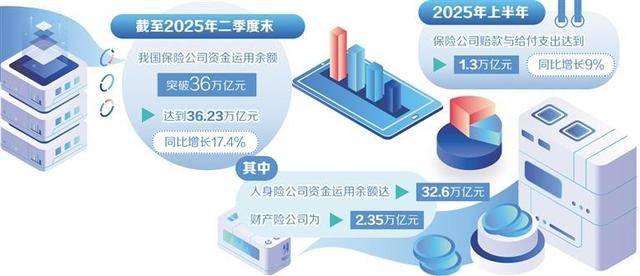
Core Viewpoint - The insurance industry in China has shown resilience and progress in the first half of 2025, with significant growth in asset utilization and premium income, while maintaining a stable solvency capacity [1][10]. Group 1: Asset and Premium Growth - As of the end of Q2 2025, the total investment balance of insurance companies exceeded 36 trillion yuan, reaching 36.23 trillion yuan, a year-on-year increase of 17.4% [2]. - The original insurance premium income for the first half of 2025 was 3.7 trillion yuan, reflecting a 5.1% year-on-year growth, indicating a recovery in the life insurance sector [2]. - The number of new insurance policies issued in the first half of 2025 reached 524 billion, a year-on-year increase of 11.1% [2]. Group 2: Investment Strategies - Bonds remain the primary investment for insurance funds, with a bond investment balance of 17.87 trillion yuan as of Q2 2025, where life insurance companies hold 16.92 trillion yuan, accounting for 51.9% of their total investments [3]. - Stock investments have also gained traction, with insurance companies' stock investments surpassing 3 trillion yuan, showing a quarterly net increase of 251.3 billion yuan, a growth of 8.9% [3]. - The shift towards equity investments is seen as a long-term strategic choice, driven by the need for higher returns in a low-interest-rate environment [3]. Group 3: Claims and Coverage - Claims and benefits paid by insurance companies reached 1.3 trillion yuan in the first half of 2025, a year-on-year increase of 9%, indicating a deepening of the insurance protection function [5]. - Health insurance and long-term care insurance have emerged as the main contributors to claims growth, driven by an aging population and rising healthcare costs [6]. - The insurance industry has demonstrated its commitment to social responsibility through rapid response to claims related to natural disasters, showcasing its role in public welfare [7]. Group 4: Solvency and Regulatory Environment - As of the end of Q2 2025, the industry’s comprehensive solvency adequacy ratio was 204.5%, with core solvency adequacy at 147.8%, significantly above regulatory requirements [8]. - Some companies, particularly smaller insurers, face challenges in capital replenishment and investment management, which may be exacerbated by market volatility [10]. - The extension of the transitional period for regulatory compliance is seen as both a buffer and a pressure for companies to enhance their capital and risk management strategies [10].
保险业上半年保障水平提升
Jing Ji Ri Bao· 2025-08-24 21:52
Core Insights - The insurance industry in China has shown resilience and progress in the first half of 2025, with total assets exceeding 39.2 trillion yuan and premium income growing by 5.1% year-on-year [2][10] - The industry is navigating challenges posed by low interest rates, stringent regulations, and new accounting standards, which present both risks and strategic opportunities for structural adjustments [1][10] Asset Management - As of the end of Q2 2025, the total investment balance of insurance companies surpassed 36 trillion yuan, marking a 17.4% increase year-on-year [2] - Bonds remain the primary investment choice for insurance funds, with a bond investment balance of 17.87 trillion yuan, accounting for 51.9% of total investments [3] - Stock investments have gained traction, with insurance companies' equity investments exceeding 3 trillion yuan, reflecting a strategic shift towards equities due to low fixed-income returns [3][4] Premium Income and Claims - In the first half of 2025, insurance companies reported original premium income of 3.7 trillion yuan, with significant recovery in life insurance products such as dividend, annuity, and health insurance [2][5] - Claims and benefits paid by insurance companies reached 1.3 trillion yuan, a 9% increase, indicating a deepening of the industry's protective functions [5][6] Solvency and Regulatory Environment - The overall solvency adequacy ratio for the insurance industry stood at 204.5% as of Q2 2025, well above regulatory requirements [8][10] - Some smaller insurance companies face solvency pressures, necessitating swift action in capital replenishment and risk management to avoid stricter regulatory measures [8][10] Strategic Developments - The industry is increasingly focusing on digitalization and service optimization to enhance claims efficiency and customer trust [7] - Insurance companies are exploring diversified investment strategies, including the establishment of private equity funds, to adapt to market conditions and regulatory changes [4][9]
阳光保险上半年总投资收益达107亿元增逾28%
Zheng Quan Shi Bao· 2025-08-24 18:34
Core Insights - Sunshine Insurance reported a stable performance for the first half of the year, with total premium income reaching 80.81 billion yuan, an increase of 5.7% [2] - The company achieved a net profit attributable to shareholders of 3.39 billion yuan, growing by 7.8% [2] - Total investment income for the first half amounted to 10.7 billion yuan, reflecting a significant growth of 28.5% [2] Insurance Business Performance - Sunshine Life, a subsidiary of Sunshine Insurance, generated total premium income of 55.44 billion yuan, marking a year-on-year increase of 7.1% [2] - The new business value for Sunshine Life was 4.01 billion yuan, with a comparable year-on-year growth of 47.3% [2] - Sunshine Property & Casualty Insurance reported original insurance premium income of 25.27 billion yuan, up by 2.5% year-on-year [2] Financial Position - Sunshine Insurance's total assets surpassed 600 billion yuan for the first time, reaching 625.56 billion yuan as of June 30 [2] - The equity attributable to shareholders decreased by 10.1% compared to the end of the previous year, amounting to 55.84 billion yuan [2] - The fluctuation in net assets is a challenge faced by multiple insurance companies following the new accounting standards [2] Investment Performance - As of June 30, the total investment asset scale of Sunshine Insurance was 591.86 billion yuan, with total investment income of 10.7 billion yuan, reflecting a year-on-year growth of 28.5% [2] - Investment income reported in the profit statement was 6.35 billion yuan, an increase of 42.3%, primarily due to higher dividend income and trading gains from investment assets [2]
