激光雷达技术

Search documents
激光雷达领先厂商禾赛科技港股IPO获中国证监会备案,目标年内在香港上市
Sou Hu Cai Jing· 2025-08-27 23:34
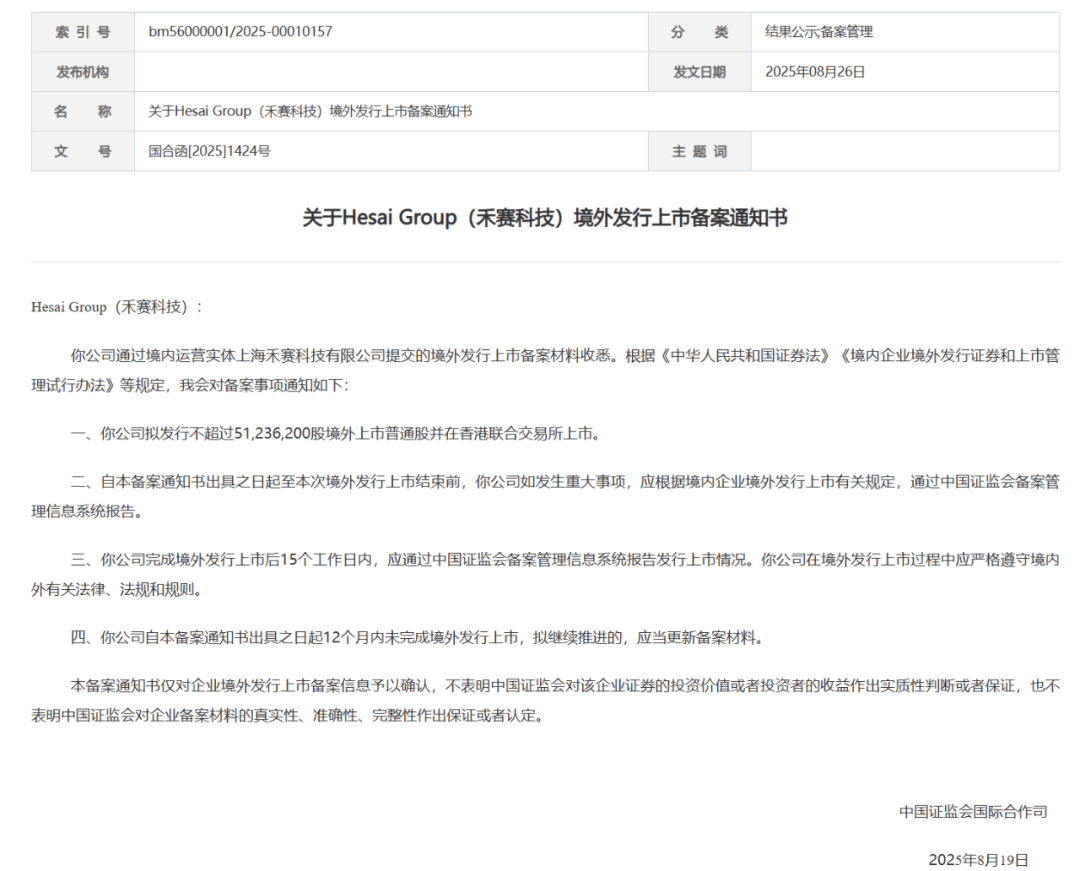
Group 1 - The core point of the article is that Hesai Technology (HSAI), a leading global lidar manufacturer, plans to raise approximately $300 million through a listing in Hong Kong, targeting to be listed on the Hong Kong Stock Exchange within the year [1] - In February 2023, Hesai Technology successfully went public on NASDAQ under the ticker "HSAI," raising about $190 million by issuing 10 million ADS at a price of $19 each [1] - The China Securities Regulatory Commission has issued a notice regarding Hesai Technology's overseas issuance and listing, with plans to issue no more than 51,236,200 shares of ordinary stock for the Hong Kong listing [5] Group 2 - According to Yole Group's report, Hesai Technology holds three global leadership positions in the automotive lidar market: the highest market share in automotive lidar, ADAS lidar, and L4 autonomous driving lidar [4] - As of April 2023, Hesai Technology has established production partnerships with over 22 domestic and international automakers, covering more than 120 vehicle models, including major brands like BYD, Li Auto, and Xiaomi [4] - In Q2 2025, Hesai Technology reported revenue of 710 million RMB, a year-on-year increase of over 50%, and a net profit exceeding 40 million RMB, surpassing GAAP profitability targets [4]


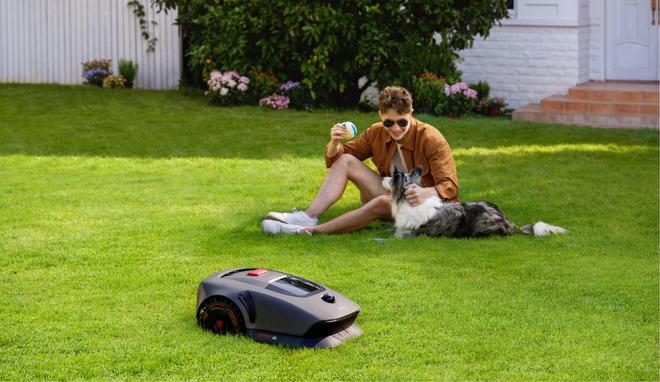
MOVA割草机器人卖出10万台背后,一场进入下半场的残酷战争|Insight全球
3 6 Ke· 2025-08-27 01:35
Core Insights - The article discusses the competitive landscape of the smart lawn mower market, highlighting the rapid growth and entry of new players like MOVA, which has achieved significant sales in a short time frame [1][2][4]. Market Overview - The global smart lawn mower market is estimated to be between $1.5 billion and $2.5 billion in 2023, with projections to reach $6 billion to $10 billion by 2030, maintaining a compound annual growth rate (CAGR) of 12% to 20% over the next 5-10 years [5]. - Current penetration of smart lawn mowers in the global lawn care equipment market is less than 2%, with potential growth to 17%, translating to a market size exceeding 300 billion RMB [5]. Company Profile: MOVA - MOVA, established in 2024, focuses on laser radar technology for smart lawn mowers, targeting the small to medium lawn market in Europe, and has achieved a shipment of over 100,000 units within six months [1][4]. - The company offers a differentiated experience with its "out-of-the-box" product, which simplifies user operation compared to traditional models [9][19]. Competitive Landscape - The smart lawn mower market has seen significant activity, with major players like Ninebot, Chasing, and others reporting substantial sales figures, indicating a collective ramp-up in production [2][4]. - The market is characterized by a shift from traditional boundary-based mowers to boundary-less solutions, with MOVA leveraging advanced technology to differentiate itself [8][16]. Technology and Innovation - MOVA's use of laser radar technology, while more expensive, provides higher precision and adaptability compared to mainstream visual or RTK solutions [11][14]. - The company has positioned itself to capitalize on the growing demand for automated lawn care solutions, particularly in regions with high consumer awareness and acceptance of smart technology [8][9]. Market Challenges - New entrants face significant barriers to entry in a market that is becoming increasingly saturated, with established brands dominating consumer trust and market share [15][18]. - The competitive focus is shifting from product performance to brand differentiation and user perception, making it challenging for startups to establish a foothold [18][22]. Future Outlook - MOVA is expanding its product line to cater to different lawn sizes and is developing products for the North American market, indicating a strategic move to diversify its offerings [19][21]. - The smart lawn mower market is transitioning from a phase of functional exploration to a period of widespread adoption, with varying technology solutions tailored to specific lawn sizes [21][22].

图达通更新招股书:新增三家国有主机厂等多个定点,毛利率转正并增至12.6%
Sou Hu Cai Jing· 2025-08-27 01:35
Core Insights - The core highlight of the updated prospectus is that the company achieved a gross profit of $319.7 million with a gross margin of 12.6% in Q1 2025, continuing the positive trend from Q4 2024, indicating sustained profitability improvement [1][3] - The company has delivered approximately 230,000 automotive-grade LiDAR units in 2024 and ranks second globally in cumulative sales revenue for ADAS LiDAR, with a market share of 20.7% in China [1][3] - The company has made significant breakthroughs in various fields, including passenger vehicles, commercial vehicles, robotics, Robotaxi, and smart transportation, establishing a multi-dimensional growth pattern with diverse products, customers, and scenarios [1][4] Financial Performance - The company reported a significant reduction in costs, with Q1 2025 costs dropping by 36.9% year-on-year, from $35.02 million to $22.09 million, driven by product design optimization, enhanced bargaining power from increased procurement scale, and ongoing production scale effects [3] - The company has shown a continuous narrowing of losses from 2022 to 2024, reflecting significant improvements in cost control and operational efficiency, laying a solid foundation for long-term profitability [3] Market Expansion - The company has deepened its collaboration with NIO, with its Falcon series being used in over 500,000 vehicles, and has established stable partnerships in the commercial vehicle and logistics sectors with companies like Deepway, Shaanxi Heavy Duty Truck, and Pony AI [6] - The company has secured additional orders from ten OEMs and ADAS/ADS companies, including three state-owned automotive manufacturers and a leading joint venture, indicating strong market demand and growth potential [6][7] Technological Advancements - The company is the only global player with mature mass production capabilities for both 1550nm and 905nm LiDAR technologies, allowing it to meet high-end market demands while also catering to cost-sensitive applications [7] - The introduction of the new generation solid-state LiDAR, the Hummingbird D1, marks a significant technological breakthrough, reinforcing the company's industry position and accelerating the adoption of solid-state technology in mass production for passenger vehicles [7] Industry Outlook - The value of LiDAR technology is increasingly recognized amid the rise of new energy vehicles and the intelligentization wave across various industries, positioning the company favorably in high-growth markets [7] - The company's strategic focus on product innovation and market penetration is expected to enhance its revenue structure and create a robust competitive advantage through a "technology + scenario + ecosystem" approach [7]

图达通更新IPO招股书:新增三家国有主机厂定点 毛利率增至12.6%
Zhi Tong Cai Jing· 2025-08-26 06:35
Core Insights - The core highlight of the updated prospectus is that Seyond achieved a gross profit of $3.197 million with a gross margin of 12.6% in Q1 2025, continuing the positive trend from Q4 2024 [1][2] - The company has delivered approximately 230,000 automotive-grade LiDAR units in 2024 and ranks second globally in cumulative sales revenue for ADAS LiDAR, with a market share of 20.7% in China [1][2] - Seyond has made significant breakthroughs in various fields, including passenger vehicles, commercial vehicles, robotics, Robotaxi, and smart transportation, establishing a diversified growth pattern [1][3] Financial Performance - In Q1 2025, Seyond's costs decreased significantly by 36.9% year-on-year, from $35.023 million to $22.099 million, driven by product design optimization and increased procurement scale [2] - The company has shown a consistent reduction in losses from 2022 to 2024, indicating improvements in cost control and operational efficiency [2] Customer Base Optimization - Seyond has deepened its collaboration with NIO, with its Falcon series being used in over 500,000 units across nine models [3] - The company has secured additional orders from ten OEMs and ADAS/ADS companies, including three state-owned manufacturers and a leading joint venture [3] Technological Advancements - Seyond is the only global company with mature mass production capabilities for both 1550nm and 905nm LiDAR technologies, allowing it to cater to both high-end and mass-market segments [4] - The introduction of the new generation solid-state LiDAR, the Hummingbird D1, marks a significant technological breakthrough, reinforcing the company's industry position [5] Market Positioning - The increasing value of LiDAR technology in the context of the intelligentization wave across various industries positions Seyond favorably for future growth [5] - The company's strategic product layout and successful penetration into high-growth markets, such as passenger vehicles and robotics, enhance its revenue structure and create a robust competitive moat [5]
10年,他“数”遍神州树
Ren Min Ri Bao· 2025-08-25 23:04
Core Insights - The article discusses the groundbreaking work of a research team led by Guo Qinghua at Peking University, which has developed China's first "Tree Density Map" that estimates the number of trees in the country, revealing approximately 142.6 billion trees as of 2020 [4][5][6] Group 1: Tree Density Map - The "Tree Density Map" shows a tree density of about 689 trees per hectare, with an average of 100 trees per person in China [4] - The map indicates that the southwestern region has the highest number of trees, approximately 36 billion, while the Yangtze River basin leads with about 49.6 billion trees [5][6] Group 2: Research Methodology - The research team utilized drones equipped with LiDAR sensors to scan forests, employing AI algorithms to analyze data and satellite remote sensing to create a comprehensive forest panorama [6][10] - Over a decade, the team collected data from over 70,000 sample plots, resulting in more than 400 terabytes of data, equivalent to over 80 million photos [6][7] Group 3: Technological Advancements - The team has developed an integrated remote sensing platform that includes various LiDAR systems, enabling high-precision data collection even in challenging terrains [10] - The use of LiDAR technology allows for detailed three-dimensional measurements of trees, overcoming limitations of traditional manual measurement methods [9][10] Group 4: Future Research and Conservation - The ongoing research aims to understand the optimal types and quantities of trees to plant in different regions, aligning with China's "dual carbon" goals [8] - The team has also discovered exceptionally tall trees, including a 102.3-meter high Tibetan cypress, emphasizing the importance of continued exploration and conservation efforts [12][13]

十年“数”遍神州树,“拼”出森林全景图(自然之子)
Ren Min Ri Bao· 2025-08-24 22:40
Core Viewpoint - The article discusses the groundbreaking work of a research team led by Guo Qinghua at Peking University, which has developed China's first "Tree Density Map" that estimates the number of trees in the country, revealing significant insights into forest resources and distribution [3][5]. Group 1: Tree Density Map - The "Tree Density Map" indicates that as of 2020, China has approximately 142.6 billion trees, with an average tree density of about 689 trees per hectare, equating to roughly 100 trees per person [3]. - The map shows that the southwestern region has the highest number of trees, approximately 36 billion, while the Yangtze River basin leads with about 49.6 billion trees [3][4]. Group 2: Research Methodology - The research team utilized drones equipped with LiDAR sensors to scan forests, employing AI algorithms to analyze data and satellite remote sensing to create a comprehensive forest panorama [4][6]. - Over a decade, the team collected data from over 70,000 sample plots, resulting in more than 400 terabytes of data, equivalent to over 80 million photos [4][5]. Group 3: Technological Advancements - The use of LiDAR technology has enabled the team to gather detailed three-dimensional information about trees, including height, diameter, and crown size, which traditional methods could not efficiently capture [6][7]. - The team has developed an integrated remote sensing platform that includes various laser radar systems, enhancing data collection capabilities in challenging terrains [7]. Group 4: Future Research and Conservation - The ongoing research aims to understand the optimal types and quantities of trees to plant in various regions, aligning with China's "dual carbon" goals for better ecological benefits [5][9]. - The discovery of exceptionally tall trees, such as a 102.3-meter high Tibetan cypress, highlights the importance of continued exploration and the need to foster a greater appreciation for nature [9][10].
禾赛(HSAI.US)涨逾3% 于世界机器人大会展示全新激光雷达产品
Zhi Tong Cai Jing· 2025-08-08 15:25
Core Viewpoint - Hesai Technology (HSAI.US) saw a rise of over 3%, closing at $23.06, following the opening of the 2025 World Robot Conference (WRC) in Beijing on August 8, where the company showcased its new lidar products [1] Group 1: Product Launch - Hesai Technology presented its new lidar products, including the mini hemispherical 3D lidar JT series designed specifically for robots and the next-generation solid-state lidar FTX [1] - The JT series is based on Hesai's fourth-generation self-developed chip architecture, claiming to provide a 360° x 189° hemispherical field of view, compact design for discreet installation, and supports 256-line resolution [1] - Since its launch less than five months ago, the JT series has delivered 100,000 units, suitable for service robots, cleaning robots, and other applications [1]
直击WRC | 专为机器人场景打造!禾赛科技展示全新激光雷达产品
Xin Lang Ke Ji· 2025-08-08 13:47
Core Insights - The 2025 World Robot Conference (WRC) opened in Beijing on August 8, showcasing advancements in robotics technology, particularly in LiDAR systems from Hesai Technology [1] Company Highlights - Hesai Technology presented its new LiDAR products, including the miniaturized ultra-hemispherical 3D LiDAR JT series and the next-generation solid-state LiDAR FTX [1] - The JT series is based on Hesai's fourth-generation self-developed chip architecture, offering a 360° x 189° ultra-hemispherical field of view, compact design for discreet installation, and supports a resolution of 256 lines. Within five months of its release, 100,000 units have been delivered, suitable for service and cleaning robots [1] - The FTX LiDAR has a measurement range of up to 30 meters (at 10% reflectivity), a point frequency of 492,000 points per second, and its size has been reduced by 66% compared to the previous generation, with an exposed window of only 47x29mm, aimed at enhancing the perception capabilities of various intelligent robots [1] Industry Context - The event also featured collaborative demonstrations with partners Vbot and Xingdong Jiyuan, showcasing applications such as Vbot's intelligent companion robot achieving autonomous path planning and crowd avoidance, and Xingdong's humanoid service robot Q5, which integrates 3D LiDAR with visual navigation for adaptability in various environments like exhibition halls and homes [1] - According to data from Gaogong Robotics Industry Research Institute, Hesai Technology ranked first in the shipment volume of 3D LiDAR in the Chinese robotics sector in the first half of 2025 [1]
华科大校友的乐动机器人要去H股 “激光雷达”企业为何发力割草机器人?
Mei Ri Jing Ji Xin Wen· 2025-06-25 13:00
Core Viewpoint - Shenzhen Ledong Robot Co., Ltd. is planning to pursue an IPO in Hong Kong, focusing on both its core business of LiDAR technology and its expansion into the lawn mowing robot sector [1][4]. Group 1: Company Overview - Ledong Robot is currently the leading company in the dToF LiDAR market, with over 720,000 units shipped last year [2][4]. - The company has achieved a compound annual growth rate (CAGR) of 41.4%, with total revenue increasing from 233 million yuan in 2022 to 467.3 million yuan in 2024 [2]. - Despite revenue growth, the company reported net losses of 73.1 million yuan in 2022, 68.5 million yuan in 2023, and 56.5 million yuan in 2024 [2]. Group 2: Product and Technology - Ledong Robot's LiDAR products include various types such as dToF, triangulation LiDAR, solid-state linear LiDAR, single-point LiDAR, 3D structured light sensors, ultrasonic sensors, and four-eye matrix vision sensors [2]. - The dToF LiDAR technology has achieved a 40% reduction in size and a 25% decrease in power consumption, meeting the design needs for lightweight and low-power robots [2]. Group 3: Market Position and Strategy - The company serves seven out of the top ten global household service robot companies and five out of the top five commercial service robot companies [2]. - Ledong Robot is positioning itself as the first provider of consumer-grade MINI dToF LiDAR, focusing on applications in household, commercial, and industrial robots [4]. - The company is also entering the lawn mowing robot market, with revenue from this segment increasing from 63,000 yuan in 2023 to 2.327 million yuan in 2024, accounting for 5% of total revenue [5]. Group 4: Industry Trends - The global lawn mowing robot market is expected to exceed $1.5 billion in 2024 and reach $3.9 billion by 2029, with a CAGR of 21% [6]. - Other LiDAR companies, such as Suteng Juchuang, are also entering the lawn mowing robot sector, indicating a competitive landscape [6].
追觅割草机器人,猛攻Top3 ?
雷峰网· 2025-05-15 10:13
Core Viewpoint - The article discusses the rapid rise of Chasing, a company in the lawn mowing robot industry, which has achieved significant sales milestones and is seen as a strong contender to disrupt the market despite skepticism from industry peers [2][4][8]. Group 1: Sales and Market Position - Chasing's lawn mowing robot sales reached over 100,000 units by the end of February 2023, including 20,000 sales orders and 80,000 units taken by distributors [3]. - The company is projected to surpass 150,000 units soon and aims for 200,000 units [4]. - Industry insiders believe Chasing has the potential to become one of the top three players in the lawn mowing robot market by 2025 [7][8]. Group 2: Technology and Innovation - Chasing is the first company to implement laser radar technology in lawn mowing robots, diverging from the mainstream "RTK + vision" approach [9][10]. - The decision to adopt laser radar was made quickly after observing a new product launch from a competitor, allowing Chasing to secure a market position [14][15]. - The laser radar technology is expected to provide higher precision and easier deployment compared to RTK solutions, which are more susceptible to interference [16]. Group 3: Cost Reduction Strategies - The article highlights a "price war" in the laser radar market, with the expectation that costs will decrease significantly as production scales up [18][20]. - Chasing's experience in mass production and established supply chains allows it to leverage cost advantages that new entrants may struggle to achieve [21][22]. - The company has developed a comprehensive capability from product design to market delivery, which is crucial in the competitive landscape of lawn mowing robots [22]. Group 4: Channel Strategy - The article emphasizes the importance of distribution channels, noting that most new entrants focus on product development without recognizing the significance of securing channels [26][32]. - Chasing has successfully negotiated partnerships with several major retailers in Europe, which is critical for market penetration [34][35]. - The company is actively expanding its channel strategy, aiming to differentiate its offerings in various retail environments [36][38]. Group 5: Industry Outlook - The lawn mowing robot market is still in its early stages, with companies like Chasing, Songling, and Ninebot actively developing solutions to address market challenges [41][42]. - As the industry evolves, the competition is expected to intensify, with established players likely to maintain visibility while new entrants vie for market share [42].