生物经济

Search documents
合成生物学周报:深圳合成生物新规落地,高纯度OPO结构脂“精准复刻”母乳-20251022
Huaan Securities· 2025-10-22 06:31
Investment Rating - The report does not explicitly state an investment rating for the synthetic biology industry Core Insights - The synthetic biology sector is experiencing a global biotechnology revolution, providing innovative solutions to major challenges such as health, climate change, and food security, as highlighted by the National Development and Reform Commission's "14th Five-Year Plan for Bioeconomic Development" [4] - The Huazhong Securities Synthetic Biology Index, which includes 58 companies involved in synthetic biology, has seen a decline of 4.96% recently, indicating a performance lag compared to the Shanghai Composite Index [5][22] Summary by Sections 1. Synthetic Biology Market Dynamics - The synthetic biology sector's stocks fell by 4.96% in the week of October 13-17, 2025, ranking 24th among sectors [22] - The top five gainers in this sector included Yuanli Technology (+11%) and Fuxiang Pharmaceutical (+11%), while the top five losers included Shengquan Group (-18%) and Jinziham (-18%) [23][27] 2. Company Business Developments - Huada Zhizao has signed a licensing agreement to expand its sequencing technology into the European and American markets [28] - Haineng Energy has been approved to enter the bio-aviation fuel "white list," allowing it to produce 158,000 tons of bio-aviation fuel annually [29] - Jinggong Holdings is set to launch a 50,000-ton green recycled material production line, which will be the largest chemical recycling polyester enterprise globally [30] 3. Industry Financing Tracking - The synthetic biology sector has seen accelerated financing, with nearly 100 companies completing new funding rounds in 2025 [35] - Zhejiang Ruiwei New Materials Technology Co., Ltd. completed a multi-million yuan financing round, focusing on biodegradable materials for the beauty and textile industries [35]

10月20日生物经济(970038)指数涨0.08%,成份股我武生物(300357)领涨
Sou Hu Cai Jing· 2025-10-20 09:42
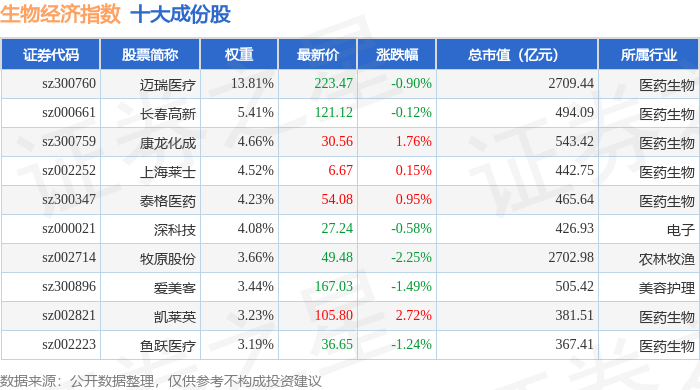
Core Points - The Bioeconomy Index (970038) closed at 2262.82 points, up 0.08%, with a trading volume of 19.253 billion yuan and a turnover rate of 1.3% [1] - Among the index constituents, 27 stocks rose, with Iwubio leading at a 10.07% increase, while 22 stocks fell, with Yifan Pharmaceutical leading the decline at 4.45% [1] Index Constituents Summary - The top ten constituents of the Bioeconomy Index include: - Mindray Medical (sz300760) with a weight of 13.81%, latest price at 223.47, down 0.90%, and a market cap of 270.944 billion yuan [1] - Changchun High-tech (sz000661) with a weight of 5.41%, latest price at 121.12, down 0.12%, and a market cap of 49.409 billion yuan [1] - Kanglong Chemical (sz300759) with a weight of 4.66%, latest price at 30.56, up 1.76%, and a market cap of 54.342 billion yuan [1] - Shizhu Aoshi (sz002252) with a weight of 4.52%, latest price at 6.67, up 0.15%, and a market cap of 44.275 billion yuan [1] - Biao Ge Shi Medicine (sz300347) with a weight of 4.23%, latest price at 54.08, up 0.95%, and a market cap of 46.564 billion yuan [1] - Shenzhen Technology (sz000021) with a weight of 4.08%, latest price at 27.24, down 0.58%, and a market cap of 42.693 billion yuan [1] - Muyuan Foods (sz002714) with a weight of 3.66%, latest price at 49.48, down 2.25%, and a market cap of 270.298 billion yuan [1] - Aimeike (sz300896) with a weight of 3.44%, latest price at 167.03, down 1.49%, and a market cap of 50.542 billion yuan [1] - Kailai Ying (sz002821) with a weight of 3.23%, latest price at 105.80, up 2.72%, and a market cap of 38.151 billion yuan [1] - Color Egg Therapy (sz002223) with a weight of 3.19%, latest price at 36.65, down 1.24%, and a market cap of 36.741 billion yuan [1] Capital Flow Summary - The Bioeconomy Index constituents experienced a net outflow of 599 million yuan from institutional investors and 215 million yuan from retail investors, while retail investors saw a net inflow of 814 million yuan [3] - Notable capital flows include: - Kanglong Chemical saw a net inflow of 74.766 million yuan from institutional investors, while retail investors experienced a net outflow of 49.703 million yuan [3] - Hualan Biological had a net inflow of 42.164 million yuan from institutional investors, with retail investors seeing a net outflow of 33.5328 million yuan [3] - Lepu Medical had a net inflow of 40.927 million yuan from institutional investors, while retail investors had a net outflow of 32.1814 million yuan [3] - Kailai Ying had a net inflow of 38.867 million yuan from institutional investors, with retail investors experiencing a net outflow of 16.4533 million yuan [3] - Iwubio had a net inflow of 23.192 million yuan from institutional investors, while retail investors saw a net outflow of 5.9208 million yuan [3]





10月15日生物经济(970038)指数涨1.32%,成份股博腾股份(300363)领涨
Sou Hu Cai Jing· 2025-10-15 09:53
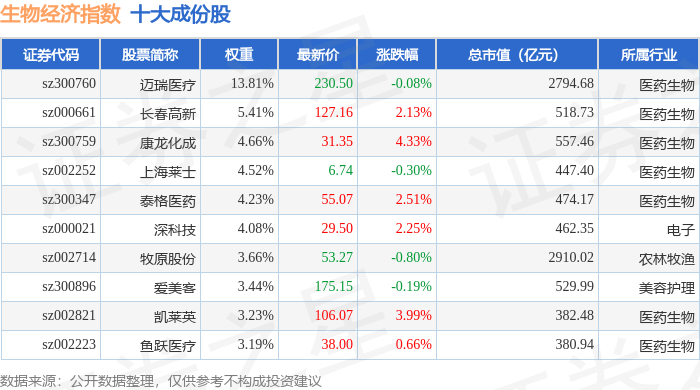
Core Points - The Bioeconomy Index (970038) closed at 2319.65 points, up 1.32%, with a trading volume of 23.929 billion yuan and a turnover rate of 1.64% [1] - Among the index constituents, 39 stocks rose while 11 fell, with Boteng Co., Ltd. leading the gainers at 6.85% and Dabo Medical leading the decliners at 2.94% [1] Index Constituents Summary - The top ten constituents of the Bioeconomy Index include: - Mindray Medical (sz300760) with a weight of 13.81%, latest price at 230.50, and a market cap of 279.468 billion yuan [1] - Changchun High-tech (sz000661) with a weight of 5.41%, latest price at 127.16, and a market cap of 51.873 billion yuan [1] - Kanglong Chemical (sz300759) with a weight of 4.66%, latest price at 31.35, and a market cap of 55.746 billion yuan [1] - Other notable constituents include Taige Pharmaceutical, Deep Technology, and Muyuan Foods, each with varying weights and market caps [1] Capital Flow Analysis - The Bioeconomy Index constituents experienced a net inflow of 265 million yuan from institutional investors, while retail investors saw a net outflow of 72.932 million yuan [3] - Key stocks with significant capital flow include: - Mindray Medical with a net inflow of 79.5868 million yuan from institutional investors [3] - Xintai (002294) with a net inflow of 66.974 million yuan, but a net outflow of 87.6434 million yuan from retail investors [3] - Changchun High-tech also saw a net inflow of 66.9424 million yuan from institutional investors, with a notable outflow from retail investors [3]




10月14日生物经济(970038)指数跌1.55%,成份股深科技(000021)领跌
Sou Hu Cai Jing· 2025-10-14 10:13
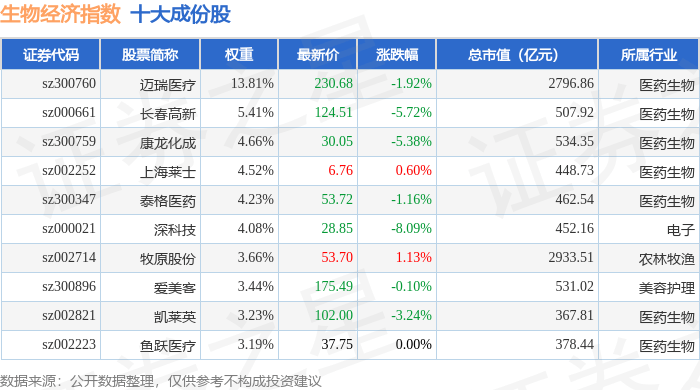
Core Points - The Bioeconomy Index (970038) closed at 2289.36 points, down 1.55%, with a trading volume of 31.408 billion yuan and a turnover rate of 1.99% [1] - Among the index constituents, 17 stocks rose while 32 stocks fell, with I-Wu Biological leading the gainers at 4.79% and Deep Technology leading the decliners at 8.09% [1] Index Constituents Summary - The top ten constituents of the Bioeconomy Index include: - Mindray Medical (sz300760) with a weight of 13.81%, latest price at 230.68 yuan, down 1.92%, and a total market value of 279.686 billion yuan [1] - Changchun High-tech (sz000661) with a weight of 5.41%, latest price at 124.51 yuan, down 5.72%, and a total market value of 50.792 billion yuan [1] - Kanglong Chemical (sz300759) with a weight of 4.66%, latest price at 30.05 yuan, down 5.38%, and a total market value of 53.435 billion yuan [1] - Other notable constituents include Shimi Aoshang (sz002252), Tigermed (sz300347), and Mu Yuan Co. (sz002714) [1] Capital Flow Analysis - The net outflow of main funds from the Bioeconomy Index constituents totaled 1.154 billion yuan, while retail investors saw a net inflow of 0.953 billion yuan [1] - Specific stocks with significant capital flow include: - Mu Yuan Co. (sz002714) with a main fund net inflow of 89.6152 million yuan [2] - I-Wu Biological (300357) with a main fund net inflow of 43.3506 million yuan [2] - Other stocks like Aimeike (300896) and Tian Kang Biological (002100) also experienced notable capital movements [2]
10月9日生物经济(970038)指数涨0.61%,成份股深科技(000021)领涨
Sou Hu Cai Jing· 2025-10-09 11:29
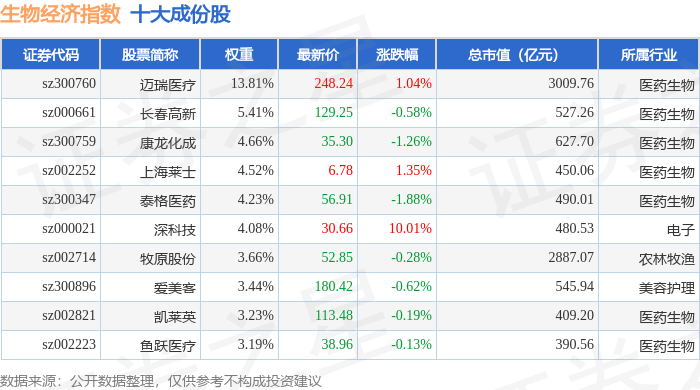
Core Points - The Bioeconomy Index (970038) closed at 2386.01 points, up 0.61%, with a trading volume of 28.528 billion yuan and a turnover rate of 1.76% [1] - Among the index constituents, 32 stocks rose while 18 fell, with Deep Technology leading the gainers at 10.01% and Xinlitai leading the decliners at 3.96% [1] Index Constituents Summary - Major constituents of the Bioeconomy Index include: - Mindray Medical (13.81% weight) at 248.24 yuan, up 1.04% [1] - Changchun High-tech (5.41% weight) at 129.25 yuan, down 0.58% [1] - Kanglong Chemical (4.66% weight) at 35.30 yuan, down 1.26% [1] - Deep Technology (4.08% weight) at 30.66 yuan, up 10.01% [1] Capital Flow Analysis - The Bioeconomy Index constituents experienced a net outflow of 224 million yuan from main funds, while retail investors saw a net inflow of 207 million yuan [3] - Notable capital flows include: - Deep Technology with a main fund net inflow of 28.4 million yuan [3] - Mindray Medical with a main fund net inflow of 80.8494 million yuan [3] - Other companies like Boteng Co. and Zhifei Biological also showed varying net inflows and outflows [3]

【环球财经】巴西与中国将设立十亿美元双边基金
Xin Hua Cai Jing· 2025-10-04 02:14
Core Points - Brazil's National Development Bank (BNDES) announced the establishment of a $1 billion bilateral fund in collaboration with the Export-Import Bank of China, focusing on investments in Brazil's capital market, particularly in energy transition, infrastructure, and digital economy [1] - This fund marks a significant milestone in Sino-Brazilian financial cooperation, being the first jointly established fund denominated in Brazilian reais, aimed at enhancing economic and financial ties between the two countries [1] - The fund is expected to commence operations in Brazil starting in 2026, with BNDES contributing approximately $400 million and the Export-Import Bank of China planning to invest $600 million [1] Investment Focus - The fund will prioritize investments in green low-carbon transition, infrastructure development, bio-economy, agriculture, mining, digital economy, and artificial intelligence [1] - The establishment of this fund follows a cooperation memorandum signed on September 17, laying the institutional groundwork for the fund's creation [1]
中国跻身全球第二大生物药市场
Zhong Guo Chan Ye Jing Ji Xin Xi Wang· 2025-09-29 00:42
Core Insights - China's bio-economy is showing a positive trend, with significant advancements in CAR-T cell therapy, original drug production, and brain-machine interface medical devices, positioning the country as the second-largest biopharmaceutical market globally [1][2] Industry Overview - The global bio-manufacturing industry is receiving heightened attention from major economies, with increased funding for genetic and cell engineering research, biomass utilization, and bio-based product development [2] - The number of CAR-T clinical research centers worldwide has grown to 2069 in 2024, a 60% increase from 1297 in 2020, with China hosting 388 centers, ranking second globally [2] - China has achieved a record high in the proportion of self-developed new drugs, with 93 new drugs approved by the National Medical Products Administration in 2024, marking a five-year peak [2] Research and Development - In 2024, China published over 20,000 SCI papers in the medical equipment field, leading globally in research output [3] - The bio-economy in China is characterized by a robust industrial foundation, with significant growth in the pharmaceutical and chemical sectors driven by advancements in synthetic biology and high-throughput screening technologies [3] Industry Transformation - The bio-industry is transitioning from "quantitative accumulation" to "qualitative leap," focusing on core technology breakthroughs, product quality upgrades, and enhancing supply chain resilience [4] - Notable innovations include the approval of the world's first "rice-derived" human serum albumin injection and the launch of the world's first 5.0T whole-body MRI system [4] Future Prospects - Innovations in synthetic biology and gene editing are driving rapid growth in bio-manufacturing, outpacing GDP growth, and positioning the bio-economy as a crucial sector in the future global economy [5]
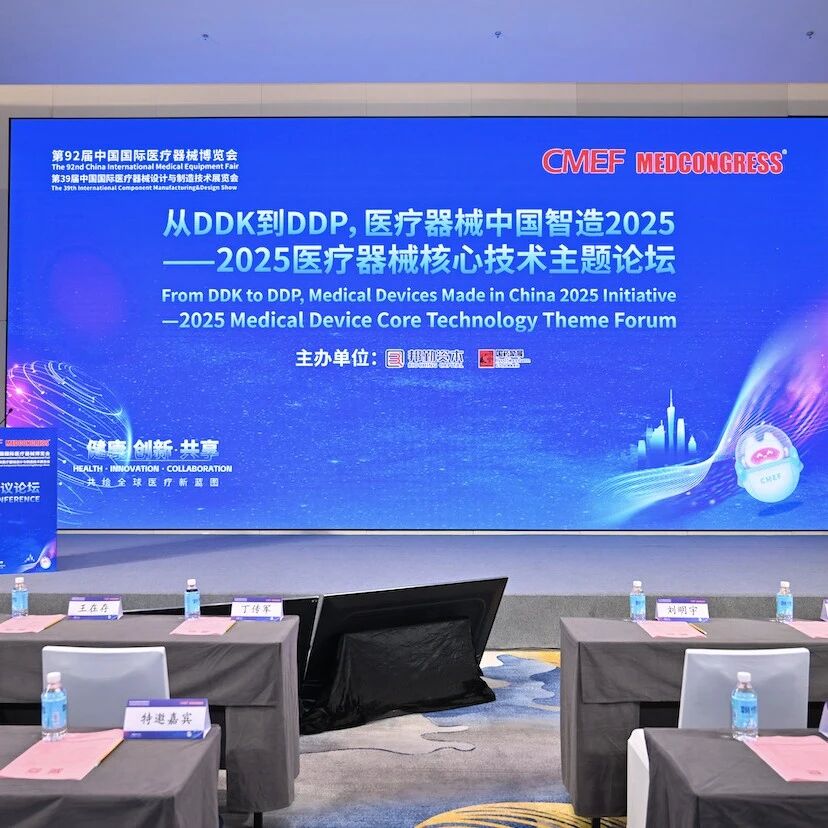
邦勤达睿基金启动暨2025医疗器械核心技术论坛圆满召开
投中网· 2025-09-28 09:16
Core Insights - The forum "From DDK to DDP: Medical Device China Intelligent Manufacturing 2025" highlighted the transition of China's medical device industry from product introduction and technology following to independent innovation and intelligent manufacturing, aligning with the national strategy of "Made in China 2025" [4][6][7] - The industry is currently experiencing a transformation phase, with a shift from a focus on manufacturing to creating innovative solutions, driven by both domestic health demand and global technological advancements [6][7][27] Group 1: Forum Overview - The forum was co-hosted by Bangqin Capital and China National Pharmaceutical Group, gathering industry leaders, academic authorities, and financial experts to discuss key topics such as biomedicine technology strategy and global market positioning [4][6] - The launch of the Bangqin Darui Fund, the first market-oriented angel sub-fund in Henan Province, aims to invest in early-stage projects in the biomedicine and health sectors, promoting technology transfer through a "capital + industry" model [10] Group 2: Strategic Insights - Professor Wang Hongguang emphasized the importance of focusing on core technology breakthroughs, high-end product development, and nurturing leading enterprises to transition from a "big country" in medical devices to a "strong country" [13] - The medical device industry is projected to reach a scale of 3 trillion yuan, with a strategic focus on life sciences as the core of the next technological revolution [13] Group 3: Industry Report - The report by Wang Zai Sun from CITIC Securities analyzed financial data from 120 listed medical device companies and highlighted the industry's growth trajectory, warning of the "valley of death" for innovation moving into commercialization [16] - The report proposed a "spiral ascent trilogy" model, emphasizing the need for a multi-faceted approach to industry growth [16] Group 4: CEO Dialogue - CEOs from leading medical device companies shared insights on innovation practices, global market expansion, and the integration of drug-device-technology [19] - Companies like Kuer Medical and Weimai Medical are actively pursuing new business strategies to adapt to market changes and enhance their product offerings [20] Group 5: Summary and Future Outlook - The current state of the medical device industry is characterized by a period of pain, reshuffling, and recovery, with a projected "H" distribution of large mainstream enterprises and innovative new companies [23] - The industry is encouraged to seek new markets, maintain technological innovation, and embrace global resource allocation to navigate through cycles and witness the growth of world-class enterprises [23][27]
9月22日生物经济(970038)指数跌0.2%,成份股普洛药业(000739)领跌
Sou Hu Cai Jing· 2025-09-22 10:32
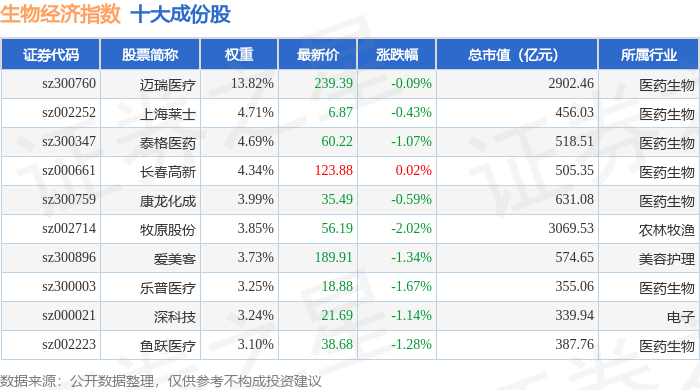
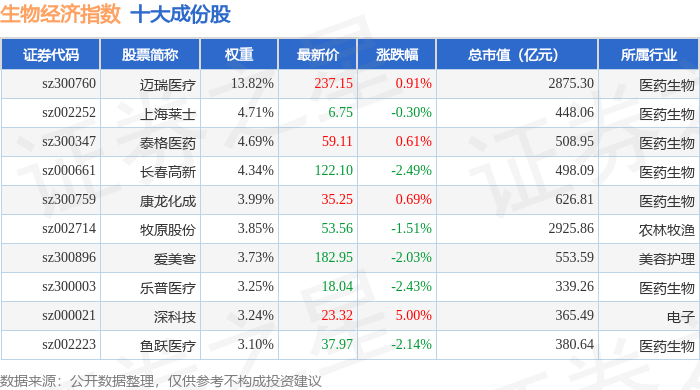
Core Points - The Biotech Economy Index (970038) closed at 2348.33 points, down 0.2%, with a trading volume of 23.011 billion yuan and a turnover rate of 1.51% [1] - Among the index constituents, 15 stocks rose while 34 stocks fell, with Meiya Optoelectronics leading the gainers at a 6.08% increase and Prologis Pharmaceuticals leading the decliners at a 3.21% decrease [1] Index Constituents Summary - The top ten constituents of the Biotech Economy Index include: - Mindray Medical (13.82% weight, latest price 237.15 yuan, market cap 287.53 billion yuan) [1] - Shima Yanshang (4.71% weight, latest price 6.75 yuan, market cap 44.81 billion yuan) [1] - Tigermed (4.69% weight, latest price 59.11 yuan, market cap 50.90 billion yuan) [1] - Changchun High-tech (4.34% weight, latest price 122.10 yuan, market cap 649.81 billion yuan) [1] - Kanglong Chemical (3.99% weight, latest price 35.25 yuan, market cap 62.68 billion yuan) [1] - Muyuan Foods (3.85% weight, latest price 53.56 yuan, market cap 292.59 billion yuan) [1] - Aimeike (3.73% weight, latest price 182.95 yuan, market cap 55.36 billion yuan) [1] - Lepu Medical (3.25% weight, latest price 18.04 yuan, market cap 33.93 billion yuan) [1] - Shenzhen Technology (3.24% weight, latest price 23.32 yuan, market cap 36.55 billion yuan) [1] - Ziyue Medical (3.10% weight, latest price 37.97 yuan, market cap 38.06 billion yuan) [1] Capital Flow Analysis - The Biotech Economy Index constituents experienced a net outflow of 524 million yuan from institutional investors and a net outflow of 202 million yuan from retail investors, while retail investors saw a net inflow of 725 million yuan [3] - Notable capital flows include: - Shenzhen Technology had a net inflow of 24.9 million yuan from institutional investors [3] - Mindray Medical saw a net inflow of 79.43 million yuan from institutional investors [3] - Muyuan Foods had a significant net inflow of 159 million yuan from retail investors [3]

9月17日生物经济(970038)指数跌0.55%,成份股药石科技(300725)领跌
Sou Hu Cai Jing· 2025-09-17 10:48
Group 1 - The Biotech Index (970038) closed at 2403.29 points, down 0.55%, with a trading volume of 25.269 billion yuan and a turnover rate of 1.59% [1] - Among the index constituents, 11 stocks rose, led by Jingxin Pharmaceutical with a 2.67% increase, while 38 stocks fell, with Yaoshi Technology leading the decline at 5.11% [1] - The top ten constituents of the Biotech Index include major companies such as Mindray Medical, with a weight of 13.82% and a market cap of 290.246 billion yuan, and other notable firms like Tigermed and Changchun High-tech [1] Group 2 - The net outflow of main funds from the Biotech Index constituents totaled 1.789 billion yuan, while retail investors saw a net inflow of 1.354 billion yuan [3] - Specific stocks like Boteng Co. experienced a net inflow of 73.5819 million yuan from main funds, while others like Jiayin Pharmaceutical saw a net outflow of 4.8669 million yuan [3] - The overall trend indicates a mixed sentiment among institutional and retail investors, with significant movements in individual stocks reflecting varying levels of confidence [3]