
生猪产能调控

Search documents
生猪期现价格跌至年内低位,产能过剩下生猪行业路在何方?
Qi Huo Ri Bao· 2025-10-20 01:40
Core Viewpoint - The recent decline in live pig prices indicates an oversupply in the market, driven by increased production capacity and insufficient reduction of breeding sows, making it difficult for prices to recover even with seasonal demand increases [2][3]. Price Trends - Since October, live pig prices have dropped significantly, with the average price falling to 12.90 yuan/kg, a decrease of 2.8% week-on-week and 29.5% year-on-year [1]. - Futures prices have also declined, with near-month contracts approaching 11,000 yuan/ton and a drop of over 9% since October [1]. Supply and Demand Dynamics - Analysts indicate that the supply of live pigs remains high, with significant outflow volumes leading to losses for enterprises, which is typical in cyclical industries [2]. - The market is currently experiencing a dual loss situation for both piglets and fattening pigs, with an increase in the sentiment to cull breeding sows, although the pace of capacity reduction is still below expectations [3][4]. Industry Response and Capacity Adjustment - The government has initiated measures to reduce breeding sow numbers, aiming for a decrease of 1 million by the end of the year, but the actual reduction has been limited, with many enterprises only making minor adjustments [4]. - Major companies like Muyuan Foods have responded positively to capacity reduction calls, but smaller firms have not shown significant reductions, leading to an overall slower pace of capacity adjustment in the industry [4]. Future Outlook - If the reduction in breeding sow capacity accelerates, it could lead to a decrease in fattening pig supply by August 2026, but the market may face oversupply until then [5]. - The price of live pigs is expected to fluctuate based on the rhythm of market supply and demand, with potential price points unlikely to exceed 14 yuan/kg or drop below 10 yuan/kg without panic selling [5].


猪价,继续下跌还是触底反弹?
Qi Huo Ri Bao· 2025-10-18 23:38
Core Viewpoint - The pig market is experiencing significant price declines, with both spot and futures prices hitting new lows due to oversupply and insufficient capacity reduction in the industry [1][2][4]. Price Trends - As of the first week of October, the average price of live pigs in China was 12.90 yuan/kg, down 2.8% week-on-week and 29.5% year-on-year [1]. - Futures prices for near-month contracts have approached 11,000 yuan/ton, with a decline of over 9% since October [1][2]. Supply and Demand Dynamics - The supply of live pigs has exceeded market expectations, leading to a fundamental shift from profitability to losses in the industry since September [2][3]. - Analysts indicate that the current market conditions suggest a prolonged period of oversupply, with limited potential for price recovery even with seasonal demand increases [1][3]. Capacity Adjustment - The industry is facing a dual loss situation for both piglets and fattening pigs, with an increase in the sentiment to cull sows, but the pace of capacity reduction remains slower than expected [3][4]. - Some leading companies have responded to calls for capacity adjustment, but many smaller firms are either making minor adjustments or maintaining a wait-and-see approach [4]. Future Outlook - If the reduction in sow capacity begins to materialize in October, it could lead to a decrease in fattening pig capacity by August 2026, but the market may still face oversupply until then [4]. - The price of live pigs is expected to fluctuate, with a potential high point unlikely to exceed 14 yuan/kg and a low point unlikely to drop below 10 yuan/kg without panic selling [4][5]. Market Sentiment and Policy Impact - The government has been actively involved in regulating the industry, with multiple meetings held to discuss capacity control, indicating a commitment to stabilizing prices [3][4]. - Analysts suggest that while the current price levels are under pressure, government policies aimed at guiding reasonable price recovery may shorten the duration of the current pressure period [5].

猪价跌至近5年低位,节假日“救市”失效,后市何去何从?
2 1 Shi Ji Jing Ji Bao Dao· 2025-10-14 01:47
Core Viewpoint - The holiday consumption effect on pig prices is weakening, with prices continuing to decline despite the recent holidays [1][2][3] Price Trends - The average national pig price was 12.90 yuan/kg in the first week of October, down 2.8% from the previous week and 29.5% year-on-year [1][2] - Prices have dropped over 22% compared to the beginning of the year, reaching a low point for the year [1] - As of October 13, the average price for external three-yuan pigs was 10.81 yuan/kg, indicating a slight daily decrease [1][2] Supply and Demand Dynamics - The supply of pigs remains abundant, with a significant number of breeding sows still in operation, leading to a challenging market for price recovery [3][6] - Analysts predict that the demand for pigs may improve in November due to cooler weather and seasonal activities, but overall supply is expected to outpace demand [2][7] Industry Response - The Ministry of Agriculture has emphasized the need for strict production capacity controls, aiming to reduce the number of breeding sows by approximately 1 million [6] - Some companies have begun to adjust their production strategies, including reducing the number of breeding sows and managing the weight of pigs being sold [6][7] Profitability Concerns - The ongoing decline in pig prices has significantly impacted the profitability of pig farming, with losses reported for self-breeding and pig fattening operations [5][6] - Smaller farming operations are facing the most pressure due to higher costs, while larger enterprises are better positioned to manage risks [5][6] Future Outlook - Analysts suggest that while there may be short-term price stabilization, the overall supply situation will limit significant price increases in the near future [5][7] - The market is expected to remain under pressure until production capacity adjustments take effect, with a potential for improved demand in the winter months [7]

养殖端积极出栏 生猪期价再创新低
Qi Huo Ri Bao· 2025-10-14 00:47
Core Viewpoint - After the National Day and Mid-Autumn Festival holiday, live pig futures prices continue to decline, reaching new lows due to the concentrated release of previously held pigs by small and medium-sized farming entities and sales driven by pandemic-related pressures [1][2] Supply Side - The government has emphasized guiding reasonable price recovery, initiating capacity reduction in the pig industry since late May. From June to August, large-scale farming entities significantly increased their slaughter volumes, but prices did not show a notable decline due to winter pandemic impacts and small-scale farmers holding back pigs [2] - Small-scale farmers typically purchase piglets for batch fattening, and the current slaughtered pigs are mainly those replenished in the spring. As inventory decreases, the number of pigs available for slaughter from small-scale farmers will decline [2] Demand Side - Post-holiday, tourism consumption has cooled, and household demand remains weak, leading to an overall decline in demand. Major slaughterhouses have limited new orders, and their operating rates are expected to decrease [2] Policy Measures - In 2023, the government has held multiple meetings to discuss capacity regulation in the pig industry, with a focus on reducing the breeding sows by 1 million by the end of January 2026 among 25 major enterprises. A cross-departmental coordination mechanism will be established to enforce regulations [1] - The Ministry of Ecology and Environment will enhance pollution supervision, while the Financial Regulatory Bureau will restrict credit for capacity expansion. The Ministry of Finance will eliminate subsidies that stimulate capacity growth, marking a shift from guiding measures to rigid enforcement [1] Market Outlook - In the medium term, indicators reflecting piglet supply and demand suggest that pig prices may continue to face pressure in the next three months. The increase in large-scale farming has led to a significant rise in their share in the front-end production, while small-scale farmers focus more on downstream fattening, stabilizing basic production capacity but highlighting production efficiency impacts [4]
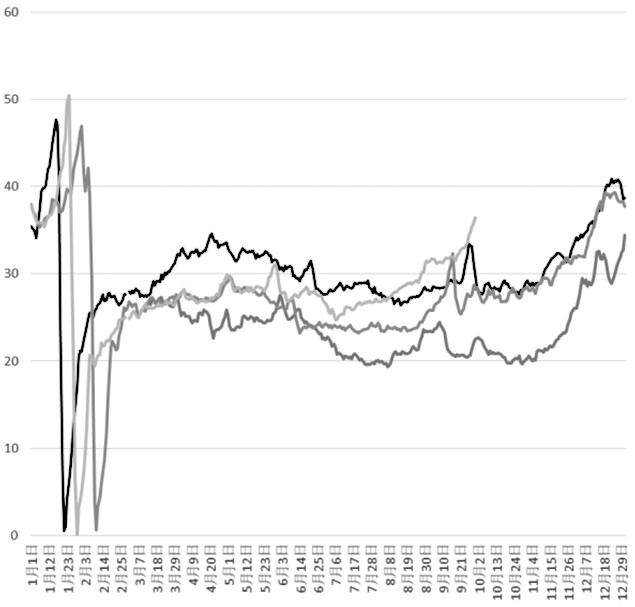
猪价狂跌、融资收紧,猪企能否熬过这个寒冬?| 行业风向标
Tai Mei Ti A P P· 2025-10-11 14:41
Core Insights - The continuous decline in pig prices has created significant challenges for pig farming companies, with prices dropping to a new low of 11.20 yuan/kg, below the cost line of 13-14 yuan/kg for most producers [2][3][6] - Major companies like Wen's Foodstuffs and New Hope are adopting a "volume compensates for price" strategy, but this has not mitigated the impact of falling prices [2][6] - The tightening of financing options due to policy changes is exacerbating the cash flow issues faced by some pig farming companies, leading to a survival-of-the-fittest scenario in the industry [9][11] Industry Overview - As of October 11, the national average price for live pigs was 11.20 yuan/kg, reflecting a 15.92% month-on-month decline and a 38.36% year-on-year drop [3] - The industry is experiencing widespread losses, with many companies forced to sell off stock due to oversupply, leading to a grim outlook for the future [8][12] - The government has implemented measures to control pig production capacity, aiming to stabilize prices and reduce the number of breeding sows [9][12] Company Performance - Major pig farming companies reported declining sales and revenues in September 2025, with examples including: - Muyuan Foods sold 5.573 million pigs, generating 9.066 billion yuan in revenue, with an average price of 12.88 yuan/kg, all showing declines from August [7] - Wen's Foodstuffs sold 3.3253 million pigs, with a revenue of 4.975 billion yuan and an average price of 13.18 yuan/kg, also reflecting declines [7] - New Hope sold 1.3942 million pigs, generating 1.746 billion yuan in revenue, with an average price of 12.89 yuan/kg, showing significant year-on-year declines [7] Market Dynamics - The market is entering a phase of weak demand and strong supply, with an increase in planned slaughter numbers for October, indicating continued pressure on prices [12] - Analysts predict that the fourth quarter will be crucial for the performance of listed pig farming companies, with price recovery largely dependent on the effectiveness of production capacity controls [12][13] - The ongoing price decline is expected to lead to a reduction in production capacity, although the timing and extent of this adjustment remain uncertain [13]




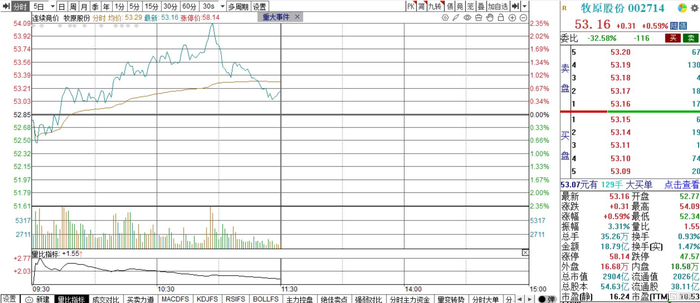
大动作!“千亿猪茅”分红超50亿元,下周四除权除息
Ge Long Hui A P P· 2025-10-10 03:40
Core Viewpoint - Muyuan Foods announced a cash dividend distribution plan for the first half of 2025, totaling 5 billion yuan, which reflects a strong financial performance and commitment to shareholder returns [1][3][5]. Dividend Distribution - The dividend distribution plan is based on a total share capital of 5.393 billion shares, excluding repurchased shares, with a payout of 9.275214 yuan per 10 shares, amounting to a total of 5 billion yuan (including tax) [1][3]. - The record date for the dividend is October 15, 2025, and the ex-dividend date is October 16, 2025 [3]. Financial Performance - In the first half of 2025, Muyuan Foods achieved a revenue of 76.463 billion yuan, representing a year-on-year increase of 34.46%, and a net profit attributable to shareholders of 10.530 billion yuan, a significant year-on-year growth of 1169.77% [5]. - The total dividend of 5 billion yuan accounts for 47.50% of the company's net profit for the half-year [5]. Sales and Market Trends - In September 2025, Muyuan Foods sold 5.573 million pigs, showing a year-on-year change of 11.05%, with an average selling price of 12.88 yuan per kilogram, down 30.94% year-on-year [10]. - The company sold a total of 11.571 million piglets from January to September 2025, with an adjusted forecast for piglet output increased to between 12 million and 14.5 million [7]. Industry Outlook - The agricultural sector anticipates a cautious optimism regarding future pig prices, with expectations of increased demand during the Mid-Autumn and National Day holidays, potentially stabilizing prices [8]. - The company is actively adjusting its breeding stock and managing pig weights to balance market supply and demand, aiming to stabilize pig prices and support the healthy development of the pig industry [9].
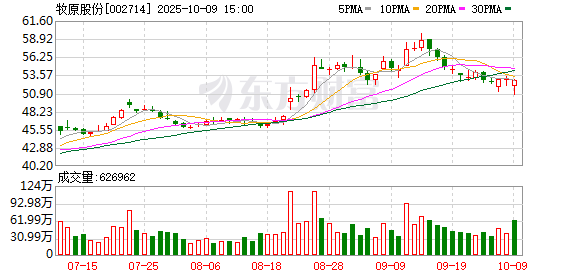
千亿龙头,拟分红超50亿元
Zhong Guo Zheng Quan Bao· 2025-10-09 15:32
Core Viewpoint - The company announced a profit distribution plan for the first half of 2025, with a total cash dividend of 5.002 billion RMB, while also reporting a significant increase in pig sales volume but a decline in sales revenue due to lower prices [2][3]. Group 1: Profit Distribution - The company plans to distribute 9.275214 RMB per 10 shares to shareholders, totaling 5.002 billion RMB [2]. - The record date for the dividend is October 15, and the ex-dividend date is October 16 [2]. - The adjusted cash dividend per share is calculated to be 0.9275214 RMB due to changes in total share capital [2]. Group 2: Sales Performance - In September, the company sold 5.573 million pigs, a year-on-year increase of 11.05%, but the average selling price dropped by 30.94% to 12.88 RMB per kilogram [2][3]. - The total sales revenue for September was 9.066 billion RMB, a year-on-year decrease of 22.46% [2]. - For the first nine months of the year, the company sold 57.323 million pigs, a 14.32% increase, with total sales revenue reaching 103.422 billion RMB, up 8.47% [3]. Group 3: Production Adjustments - The company is reducing the number of breeding sows to stabilize market supply and demand, with a target of 3.3 million sows by year-end [3]. - The company has stopped selling fattening pigs to secondary fattening customers to ensure all pigs are directed to slaughterhouses [3]. - The expected range for piglet output in 2025 has been adjusted from 8 million to 12 million to a new range of 12 million to 14.5 million [4]. Group 4: Cost Management - The company's production costs have decreased from 13.1 RMB/kg in January to 11.8 RMB/kg by July, attributed to improved production performance and reduced unit costs [3].
生猪价格跌至年内新低 行业面临不同程度亏损
Xin Hua Cai Jing· 2025-09-29 12:47
Core Viewpoint - The continuous decline in pig prices is primarily driven by oversupply, with the national average price dropping to 12.26 yuan/kg, marking a new low for the year [1][2]. Supply and Demand Dynamics - The high inventory of breeding sows, which stood at 40.38 million heads as of August 2025, is 103.5% of the normal level, contributing to the oversupply [2]. - The planned pig slaughter volume for September is expected to reach 13.32 million heads, a 1.29% increase from August and a 17.46% increase year-on-year, indicating a growing supply pressure [2]. - Seasonal factors, such as typhoons in southern regions and the upcoming holidays, are expected to further increase market supply as producers rush to sell [2][3]. Production Efficiency and Costs - Leading enterprises are improving production efficiency, with some achieving a PSY (pigs per sow per year) of 28-29 heads, which supports supply despite the current low prices [3]. - The average cost of pig farming is around 6.5 yuan/kg for large groups and can reach 7 yuan/kg for smaller farmers, indicating that current prices are nearing the cost line for many producers [4]. Market Outlook - Analysts suggest that the pig price has not yet reached its bottom, with the industry likely to remain in a "bottoming phase" due to continued oversupply [4][5]. - Long-term improvements in the supply-demand balance are anticipated as production capacity control policies are implemented, potentially leading to a decrease in breeding sow inventory to around 39 million heads by late 2026 [5].
【财经分析】生猪价格跌至年内新低 行业面临不同程度亏损
Zhong Guo Jin Rong Xin Xi Wang· 2025-09-29 12:44
Core Viewpoint - The continuous decline in pig prices is primarily driven by oversupply, with the average price dropping to 12.26 yuan/kg, marking a new low for the year [2][3]. Supply and Demand Dynamics - The high inventory of breeding sows, which stood at 40.38 million heads as of August 2025, is 103.5% of the normal holding capacity, contributing to the oversupply [3]. - The planned pig slaughter volume for September is expected to reach 13.32 million heads, a slight increase of 1.29% from August and a 17.46% increase year-on-year [3]. - The market is currently experiencing a phase of supply surplus, leading to downward pressure on prices [3][4]. Market Conditions and Consumer Behavior - The upcoming holidays are expected to increase market stocking intentions, potentially accelerating the outflow of previously held pigs [4]. - Consumer demand remains weak, with no significant boost to pig prices anticipated in the near term [4][5]. Financial Impact on Farmers - Farmers are facing significant losses, with self-breeding farmers losing approximately 116 yuan per head and fattening farmers losing about 263 yuan per head [6]. - The cost of raising pigs for large groups is around 6.5 yuan/kg, while for smallholders it is about 7 yuan/kg, indicating that current prices are nearing the cost line for many producers [7]. Future Outlook - Analysts believe that pig prices have not yet reached the bottom, with the industry likely to remain in a "bottoming phase" [8]. - Long-term improvements in the supply-demand balance are anticipated due to production capacity regulation policies, with a potential decrease in breeding sow inventory to around 39 million heads [9].

生猪投资周报:出栏量兑现,产能出清仍需时间-20250929
Guo Mao Qi Huo· 2025-09-29 06:51
1. Report Industry Investment Rating - Investment view: Oscillating with a bearish bias [1] 2. Core View of the Report - The recent increase in supply has made the spot market weak, and the downstream demand is limited. The futures market may remain weak. The 01 contract's upside is restricted by increased production capacity until February next year. If there are winter epidemics, there will be short - term selling pressure. With piglets in continuous loss for a month, if the loss situation persists, the long - term investment value of the far - month 07 contract can be considered [2] 3. Summary According to the Directory 3.1 Market Review 3.1.1 Spot Market Review - In September, the spot price hit a new low since the beginning of the year, and the overall price center has been declining. The price mainly fluctuates between 12.8 yuan/kg and 16 yuan/kg, with no obvious seasonal trend. The recent decline is due to increased supply and high slaughter weight, indicating abundant production capacity [4] - From July to August, affected by winter piglet losses, the slaughter slowed down. In June, under the background of anti - involution, production capacity regulation stimulated the spot market. The price difference between standard and fat pigs widened, and group farms reduced slaughter while secondary fattening was active, leading to a price increase in July. In September, the slaughter growth inflection point arrived, with production capacity restoration from high - profit piglets in the first quarter. The anti - involution sentiment faded, and the spot price dropped to the lowest point of the year, but the decline was gentle compared to the past five years [6] 3.1.2 Spread Market Review - Affected by anti - involution, the futures - spot structure has shifted to contango. As the spot market weakened in September, the futures market followed passively, maintaining the contango structure. The 07 contract has the highest price due to the expected impact of production capacity reduction on next year's second half - year supply [3][7] 3.2 Capacity Realization in the Cycle 3.2.1 Gradual Restoration of Reproductive Sows - In the second half of the year, the monthly change in the number of reproductive sows was small. As of the end of July, the national inventory of reproductive sows was 40.42 million, 103.6% of the normal level of 39 million. According to the meeting, the number of reproductive sows is expected to be reduced by 1 million by the end of the year, still above the normal level [3][10] 3.2.2 Obvious Improvement in Production Efficiency - In the third quarter, the monthly slaughter volume increased significantly, reflecting the restoration of piglet production capacity in spring. The high piglet profit in February and March stimulated breeding, and the number of piglets increased. The slaughter volume is expected to continue to rise until February 2026, with a significant increase from September to November [3][13] - Since 2023, production efficiency has improved significantly. The average number of healthy piglets per litter has shown an upward trend and remained stable at a high level throughout the year, which is related to increased production capacity and attention to piglet survival rate due to high profits [15] 3.2.3 Steady Increase in Slaughter Weight - The large price difference between standard and fat pigs this year led to low expectations for weight reduction. In the second half of the year, the slaughter weight reached the highest level in the past five years. Although leading enterprises have reduced the weight, the overall national weight reduction is not obvious. The current average national slaughter weight is 128.32 kg, still at a high level in the past five years. Continuous secondary fattening has hindered active weight reduction [16][18] 3.3 Breeding Profit - This week, the self - breeding and self - raising profit entered a loss, ending 16 consecutive months of positive profit. However, the cash cost of breeding is still positive. The positive profit in this cycle is mainly due to the decline in feed raw material prices and the reduction of purchased piglet prices to the cost level. Short - term losses have little impact on breeding behavior, but if losses continue for more than a quarter, there may be motivation to reduce production capacity [21][23] 3.4 Stable Demand - This year's slaughter volume is better than last year, and the overall demand is normal. During the fourth - quarter peak season, the relatively low pig price supports demand. The increase in the frozen product inventory rate reflects the expectation of production capacity reduction in the future [24] 3.5 Policy Attention - The policy focuses on the active reduction of reproductive sows, aiming to reduce the number by 1 million by the end of the year. If implemented, it may affect the pig slaughter volume in the second half of next year. The current pig - grain ratio has triggered the purchase and storage policy. Although the grain price increase is limited due to a good corn harvest, attention should still be paid to policies related to the pig - grain ratio caused by falling pig prices [27]