
轻量化

Search documents
电竞玩家,正在改写键鼠品类增长逻辑
Xin Lang Cai Jing· 2025-11-06 07:57
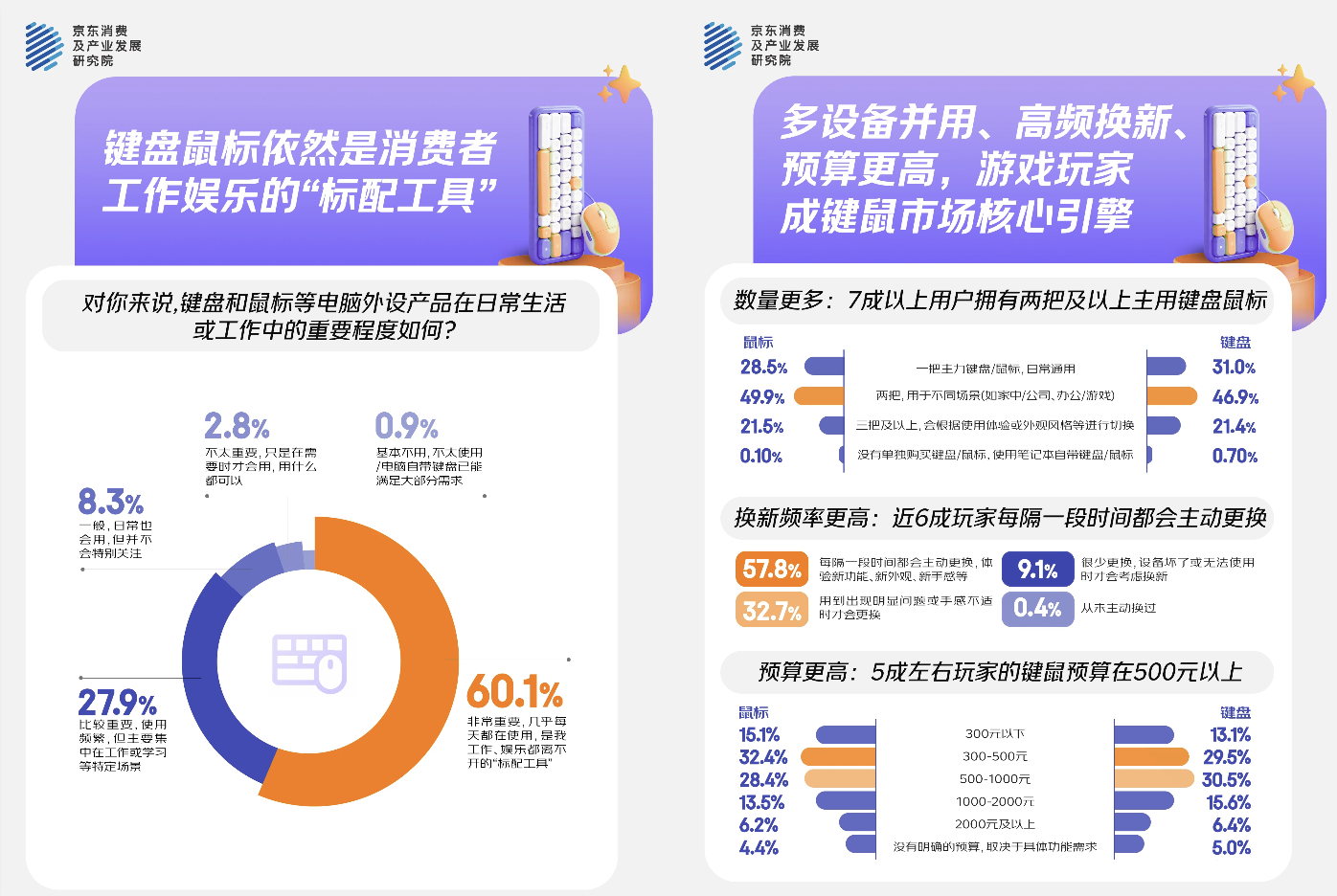
Core Insights - The keyboard and mouse market is experiencing significant growth driven by high demand for gaming peripherals, with over 90% of laptop users opting for additional keyboards and mice, and 63.3% using them for more than 6 hours daily [1][2] - The concept of "eSports" is redefining consumer expectations and driving up the average price of gaming peripherals, with search volumes for "eSports keyboard" and "eSports mouse" increasing by 138% and 119% respectively [3][4] - The market is shifting focus from niche high-end products to a broader audience, emphasizing the integration of advanced technology into everyday digital experiences [5][6] Market Trends - The growth of the keyboard and mouse market is primarily fueled by mid-to-high-end products, particularly those centered around eSports [7] - The average price of keyboards has risen to 249 yuan, a 22.7% year-on-year increase, while the average price of mice has reached 146 yuan, up 19.4% [8][9] - High-end products priced above 500 yuan for keyboards and above 665 yuan for mice are seeing sales growth rates exceeding 68% and 87% respectively, indicating a clear trend towards premiumization [8][9] Consumer Behavior - Approximately 42% of keyboard and mouse consumers identify as "deep gamers," with nearly 60% investing in specialized equipment for different games [2][31] - The majority of heavy gamers own multiple sets of peripherals, with 70% indicating a preference for high-performance products, driven by a desire for superior functionality rather than necessity [35][41] - Light users and office workers are increasingly adopting eSports peripherals, valuing comfort and reliability, with 61% prioritizing ergonomic design and 58.2% seeking quiet operation [42][43] Technological Advancements - Key trends in the eSports keyboard and mouse market include lightweight designs, magnetic switches, and optical switches, which are becoming essential for high-performance gaming [13][21] - The magnetic switch technology is rapidly gaining traction, with over 70% of the market for keyboards priced above 300 yuan, while optical switches are recognized for their speed and durability [25][21] - Brands are competing by focusing on specific technological advancements, with Logitech leading in lightweight designs and ROG excelling in magnetic switch technology [20][21][26] Market Dynamics - The market is evolving from a focus on basic functionality to an emphasis on user experience, with brands needing to balance technological innovation with consumer needs [47] - The segmentation of the market is evident, with high-end products catering to hardcore gamers and mid-range products appealing to casual users [46][47] - The future of the keyboard and mouse market will depend on brands' ability to translate advanced technology into accessible, everyday value for a diverse consumer base [46][47]


晨会纪要:对近期重要经济金融新闻、行业事件、公司公告等进行点评-20251104
Xiangcai Securities· 2025-11-04 01:45
Group 1: Automotive Industry - The report highlights that Ningbo Huaxiang's Q3 2025 performance shows a significant increase in net profit, primarily due to the sale of European operations which alleviated previous losses, alongside a recovery in profits driven by the growth of domestic self-owned brands [2][7] - The company is accelerating its transformation towards lightweight and intelligent products, with revenue from self-owned brands expected to exceed 40% of total revenue by 2025 [3] - The company has successfully completed the divestiture of its European subsidiaries, which will allow for a more accurate reflection of its future operational performance and investment value [5] Group 2: Robotics and New Growth Areas - Ningbo Huaxiang is expanding into the humanoid robotics sector, having signed a contract to produce full-size biped robots for Shanghai Zhiyuan, which is expected to accelerate growth in this emerging business area [6] - A joint venture has been established to focus on robot data collection and training, as well as the development of intelligent models, indicating a strategic move towards innovation in robotics [6] Group 3: Financial Projections and Investment Recommendations - The company is projected to achieve revenues of 288.90 billion, 320.23 billion, and 350.39 billion from 2025 to 2027, with corresponding net profits of 5.16 billion, 13.21 billion, and 16.12 billion, reflecting a significant growth trajectory [7] - The report recommends investors pay attention to the company's developments in the humanoid robotics field and its core business capabilities, with an initial coverage rating of "Accumulate" [7] Group 4: Medical Consumables Industry - The medical consumables sector experienced a decline of 1.98% last week, with notable performances from companies like Zhend Medical and Tianyi Medical, while others like Nanwei Medical and Sainuo Medical faced significant losses [9][10] - Gansu province is leading a centralized procurement initiative for heart valve products, which may accelerate the domestic market's growth and provide opportunities for local brands, although it poses risks of revenue pressure due to potential price reductions [10] Group 5: Company Performance in Medical Consumables - Spring Medical reported a substantial increase in net profit for the first three quarters of 2025, with a 213.21% year-on-year growth, indicating strong operational performance and improved cash flow [12] - The report suggests that the pressure from centralized procurement on high-value consumables is gradually being absorbed, with ongoing innovation and overseas business development expected to drive future growth [12][13]


北特科技 | 2025Q3:业绩超预期 丝杠产能加速落地【民生汽车 崔琰团队】
汽车琰究· 2025-11-02 08:45
Group 1 - The company reported a revenue of 1.712 billion yuan for the first three quarters of 2025, representing a year-on-year increase of 17.50% [2] - The net profit attributable to shareholders for the same period was 93 million yuan, up 52.39% year-on-year, while the net profit excluding non-recurring items was 84 million yuan, reflecting a 69.38% increase year-on-year [2] - In Q3 2025, the company achieved a revenue of 599 million yuan, a year-on-year growth of 23.07% and a quarter-on-quarter increase of 4.85% [3] Group 2 - The gross profit margin for Q3 2025 was 21.23%, an increase of 0.39 percentage points year-on-year and 1.20 percentage points quarter-on-quarter [3] - The company has effectively controlled costs, leading to a significant increase in profitability, with the net profit margin for Q3 2025 at 6.29%, up 1.58 percentage points year-on-year [3] - The company is actively pursuing cost reduction and efficiency improvement initiatives, as evidenced by the decreasing expense ratios in sales, management, R&D, and financial costs [3] Group 3 - The company has over 20 years of experience in the automotive chassis components industry, specializing in metal precision processing technologies [4] - Key products include steering gear racks, gears, shock absorber piston rods, and electronic brake components, with ongoing development of new products such as dual-tooth racks and electronic brake gears [4] - The company is expanding its production capacity for planetary roller screws and other critical components, targeting applications in automotive steering and emerging markets like humanoid robotics [5] Group 4 - The company is positioned as a leader in the chassis segment, with expectations for revenue growth to reach 2.324 billion yuan in 2025, 3.090 billion yuan in 2026, and 4.452 billion yuan in 2027 [6] - Projected net profits for the same years are 137 million yuan, 211 million yuan, and 361 million yuan, respectively, indicating strong growth potential [6] - The company maintains a "recommended" rating based on its performance and growth prospects, with projected EPS of 0.40 yuan in 2025, 0.62 yuan in 2026, and 1.07 yuan in 2027 [6][8]


华域汽车
2025-11-01 12:41
Summary of the Conference Call for Huayu Automotive's Q3 Financial Results Company Overview - **Company**: Huayu Automotive - **Event**: Q3 Financial Results Conference Call Key Financial Metrics - **Total Revenue**: 130.8 billion CNY, a year-on-year increase of 9.51% [5] - **Net Profit Attributable to Parent Company**: 4.688 billion CNY, a year-on-year increase of 4.79% [5] - **Basic Earnings Per Share**: 1.487 CNY [5] - **Net Cash Flow from Operating Activities**: 9.977 billion CNY, a year-on-year increase of 77.56% [5] - **Total Assets**: 198.244 billion CNY, a year-on-year increase of 7.16% [6] - **Equity Attributable to Parent Company**: 64.725 billion CNY, a year-on-year increase of 4.32% [6] - **Debt-to-Asset Ratio**: 65.41%, an increase of 1.15 percentage points from the previous year [6] Revenue Breakdown by Segment - **Interior and Exterior Trim**: Significant revenue growth due to recovery in vehicle production and sales [7] - **Metal Forming and Molds**: Revenue increased by 7.6% [7] - **Electronics and Electrical**: Slight decline of 2.6% [7] - **Heat Processing Components**: Decrease of 39.7% due to business restructuring and exit from high-energy consumption sectors [7] Profitability Insights - **Overall Profit Growth**: Approximately 5% increase in profit, slightly lower than revenue growth due to competitive pricing pressures in the automotive market [8] - **Investment Income Contribution**: 2.2 billion CNY increase in investment income compared to the previous year, primarily from joint ventures [9] Challenges and Market Conditions - **Increased Competition**: The automotive market is experiencing intensified competition, leading to pricing pressures [8] - **Impact of Price Wars**: Ongoing price wars in the vehicle market are affecting profit margins [8] - **Taxation Changes**: Anticipated increases in purchase tax for new energy vehicles may impact future profitability [28] Cash Flow and Working Capital Management - **Accounts Receivable**: Increased by 12.5% due to prolonged payment terms amid price negotiations [12] - **Inventory Management**: Inventory increased by only 2%, indicating effective control over working capital [13] - **Cash Flow Improvement**: Significant improvement in cash flow from operating activities, supported by enhanced collection efforts [14] Future Outlook - **Investment Plans**: Continued focus on investments in electric and lightweight technologies, with a cautious approach to capital expenditure [17] - **International Expansion**: Plans to leverage opportunities in North America and Europe, particularly in response to the growing demand for new energy vehicles [33][34] - **Product Development**: Ongoing discussions with European OEMs to expand product offerings, particularly in new energy vehicle segments [42] Analyst Questions and Management Responses - **Solid-State Battery Investment**: The impact of solid-state battery investments will be assessed in future reports as they are not yet included in current financials [22] - **Customer Payment Terms**: Challenges remain in achieving shorter payment terms, with ongoing negotiations to improve cash flow [24] - **Profitability by Customer Type**: Profitability varies significantly by product and customer type, with ongoing efforts to enhance product value and maintain margins [46] Conclusion - Huayu Automotive reported solid financial performance in Q3, with growth in revenue and net profit despite challenges from market competition and pricing pressures. The company is strategically positioning itself for future growth through investments in new technologies and international expansion.

普莱得(301353) - 301353普莱得投资者关系管理信息20251101
2025-11-01 09:28
Group 1: Product Development and Market Positioning - The company recognizes the significant advantages of solid-state batteries in energy density, safety, and cycle life, which align with the core demands of electric tools for endurance, reliability, and durability. This technology can expand product application boundaries and enhance competitiveness, opening new market opportunities [2][3] - The company's leading position in niche markets is attributed to strategic layout, resource allocation, talent development, and operational synergy, supported by three key advantages: deep binding with top clients, innovation-driven strategy, and a leading manufacturing system [3][4] Group 2: Product Applications and Market Coverage - The company's spray gun products cater to various spraying needs across multiple fields, including construction decoration, industrial manufacturing, and automotive aftermarket, providing substantial support for business expansion in related niche markets [5] - The company’s main product categories do not exhibit significant seasonal fluctuations, maintaining stable demand across various application scenarios throughout the year, ensuring balanced revenue distribution across quarters [8] Group 3: Talent Retention and Capacity Planning - The core R&D team is stable, with members possessing strong professional skills and management experience, supported by a shareholding mechanism that enhances their sense of belonging and responsibility, ensuring continuity in technological innovation [6] - Current capacity planning focuses on optimizing existing bases in China and Thailand, with no immediate plans for expansion into Mexico or Brazil, as Thailand offers superior supply chain collaboration and component maturity for electric tool production [7][8]
北特科技(603009):系列点评五:25Q3业绩超预期,丝杠产能加速落地
Minsheng Securities· 2025-10-30 13:53
Investment Rating - The report maintains a "Recommended" rating for the company, indicating an expected stock price increase of over 15% relative to the benchmark index within the next 12 months [6][12]. Core Insights - The company reported a revenue of 1.712 billion yuan for the first three quarters of 2025, representing a year-on-year increase of 17.50%. The net profit attributable to shareholders was 93 million yuan, up 52.39% year-on-year, with a significant increase in the third quarter [1][2]. - The company is focusing on vertical development strategies, continuously evolving its product structure, and has developed new products such as dual-tooth racks and electronic brake gears [3][4]. - The company is expanding its production capacity for planetary roller screws, which are essential for emerging markets like intelligent braking systems and humanoid robots [4]. Financial Performance Summary - For Q3 2025, the company achieved a revenue of 599 million yuan, a year-on-year increase of 23.07%, and a net profit of 38 million yuan, up 64.40% year-on-year. The gross margin for Q3 was 21.23%, reflecting a slight improvement [2][3]. - The company is expected to see revenues of 2.324 billion yuan in 2025, with net profits projected at 137 million yuan, and EPS of 0.40 yuan. The PE ratios for 2025, 2026, and 2027 are forecasted to be 121, 78, and 46, respectively [5][10].
超达装备三季报揭示质变:盈利能力实现历史跨越 利润飞增背后的战略升维
Jing Ji Guan Cha Wang· 2025-10-30 05:30
Core Viewpoint - The company, South China Chao Da Equipment (301186), has demonstrated impressive financial performance in its Q3 2025 report, showcasing a shift from revenue-driven growth to profit-driven growth, supported by long-term technological accumulation and industry trends [1][3]. Financial Performance - For the first three quarters of 2025, the company reported revenue of 566 million yuan, a year-on-year increase of 8.5%, and a net profit attributable to shareholders of 110 million yuan, up 44.17% year-on-year [1][3]. - In Q3 2025, the company achieved revenue of 212 million yuan, a 7.3% increase year-on-year, and a net profit of 49.34 million yuan, reflecting a remarkable 93.5% year-on-year growth [1][3]. - The net profit growth rate in Q3 was 12 times that of revenue growth, indicating a significant improvement in profitability [1][3]. Competitive Advantage - The company's core competitiveness lies in its unique "full-process manufacturing" capability, allowing it to independently manage all stages from design to production, creating a strong competitive moat [2][3]. - The company has established a significant advantage in precision, lifespan, and stability of molds due to its long-term technological accumulation and international operations [2][6]. Global Expansion and Strategy - The company has achieved a remarkable 43.46% of its revenue from exports, with products successfully entering major automotive markets in Europe, North America, and Asia [6]. - The establishment of production bases in Germany, the U.S., and Thailand reflects a strategic focus on local operations to better meet customer needs and respond quickly to market demands [6][8]. Research and Development - The company has invested 36.21 million yuan in R&D for the first three quarters of 2025, marking a 10.04% increase and positioning it among the top tier in its industry [7][8]. - With 151 patents, including 79 invention patents, the company demonstrates a strong technical foundation that supports its entry into high-growth sectors like new energy vehicles [8]. Market Trends and Future Outlook - The automotive industry is undergoing significant changes towards lightweight and intelligent vehicles, presenting historical growth opportunities for the company [9][10]. - The demand for lightweight solutions in new energy vehicles aligns with the company's technological advantages, positioning it well for future growth [9][10]. - The company is expected to continue benefiting from a robust order book and high production capacity utilization, supporting sustained performance in the near term [9].

中国巨石(600176):深度报告:全球玻纤工业领导者,业绩实现探底回升
Dongguan Securities· 2025-10-29 07:31
Investment Rating - The report assigns an "Accumulate" rating to the company, indicating a positive outlook for its stock performance in the near term [1][39]. Core Insights - China Jushi Co., Ltd. is a global leader in the fiberglass industry, with a complete product line and a market share exceeding 30%. The company is expected to benefit from the recovery of industry demand and an increase in the proportion of high-end products, leading to sustained growth in performance over the next few years [39]. - The company has shown significant revenue growth in 2025, with a total revenue of 139.04 billion yuan, representing a year-on-year increase of 19.53%, and a net profit of 25.68 billion yuan, up 67.51% year-on-year [33][34]. Summary by Sections Company Overview - China Jushi was established in 1993 and is headquartered in Tongxiang, Zhejiang Province. It is a leading manufacturer of fiberglass, with a stable shareholding structure supported by strong state-owned and private enterprises [11][12]. Product Diversification and High-End Application - The company produces a wide range of fiberglass products, transitioning towards high-end applications such as wind power yarn and thermoplastic short-cut yarn, which have seen rapid sales growth [21][22]. Emerging Industries Driving Demand - The demand for fiberglass is expected to rise due to its increasing applications in emerging industries such as renewable energy, lightweight manufacturing, and electronics. The company is well-positioned to capitalize on these trends [25][27]. Competitive Advantages - China Jushi has established solid competitive barriers through scale and cost advantages, with a production capacity significantly higher than industry averages. The company is also focusing on high-end product development and international expansion [28][31]. Performance Recovery and Profitability Improvement - The company's performance rebounded in 2025, with significant increases in both revenue and net profit compared to previous years. This recovery is attributed to rising product prices and an improved product mix [33][34][35]. Investment Recommendations - The report forecasts earnings per share (EPS) for 2025-2027 to be 0.8 yuan, 0.99 yuan, and 1.13 yuan, respectively, with corresponding price-to-earnings (PE) ratios of 20.1, 16.3, and 14.3 times. The company is expected to continue its growth trajectory, warranting an "Accumulate" rating [39][41].

370克!全球最轻量产灵巧手背后,人形机器人普及的关键密码
机器人大讲堂· 2025-10-28 11:10
Core Viewpoint - The development of Tesla's third-generation humanoid robot, Optimus, has been delayed due to challenges in developing a dexterous hand, which is crucial for the robot's functionality and market application [1][3]. Market Overview - The global market for dexterous hands is rapidly expanding, with projections indicating a market size of 700 million yuan by 2025 and potentially exceeding 20 billion yuan by 2030 [3][21]. - Dexterous hands account for 15%-30% of the total cost of humanoid robots, making their development and cost reduction critical for the commercialization of humanoid robots [3][17]. Product Innovation - The Linker Hand O6, developed by Lingxin Qiaoshou, weighs only 370 grams and can support a load of 50 kg, setting a record for the lightest mass-produced dexterous hand globally, priced at 6,666 yuan [1][4][17]. - The design of Linker Hand O6 targets medium-sized humanoid robots (1-1.6 meters tall) and emphasizes a "lightweight yet powerful" approach [4][7]. Technical Challenges - Achieving extreme lightweight in dexterous hands involves overcoming multiple technical challenges, including material selection and structural design [9][10]. - The use of advanced materials like PEEK and magnesium alloys has been pivotal in reducing weight while maintaining strength and durability [10][18]. Application and Impact - The lightweight design of Linker Hand O6 enhances the operational capabilities of humanoid robots, making them more effective in interacting with the physical world [7][15]. - In the prosthetics field, the reduced weight of Linker Hand O6 significantly improves user comfort and willingness to use, compared to traditional prosthetics that often exceed one kilogram [7][15]. Cost Reduction and Market Accessibility - The price reduction of dexterous hands, exemplified by Linker Hand O6, is expected to facilitate broader adoption of humanoid robots across various sectors, including industrial and service industries [17][20]. - The cost of high-performance dexterous hands has historically been a barrier to commercialization, with previous models priced at tens of thousands of dollars; however, the new pricing strategy aims to make these technologies more accessible [17][20]. Future Trends - The dexterous hand market is projected to grow significantly, with estimates suggesting a market capacity of 760,100 units and a market size of 1.706 billion USD by 2024 [21]. - Future developments in the dexterous hand sector are expected to focus on standardization, application-specific designs, and integration of AI technologies, enhancing their functionality and market appeal [22].

长虹电源为“全球最快高铁”CR450注入最强动能
Zhong Jin Zai Xian· 2025-10-28 03:17
Core Insights - The CR450 high-speed train, known as the "world's fastest high-speed train," achieved a record speed of 453 km/h during trials, significantly outperforming the previous model [1] - The AI lithium-ion battery system developed by Changhong Power is a key contributor to this achievement, being 57% lighter and capable of predictive fault management [1][6] - The CR450 project is part of China's "14th Five-Year Plan" for major scientific research, aiming to overcome technological bottlenecks in railway innovation [6][7] Technical Achievements - The CR450 train can accelerate to 350 km/h in just 4 minutes and 40 seconds, a 100-second improvement over the previous model [1] - The battery system has a nominal voltage of DC 103.5V and a total capacity of 460Ah, providing emergency power for 90 minutes in extreme temperatures [10] - The battery system's weight was successfully reduced to 920 kg, meeting the overall weight requirements of the train [13] Innovation and Development - The PHM health management system allows for real-time monitoring and predictive analysis of battery performance, enhancing safety and reliability [9][10] - The project has accumulated valuable operational data, which is being used to continuously improve battery health management technology [12] - The CR450 project has led to a 50% market share in its niche, indicating strong commercial potential [15] Talent Development - Changhong Power employs a dual approach of internal training and external recruitment to build a skilled workforce [16][20] - The company emphasizes hands-on project involvement for new employees to foster a sense of belonging and accelerate talent development [20][22] - The mentorship system has proven effective in nurturing talent, as demonstrated by the rapid growth of team members involved in critical projects [18][20]

