工程塑料

Search documents
浙江大华陈思杭高工:尼龙在安防电子的创新应用与趋势
DT新材料· 2026-03-12 16:05
Group 1 - The article discusses the upgrade of nylon in the security electronics field from traditional structural materials to high-performance, functional, and specialized materials, including glass fiber reinforced, halogen-free flame retardant, high-temperature resistant, low moisture absorption, thermally conductive, electrically conductive, and low dielectric modified nylon [2] - These advanced nylon materials are widely used in applications such as surveillance cameras, AI smart terminals, connectors, access control intercoms, wireless security, and radar equipment, meeting core requirements for high reliability, compact precision, weather resistance, electromagnetic compatibility, and high-temperature resistance [2] - Zhejiang Dahua Technology Co., Ltd. is highlighted as a leading global provider of video-centric smart IoT solutions and services, focusing on digital innovation and transformation for cities and enterprises [2][3] Group 2 - The company employs over 23,000 staff, with more than 50% in R&D, investing about 10% of annual sales revenue into research and development, and holds 51 national-level research projects [3] - Dahua has applied for over 10,800 patents, including around 900 overseas, and has received multiple awards, including the National Quality Award and recognition as a high-quality development leading enterprise [3] - The upcoming "2026 Advanced Nylon Industry Innovation and Application Development Conference" will feature a presentation by a senior engineer from Dahua on the innovative applications and trends of nylon in the security electronics sector [3][5] Group 3 - The conference will focus on the latest advancements in nylon monomers, polymers, and modifications, addressing new material demands and solutions in various applications, including automotive, electronics, low-altitude economy, and humanoid robots [7][13] - The agenda includes discussions on the synthesis, structure, performance, and industrialization of bio-based polyamides, as well as the application of nylon engineering materials in the automotive sector [9][10] - The event aims to gather leading enterprises, experts, and core end-users from the industry chain to explore high-quality development paths for the nylon industry [13]


时代工塑宋克东副总经理:聚酰胺材料改性应用及发展趋势
DT新材料· 2026-03-11 16:05
Company Overview - Zhuzhou Times Engineering Plastics Technology Co., Ltd. (referred to as Times Engineering Plastics) focuses on the R&D, production, sales, and service of high-performance engineering plastics and their composite materials and products, operating as a high-tech enterprise under CRRC Corporation Limited [2] - The company has inherited the product division, technology, and team from the original Times New Materials, with main products including modified engineering plastics, functional nylon resins, wear-resistant polymer materials, and lightweight thermoplastic composite materials [2] - In 2018, the company established the Nanzhou Industrial Park production base, featuring fully automated production lines with an annual output of 80,000 tons of modified materials, 5 million EPS worm gears, 10 million precision injection products, and 2,000 tons of continuous fiber thermoplastic composite materials, achieving annual sales exceeding 500 million yuan [2] Technological Capabilities - Times Engineering Plastics boasts a development and design team led by experienced experts and PhDs, holding over 20 invention patents and achieving significant domestic production of previously imported products [3] - The company has received multiple national and provincial-level technology and project awards, and has certifications including ISO9000, ISO14001, and IATF16949, showcasing its core technological capabilities in materials technology, systems and structures, process equipment, and testing analysis [3] Industry Events - The "2026 Advanced Nylon Industry Innovation and Application Development Conference" will be held in Guangzhou on March 19-20, 2026, featuring a keynote report by Song Kedong, Deputy General Manager of Times Engineering Plastics, on the topic of "Modification Applications and Development Trends of Polyamide Materials" [3][9] - The conference will focus on the latest advancements in nylon monomers, polymerization, and modification, addressing new material demands and solutions in various application fields such as automotive, electronics, low-altitude economy, and humanoid robots [9][14] Market Position - Times Engineering Plastics has established long-term strategic partnerships with numerous well-known domestic and international companies, including CRRC, Mercedes-Benz, BOGE, BAIC, Changan, Great Wall, Gree, and Nexteer [3] - The conference aims to explore the challenges and strategies in technology innovation, application development, cost reduction, efficiency enhancement, and market expansion within the nylon industry, particularly in emerging sectors like humanoid robots and new energy vehicles [14]
北京安耐吉能源工程技术有限公司邀您共聚先进尼龙应用开发大会!
DT新材料· 2026-03-05 16:05
Core Viewpoint - Beijing Annergy Energy Engineering Technology Co., Ltd. is a high-tech company established in 2010, focusing on the development and service of refining, petrochemical, and new chemical materials technology, with a strong emphasis on breaking foreign monopolies in specialized nylon products [2][3]. Company Overview - The company has an annual production capacity of 4,300 tons of new catalysts and 20,000 tons of specialty polyamide, integrating research, development, production, and sales [3]. - It has a comprehensive quality assurance system and has obtained several international certifications, including ISO9001:2015, ISO14001:2015, and ISO45001:2018, and is recognized as a national high-tech enterprise [3]. Product Introduction - **Special Nylon 66 Resin A3015wl**: This product offers higher dimensional stability, temperature resistance, and long-term aging performance compared to PA66, with a melting point of up to 275°C [6][15]. - **MXD6 Nylon Resin**: A semi-crystalline polyamide resin known for its high rigidity and flowability, suitable for composite applications with glass fibers and capable of achieving a high-gloss surface even with high fiber content [8][16]. - **Transparent Nylon Resin A1315**: A copolyamide that enhances rigidity and flowability in various processing methods, including blow molding and injection molding [10][17]. - **Long Carbon Chain Nylon Resins (A50 and A60)**: These resins exhibit excellent tensile strength and toughness, with applications in electronics, automotive parts, and sports equipment, with A60 offering lower water absorption and better dimensional stability [12][18]. Upcoming Event - The company will participate in the "2026 Advanced Nylon Industry Innovation and Application Development Conference" in Guangzhou on March 19-20, 2026, showcasing its key products and inviting collaboration from industry chain partners [14][24].
议程发布!2026先进尼龙产业创新与应用开发大会(3.19-20·广州)
DT新材料· 2026-02-28 04:07
Core Insights - The article discusses the upcoming 2026 Advanced Nylon Industry Innovation and Application Development Conference, focusing on the latest advancements in nylon monomers, polymers, and modifications, as well as new material demands in various applications such as automotive, electronics, low-altitude economy, and humanoid robots [1][4]. Event Overview - The conference will take place on March 19-20, 2026, in Guangzhou, featuring a series of presentations and discussions on the current state and trends of the nylon industry, particularly in engineering materials for automotive applications [2][3]. - The agenda includes topics such as MXD6 special nylon applications, bio-based polyamide synthesis, and the challenges and opportunities in materials for eVTOL aircraft [3][4]. Key Themes - The conference aims to explore the technical innovations, application developments, cost reduction strategies, and market expansion challenges within the nylon industry, with a special focus on emerging industries like humanoid robots and new energy vehicles [4][6]. - It will also facilitate interactions between upstream and downstream players in the industry, including leading enterprises and experts, to discuss high-quality development paths for the nylon sector [4][6]. Participation Details - The event will include a visit to the headquarters of Xiaopeng Motors, allowing participants to engage directly with end-users [6][8]. - Registration details indicate that there are special provisions for end-users, with free participation for a limited number of representatives from relevant sectors such as new energy vehicles and electronics [12][16].


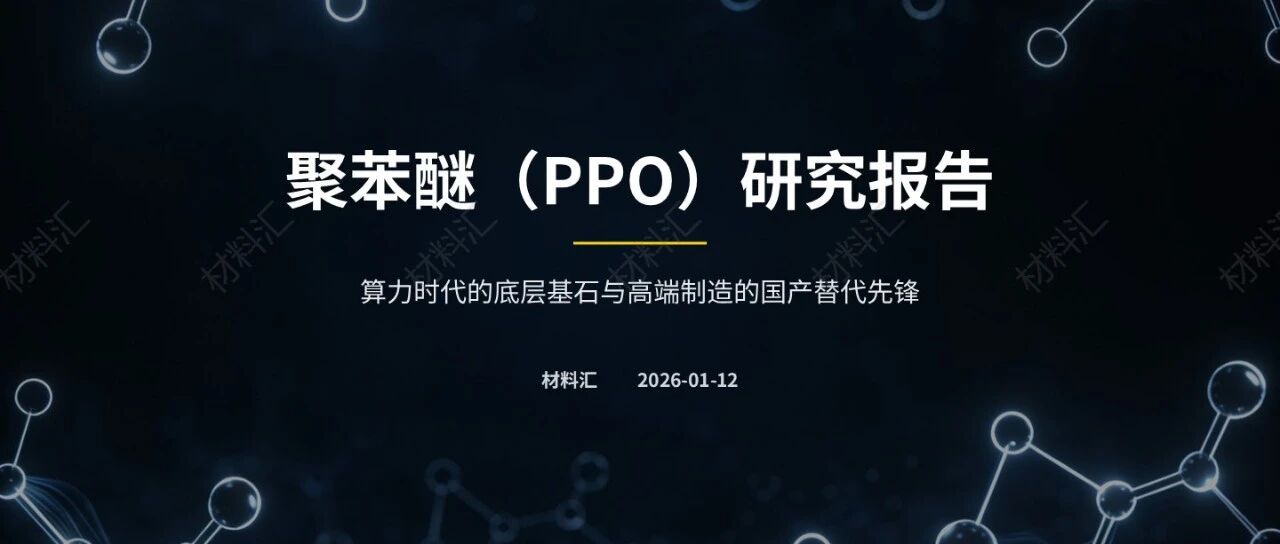
聚苯醚(PPO)研究:算力时代的底层基石与高端制造的国产替代先锋(附42页PPT)
材料汇· 2026-01-12 13:52
Core Viewpoint - The article emphasizes the transformative role of Polyphenylene Oxide (PPO) in various industries, particularly in high-performance applications such as AI servers and electric vehicles, highlighting its transition from a general-purpose material to a strategic specialty material [4][18]. Summary by Sections Introduction - The evolution of engineering plastics, particularly PPO, is linked to significant industrial transformations, akin to the role of steel in the industrial revolution [3]. Overview of PPO - PPO, known for its high production barriers and stringent polymerization processes, is recognized as one of the five major engineering plastics globally [4]. - Its unique molecular structure provides several core physical advantages, including low dielectric loss, excellent thermal stability, and high mechanical strength [7][9][11]. Development History - The commercialization of PPO has evolved through various phases, from initial discovery in the 1950s to the current phase of domestic production breakthroughs in China [12][13]. Classification and Forms of PPO - PPO can be categorized into various types, including pure PPO, modified PPO, and functionalized PPO, each with distinct properties and applications [14][15]. Core Application Scenarios - PPO is extensively used in strategic fields such as new energy vehicles, photovoltaic energy, and aerospace, with its most critical value being in AI servers and data centers due to its low signal loss characteristics [16][17]. Industry Chain Analysis - The PPO industry chain is characterized by high technical and capital intensity, with a clear division from upstream raw materials to downstream applications [20][21]. - The production chain includes the synthesis of the core monomer 2,6-Dimethylphenol, followed by polymerization and modification processes [23][25][29]. Market Analysis - The global PPO market is projected to grow from approximately 22.55 billion yuan in 2023 to nearly 30.68 billion yuan by 2030, with a CAGR of 3.5% [33]. - The Chinese PPO market is also expanding, with a forecasted demand of 245,000 tons by 2030, accounting for 22% of the global market [35]. Supply and Demand Dynamics - The supply side of the PPO market is dominated by a few key players, including SABIC and Asahi Kasei, while domestic production in China is rapidly increasing [39][42]. - Demand drivers include the surge in AI computing needs and the electrification of vehicles, with PPO being essential for high-frequency applications [46][50]. Technical Analysis - PPO's competitive edge lies in its unique molecular structure and the complexity of its polymerization process, which presents significant barriers to entry for new competitors [55][56]. - The modification techniques for PPO are crucial for enhancing its processability and functional properties, enabling its application in high-end markets [59].

66亿元!这家化工巨头出售两大资产
Zhong Guo Hua Gong Bao· 2026-01-12 09:07
Core Viewpoint - Saudi Basic Industries Corporation (SABIC) has agreed to sell its European petrochemical assets and engineering plastics assets in Europe and the Americas for a total value of $950 million (approximately 6.6 billion RMB) [1] Group 1: Asset Sale Details - SABIC is selling its European petrochemical business for an enterprise value of $500 million to German private equity firm Aequita [1] - The engineering plastics business in Europe and the Americas is being sold for an enterprise value of $450 million to Mutares [1] - The European petrochemical business produces and sells ethylene, propylene, low-density polyethylene (LDPE), high-density polyethylene (HDPE), polypropylene (PP), and value-added polymer compounds, managing multiple manufacturing sites in the UK, Germany, the Netherlands, and Belgium [1] Group 2: Asset Composition - The engineering plastics assets sold include various polycarbonate, polybutylene terephthalate, and acrylonitrile-butadiene-styrene facilities located in Brazil, Canada, Mexico, the Netherlands, Spain, and the United States [1] Group 3: Expected Impact - SABIC anticipates that the sale will enhance the company's performance by increasing overall EBITDA, improving free cash flow, and supporting higher capital return rates [1]
科思创展示低碳充电站外壳PC材料
Zhong Guo Hua Gong Bao· 2026-01-07 03:12
Core Viewpoint - The collaboration between Covestro and Pludite at the 2026 CES highlights the launch of the Elite100 low-carbon charging station, which utilizes Covestro's Bayblend RE polycarbonate made from 25% recycled biomass, resulting in a carbon footprint reduction of over 20% compared to traditional models [1] Group 1: Product Features - The Elite100 charging station's shell is made from Covestro's Bayblend RE polycarbonate, which has excellent impact strength and meets UL94V-0 flame retardant standards, ensuring safe operation of the equipment [1] - The new charging station incorporates a 25% share of renewable raw materials, effectively reducing the product's carbon footprint [1] Group 2: Sustainability and Innovation - Bayblend RE is part of Covestro's Circular Economy (CQ) product line, with a minimum of 25% alternative raw material content in CQ-labeled products [1] - The collaboration demonstrates that innovative materials can accelerate the transition to more sustainable solutions in the rapidly growing portable power market, helping customers reduce their environmental footprint and promote the circular economy [1]
如何挖掘新材料进口替代机会?100大新材料国产化详解(附100+行研报告)
材料汇· 2025-12-29 16:01
Semiconductor Wafer Manufacturing Materials - The global photoresist market is projected to reach approximately $15 billion by 2030, with the domestic market expected to grow to 30 billion RMB [4] - The current domestic photoresist localization rate is around 10%, with high-end products heavily reliant on imports [4] - Major foreign companies in the photoresist market include Tokyo Ohka Kogyo, Dow Chemical, and Sumitomo Chemical, which dominate the market shares [5] Silicon Wafers - The global semiconductor silicon wafer market is estimated to exceed $20 billion by 2030, with the domestic market projected to reach about 50 billion RMB [10] - The current localization rate for silicon wafers is approximately 15%, with significant progress in small-sized wafers [11] - Key domestic players include Shanghai Silicon Industry and Zhonghuan Semiconductor, with substantial monthly production capacities [12] Electronic Specialty Gases - The global electronic specialty gas market is expected to reach $12 billion by 2030, with the domestic market projected to grow to 35 billion RMB [14] - The localization rate for electronic specialty gases is around 20%, with some conventional gases showing progress in domestic production [13] - Major foreign companies include Air Products, Linde, and Air Liquide, which hold over 70% of the global market share [13] Target Materials - The global target materials market is projected to exceed $20 billion by 2030, with the domestic market expected to reach 40 billion RMB [15] - The current localization rate for target materials is about 30%, with high-end products still dependent on imports [16] - Leading foreign companies include JX Nippon Mining & Metals and Honeywell, which dominate the market [16] Chemical Mechanical Polishing (CMP) Materials - The global CMP materials market is expected to grow to $4 billion by 2030, with the domestic market projected to reach 7 billion RMB [21] - The current localization rate for CMP materials is around 15%, with domestic companies making strides in the mid-to-low-end market [22] - Major foreign suppliers include Cabot and Hitachi, which hold significant market shares [23] Wet Electronic Chemicals - The global wet electronic chemicals market is projected to reach $9 billion by 2030, with the domestic market expected to grow to 20 billion RMB [24] - The localization rate for wet electronic chemicals is approximately 35%, with better progress in mid-to-low-end products [24] - Key foreign players include BASF and Merck, which dominate the market [24] Photomasks - The global photomask market is expected to exceed $7 billion by 2030, with the domestic market projected to grow to over 12 billion RMB [28] - The current localization rate for photomasks is around 20%, with high-end products still heavily reliant on imports [27] - Major foreign companies include Toppan and Photronics, which hold a significant market share [27] Gallium Nitride (GaN) Materials - The global GaN materials market is projected to reach $5 billion by 2030, with the domestic market expected to grow to 8 billion RMB [30] - The current localization rate for GaN materials is about 30%, with progress in power device applications [30] - Leading foreign companies include Cree and Sumitomo Electric, which dominate the market [30] Silicon Carbide (SiC) Materials - The global SiC materials market is expected to reach $3.5 billion by 2030, with the domestic market projected to grow to 6 billion RMB [31] - The current localization rate for SiC materials is around 25%, with high-end products still dependent on imports [31] - Key foreign players include Cree and II-VI, which hold significant market shares [31] Semiconductor ALD/CVD Precursors - The global ALD/CVD precursors market is projected to exceed $3 billion by 2030, with the domestic market expected to reach 6 billion RMB [32] - The current localization rate for ALD/CVD precursors is about 10%, with high-end products dominated by foreign companies [32] - Major foreign companies include SK Materials and Merck, which hold a significant market share [32]

产能大爆发,原料国产化:尼龙66行业正迎来“黄金十年”?
材料汇· 2025-12-27 15:46
Industry Overview - Nylon 66 (PA66) is recognized as the "crown jewel" of engineering plastics, characterized by its high crystallinity and excellent physical properties due to its symmetrical molecular structure [4][6][18] - The historical development of PA66 reflects significant advancements in synthetic materials, starting from its invention by DuPont in the 1930s to its strategic military applications during World War II and subsequent industrial expansion [8][12][14] - PA66's unique properties, such as high melting point (approximately 260°C), mechanical strength, self-lubrication, and chemical resistance, make it irreplaceable in various applications [18][20][21] Industry Positioning - The PA66 industry is transitioning from a "high premium monopoly" to a "self-controlled" model, as China has made significant breakthroughs in the production of key raw materials, particularly adiponitrile (ADN) [33] - The industry is now viewed as a symbol of China's chemical sector achieving high levels of self-reliance and independence [33] Supply Chain Analysis - The PA66 supply chain is characterized by high barriers to entry and significant global division of labor, with ADN being the critical intermediate that determines the industry's viability [40][41] - The supply chain exhibits a "sandglass" structure, with numerous participants upstream and a concentrated number of key players in the middle [43] - The production of ADN is dominated by a few global giants, and the technology involved is complex, leading to a historical monopoly [48][51] Market Dynamics - The global nylon 66 market has been historically dominated by a few companies, with pricing power held by major players like Invista, Ascend, and BASF [63][65] - The market is experiencing a shift, with China's domestic production capacity rapidly increasing, moving from a net importer to a potential net exporter of nylon 66 [79] - The demand for nylon 66 is expected to grow significantly, particularly in the Asian market, driven by applications in automotive and consumer goods [75][76] Technological Advancements - Continuous polymerization processes and vertical reactors are becoming the industry standard, enhancing efficiency and reducing energy consumption [82][87] - The adoption of advanced technologies in production is crucial for maintaining competitive advantages in the global market [105][107] Downstream Applications - The consumption structure of nylon 66 is highly concentrated, with engineering plastics accounting for approximately 57% and synthetic fibers for about 40% of the market [109]



产能大爆发,原料国产化:尼龙66行业正迎来“黄金十年”?
材料汇· 2025-12-22 14:13
Core Viewpoint - The nylon 66 (PA66) industry is at a pivotal turning point in 2024, driven by domestic technological breakthroughs and the planning of million-ton production capacity, which is expected to dissolve the long-standing foreign monopoly on key raw materials like adiponitrile [2]. Industry Overview - Nylon 66, known as the "king of engineering plastics," is a semi-crystalline thermoplastic resin produced from adipic acid and hexamethylenediamine, characterized by its symmetrical molecular structure that provides high crystallinity and excellent physical properties [4][6]. - The historical development of PA66 reflects significant advancements in synthetic materials, starting from its invention by DuPont in the 1930s to its strategic military applications during World War II, and its subsequent industrial expansion [8][12][14]. - PA66's unique properties, such as high melting point (approximately 260°C), mechanical strength, self-lubrication, and chemical resistance, make it irreplaceable in various applications [18][19][20][21]. Industry Positioning - The PA66 industry is classified as both technology-intensive and capital-intensive, previously dominated by global giants like Invista, Ascend, and BASF. However, with China's advancements in adiponitrile technology, the industry is transitioning from a "noble plastic" to a more generalized engineering plastic [33]. Supply Chain Analysis - The nylon 66 supply chain is characterized by a "sandglass" structure, with numerous participants upstream and a highly concentrated midstream focused on adiponitrile production, which is critical for PA66 manufacturing [40][43]. - Adiponitrile is the key intermediate in the production of nylon 66, and its production technology is complex, with only a few companies globally mastering commercial production [48]. - The global supply landscape for adiponitrile has shifted from a triopoly dominated by Invista, Ascend, and Solvay to a more competitive environment, with China's self-sufficiency in adiponitrile rapidly increasing [51]. Market Analysis - The global nylon 66 market has historically been oligopolistic, with pricing heavily influenced by raw material costs and supply disruptions. However, the market is evolving towards a more competitive landscape as domestic production stabilizes [63][64]. - China's nylon 66 industry is experiencing a significant capacity expansion, transitioning from a net importer to a potential global manufacturing hub, with projections indicating a rise in domestic production capacity to over 200,000 tons by 2027 [69][72]. - The demand for nylon 66 is expected to grow, particularly in the high-end textile market, as price reductions due to increased supply make it more competitive against alternatives like nylon 6 [75]. Technical Analysis - The production process of nylon 66 is shifting towards continuous polymerization methods, particularly using vertical reactors, which enhance efficiency and reduce energy consumption [82][97]. - Continuous polymerization allows for a more stable production process, minimizing quality fluctuations and improving overall yield, which is crucial for meeting the growing demand [90][101]. Downstream Application Analysis - The downstream consumption of nylon 66 is highly concentrated, with engineering plastics accounting for approximately 57% and synthetic fibers for about 40% of the market [109].