
通货紧缩

Search documents
接下来,好好存钱,你就是赢家
大胡子说房· 2025-07-08 12:24
这几年,相信大家都能意识到,此刻 我们正在经历一个财富不断减少的时代。 说一个扎心的数据: 根据机构统计的数据显示,这 几年居民财富 总市值从 400 万亿人民币,降到现在的 300 万亿, 大概损失了 100 万亿左右。 这其中,居民财富主要流失的份额,大多来自于房产。 所以这几年居民的财富缩水,基本上都是因为房子的价格回落。 房子的价格为什么会回落? 你可以说很多的原因,但是最根本的原因只有一个: 通S 在统计局公布的最新数据中,有两个关键的数据值得关注: 第一个 是 PPI数据 ,这项数据代表的是工厂的商品出厂价,下跌了3.3%; 第二个是 CPI数据 ,这项数据代表的是居民端买东西消费的价格,下跌3.6%。 这两个指数双双下跌,可以说紧缩已经形成了大趋势。 但老实说,通S本身其实并不可怕,对于多数人而言,真正可怕的是: 很多人还在用匹配通胀的资产结构应对着通S,做着错误的资产配置。 为什么说现在很多人正在做错误的资产配置? 原因很简单,就是 没有经历过通S 。 这事情其实就和谈恋爱是一样的—— 吃过见过的人,自然能应对自如;没有经历过的人,肯定要交学费。 可以说 过去这40年以来,我们从来没经历过这么 ...


接下来,好好存钱,你就是赢家
大胡子说房· 2025-07-05 04:50
Core Viewpoint - The article discusses the significant reduction in household wealth in China, primarily attributed to the decline in real estate prices, and emphasizes the need for a shift in asset allocation strategies in response to the current economic environment characterized by deflation [2][3][4][15]. Group 1: Wealth Reduction - Household wealth in China has decreased from 400 trillion RMB to 300 trillion RMB, resulting in a loss of approximately 100 trillion RMB [2]. - The primary source of this wealth loss is the decline in real estate prices [3][4]. Group 2: Economic Indicators - Key economic indicators show a downward trend: the Producer Price Index (PPI) has dropped by 3.3%, and the Consumer Price Index (CPI) has decreased by 3.6% [5]. - The simultaneous decline in both indices indicates a broader trend of economic tightening [6]. Group 3: Asset Allocation Misconceptions - Many individuals are making incorrect asset allocation decisions due to a lack of experience with deflationary periods [7][8]. - The current economic environment is characterized by negative real interest rates, where holding cash is less beneficial compared to leveraging debt to acquire assets [12][13]. Group 4: Historical Context and Lessons - The article draws parallels with historical deflationary periods in other countries, such as Japan in the 1990s and the U.S. during the Great Depression, highlighting the importance of adapting to changing economic conditions [17][18]. - It suggests that understanding the significance of saving and adjusting asset allocation strategies is crucial for navigating the current economic cycle [17]. Group 5: Structural Economic Issues - There is a structural contradiction in the economy where older generations hold wealth but have declining consumption capacity, while younger generations lack wealth and purchasing power [21][22]. - This disparity complicates the resolution of the current economic challenges, which may persist for an extended period [24]. Group 6: Recommended Strategies - To navigate the deflationary environment, it is advised to shift towards low-risk, stable income-generating assets, with a recommendation to hold 60% to 80% of household wealth in cash or similar assets [30][33]. - The focus should be on preserving capital rather than chasing high-risk returns during this period [34].

瑞士通胀反弹,但仍接近通缩水平
news flash· 2025-07-03 06:44
Core Viewpoint - Switzerland's inflation rate has increased in June but remains close to deflation levels, indicating a potential for the Swiss National Bank to lower interest rates below zero later this year [1] Group 1: Inflation Data - The annual inflation rate in Switzerland for June rose by 0.1% compared to the same month last year, while the inflation rate for May was -0.1% [1] - The Consumer Price Index (CPI) reflects this slight increase, suggesting a modest recovery in price levels [1] Group 2: Monetary Policy Implications - The Swiss National Bank lowered the benchmark interest rate to zero last month to curb demand for the Swiss franc [1] - The rapid appreciation of the Swiss franc has negatively impacted demand for Swiss exports, including luxury watches and pharmaceuticals [1] Group 3: Currency Impact - Since the beginning of the year, the Swiss franc has appreciated nearly 15% against the US dollar, leading to lower prices for imported goods and services [1] - This currency strength has contributed to a downward spiral in inflation rates within Switzerland [1]
接下来,好好存钱,你就是赢家
大胡子说房· 2025-07-02 12:47
Core Viewpoint - The article discusses the significant reduction in household wealth in recent years, primarily attributed to the decline in real estate prices, and emphasizes the need for a shift in asset allocation strategies in response to the current economic environment characterized by deflation [2][3][4][15]. Group 1: Wealth Reduction - Household wealth has decreased from 400 trillion RMB to 300 trillion RMB, resulting in a loss of approximately 100 trillion RMB [2]. - The primary source of this wealth loss is the decline in real estate prices [3][4]. Group 2: Economic Indicators - Key economic indicators show a downward trend: PPI has decreased by 3.3% and CPI has decreased by 3.6%, indicating a tightening economic environment [5][6]. Group 3: Asset Allocation Misconceptions - Many individuals are making incorrect asset allocation decisions due to a lack of experience with deflationary periods [7][8][10]. - The article compares the situation to relationships, suggesting that those who have not experienced deflation are likely to make costly mistakes [9]. Group 4: Characteristics of Deflation - The defining characteristic of a deflationary period is negative real interest rates, where debt can become an asset [12]. - In a deflationary environment, saving money is less advantageous, and leveraging debt to acquire assets can be more profitable [13][14]. Group 5: Long-term Economic Transition - The current economic transition may last 10 to 20 years, similar to historical events in Japan, the U.S., and South Korea [17][18]. - The article highlights the structural issues in wealth distribution, where older generations hold wealth but have declining consumption capacity, while younger generations lack wealth accumulation [21][22][23]. Group 6: Strategies for Navigating Deflation - To navigate deflation, individuals should focus on stable income-generating assets rather than riskier investments [30][31]. - The recommendation is to hold 60% to 80% of household wealth in low-risk, stable income assets to protect against wealth erosion during deflation [33]. Group 7: Future Considerations - Unless significant changes in wealth distribution policies occur, or a major bull market emerges, the focus should remain on preserving capital rather than chasing high-risk returns [32][34].

接下来,好好存钱,你就是赢家
大胡子说房· 2025-06-28 04:58
说一个扎心的数据: 根据机构统计的数据显示,这 几年居民财富 总市值从 400 万亿人民币,降到现在的 300 万亿, 大概损失了 100 万亿左右。 这其中,居民财富主要流失的份额,大多来自于房产。 所以这几年居民的财富缩水,基本上都是因为房子的价格回落。 这几年,相信大家都能意识到,此刻 我们正在经历一个财富不断减少的时代。 房子的价格为什么会回落? 你可以说很多的原因,但是最根本的原因只有一个: 通S 在统计局公布的最新数据中,有两个关键的数据值得关注: 第一个 是 PPI数据 ,这项数据代表的是工厂的商品出厂价,下跌了3.3%; 第二个是 CPI数据 ,这项数据代表的是居民端买东西消费的价格,下跌3.6%。 这两个指数双双下跌,可以说紧缩已经形成了大趋势。 但老实说,通S本身其实并不可怕,对于多数人而言,真正可怕的是: 很多人还在用匹配通胀的资产结构应对着通S,做着错误的资产配置。 为什么说现在很多人正在做错误的资产配置? 通Z周期最大的特点是什么? 我认为就一个—— 实际利率为负,负债其实就是资产 。 别看之前通Z的时候银行的利率能高到5%甚至6%,实际上如果你把通胀率算上,每年增加7%-8% 的M ...

泰国央行:不存在通货紧缩的风险。
news flash· 2025-06-25 07:49
Core Viewpoint - The Bank of Thailand asserts that there is no risk of deflation in the economy [1] Group 1 - The central bank emphasizes that inflation remains stable and does not indicate any signs of deflation [1] - Economic indicators suggest a steady growth trajectory, supporting the central bank's position on inflation [1] - The Bank of Thailand plans to monitor economic conditions closely to ensure stability [1]
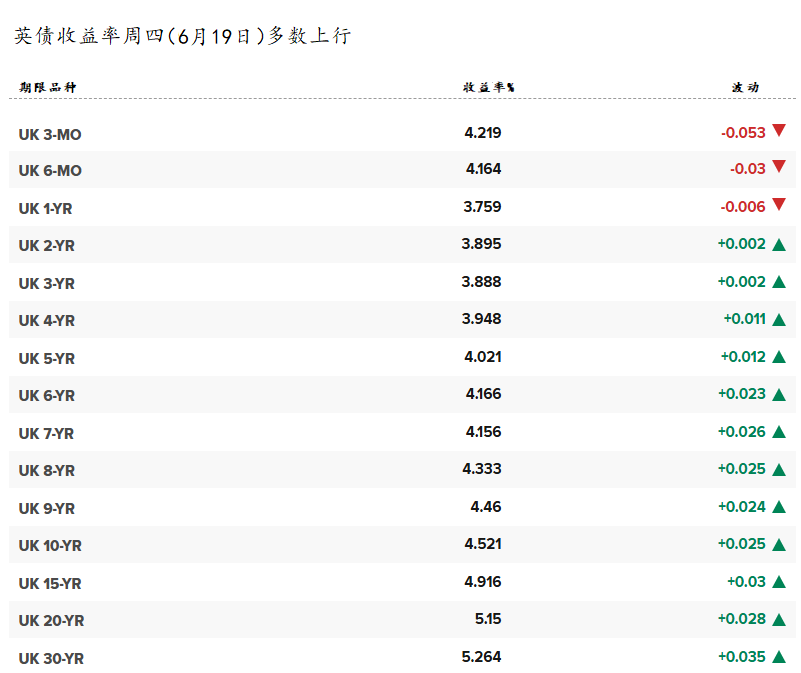
英国央行维持利率不变 英债收益率多数上行
Xin Hua Cai Jing· 2025-06-19 13:44
Group 1 - The Bank of England maintained its benchmark interest rate at 4.25%, with economists expecting a potential rate cut in August [1][3] - Following the announcement, there was a sell-off in medium to long-term UK bonds, with the 2-year bond yield rising by 0.5 basis points to 3.898% and the 10-year bond yield increasing by 3.1 basis points to 4.527% [1] - The monetary policy committee showed a split decision, with 6 members voting to keep rates unchanged and 3 members favoring a 25 basis point cut [3] Group 2 - The UK economy showed signs of weakness, with a 0.3% contraction in April, leading to concerns about the timing of potential rate cuts [4] - Recent inflation data indicated a year-on-year rate of 3.4% in May, which is above the Bank of England's target of 2% [3][4] - Analysts expect the Bank of England to cut rates by 25 basis points in August and again in the fourth quarter [4] Group 3 - The Swiss National Bank lowered its interest rate to 0%, raising concerns about the potential return of negative interest rates [4][5] - The European bond market experienced slight fluctuations, with German and Italian bond yields rising marginally [5] - The Federal Reserve maintained its overnight interest rate target range at 4.25%-4.50%, indicating potential future rate cuts [6]
两大央行,同日降息!
证券时报· 2025-06-19 11:02
两家央行同日降息 降息! 继昨日瑞典央行宣布降息后,瑞士央行和挪威央行也在19日宣布,将基准利率下调25个基点。分析认为,随着经济复苏力度减弱,以及物价持续回落,欧洲国家不 得不通过降息来刺激经济的发展。 根据公告,挪威央行将其主要存款利率下调25个基点至4.25%,出乎调查的所有经济学家预料,没有一位经济学家预期会出现调整。随后,瑞士央行也宣布将利率 进一步下调25个基点至0%,为2024年3月以来的第6次降息,这增加了人们对负利率可能回归的担忧。 这是继18日瑞典央行降息后,再有两家欧洲央行宣布降息。 记者查询挪威央行和瑞士央行的公告发布,物价的持续回落,以及对经济复苏的担忧是两国央行降息的主要原因。 挪威央行官员表示,如果经济总体发展符合目前预测,政策利率将在2025年进一步下调。"自3月份货币政策会议以来,通胀已经下降,未来一年的通胀前景表明会 低于此前预期。"挪威央行行长Ida Wolden Bache说道,"谨慎地将政策利率正常化,将为通胀回归目标水平奠定基础,同时又不会对经济造成不必要的限制。" 挪威央行意外宣布下调基准利率,是自新冠疫情后的首次降息,并表示今年还将进一步调降。 瑞士央行则在声明 ...

利率又降了,但我劝你尽快存钱
大胡子说房· 2025-06-12 11:53
Core Viewpoint - The article argues that in a low interest rate environment, saving money is more beneficial than investing, as banks are unable to find high-yield investment opportunities, indicating a pessimistic economic outlook [1][2]. Group 1: Economic Indicators - The two key indicators to assess the current economic situation are interest rates and gold prices [2]. - High interest rates lead to losses in savings, while low interest rates make saving more profitable [2]. - The price of gold has risen significantly from over 300 to nearly 800 per gram since 2022, reflecting a lack of stable high-yield investments [2]. Group 2: Historical Context - Historical data shows that during economic crises, gold prices tend to rise while returns on stocks, funds, and bonds are lower than savings [2]. - The highest historical savings rates occurred in 1993, with 1-year and 5-year rates at 10.98% and 13.86%, respectively, driven by high inflation rates of 20%-30% [4]. - The period from 2011 to 2018 saw a decline in gold prices, coinciding with a rapid increase in real estate prices [3]. Group 3: Saving Strategies - The primary purpose of saving money now is to preserve capital rather than to earn interest [5][6]. - Suggested saving methods include: - Keeping money in a bank for a low interest rate, with options like large time deposits offering slightly higher returns [7]. - Investing in bank stocks, which provide stable dividends of 5-8%, aligning with the trend of increased capital flow into bank stocks due to new regulations on public funds [8]. - Allocating funds to professional institutions for diversified asset management, which can offer lower-risk investments with guaranteed returns [9].

欧洲央行管委Vujcic:欧洲央行在利率方面处于非常有利的地位。欧洲央行可以等待新的预测和数据,然后再采取下一步行动。希望我们能在9月份之前有关税方面更明确的信息。不知道美国的关税是(导致)通货紧缩还是通货膨胀。不稳定的美国政策正推动投资者转向欧元。
news flash· 2025-06-10 13:45
欧洲央行管委Vujcic:欧洲央行在利率方面处于非常有利的地位。 欧洲央行可以等待新的预测和数据,然后再采取下一步行动。 希望我们能在9月份之前有关税方面更明确的信息。 不知道美国的关税是(导致)通货紧缩还是通货膨胀。 不稳定的美国政策正推动投资者转向欧元。 ...