
生态文明建设

Search documents
绘就美丽中国画卷 推动生态文明建设再上新台阶
Ren Min Ri Bao· 2025-08-06 22:49
Core Viewpoint - The construction of a beautiful China is positioned as a prominent goal in the modernization of the country and the rejuvenation of the nation, emphasizing ecological civilization as a key component of the Chinese Dream [1][2]. Group 1: Importance of Ecological Civilization - The construction of a beautiful China is a strategic deployment by the central government to achieve harmony between humans and nature, responding to the people's aspirations for a better life [2][3]. - The emphasis on ecological protection is seen as essential for sustainable social development, with a commitment to prioritize ecological civilization in national work [2][4]. Group 2: Green Development and High-Quality Growth - The integration of ecological protection with economic development is crucial, with the idea that protecting the environment equates to protecting productivity [3][5]. - The government aims to optimize land use, promote green and low-carbon development, and ensure that ecological protection supports high-quality economic growth [3][6]. Group 3: Public Welfare and Environmental Justice - A good ecological environment is viewed as a fundamental public good and a vital aspect of people's well-being, with increasing demand for clean water and air [4][5]. - The government is committed to addressing environmental equity and enhancing public engagement in ecological protection efforts [4][6]. Group 4: Progress and Achievements - Since the 18th National Congress, significant progress has been made in ecological protection, with policies aimed at reducing carbon emissions and promoting resource recycling [5][6]. - Major ecological projects have been implemented, resulting in increased forest coverage and improved water quality in key regions [6][7]. Group 5: Future Directions - The government plans to continue promoting green transformation across all sectors, focusing on energy conservation and carbon reduction [7][8]. - There is an emphasis on establishing a market-oriented ecological compensation system to incentivize ecological protection and sustainable development [8].


保护生态环境就是保护生产力
Jing Ji Ri Bao· 2025-08-06 22:19
Group 1 - The core viewpoint emphasizes that a good ecological environment is fundamental for human survival and development, highlighting the need to balance economic development with ecological protection for sustainable growth [1][2] - The relationship between ecological protection and economic development is described as dialectical, where protecting the environment is seen as protecting productivity, thus creating a new understanding of Marxist productivity theory [2][3] - Since the 18th National Congress, the Chinese government has integrated ecological civilization construction into the overall layout of socialism with Chinese characteristics, achieving significant economic growth alongside environmental improvements [2][3] Group 2 - The new journey requires a firm establishment of the idea that "protecting the ecological environment is protecting productivity," promoting the development of green productivity to support high-quality development [3] - Encouragement of environmentally friendly industries tailored to local conditions is essential, with a focus on developing ecological agriculture, tourism, and other strategic emerging industries [3] - The need for technological innovation in green productivity is highlighted, with an emphasis on increasing investment in low-carbon technologies and improving resource utilization efficiency [3]
环保设施开放里的治理之道(人民时评)
Ren Min Ri Bao· 2025-08-06 22:11
Core Viewpoint - The opening of environmental facilities to the public serves as a window to observe the effectiveness of building a beautiful China and as a tool to strengthen ecological environment protection and governance [1][3]. Group 1: Public Engagement and Awareness - The initiative to open environmental facilities allows the public to experience firsthand the role of technology in pollution reduction and carbon neutrality, enhancing ecological awareness among citizens [1][2]. - Currently, there are 2,512 environmental facilities open to the public across all prefecture-level cities in China, covering both traditional and new categories of environmental management [1][2]. - Engaging the public through facility visits helps to build consensus on ecological civilization and promotes environmental knowledge dissemination [1][2]. Group 2: Trust and Participation - Public access to environmental facilities is an effective way to ensure the public's right to know and supervise environmental governance, reducing misunderstandings and increasing trust between the government, enterprises, and the public [2][3]. - Initiatives like inviting local residents to observe operations in the petrochemical industry help to change negative perceptions and encourage public participation in environmental oversight [2]. Group 3: Innovative Approaches to Governance - The methods of opening environmental facilities have evolved from traditional in-person visits to include online live streaming, allowing real-time access to operational data and enhancing public supervision [3]. - The shift towards proactive governance in environmental management is supported by the increased visibility and accessibility of environmental facilities, fostering a culture of accountability among enterprises [3].
杭州高水平打造“绿水青山就是金山银山”理念实践鲜活样本
Zhong Guo Huan Jing Bao· 2025-08-06 01:35
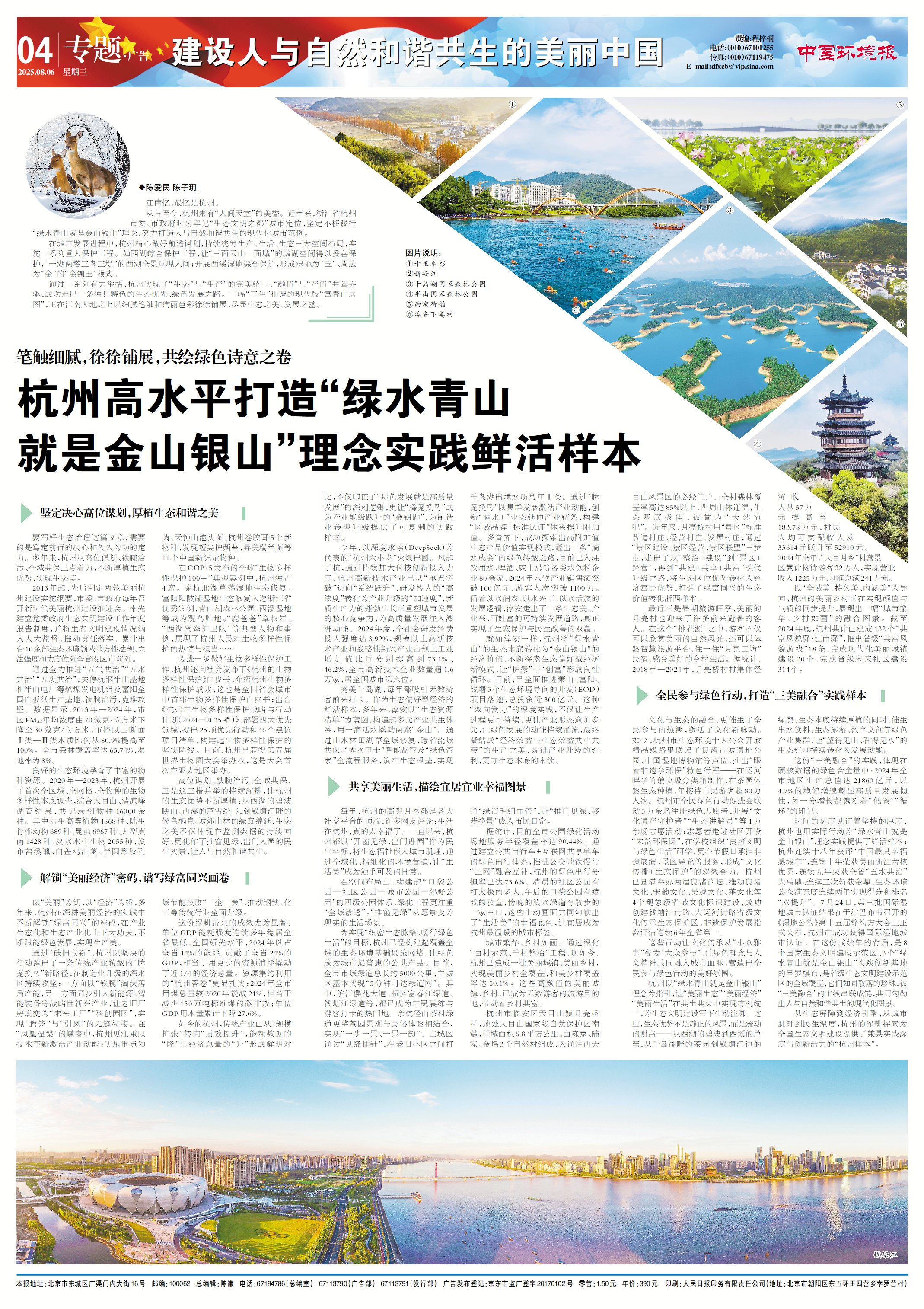
Core Viewpoint - Hangzhou is committed to ecological civilization and sustainable development, successfully integrating ecological beauty with economic growth, showcasing a unique model of green development and harmonious coexistence between humans and nature [5][6][10]. Group 1: Ecological Initiatives - Since 2013, Hangzhou has implemented multiple ecological protection measures, including the "Beautiful Hangzhou" construction guidelines and strict pollution control, resulting in a significant reduction in PM2.5 levels from 70 µg/m³ to 30 µg/m³ by 2024 [8][10]. - The city has achieved a forest coverage rate of 65.74% and a wetland rate of 8%, enhancing its ecological advantages [8][9]. - A comprehensive biodiversity survey recorded over 16,000 species, highlighting Hangzhou's commitment to biodiversity protection, with four projects recognized in the global "Biodiversity Conservation 100+" initiative [9][10]. Group 2: Economic Transformation - Hangzhou has shifted from traditional industrial expansion to quality improvement, achieving a 21% reduction in coal consumption since 2020, equivalent to a decrease of 1.5 million tons of standard coal emissions [14][15]. - The city’s high-tech industries have seen a significant increase, with R&D expenditure reaching 3.92% of GDP, and high-tech enterprises exceeding 16,000, ranking sixth among Chinese cities [16][17]. - The "green economy" model has been successfully implemented, with the water beverage industry sales projected to exceed 16 billion yuan in 2024, demonstrating the economic benefits of ecological preservation [16][17]. Group 3: Community and Cultural Engagement - Hangzhou promotes community involvement in ecological initiatives, with over 30,000 registered volunteers participating in various environmental activities, fostering a culture of sustainability [24][25]. - The city has developed a network of ecological infrastructure, including approximately 5,000 kilometers of greenways, enhancing public access to green spaces and promoting a green lifestyle [18][19]. - The integration of cultural heritage and ecological awareness has led to increased public participation in environmental protection, transforming cultural preservation into a community-wide effort [24][25]. Group 4: Overall Achievements - Hangzhou's GDP reached 21.86 billion yuan in 2024, with a growth rate of 4.7%, reflecting the city's commitment to high-quality, low-carbon development [25][26]. - The city has received multiple accolades for its ecological efforts, including the title of "Most Livable City in China" for 18 consecutive years and successful certification as an international wetland city [26].
以高质量政治监督守护高品质生态环境
Zhong Yang Ji Wei Guo Jia Jian Wei Wang Zhan· 2025-08-05 23:59
建设生态文明,关系人民福祉,关乎民族未来。习近平总书记要求,必须牢固树立和践行绿水青山就是 金山银山的理念,站在人与自然和谐共生的高度谋划发展。河南省纪委监委牢牢把握政治机关定位,以 具体化、精准化、常态化政治监督,为建设人与自然和谐共生的美丽河南提供坚强保障。 聚焦常态长效,注重在融入日常上下功夫。开展政治监督,贵在经常、要在坚持,必须聚焦"国之大 者",把政治监督做在经常、融入日常、形成长效,将监督成果及时转化为治理效能。河南省纪委监委 认真贯彻执行党中央关于生态文明建设和生态环境保护的方针政策和决策部署,持续加强生态环境领域 政治监督统筹协调,督促相关职能部门积极推进污染防治、生态保护、绿色低碳等任务落实。加强跨地 区跨部门重大战略落实情况协调监督,与中央纪委国家监委驻水利部纪检监察组、驻中国南水北调集团 有限公司纪检监察组建立协作联动机制,协同职能部门对环评审批等重点领域开展监督检查,健全"省 市县三级联动+跨部门协作"机制,不断提高政治监督质效。紧盯政商勾连、破坏生态环境的严重违纪 违法案件,深挖案件背后的责任、作风和腐败问题,严肃查处生态环境领域严重违纪违法案件。如,济 源产城融合示范区纪工委监察 ...
第二次东盟国家议员研讨班在昆明结业
Ren Min Ri Bao· 2025-08-05 22:21
Core Points - The seminar aimed to strengthen legislative cooperation among ASEAN countries and promote the construction of a closer China-ASEAN community of shared future [1] - Participants included 23 legislators and senior officials from five Southeast Asian countries: Cambodia, Laos, Malaysia, Thailand, and Vietnam [1] Group 1 - The seminar took place in Kunming, Yunnan, and concluded on August 5 [1] - Participants visited Beijing, Nanjing, and Kunming to examine various projects related to rural revitalization, connectivity, high-tech, digital economy, cultural tourism, and grassroots legislative contact points [1] - The event included thematic discussions on experiences in economic, political, cultural, social, and ecological civilization construction, facilitating in-depth exchanges with relevant Chinese government officials and experts [1]
【美丽四川】你好,曾家山!‖应德
Sou Hu Cai Jing· 2025-08-05 08:54
Core Viewpoint - The article highlights the transformation of Zengjiashan from a historically isolated and underdeveloped area to a popular summer retreat, emphasizing its natural beauty and potential for tourism and ecological development [5][11][15]. Group 1: Historical Context - Zengjiashan, previously known as Daman Tianling and Gaoben Mountain, has a history of being underdeveloped due to its geographical isolation and lack of agricultural and industrial resources [5][8]. - The region was characterized by poor agricultural conditions and a lack of industrial development, leading to a perception of poverty and isolation among its inhabitants [8]. Group 2: Current Development - The area has seen significant development in the 21st century, driven by factors such as global warming, urbanization, and a shift towards ecological civilization [11][15]. - Zengjiashan is now recognized as a wellness destination, with a comfortable summer climate averaging 23 degrees Celsius and abundant natural resources [7][15]. - The integration of tourism, agriculture, and local culture has led to a thriving economy, with an emphasis on sustainable practices and ecological products [15]. Group 3: Future Potential - The article suggests that Zengjiashan's development is a model for leveraging local resources and comparative advantages to achieve economic growth and ecological sustainability [15]. - The region's transformation reflects broader trends in rural development and the importance of adapting to changing environmental and market conditions [15].

“人权行动看中国·2025”中外媒体内蒙古行采访活动启动
Nei Meng Gu Ri Bao· 2025-08-05 02:13
Core Viewpoint - The event "Human Rights Action Looking at China 2025" aims to showcase Inner Mongolia's achievements in ecological development and human rights through a media tour involving international journalists and experts [1] Group 1: Event Overview - The media tour was launched on August 4 in Xilin Gol League, focusing on "Green Development and Harmonious Coexistence" as its theme [1] - Participants include over 40 journalists from 10 countries, along with social media influencers and representatives from major Chinese media outlets [1] Group 2: Objectives and Activities - The tour will last for 7 days, during which the group will visit Xilin Gol League and Hinggan League [1] - The aim is to conduct on-site interviews and experiential reporting to highlight Inner Mongolia's policies and achievements in ecological civilization, ethnic unity, and improving people's livelihoods [1] - The event seeks to narrate the story of human rights in the context of Inner Mongolia's development [1]
《重庆市生态文明宣传教育条例》自2025年10月1日起施行
Zhong Guo Fa Zhan Wang· 2025-08-04 12:31
Core Points - The "Chongqing Ecological Civilization Promotion and Education Regulations" was passed and will be implemented starting October 1, 2025, aiming to enhance ecological environment protection and promote ecological civilization construction in Chongqing [1] Group 1: Legislative Framework - The regulations consist of 5 chapters and 34 articles, summarizing the experiences and practices in ecological environment promotion and education in Chongqing [1] - The regulations focus on four key areas: responsibility implementation, ecological civilization promotion, ecological education, and supervision and guarantee [1] Group 2: Responsibility and Participation - The regulations establish a clear responsibility framework for ecological civilization promotion, emphasizing government leadership, departmental collaboration, and broad social participation [2] - Responsibilities are divided among municipal and district-level governments, relevant departments, enterprises, and social organizations [2] Group 3: Communication and Education - The regulations encourage the integration of various communication channels, including government announcements and social media, to promote ecological civilization content [3] - They promote the creation and dissemination of ecological-themed cultural works and encourage local ecological culture promotion through festivals and tourism [3][4] Group 4: Educational Integration - The regulations mandate the inclusion of ecological civilization education in training for civil servants, enterprise staff, and school curricula, targeting different educational levels [4] - They emphasize a collaborative educational approach involving families, schools, and communities to create a comprehensive educational network [5] Group 5: Resource Sharing and Support - The regulations establish a multi-source funding mechanism for ecological civilization promotion and education, facilitating resource and information sharing [6]
“绿水青山就是金山银山”理念提出二十年—— 为世界生态文明发展贡献中国智慧(权威论坛)
Ren Min Ri Bao· 2025-08-03 22:15
Core Concept - The "Two Mountains" concept emphasizes the unity of economic development and ecological protection, highlighting that protecting the environment is equivalent to protecting productivity and improving the environment leads to the development of productivity [1][2][3] Theoretical Innovation - The "Two Mountains" concept represents a theoretical innovation that unifies economic development and ecological protection, breaking away from the traditional Western paradigm that views them as oppositional [2][3] - It introduces the concept of "ecological products," linking natural ecological functions with economic value, and recognizes that protecting nature enhances its value, thus contributing to productivity [2][3] Practical Innovation - The "Two Mountains" concept provides a practical guide for building a modern society where humans and nature coexist harmoniously, supported by top-level design and innovative mechanisms [5][6] - China has made significant progress in pollution prevention, biodiversity protection, and climate change mitigation, demonstrating effective ecological governance [5][6] Global Contribution - The "Two Mountains" concept promotes green international cooperation, offering a framework for developing countries to achieve green transformation while avoiding the pitfalls of traditional industrialization [8][9] - It aligns with the United Nations' sustainable development goals, providing a model for ecological governance and sustainable growth [9][10]