数字孪生

Search documents
达实智能涨2.08%,成交额1.04亿元,主力资金净流入471.18万元
Xin Lang Cai Jing· 2025-11-10 02:59
Core Viewpoint - The stock of Dasan Intelligent has shown a decline of 14.16% year-to-date, with significant recent trading activity and a notable drop in revenue and profit for the year [1][2]. Group 1: Stock Performance - On November 10, Dasan Intelligent's stock rose by 2.08%, reaching 2.94 CNY per share, with a trading volume of 1.04 billion CNY and a turnover rate of 1.78%, resulting in a total market capitalization of 62.35 billion CNY [1]. - Year-to-date, the stock has decreased by 14.16%, with a 10.09% drop over the last five trading days, a 13.53% decline over the last 20 days, and a 14.04% decrease over the last 60 days [1]. - The stock has appeared on the "Dragon and Tiger List" once this year, with the most recent occurrence on November 4, where it recorded a net purchase of 71.34 million CNY [1]. Group 2: Company Overview - Dasan Intelligent, established on March 17, 1995, and listed on June 3, 2010, is based in Shenzhen, Guangdong Province, and specializes in building intelligence and energy-saving services [2]. - The company's main business segments include smart space solutions (79.25% of revenue), smart space products and technical services (12.60%), and smart space operation services and others (8.15%) [2]. - As of September 30, the number of shareholders increased by 8.33% to 129,500, while the average circulating shares per person decreased by 7.69% to 15,490 shares [2]. Group 3: Financial Performance - For the period from January to September 2025, Dasan Intelligent reported a revenue of 1.473 billion CNY, a year-on-year decrease of 31.36%, and a net profit attributable to shareholders of -415 million CNY, reflecting a significant year-on-year decline of 964.15% [2]. - The company has distributed a total of 540 million CNY in dividends since its A-share listing, with 180 million CNY distributed over the past three years [3]. Group 4: Institutional Holdings - As of September 30, 2025, the top ten circulating shareholders include Southern CSI 1000 ETF, holding 19.3932 million shares (a decrease of 247,100 shares), and Hong Kong Central Clearing Limited, holding 16.5015 million shares (an increase of 16,500 shares) [3].

众合科技涨2.10%,成交额9246.75万元,主力资金净流入251.34万元
Xin Lang Zheng Quan· 2025-11-10 02:32
Core Insights - The stock price of Zhonghe Technology increased by 2.10% on November 10, reaching 8.28 CNY per share, with a market capitalization of 5.6 billion CNY [1] - The company has experienced a year-to-date stock price decline of 4.50%, but has seen a recent increase of 5.48% over the last five trading days [1] Financial Performance - For the period from January to September 2025, Zhonghe Technology reported a revenue of 1.446 billion CNY, representing a year-on-year growth of 31.47% [2] - The net profit attributable to shareholders was -46.22 million CNY, showing a year-on-year increase of 47.01% [2] Business Overview - Zhonghe Technology's main business segments include rail transit systems (54.76% of revenue), monocrystalline silicon and its products (32.74%), automatic ticketing systems (9.01%), smart products (2.24%), and others (1.25%) [1] - The company is classified under the mechanical equipment industry, specifically in rail transit equipment [2] Shareholder Information - As of September 30, the number of shareholders for Zhonghe Technology was 48,600, a decrease of 7.08% from the previous period [2] - The average number of circulating shares per shareholder increased by 7.62% to 13,847 shares [2] Dividend Information - Since its A-share listing, Zhonghe Technology has distributed a total of 78.68 million CNY in dividends, with 10.04 million CNY distributed over the last three years [3]

南京进博会上“链”全球
Nan Jing Ri Bao· 2025-11-10 02:13
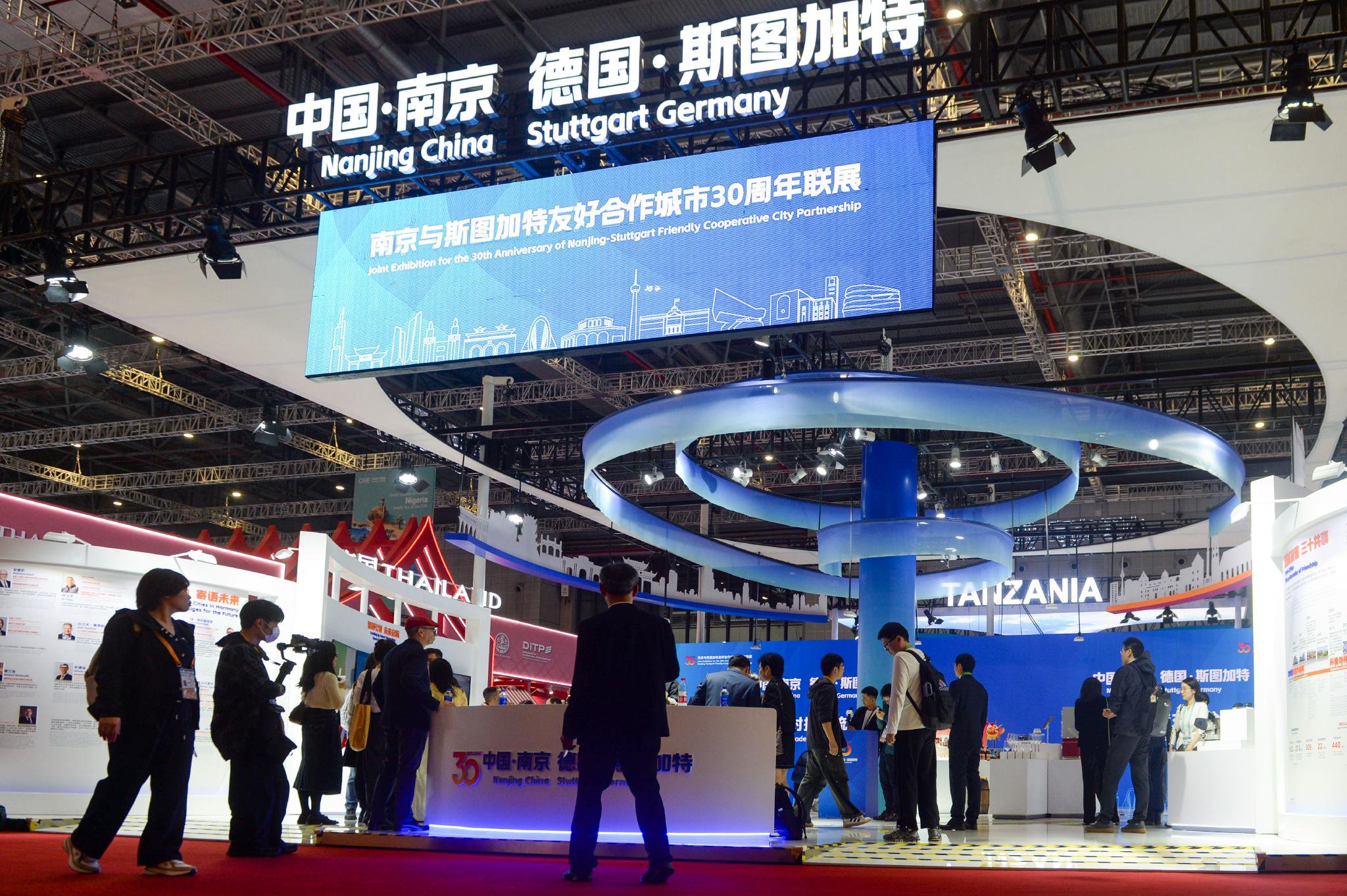
Group 1 - The 8th China International Import Expo is held in Shanghai from November 5 to 10, showcasing Nanjing's high-level openness through various economic and cultural exchange activities [1] - The "Nanjing and Stuttgart Friendly Cooperation City 30th Anniversary Exhibition" attracts numerous visitors [3] - The Jiangsu Cultural Exchange Exhibition area features the "Su Chao" championship trophy, drawing attention [5] Group 2 - Siemens showcases a 3D collaboration and verification platform using AI and digital twin technology, engaging visitors with a mechanical arm puzzle [7] - Su Mei Da Co., Ltd. presents a manned aircraft at the technology equipment exhibition area, capturing audience interest [9] - The exhibition area for friendly cities features Nanjing and Stuttgart, highlighting 30 years of cooperation in trade, technology, and culture under the theme "Double City Craftsmanship, Win-Win Future" [12] Group 3 - The Jiangsu Cultural Exchange Exhibition area prominently features Nanjing's traditional crafts, with seven time-honored brands showcasing new products and interactive experiences [15] - Nanjing Yunjin Research Institute presents innovative works that blend traditional craftsmanship with modern technology, demonstrating the heritage and evolution of Chinese intangible cultural heritage [17] - The "Jinling Elegance" section of the Jiangsu exhibition showcases the cultural charm and consumer trends of the ancient capital, with local enterprises presenting high-end equipment and AI technology [19]


跨境通赔零障碍 千亿元保障全覆盖 中国人保为全运会织密风险防控网
Jin Rong Shi Bao· 2025-11-10 02:00
Core Viewpoint - The 15th National Games, hosted by Guangdong, Hong Kong, and Macau, marks a significant milestone as the largest and highest-level comprehensive sports event in China, with China Life Insurance acting as the official partner to provide extensive risk management and insurance services [1] Group 1: Insurance and Risk Management Strategy - China Life Insurance adopts a "risk reduction" approach, transitioning from traditional post-event compensation to proactive risk management and control during the event [2] - The company utilizes its proprietary "Wandering Cloud" platform, integrating AI, big data, IoT, and digital twin technologies to create a comprehensive service system covering pre-event prevention, in-event monitoring, and emergency simulations [2][3] - A "Sports Center Risk Database" has been established, combining historical insurance claims data, meteorological information, and technical standards to formulate scientific risk reduction recommendations [2] Group 2: Monitoring and Emergency Preparedness - Key areas such as power distribution rooms and fire control centers are equipped with IoT monitoring devices, while drones are deployed for 24-hour dynamic monitoring of venue safety [3] - Digital twin technology is employed to create virtual models of critical venues, allowing for simulations of emergencies like fires and power outages, thereby optimizing emergency response plans [3] Group 3: Comprehensive Insurance Coverage - China Life Insurance has developed a tailored "full-process, multi-dimensional, integrated" insurance plan that covers all aspects of risk from participants to venues, providing over 100 billion yuan in insurance coverage [4] - The insurance products include venue property insurance, personal accident insurance, public liability insurance, and organizer liability insurance, addressing the unique needs of large-scale events [4] Group 4: Cross-Border Claims Mechanism - A collaborative claims mechanism has been established to address the challenges of cross-border insurance services, ensuring information sharing and mutual recognition of claims standards among Guangdong, Hong Kong, and Macau [5] - A dedicated green claims channel allows participants to enjoy "on-site claims" regardless of where the incident occurs, streamlining the claims process [5][6] - For Hong Kong and Macau participants, a specialized service window has been set up to ensure claims are processed within 8 hours, enhancing service efficiency and convenience [7]

中国一汽“智能网联、智能驾驶汽车产线整车智能检测装备”成功入选“智能制造装备创新成果”
Zhong Guo Jin Rong Xin Xi Wang· 2025-11-10 01:59
Core Insights - The 2025 Automotive Technology and Equipment Development Forum highlighted the innovative achievements in automotive technology, with China First Automobile Works (FAW) recognized for its "Intelligent Connected and Autonomous Vehicle Production Line Intelligent Testing Equipment" [1] - The project addresses three major bottlenecks in traditional automotive manufacturing and testing: difficulty in intelligent function verification, insufficient flexible production capacity, and lack of core equipment and standards [1] Innovation Highlights - The project is not a single device but an AI-driven "intelligent testing body" that integrates digital twin mapping and cloud-edge collaboration, achieving four major technological breakthroughs [2] - It features the first AI model-enabled "intelligent testing body" and "brain-like diagnosis," covering the entire automotive manufacturing process with AI decision-making capabilities [2] - The project developed the world's first high-level intelligent driving function testing platform for production lines, applying VIL testing technology to large-scale production [2][3] Equipment and Technology Advancements - The equipment integrates industrial-grade components and advanced simulation technologies to safely and efficiently simulate complex traffic scenarios for automated testing of key intelligent driving functions [3] - The project has developed the first domestic vehicle-level GNSS offline testing system, overcoming limitations of module-level testing and enabling precise evaluation of vehicle positioning performance [3][4] - A "software-defined manufacturing" flexible platform was created to support personalized and agile production, utilizing high-precision timing and a flexible production algorithm [4] Performance Metrics - The project has significantly improved R&D efficiency, reducing vehicle debugging cycles from 45 days to 15 days (67% reduction) and cutting intelligent driving function development time from 10 months to 4 months (60% improvement) [4] - Production flexibility and efficiency have also seen dramatic improvements, with new model introduction cycles reduced from 14 days to 2 days and single vehicle electrical inspection time decreased from 2 hours to under 5 seconds [4] - Quality control has been enhanced, with software writing accuracy increasing from 74% to 99% and AI defect interception rates achieving an 80% early interception of potential defects [4] Economic and Industry Impact - The project has demonstrated strong industrial driving capabilities and economic value, with core achievements generating sales of 212 million yuan over three years [5] - The modular and standardized architecture of the equipment system allows for high replicability and adaptability across various high-end manufacturing sectors, including aerospace and rail transportation [5]

记者探秘南京“智造军团”:小机器人撬动大产业
Yang Zi Wan Bao Wang· 2025-11-10 01:29
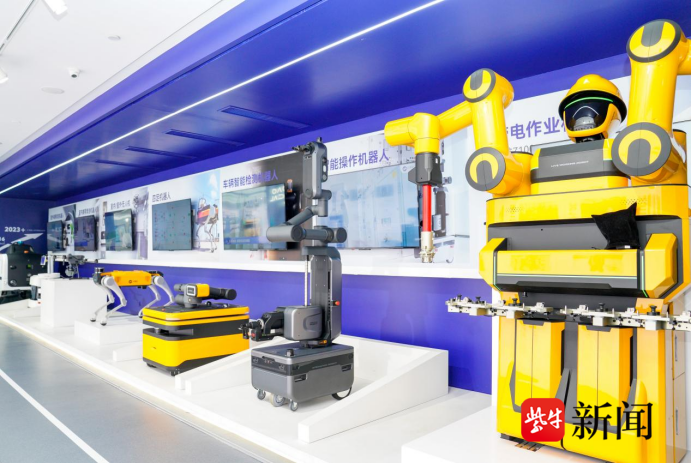
Core Insights - Nanjing is emerging as a leader in intelligent manufacturing, showcasing technological innovations such as inspection robots, AI vision, and digital twins [1][9] - The 2025 World Intelligent Manufacturing Conference will be held in Nanjing, highlighting the city's advancements in industrial software and manufacturing [1][9] Company Highlights - Yijiahe Technology has developed the M100 inspection robot, which can identify loose screws and foreign objects with an accuracy rate exceeding 96%, significantly reducing the workload of staff [3][5] - Yijiahe is expanding its product line to include various robots for different applications, including health management for the elderly and overseas market expansion [5] - Xiaoshi Technology has achieved breakthroughs in AI vision technology, addressing challenges such as complex lighting and motion blur, with its smart manufacturing output reaching hundreds of millions [7] - Xiaoshi plans to enhance AI's adaptability to manufacturing needs and contribute to standardization efforts in the industry [7] - Qiangsi Digital Technology has introduced high-precision 3D intelligent modeling for process industries, reducing costs by 50% and maintaining a modeling accuracy within 2mm [9] Industry Trends - Nanjing's AI products and services span various sectors, including consumption, healthcare, transportation, energy, and industrial manufacturing, with over 90 large models released [9] - The advancements in AI and intelligent manufacturing are expected to contribute significantly to the city's industrial strength and high-quality development [9]


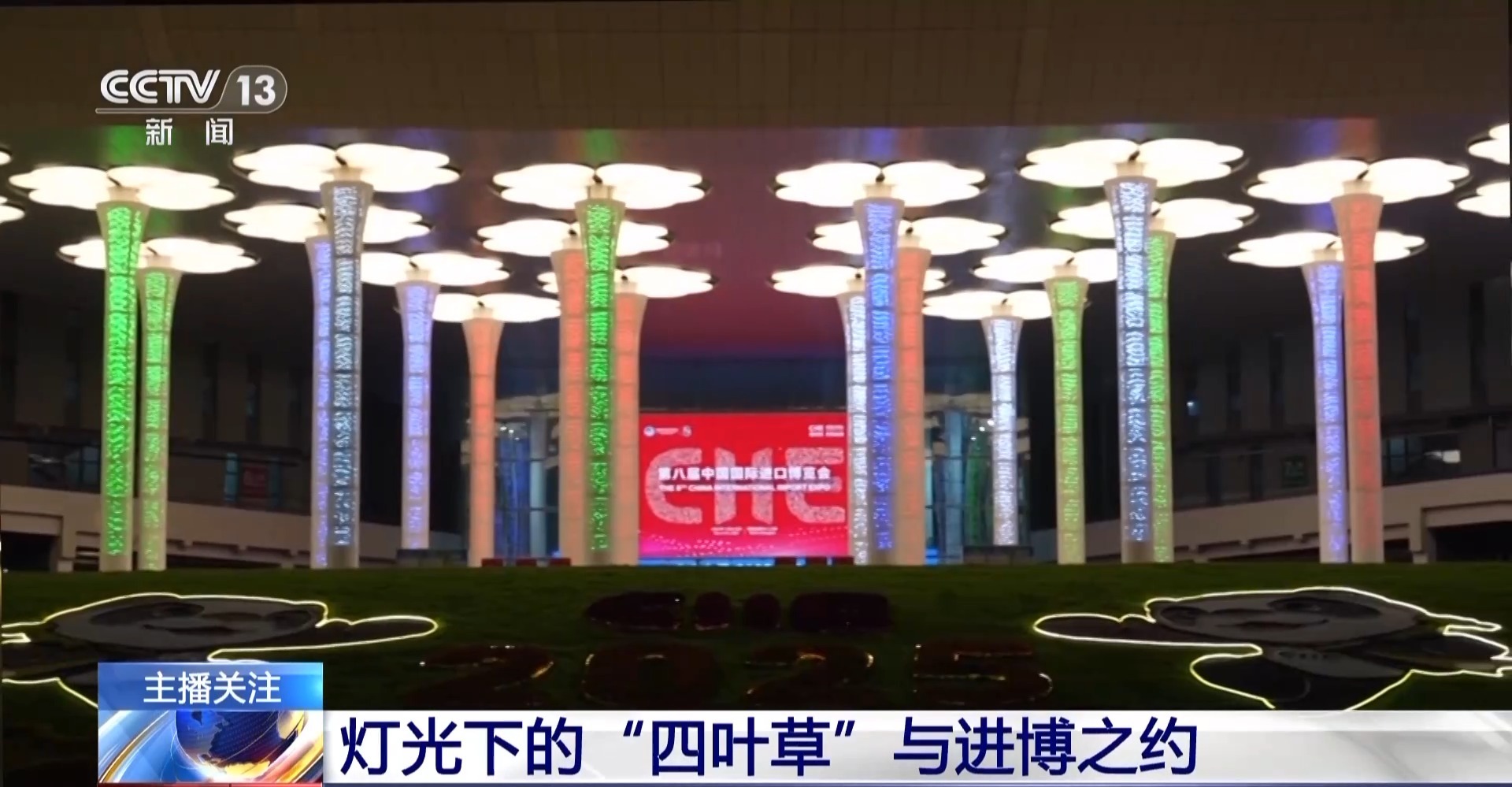
“绿电之光”点亮“四叶草” 进博会开启“越夜越精彩”模式
Yang Shi Xin Wen Ke Hu Duan· 2025-11-09 23:57
Group 1 - The eighth China International Import Expo (CIIE) is being held at the National Exhibition and Convention Center in Shanghai, showcasing a vibrant atmosphere enhanced by innovative technologies and green energy solutions [1][3] - The event has achieved full green electricity operation for the third consecutive year, utilizing wind power from the East China Sea and clean energy from western regions, demonstrating a commitment to sustainability [5][7] - A real-time health evaluation and fault prediction system for all electrical equipment has been established, ensuring continuous monitoring and support for power supply during the event [7] Group 2 - AI-powered volunteer robots are providing interactive services such as Q&A and exhibition introductions, enhancing the visitor experience at the expo [9][11] - The media center features an AI island platform that offers new solutions for journalists, including digital news broadcasting and AI-generated content, improving efficiency in news reporting [11] - The Green Land Global Commodity Trade Port has introduced an outdoor market that showcases international products and cultural experiences, extending the expo's reach and vibrancy into the evening [14][16]
进博会观察 | 高通分享6G愿景:2028年有望推出预商用终端
Huan Qiu Wang· 2025-11-09 12:25
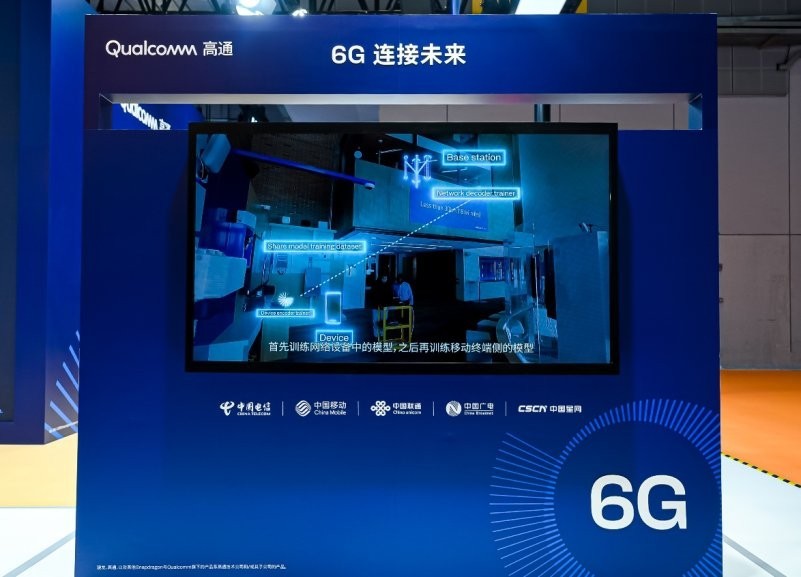
Core Viewpoint - Qualcomm is showcasing its advancements in 6G technology at the China International Import Expo, emphasizing the integration of AI to enhance communication efficiency and user experience [1][3][6] Group 1: 6G Development and Standards - Qualcomm has initiated its 6G research and development, aiming for the standardization of 6G technology by 2025, with pre-commercial devices expected as early as 2028 [3] - The development of 6G is driven by the need to significantly improve energy efficiency and cost-effectiveness, addressing issues present in 5G technology [3][4] Group 2: AI Integration in 6G - 6G technology will incorporate AI as a core component of its system architecture, moving beyond the limited AI support seen in 5G [4] - The use of AI will enable adaptive intelligence, allowing for real-time optimization of network parameters based on user needs and conditions, enhancing user experience [4][5] Group 3: Practical Applications and Benefits - AI models in 6G will improve channel information feedback accuracy while reducing overhead, leading to enhanced transmission performance [5] - The integration of digital twin technology will allow for real-time environmental sensing and resource optimization, contributing to energy efficiency and operational cost reduction [6] Group 4: Industry Collaboration and Future Opportunities - Qualcomm is collaborating with Chinese telecom operators and other partners to promote the large-scale implementation of AI at the terminal level [6] - The ongoing development of 6G and AI technologies presents new opportunities for collaboration between Qualcomm and Chinese industry partners, paving the way for industrial synergy [6]

天润科技斩获多项行业大奖,全产业链布局助推时空信息产业高质量发展
Zheng Quan Shi Bao Wang· 2025-11-09 10:01
Core Insights - Tianrun Technology has been recognized as one of the "Top 100 Geographic Information Enterprises by 2025" and has received multiple awards, showcasing its strong capabilities in technology development and engineering practice [1][2] - The second China Surveying and Geographic Information Conference focused on the integration of surveying technology with AI and big data, providing new ideas for digital transformation across various industries [1][2] Group 1 - Tianrun Technology showcased a comprehensive ecosystem solution covering the entire industry chain from data collection to smart city applications during the second China Surveying and Geographic Information Technology and Beidou Application Expo [2] - The company is a leader in the spatiotemporal information field, continuously promoting the integration of surveying technology with new-generation information technologies, which aids in digital transformation across industries [2] - The ongoing policy support for the construction of a realistic three-dimensional China and the large-scale application of Beidou presents new development opportunities for the geographic information industry [2] Group 2 - Tianrun Technology aims to enhance its brand influence and demonstrate its forward-looking layout in technology innovation and market expansion through the conference [2] - The company plans to deepen technological integration, strengthen industry collaboration, and actively expand into international markets through its Hong Kong subsidiary [2] - With the rapid development of emerging industries like digital twins and low-altitude economy, Tianrun Technology is expected to benefit from the industry's high prosperity cycle, creating long-term value for investors [3]
新镜界丨南京,进博会上“链”全球
Nan Jing Ri Bao· 2025-11-09 05:21
Core Viewpoint - Nanjing and Stuttgart are celebrating their 30th anniversary of friendship and cooperation through a joint exhibition at the 8th China International Import Expo, showcasing their achievements in trade, technology, and culture [2][4]. Group 1: Exhibition Highlights - The exhibition is themed "Dual City Craftsmanship, Win-Win Future," highlighting the fruitful results of collaboration between Nanjing and Stuttgart over the past three decades [4]. - The exhibition features a variety of traditional crafts and modern innovations, including Nanjing Yunjin's new products and interactive experiences that showcase intangible cultural heritage [11][13]. - The event attracted a large number of visitors, indicating strong interest in the cultural and technological exchanges presented [6][8]. Group 2: Technological Innovations - Nanjing enterprises showcased advanced technologies and high-end equipment, including Siemens' AI solutions and Su Mei Da's manned aircraft, emphasizing the city's innovative capabilities [21][23]. - The exhibition included a Tesla Cybertruck, marking its Asia-Pacific debut, which became a major attraction [27]. - Honeywell's future aviation theme area allowed visitors to experience simulated aircraft operations, further demonstrating the integration of technology and innovation [26]. Group 3: Cultural Exchange - The Jiangsu Cultural Exchange area featured traditional crafts from Nanjing, such as gold foil and cloud brocade, attracting significant attention from both domestic and international audiences [11][16]. - The exhibition served as a platform for cultural dialogue, with foreign visitors engaging actively with the showcased products and technologies [15][29].