AI芯片

Search documents
黄仁勋发出警告,美国必须允许在中国销售美国制造的AI芯片
Xin Lang Cai Jing· 2025-10-29 11:27
Core Viewpoint - Jensen Huang warns that the U.S. must allow the sale of American-made AI chips in China to maintain competitiveness in the global market [1] Group 1 - The meeting between Chinese and Indian military officials on the 25th focused on border control issues, indicating ongoing diplomatic efforts to maintain peace in the region [1]


Trump signals he plans to speak to China's Xi about Nvidia's 'super duper' chips
CNBC· 2025-10-29 03:31
Core Insights - U.S. President Donald Trump plans to discuss Nvidia's advanced AI chips, specifically the Blackwell architecture, with Chinese President Xi Jinping during their upcoming meeting [1][2] - Nvidia's Blackwell chips, particularly the GB200 Grace Blackwell Superchip, are touted as being a decade ahead of competitors in the AI chip market [2][3] - The discussion comes amid Nvidia's challenges in accessing the Chinese market due to export controls and recent actions by Beijing to prevent imports of Nvidia's chips [3][4] Company Insights - Nvidia's Blackwell architecture represents its latest generation of AI chips, which are essential for training and running large language models [2] - The company has faced restrictions on selling its most advanced AI chips to China, although some restrictions were rolled back in July for its H20 chips [3] - Nvidia's CEO indicated that the company is currently "100% out of China" and has no market share there, highlighting the significant impact of geopolitical tensions on its business [4] Industry Insights - The AI chip market is highly competitive, with Nvidia claiming a technological lead over other companies [2][3] - The situation reflects broader trade dynamics between the U.S. and China, with Nvidia's access to the Chinese market potentially being used as leverage in negotiations [4]


挑战英伟达,高通时隔五年再度入局AI服务器芯片赛道
3 6 Ke· 2025-10-28 23:24
Core Insights - Qualcomm is entering the data center AI chip market with its AI200 and AI250 chips, aiming to challenge Nvidia's dominance in this space [1][2] - Qualcomm's stock surged nearly 21% on the announcement, reflecting positive market sentiment and increasing its market capitalization by approximately $28 billion [2] - The company is diversifying its business due to structural growth challenges in its core mobile chip segment, particularly from Apple's move towards in-house chip development [4][5] Qualcomm's AI Chip Strategy - Qualcomm's AI200 and AI250 chips are designed for low power consumption, high cost-performance, and modular deployment, with the AI200 expected to launch in 2026 and the AI250 in 2027 [1][11] - The AI200 features 768GB LPDDR memory, significantly more than Nvidia's offerings, and supports flexible deployment options [10][11] - The AI250 introduces a "near-storage computing" architecture, promising over ten times memory bandwidth improvement and reduced power consumption [11] Market Context - Nvidia's revenue from data center AI chips has surged, with an increase of over $100 billion from 2022 to 2024, highlighting the rapid growth in this market [8][10] - The global AI chip market is projected to see a shift towards ASIC chips, which are expected to capture a larger market share by 2027, providing an opportunity for Qualcomm [9][10] - The demand for AI chips is expected to grow significantly, with projections of 10 million units in 2025 and 17 million in 2027, indicating a robust market for specialized chips [9] Competitive Landscape - Qualcomm faces strong competition from Nvidia, which has established a powerful ecosystem through its CUDA platform, making it challenging for new entrants to gain traction [11] - Other tech giants like Google, Amazon, and Microsoft are also developing their own AI chips, which could impact Qualcomm's ability to attract large clients [11] - Despite these challenges, Qualcomm's experience in low-power chip design positions it well to capitalize on the growing demand for efficient AI solutions in data centers [10]

德福科技:投资者询问合作企业,董秘让看半年报披露情况
Xin Lang Cai Jing· 2025-10-28 08:19
Core Viewpoint - The company is acquiring a Luxembourg-based copper foil enterprise, which holds the leading market share in the global high-frequency copper foil sector and has established deep collaborations with top high-frequency copper-clad laminate manufacturers [1] Group 1: Acquisition Details - The Luxembourg copper foil company has secured supply qualifications from four of the world's top high-speed copper-clad laminate manufacturers, particularly in the rapidly growing AI server market [1] - Among the high-end product series, one of the four manufacturers is an exclusive supplier, while two are core suppliers, and the remaining one has supply qualifications [1] Group 2: Partnerships and Collaborations - As of the 2025 semi-annual report, the company has established stable partnerships with well-known downstream manufacturers, including Shengyi Technology, Shenchao Technology, Taiko Electronics, Panasonic Electronics, Lianmao Electronics, Huazheng New Materials, Dingxin Electronics, and Shenzhen South Circuit [1] - The company's product line has achieved comprehensive coverage across all categories and application fields [1]
每经热评|英伟达不甘心,阿斯麦不安心 安世中国不屈服
Mei Ri Jing Ji Xin Wen· 2025-10-27 14:18
Group 1: Nvidia's Challenges - Nvidia's CEO expressed regret over losing access to the Chinese market, stating that U.S. policies have led to a significant decline in their market share from 95% to 0% in AI chips [3][4] - Nvidia's revenue from the Chinese market dropped to $2.769 billion in Q2 2026, a decrease of nearly $900 million compared to the same period in 2025 [4] - The company faces increasing competition from domestic Chinese firms, particularly from Cambrian, which reported a 1332.52% year-on-year revenue increase in Q3 2025 [4][6] Group 2: ASML's Market Position - ASML reported that its sales in the Chinese market reached a record high of 42% in Q3 2025, but the CEO anticipates a significant decline in 2026 [5][6] - ASML's reliance on DUV lithography machines, which account for 70% of its revenue in China, poses a risk due to U.S. export restrictions [6] - The company is experiencing a shift in the Chinese semiconductor landscape, with local firms making significant advancements in technology [7] Group 3: Nexperia's Resistance - Nexperia, a subsidiary of China's Wingtech Technology, is facing severe restrictions due to U.S. export controls, which have led to asset freezes and management changes imposed by the Dutch government [8][9] - The company has publicly condemned the Dutch government's actions and is pursuing legal recourse, emphasizing its commitment to operate within Chinese laws [9][10] - Nexperia's strong local production capabilities, accounting for 70% of the group's output, provide it with a competitive edge in the face of geopolitical challenges [10]


亿都国际尾盘跌超23% 沐曦股份科创板正式过会 市场此前热炒沐曦概念股
Zhi Tong Cai Jing· 2025-10-27 07:58
Core Viewpoint - Yidu International (00259) experienced a significant decline of over 23% in its stock price, closing at 4.51 HKD with a trading volume of 58.31 million HKD, amidst the backdrop of the successful listing of Muxi Technology on the Sci-Tech Innovation Board, marking a notable event in the domestic high-performance GPU sector [1] Group 1: Company Performance - Yidu International's stock price has doubled over the past two months, driven by market speculation surrounding Muxi Technology [1] - The company's stock fell by 22.38% as of the latest report, indicating a sharp market reaction [1] Group 2: Industry Developments - Muxi Technology has officially passed the listing committee review for the Sci-Tech Innovation Board, aiming to raise funds for the development and industrialization of new high-performance general-purpose GPUs and AI inference GPUs [1] - The funding will also support high-performance GPU technology research for emerging applications and frontier fields [1] - Suanfeng Information, a wholly-owned subsidiary of Yidu International, is a core customer and shareholder of Muxi Technology, highlighting the interconnectedness within the industry [1] - At the WAIC exhibition, Suanfeng Information collaborated with multiple institutions, including Muxi Technology, to develop the domestic high-density computing system known as Shanghai Cube [1]
港股异动 | 亿都国际(00259)尾盘跌超23% 沐曦股份科创板正式过会 市场此前热炒沐曦概念股
智通财经网· 2025-10-27 07:54
Core Viewpoint - Yidu International (00259) experienced a significant decline of over 23% in its stock price, closing at 4.51 HKD with a trading volume of 58.31 million HKD, amidst news of Muxi Technology's successful listing on the Sci-Tech Innovation Board, marking a notable event in the domestic high-performance GPU sector [1]. Group 1: Company Developments - Muxi Technology has officially passed the review of the Sci-Tech Innovation Board, aiming to raise funds primarily for the research and industrialization of new high-performance general-purpose GPUs, next-generation AI inference GPUs, and high-performance GPU technology for emerging applications [1]. - Yidu International's stock price has doubled over the past two months, driven by market speculation surrounding Muxi Technology [1]. Group 2: Industry Context - Yidu International's wholly-owned subsidiary, Sannong Information, is a core customer and shareholder of Muxi Technology, which is recognized as a leading domestic AI chip company [1]. - At the WAIC exhibition, Sannong Information collaborated with Muxi Technology and several institutions to develop the domestic high-density computing system, Shanghai Cube [1].
信创ETF(159537)涨超2.3%,AI芯片带动行情爆发
Mei Ri Jing Ji Xin Wen· 2025-10-27 06:40
Core Viewpoint - The continuous optimism towards the recovery trends in upstream sectors such as passive components, digital SoC, RF, storage, packaging and testing, and panels is highlighted, with specific mention of storage prices rebounding and increased utilization rates in packaging and testing due to the demand from advanced packaging driven by AI chips [1] Industry Summary - The recovery trend in the upstream sectors is supported by the rebound in storage prices and the gradual increase in packaging and testing utilization rates [1] - The demand for advanced packaging is expected to surge, driven by AI chip requirements [1] Company Summary - The Xinchang ETF (159537) tracks the Guozheng Xinchang Index (CN5075), which selects listed companies in the semiconductor, software development, and computer equipment sectors from the Shanghai and Shenzhen markets [1] - The index aims to reflect the overall performance of listed companies related to the information technology theme, with a focus on large-cap stocks [1] - The industry allocation of the index emphasizes sectors such as semiconductors, software development, IT services, and computer equipment [1]

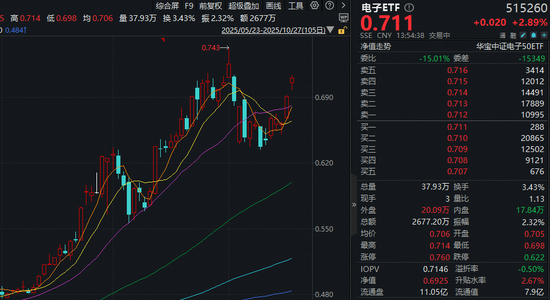
主力资金偏爱电子板块?技术突破+顶层定调,电子ETF(515260)大涨3%!闻泰科技涨停,Q3业绩飙升近3倍
Xin Lang Ji Jin· 2025-10-27 06:10
Group 1 - The core viewpoint of the news highlights the strong performance of electronic stocks, particularly in the semiconductor and consumer electronics sectors, with a notable increase in the electronic ETF (515260) [1][5] - The electronic sector has attracted significant capital inflow, with a net inflow of 9.64 billion yuan on the day of reporting, and cumulative inflows of 63.8 billion yuan, 110.3 billion yuan, and 415.3 billion yuan over the past 5, 20, and 60 days respectively [3] - Notable stocks include WenTai Technology, which reported a 279.29% year-on-year increase in net profit for Q3 2025, reaching 1.04 billion yuan, and a record revenue of 4.43 billion yuan [3] Group 2 - A breakthrough in China's photoresist technology has been achieved, significantly reducing defects in chip lithography, which may enhance the domestic semiconductor industry's capabilities [4] - A recent high-level meeting emphasized the importance of technological self-reliance and innovation, with a notable increase in mentions of "technology" from 2 to 10 times compared to previous meetings, indicating its strategic significance in the new five-year plan [4] - The electronic ETF (515260) is designed to track the electronic 50 index, focusing on sectors like semiconductors and consumer electronics, with major holdings in leading companies such as Luxshare Precision and SMIC [4][5]
【早报】中美双方达成基本共识;事关光刻胶、存储芯片,行业再传重要消息
财联社· 2025-10-26 23:08
Industry News - Some original manufacturers' DRAM and Flash products are currently in a state of suspended quotation, with prices changing daily even if quoted [6] - A breakthrough in the photoresist field has been achieved by a research team from Peking University, which has developed an industrial solution to significantly reduce lithography defects [4] - The logistics industry is experiencing a price increase success rate of 100% due to factors like "anti-involution" and the upcoming Double Eleven shopping festival [6] - The Shanghai and Shenzhen stock exchanges reported that as of the end of September, the total market value of ETFs in both markets has exceeded 5.6 trillion yuan [6] - JD Logistics announced plans to purchase 3 million robots, 1 million unmanned vehicles, and 100,000 drones over the next five years to enhance its logistics supply chain [7] Company News - Chen Hua, the director of the Guizhou Provincial Energy Bureau, has been appointed as the chairman of Kweichow Moutai Group, following the departure of Zhang Deqin [8] - WuXi AppTec reported a net profit of 12.076 billion yuan for the first three quarters, a year-on-year increase of 84.84%, and plans to sell 100% equity in two subsidiaries for 2.8 billion yuan [8] - Cambridge Technology achieved a revenue of 3.36 billion yuan in the first three quarters, a year-on-year increase of 21.57%, with a net profit of 259 million yuan, up 70.88% [9] - Zhenhai Magnetic Materials reported a net profit growth of 189.72% in the third quarter, primarily due to rising rare earth prices [10] - Dongfang Caifu announced a total revenue of 4.733 billion yuan in the third quarter, a year-on-year increase of 100.65%, with a net profit of 3.53 billion yuan, up 77.74% [11]