
高水平对外开放

Search documents
《坚定不移推进高水平对外开放》:中国开放的大门不会关闭,只会越开越大
news flash· 2025-07-15 07:06
《坚定不移推进高水平对外开放》:中国开放的大门不会关闭,只会越开越大 金十数据7月15日讯,《求是》杂志将发表中共中央总书记、国家主席、中央军委主席习近平的重要文 章《坚定不移推进高水平对外开放》。文章强调,开放带来进步,封闭必然落后。中国的发展离不开世 界,世界的繁荣也需要中国。不断扩大对外开放、提高对外开放水平,以开放促改革、促发展,是我国 发展不断取得新成就的重要法宝。中国开放的大门不会关闭,只会越开越大。 (新华社) ...
《坚定不移推进高水平对外开放》:中国利用外资的政策没有变也不会变
news flash· 2025-07-15 07:06
Core Viewpoint - China's policy on utilizing foreign investment remains unchanged and will continue to do so, emphasizing its commitment to high-level opening up [1] Group 1: Investment Environment - China is the world's second-largest consumer market, with the largest middle-income group, indicating significant investment and consumption potential [1] - A relatively sound legal and policy framework for foreign investment has been established in China [1] - China has maintained political stability and social order, recognized as one of the safest countries for investment globally [1] Group 2: Future Outlook - China is positioned as an ideal, safe, and promising investment destination for foreign investors [1] - Engaging with China is equated with seizing opportunities, and investing in China is viewed as investing in the future [1]
“十四五”的高分成绩单(望海楼)
Ren Min Ri Bao Hai Wai Ban· 2025-07-11 21:25
Economic Development - China's "14th Five-Year Plan" has exceeded expectations, with significant progress in key indicators such as urbanization rate, life expectancy, and food and energy production capacity [1] - The total economic output has crossed three thresholds of 10 trillion yuan, with an expected increase of over 35 trillion yuan, surpassing the economic total of the world's third-largest economy [1] Environmental Sustainability - China has achieved economic growth while reducing energy intensity, contributing approximately 30% to global economic growth and becoming one of the fastest countries in reducing energy consumption intensity [1] - The country has contributed to 25% of the world's new greening area, showcasing its commitment to green transformation [1] Social Welfare - During the "14th Five-Year Plan" period, over 400 million people benefited from cross-province medical settlement services, and the number of childcare placements increased by 1.25 times compared to the end of the previous five-year plan [2] - The income disparity between urban and rural residents is projected to decrease, with the urban-rural income ratio dropping to 2.34 by 2024 [2] Openness and Investment - China has significantly reduced trade barriers, with the overall tariff level dropping to 7.3% and the negative list for foreign investment reduced to 29 items [2] - From 2021 to May 2023, foreign direct investment in China reached 4.7 trillion yuan, exceeding the total during the previous five-year plan [2] Future Outlook - The achievements of the "14th Five-Year Plan" have strengthened China's institutional advantages and innovation capabilities, laying a solid foundation for future development [3]
支持企业充分利用国际国内两个市场两种资源
Ren Min Ri Bao· 2025-07-07 22:28
Core Viewpoint - The "Sweet Potato Economy" theory encourages local enterprises to expand beyond their regions while reinvesting in their home industries, fostering a symbiotic growth effect that enhances both local and global competitiveness [2][3]. Group 1: Theoretical Insights - The "Sweet Potato Economy" metaphor illustrates local enterprises extending their reach to gather resources while maintaining a strong local foundation, promoting a dual growth model [2]. - This theory emphasizes a pragmatic approach, encouraging businesses to venture outside their localities to enhance their own growth and contribute to local industry development [2]. - It reflects a spirit of innovation and resilience, urging companies to focus on their unique strengths and long-term development while engaging in broader market opportunities [2]. Group 2: Policy Implications - The current push for a unified national market and high-level openness is seen as a strategic advantage for leveraging China's vast market resources [3]. - Breaking down regional protectionism and market entry barriers is essential for facilitating resource flow and enhancing productivity [3]. - Expanding international cooperation will strengthen China's global economic ties and improve resource allocation efficiency [3]. Group 3: Actionable Strategies - Accelerate the establishment of a unified national market to provide better support for domestic and international investments [4]. - Optimize the business environment by ensuring fair regulatory practices and protecting the rights of various business entities [4]. - Foster collaborative relationships between government and businesses to enhance administrative efficiency and responsiveness [4]. - Promote resource flow by encouraging cross-regional cooperation and utilizing digital platforms for better industry coordination [4]. - Support the growth of specialized industries through targeted policies and collaboration between local industries and educational institutions [4].
中欧合作是助力欧洲发展的积极力量(国际论坛)
Ren Min Ri Bao· 2025-07-05 22:02
Group 1 - The core viewpoint emphasizes that maintaining a partnership-oriented approach and enhancing dialogue and cooperation can lead to the development of China-Europe relations, benefiting both sides and providing more stability to the world [1] - China-Europe economic and trade relations are characterized by complementarity and resilience, which will significantly support Europe's economic recovery and growth [2] - In 2024, the trade volume of goods between China and Europe is projected to reach $785.8 billion, with notable performance in the renewable energy sector [2] Group 2 - China's greenfield investment in the EU reached €5.3 billion in 2023, marking a 48% year-on-year increase, while the total bilateral investment stock is expected to reach $260 billion by 2024 [2] - The cooperation between China and Europe can enhance Europe's strategic autonomy and increase the EU's international influence amid external unilateralism and protectionism [2] - China supports the European integration process and aims to strengthen strategic coordination with the EU through various international platforms [2] Group 3 - Deepening cooperation between China and Europe will assist in upgrading European industries, particularly in electric vehicles and clean energy, injecting new momentum into Europe's green transition [3] - The economic interaction between China and Europe supports approximately 3 million jobs in the EU, helping to alleviate social tensions arising from economic challenges and immigration issues [3] - The 50th anniversary of diplomatic relations should be leveraged to strengthen practical cooperation and achieve mutual benefits, contributing to more stability in global economic inclusive growth [3]
充分释放制度型开放红利 上海自贸试验区77条试点措施将复制推广
news flash· 2025-07-04 07:29
Core Viewpoint - The State Council has issued a notice to replicate and promote 77 pilot measures from the Shanghai Free Trade Zone, which have shown maturity, effectiveness, and controllable risks, to a broader scope [1] Group 1: Overview of Measures - Among the 77 pilot measures, 34 will be promoted to other free trade zones, while 43 will be implemented nationwide [1] - The measures focus on seven areas: 8 measures in service trade, 12 in goods trade, 15 in digital trade, 8 in intellectual property protection, 15 in government procurement, 13 in "post-border" management system reform, and 6 in risk prevention system construction [1] Group 2: Implementation Strategy - The Ministry of Commerce will work with local governments and departments to implement the decisions of the Central Committee and the State Council, ensuring that the pilot measures meet the urgent needs of enterprises and the public [1] - The goal is to promote compatibility in rules, regulations, management, and standards on a larger scale, thereby fully unleashing the dividends of institutional openness [1]
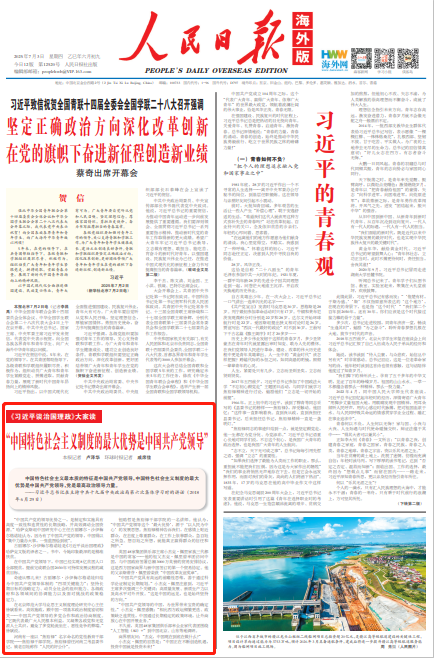
“中国特色社会主义制度的最大优势是中国共产党领导”(《习近平谈治国理政》大家读)
Ren Min Ri Bao Hai Wai Ban· 2025-07-03 00:26
Group 1 - The core advantage of the socialist system with Chinese characteristics is the leadership of the Communist Party of China (CPC), which is seen as the highest political leadership force [1][5] - Under the CPC's leadership, China has achieved the goal of lifting 800 million people out of poverty, surpassing the United Nations' 2030 sustainable development agenda for poverty reduction [1] - The CPC's leadership is characterized by four key capabilities: strategic determination to maintain long-term goals, organizational ability to mobilize society, coordination among various levels of government and sectors, and policy stability in the face of challenges [1] Group 2 - The effective governance in China is closely related to the political system of multi-party cooperation and political consultation led by the CPC, which represents the fundamental interests of the broadest masses [2] - The spirit of focus on the people, as exemplified by the legacy of figures like Jiao Yulu, emphasizes the importance of being close to the masses and addressing their needs to gain their trust [2] - The CPC's long-term planning and high-level strategic thinking are noted as essential for creating a stable policy environment that attracts foreign investment [3][4]

多向赋能,中国外贸竞争力稳增
Zhong Guo Chan Ye Jing Ji Xin Xi Wang· 2025-07-03 00:19
Group 1: Global Trade Environment - The global manufacturing PMI new export orders index fell below the growth line for two consecutive months, indicating a contraction in trade due to rising protectionism and uncertainty [1] - Despite these challenges, China's foreign trade maintained steady growth in the first five months of the year, with a total import and export value of 17.94 trillion yuan, a year-on-year increase of 2.5% [1] Group 2: China's Foreign Trade Strategy - China is committed to expanding high-level opening-up and diversifying its trade partnerships, as evidenced by recent agreements with African nations and the completion of the China-ASEAN Free Trade Area 3.0 negotiations [2][3] - Chinese foreign trade enterprises are increasingly shifting from a "single-polar dependence" to a "multi-polar resonance" strategy to mitigate risks [3] Group 3: Product Structure and Competitiveness - In the first five months, China's exports of electromechanical products grew by 9.3%, with integrated circuit exports increasing by 18.9%, reflecting a shift from scale advantages to technological advantages in the global supply chain [4] - The growth in high-tech product exports, which rose by 7.4%, indicates an ongoing optimization of China's export structure, with green technology products gradually replacing traditional low-value goods [4] Group 4: R&D Investment and Innovation - China's robust growth in high-tech product exports is closely linked to increased R&D investment, which is projected to reach 2.68% of GDP in 2024, surpassing the EU average [5] - This innovation investment is transforming into tangible export competitiveness, with technology-intensive products becoming a new engine for foreign trade growth [5] Group 5: Trade Facilitation and Support - China's foreign trade policies have become more precise and pragmatic, providing support through financial assistance, customs facilitation, and market expansion [6] - Measures include expanding export credit insurance coverage and enhancing cross-border trade facilitation, which have boosted the confidence of foreign trade enterprises [6] Group 6: Market Potential and Economic Stability - China's vast market potential continues to be released, with policies aimed at stabilizing the economy and foreign trade showing positive effects [7] - The fundamental outlook for China's foreign trade remains optimistic, with confidence to face various risks and challenges [7]
“中国经济韧性不断增强” ——访世界经济论坛国际贸易和投资部负责人肖恩·多尔蒂
Ren Min Ri Bao· 2025-06-27 21:48
Core Viewpoint - China's economy is enhancing its resilience through sustainable growth, playing a crucial role in global supply and demand balance, and implementing innovation-driven development strategies to stimulate corporate innovation [1][2]. Group 1: China's Role in Global Trade - China is accelerating the implementation of policies that support innovation, which is vital for enhancing the global supply chain [1]. - The Belt and Road Initiative has significantly contributed to infrastructure upgrades in participating countries, improving connectivity and global logistics efficiency [1]. - China's favorable environment for innovation and entrepreneurship is leading to the growth of industrial clusters, which will provide new opportunities for global trade [1]. Group 2: Economic Development and High-Quality Growth - As China's economy continues to expand, it is focusing on high-quality development and nurturing new productive forces, which aligns with economic development trends and will benefit the global market with high-tech and high-value-added products [1]. - The application of high technology in the service sector will also allow other economies to benefit from China's development of new productive forces [1]. Group 3: Regional Cooperation and Trade Facilitation - China is actively promoting the Regional Comprehensive Economic Partnership (RCEP) and has made significant progress in simplifying origin rules and enhancing trade facilitation, which supports regional and global supply chain collaboration [2]. - The use of new technologies such as cross-border payment systems and supply chain management is expanding trade between China and regions like the Middle East and Africa, setting an example for the "Global South" [2]. Group 4: Stability in Global Trade - Predictability and stability are crucial for global trade and investment, and trade wars create significant uncertainty for the global economy [2]. - The resolution of trade frictions requires dialogue and negotiation among parties to find suitable solutions, preventing global economic growth from facing challenges [2].
深圳亮出进一步推进高水平对外开放新招
Zhong Guo Chan Ye Jing Ji Xin Xi Wang· 2025-06-24 00:08
Group 1 - Shenzhen is advancing high-level opening-up initiatives, including the application of employee contract systems in new R&D institutions and exploring joint venture capital funds between mainland China and Hong Kong [1] - The Qianhai area will enhance foreign talent services and deepen the joint talent introduction mechanism with Hong Kong and Macau, while also facilitating the practice of professionals from these regions [1] - The He Tao area will strengthen collaboration between industry, academia, and research, introducing key research projects from renowned universities in Hong Kong and Macau [1] Group 2 - Qianhai plans to launch intellectual property securitization products and develop a nurturing base for companies going public in Hong Kong, while also exploring diversified data circulation and transaction methods [2] - The He Tao area aims to establish a cross-border dual-currency early-stage mother fund in collaboration with Hong Kong venture capital [2] - Qianhai will focus on developing cross-border e-commerce and other new business models, while enhancing existing advantages in transportation, finance, and telecommunications [2]