
太空算力

Search documents
太空算力开启商业航天盈利新纪元 ,航空航天 ETF(159227)规模创新高
Mei Ri Jing Ji Xin Wen· 2025-11-14 07:12
Core Viewpoint - The aerospace ETF (159227) has reached a new high in both scale and shares, indicating strong market performance and investor interest in the aerospace sector [1] Group 1: ETF Performance - As of November 14, the aerospace ETF (159227) saw an intraday increase of 0.27% with a transaction volume of 1.26 billion yuan, maintaining its position as the leading ETF in its category [1] - The latest scale of the aerospace ETF is 2.009 billion yuan, with 1.799 billion shares, both reaching new highs since its inception [1] Group 2: Space Computing Development - Space computing is identified as the latest breakthrough in satellite applications, with the domestic three-body computing constellation led by Zhijiang Laboratory having launched 12 satellites, achieving a total computing power of 5 POPS [1] - The constellation aims to complete the deployment of over 50 satellites by 2025 and reach a scale of 1,000 satellites by around 2030, with a total computing power of 1,000 P once fully established [1] Group 3: Commercial Aerospace Profitability - Huaxi Securities believes that the characteristics of space computing, such as "low cost, abundant resources, and vast space," provide a stable and long-term profit model for commercial aerospace [1] - With advancements in technology and decreasing costs, the application scenarios for commercial aerospace are expected to increase, leading to more stable and sustainable profit models [1] Group 4: ETF Composition - The aerospace ETF (159227) tracks the Guozheng Aerospace Index and has a deep layout in the aerospace industry chain [1] - The constituent stocks cover emerging fields such as large aircraft manufacturing, low-altitude economy, and commercial aerospace, aligning closely with the development direction of new productive forces [1]
【点金互动易】锂电+农药,六氟磷酸锂产线建成转固,这家公司主要客户连续多个季度业绩超预期,农药中间体受益海外景气周期上行
财联社· 2025-11-14 00:44
Group 1 - The article emphasizes the investment value of significant events, analyzing industry chain companies and interpreting key points of major policies [1] - A lithium battery and pesticide company has completed the production line for lithium hexafluorophosphate, with major clients exceeding performance expectations for multiple consecutive quarters, benefiting from the upturn in the overseas pesticide intermediate market [1] - A space computing and commercial aerospace company is investing in a satellite company to establish a space data center, with its first experimental satellite featuring 25P computing power [1]


中国抢滩390亿太空算力市场
21世纪经济报道· 2025-11-13 14:51
Core Viewpoint - The article discusses the emerging trend of space computing driven by the increasing demand for AI computational power, highlighting initiatives by major tech companies to establish data centers in space to address the limitations of terrestrial data centers [1][4][20]. Group 1: Space Computing Initiatives - Nvidia launched its H100 GPU into space on November 2, marking the first instance of a data center-grade GPU being sent to low Earth orbit [2][8]. - Elon Musk announced plans to expand the Starlink V3 satellite network to build space data centers, aiming for a deployment of 100 GW of data centers annually within 4-5 years [2][9]. - Google initiated the "Project Suncatcher," planning to launch two prototype satellites equipped with TPU chips by early 2027 to deploy AI computing directly in space [2][10]. Group 2: Advantages of Space Computing - Space offers unique environmental advantages, such as solar panels receiving eight times more solar energy than those on Earth, which can alleviate the pressure on terrestrial resources [6][4]. - In-orbit computing can process vast amounts of data generated by satellites, significantly reducing the time required to transmit valuable data back to Earth from hours to seconds [6][7]. Group 3: Market Potential - The market for in-orbit data centers is projected to reach $39 billion by 2035, with a compound annual growth rate of 67.4%, indicating a significant opportunity for the space economy [6][14]. - The Chinese commercial space industry is expected to grow from approximately 1 trillion yuan in 2020 to 2.3 trillion yuan by 2024, with a projected value of around 8 trillion yuan by 2029 [15]. Group 4: Technological Challenges - The development of space computing faces challenges such as high radiation levels affecting chip reliability and the need for effective thermal management in the vacuum of space [19][18]. - The economic feasibility of space computing hinges on reducing launch costs to around $200 per kilogram, which could make the annualized launch power costs comparable to current terrestrial data center electricity costs [18][19]. Group 5: Strategic Positioning - Companies like Guoxing Aerospace are positioning themselves as full-chain participants in the space computing industry, focusing on satellite manufacturing and advanced AI-driven data analysis services [11][15]. - The article emphasizes the potential for Chinese companies to leverage the nascent nature of the space computing sector to overcome existing technological limitations in terrestrial data centers [20].


中国太空算力进击
2 1 Shi Ji Jing Ji Bao Dao· 2025-11-13 12:15
Core Viewpoint - The rise of space computing is driven by the increasing demand for AI computing power, with major tech companies like NVIDIA, Google, and Chinese firms investing in space data centers to address the limitations of terrestrial data centers [1][3][5]. Group 1: Space Computing Initiatives - NVIDIA launched its H100 GPU into space, marking the first instance of a data center-grade GPU being sent to low Earth orbit [5]. - Elon Musk announced plans to expand the Starlink V3 satellite network to build space data centers, aiming for a deployment of 100GW of data centers annually within 4-5 years [2]. - Google initiated the "Project Suncatcher," planning to launch two prototype satellites equipped with TPU chips by early 2027 to deploy AI computing directly in space [2][6]. Group 2: Advantages of Space Computing - Space offers unique environmental advantages for solar energy collection, with solar panels in space receiving eight times more energy than those on Earth [3]. - In-orbit computing can process vast amounts of data generated by satellites, significantly reducing the time needed to transmit valuable data back to Earth from hours to seconds [3][8]. - The market for in-orbit data centers is projected to reach $39 billion by 2035, with a compound annual growth rate of 67.4% [4]. Group 3: China's Role in Space Computing - China is actively participating in the space computing race, with the launch of the "zero-carbon space computing center" recognized at the World Internet Conference [2]. - The Chengdu Guoxing Aerospace Technology Co. has developed AI satellites with a total in-orbit computing capability of 5POPS, aiming to create a distributed computing network in space [7][10]. - The Chinese commercial space industry is expected to grow from approximately 1 trillion yuan in 2020 to 2.3 trillion yuan by 2024, with a projected value of around 8 trillion yuan by 2029 [10]. Group 4: Challenges and Future Prospects - Despite the potential, space computing faces significant challenges, including high launch costs and the need for advanced thermal management systems in the vacuum of space [13][14]. - The industry is expected to evolve, with advancements in technology potentially overcoming current limitations, making space computing a vital component of AI infrastructure within 5-10 years [11][15]. - The competitive landscape remains fluid, providing opportunities for Chinese companies to innovate and establish a foothold in this emerging sector [15].
“算力”上天,航空航天ETF天弘(159241)近5日“吸金”超4100万元,份额续创新高,海内外巨头竞逐新赛道!
Xin Lang Cai Jing· 2025-11-13 06:45
Core Insights - The aerospace ETF Tianhong (159241) has seen significant trading activity, with a turnover of 8.93% and a transaction volume of 46.70 million yuan as of November 13, 2025 [1] - The ETF's latest scale reached 521 million yuan, marking a one-month high, and its share count hit 461 million, the highest since inception [1] - Recent inflows into the ETF totaled 15.70 million yuan, with a cumulative "capital absorption" of 41.19 million yuan over the past five trading days [1] Product Highlights - The aerospace ETF Tianhong (159241) effectively captures thematic investment opportunities, aligning with popular themes such as low-altitude economy, large aircraft, and satellite internet [1] - The constituent stocks are deeply involved in emerging fields like commercial aerospace, benefiting from both policy and market support [1] Hot Events - There has been a surge in global developments in the space computing sector, with domestic and international companies advancing key layouts, indicating a clear timeline of progress [2] - Notable advancements include NVIDIA's collaboration with Starcloud to deploy H100 GPUs on satellites, achieving a 100-fold increase in computing power for complex tasks [2] - Elon Musk's plans for a 100GW space data center deployment via Starship and Google's "Sun Catcher Project" to explore solar energy for orbital AI data centers highlight the accelerating commercialization of space computing [2] - Domestic advancements include the successful selection of Guoxing Aerospace's "Zero Carbon Space Computing Center" at the World Internet Conference, showcasing significant computing capabilities [2] Institutional Perspectives - Guosheng Securities notes that space computing has transitioned from conceptual validation to engineering implementation, presenting a strategic solution to ground-based computing challenges [2] - The involvement of major AI players like NVIDIA and Amazon indicates a growing trend, with potential acceleration in development due to policy support and investment [2]

太空算力热度提升,航空航天ETF(159227)连续5日净流入,规模突破20亿元
Mei Ri Jing Ji Xin Wen· 2025-11-13 02:03
Group 1 - The A-share market saw all three major indices open lower, with the Aerospace ETF (159227) experiencing a slight increase of 0.09% and a trading volume of 11.17 million yuan as of 9:37 AM [1] - The Aerospace ETF (159227) has recorded a net inflow of funds for five consecutive trading days, totaling 315 million yuan, reaching a new high of over 2 billion yuan in total assets, making it the largest aerospace ETF in the market [1] - Recent developments in overseas space computing have accelerated, with Nvidia successfully sending the H100 GPU to space for testing, and Elon Musk announcing plans to expand the Starlink V3 satellite scale to establish a space data center [1] Group 2 - The characteristics of low-cost, abundant resources, and large space in space computing have provided a stable and long-term profit model for commercial aerospace [2] - The Aerospace ETF (159227) closely tracks the National Aerospace Index, which has a high military industry proportion of 98.2%, making it the highest purity military index in the market, covering key industry chain segments such as aerospace equipment, satellite navigation, and new materials [2] - The commercial aerospace concept accounts for 51.83% of the index's weight [2]
机构:太空算力有望改变传统算力格局
Zheng Quan Shi Bao Wang· 2025-11-12 00:57
Core Viewpoint - The importance of computing power as a fundamental infrastructure in the rapidly developing AI industry is increasingly recognized, with space computing power gaining traction and attracting interest from major tech giants, indicating a potential leap from "0 to 1" in development [1] Group 1: Industry Insights - Space computing power is expected to change the traditional computing power landscape and empower traditional satellite systems [1] - Traditional satellite systems operate on a "ground-based computing" model, which faces challenges in timeliness and cost as data volume increases due to higher resolution observations [1] - Space computing satellites aim to integrate AI with space-based computing, enabling data processing in space before transmission back to Earth, representing a revolutionary breakthrough [1] Group 2: Technological Advancements - According to Guosheng Securities, space computing power has transitioned from concept validation to engineering implementation, addressing challenges related to energy and heat dissipation in ground computing [1] - The involvement of AI giants like NVIDIA and Amazon in this field indicates a significant trend, with the potential for accelerated development driven by the participation of domestic and international players and supportive policies [1] - Investments in this area are expected to begin yielding results as the industry matures [1]

太空算力逐步走进现实 相关概念股受关注
Zheng Quan Shi Bao· 2025-11-11 17:56
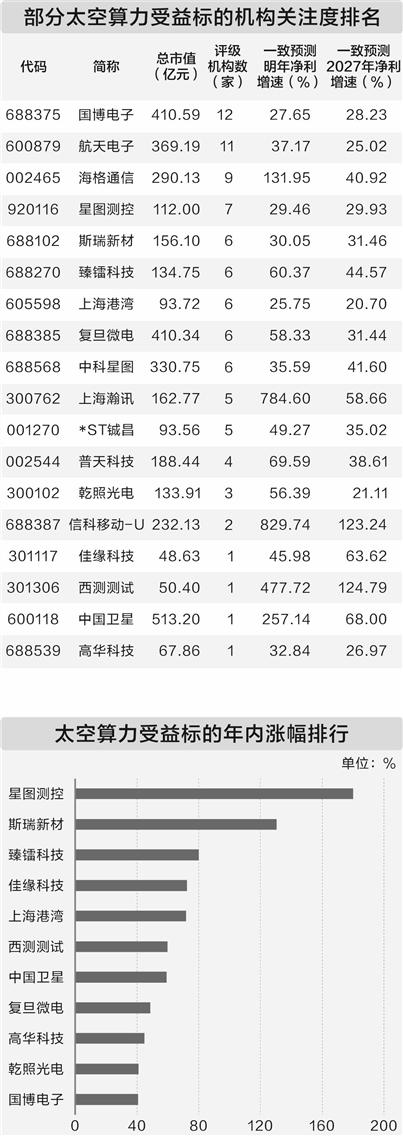
Core Insights - The importance of computing power as a foundational infrastructure is increasingly recognized in the context of the booming AI industry, with space computing power gaining traction and attracting interest from major tech companies [3] - The development of space computing power is expected to achieve a leap from "0 to 1," with significant advancements in both domestic and international efforts [3] Company Insights - The top companies benefiting from space computing power include Guobo Electronics, Aerospace Electronics, and Haige Communication, with projected net profit growth rates exceeding 20% for 18 stocks identified by institutions [4][5] - Guobo Electronics and Aerospace Electronics have garnered attention from over 10 institutions, indicating higher certainty in their future performance [5] - Guobo Electronics is recognized as a leader in active phased array T/R components, benefiting from the recovery of special orders and the demand for satellite T/R components driven by commercial aerospace development [5] Industry Insights - Space computing power involves deploying data centers in space, allowing satellites to perform both observation and computation, which offers advantages over ground data centers, such as efficient energy supply and reduced environmental constraints [4] - The domestic space computing landscape is advancing, with China's "Three-body Computing Constellation" entering the networking phase, featuring satellites equipped with onboard intelligent computing systems [3] - Institutions suggest focusing on seven sub-sectors that are likely to benefit from space computing, including solar wings, space computing satellites, and satellite payloads [4]
存储大牛股,突然跳水!科技巨头押注太空算力,这些股有望受益(名单)
Zheng Quan Shi Bao· 2025-11-11 10:21
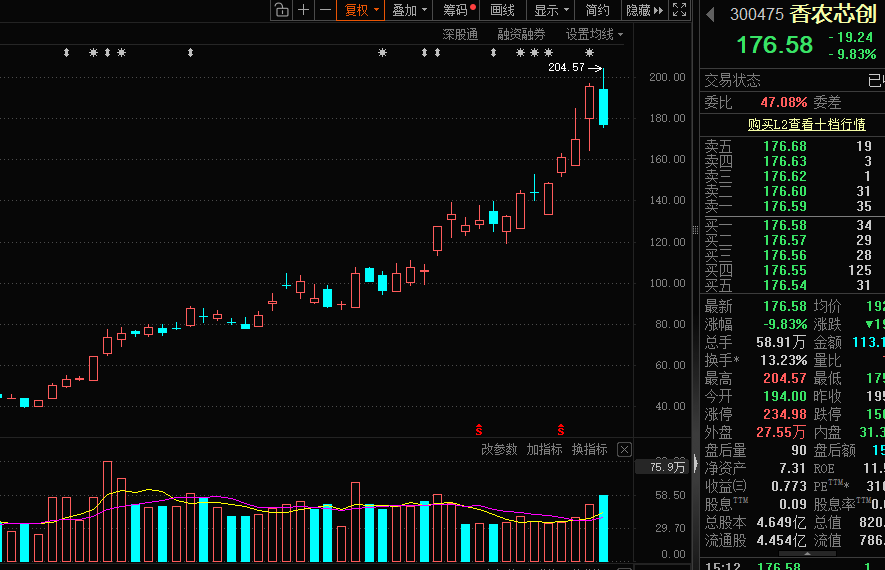
Group 1: Storage Chip Market Dynamics - The storage chip sector experienced a significant decline, with leading stock Xiangnong Xinchuan dropping nearly 10% at the close, despite earlier reaching a record high market value of over 950 billion yuan [1][3] - Xiangnong Xinchuan's stock had previously surged, with increases of approximately 25% in August, 117% in September, and over 45% in October, resulting in a cumulative rise of over 420% since August [1] Group 2: Space Computing Developments - The importance of computing power as a foundational infrastructure is increasingly recognized, with major tech companies investing in space computing, aiming for transformative advancements [4] - Notable developments include NVIDIA successfully sending its H100 GPU to space for testing, and Elon Musk's plans to expand Starlink V3 satellite capabilities to establish a space data center [4][5] - Domestic advancements in space computing are highlighted by the completion of the initial network of the "Three-Body Computing Constellation," which has deployed 12 satellites with a total computing power of 5 petaflops and 30 terabytes of storage [4][5] Group 3: Beneficiary Companies in Space Computing - Companies such as Putian Technology, Holoway, Shanghai Hantong, and Zhenlei Technology are expected to benefit from the advancements in space computing [7] - Putian Technology is significantly involved in the "Three-Body Computing Constellation" project, while Holoway is a key player in satellite measurement [7] - A total of 18 stocks are identified with projected net profit growth exceeding 20% for the next year and 2027, with some companies like Xinke Mobile-U and Xice Testing expected to see over 100% growth [7][8]

四川金顶(集团)股份有限公司关于召开2025年第四次临时股东会提示性公告
Shang Hai Zheng Quan Bao· 2025-11-10 19:25
Group 1 - The company will hold its fourth extraordinary general meeting of shareholders on November 18, 2025, with the record date for shareholders being November 11, 2025 [2][20] - The meeting will be conducted using a combination of on-site and online voting methods, with specific time slots for voting [3][4] - The company has confirmed that there are no major undisclosed matters that could affect its stock price, and it has been monitoring market rumors related to its subsidiaries [21][22] Group 2 - The company's stock experienced a significant price fluctuation, with a cumulative increase of over 20% over three consecutive trading days [21][23] - The company has clarified that its subsidiary, Kaishi Information Technology Co., Ltd., does not engage in space computing concepts and has not yet achieved profitability [27][32] - The company has established a new subsidiary, Dingjin Gold Mining Co., Ltd., with a registered capital of 10 million yuan, but it has not yet commenced business operations [28][32]
