通用人工智能(AGI)

Search documents
与院士、企业高管共话智能共生时代,“有为青年公开课”启幕
Bei Jing Ri Bao Ke Hu Duan· 2025-10-19 01:50
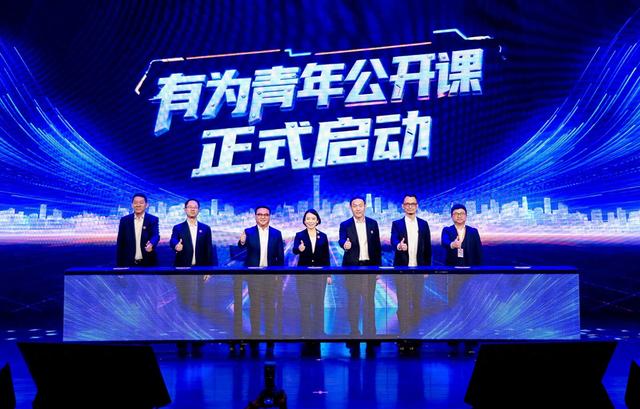
Core Insights - The event "Dynamic Zone for Youth Open Class" hosted by China Mobile focuses on the theme of "Intelligent Symbiosis Era," combining cutting-edge technology and humanistic thinking for contemporary youth [1][11] Group 1: Event Overview - The first session took place at Tsinghua University, featuring lectures from academicians, sharing from entrepreneurs, and discussions among students [1] - The event aims to provide a platform for youth to engage with the latest technological advancements and their implications for society [1][9] Group 2: Key Presentations - Academician Zhang Yaqin discussed the technological trends of the AI era, outlining five development directions for AI large models and predicting that the intelligent era will offer opportunities 100 times greater than the mobile internet era [3] - Chen Li, co-founder of Yushu Technology, highlighted the focus of intelligent robotics technology over the next 2-5 years, emphasizing that bipedal and quadrupedal robots will lead the next generation of hardware trends and integrate into daily life [5] Group 3: Student Engagement - A dialogue session allowed outstanding students to discuss the ultimate form of "coexistence" between artificial intelligence and humanity, exploring whether AI will replace or enhance human productivity [7] - The event included interactive experience zones showcasing the latest applications of intelligent technology, such as robot exhibitions and AI video ringtone experiences [9] Group 4: Future Plans - The open class will continue at other universities on October 25 and November 8, discussing themes like "New Blueprint for Low-altitude Economy" and "Intelligent Future" [11]


马斯克:AGI三五年内实现
Sou Hu Cai Jing· 2025-10-18 14:57
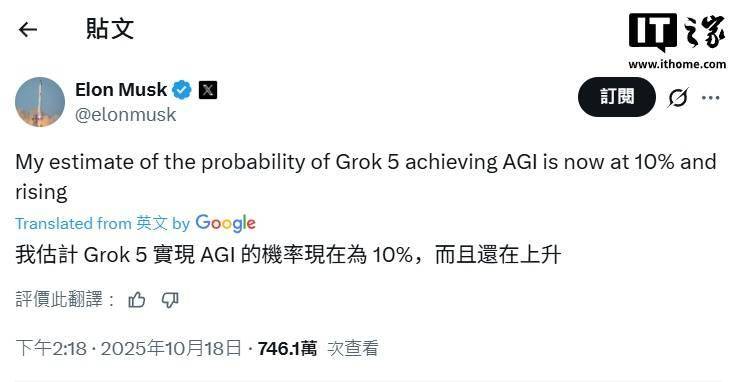
Group 1 - Elon Musk predicts a 10% probability of Grok 5 achieving Artificial General Intelligence (AGI), with the likelihood increasing over time [2][5] - Musk defines AGI as the capability to perform all tasks that humans can accomplish with computers, but notes that it will not surpass the combined intelligence of all humans and computers [5][6] - Musk humorously claims that Grok 5 is stronger in AI engineering than Canadian expert Andrej Karpathy [6] Group 2 - OpenAI CEO Sam Altman expressed willingness to resolve conflicts with Musk and collaborate on advancing AGI development [6]

卡帕西:强化学习很糟糕,但其他所有方法都更糟
量子位· 2025-10-18 09:30
Group 1 - The core viewpoint of the article is that achieving Artificial General Intelligence (AGI) will take at least another decade, as current AI systems need significant improvements to reach their full potential [5][10][28] - Karpathy emphasizes that existing AI systems lack maturity, multi-modal capabilities, and the ability to learn continuously, which are essential for them to function effectively in collaboration with humans [8][9][10] - He critiques the current state of Large Language Models (LLMs), stating that they have cognitive deficiencies and overestimate their capabilities, requiring substantial enhancements [16][18] Group 2 - Karpathy argues that reinforcement learning is more flawed than commonly perceived, as it reinforces all steps taken in reaching a correct answer, regardless of their validity, leading to inefficient learning [20][21][23] - He believes that AGI will not lead to a sudden leap in productivity but will follow a gradual growth pattern, similar to the historical 2% GDP growth trend observed with the internet [25][29] - The lengthy development of autonomous driving technology is attributed to the high stakes involved, where even minor errors can have severe consequences, necessitating extensive reliability improvements [30][32][33] Group 3 - As a full-time educator, Karpathy aims to establish a leading-edge educational institution that offers a unique mentorship experience, focusing on personalized learning and advanced AI education [34][36] - He highlights the importance of tailored teaching methods, which current LLMs cannot replicate, emphasizing the need for human instructors to provide appropriate challenges to students [36][38]

图灵奖得主答21:AGI世界人类的价值在于创造力和想象力
2 1 Shi Ji Jing Ji Bao Dao· 2025-10-17 14:52
南方财经 21世纪经济报道记者吴斌 上海报道 2025可持续全球领导者大会于10月16日-18日在上海市黄浦区世博园区召开。2007年图灵奖得主、 Verimag实验室创始人约瑟夫·希发基思在接受21世纪经济报道记者采访时表示,有一个通用人工智能的 定义,是指能够在任何任务上胜过人类的机器。但即使人工智能可以在所有任务上胜过人类,也不意味 着与人类同样有智慧。 约瑟夫·希发基思解释称,人类可能非常不擅长解决某些问题,但人类可以组合出无数种解决方案, AGI世界人类的价值在于创造力和想象力,机器不可能比人类更聪明。 但不管AI是否能超越人类智慧,世界都将被重塑。约瑟夫·希发基思也提醒,AI和以往其他技术截然不 同,在产生和应用知识的能力上可与人类竞争。因此,它可能对个体身份产生深远影响,同时也能影响 经济和社会组织。其收益和潜在风险成正比。 在通用人工智能(AGI)的世界里,人类的价值何在? ...
AI终端新拐点已至 自进化能力成破局关键
财联社· 2025-10-17 08:01
Core Viewpoint - The article emphasizes the transformative potential of AI-native smartphones, particularly highlighting the launch of Honor's Magic 8 series, which integrates self-evolving AI capabilities to redefine the smartphone experience and enhance user interaction with technology [1][4][7]. Group 1: AI Evolution and Market Position - The AI terminal ecosystem is seen as a pivotal point for industry transformation, with Honor's Magic 8 series introducing the concept of "self-evolving AI native smartphones" [1]. - Honor is positioned as a leader in the AI terminal field, with its advancements expected to push the industry into a new phase characterized by "Chinese definitions" [3][12]. - The self-evolution capability of AI is identified as a key competitive advantage for future AI terminals, with Honor's CEO stating it is crucial for the transition from large language models (LLMs) to artificial general intelligence (AGI) [5][9]. Group 2: Technological Innovations - The Magic 8 series features the YOYO intelligent agent, which has been upgraded to possess autonomous learning and continuous evolution capabilities, marking a significant advancement in AI interaction [7]. - The MagicGUI model, with 70 billion parameters, achieves a 91.5% accuracy rate in multi-modal deep understanding, expanding from 200 to over 3000 automated execution scenarios [7]. - Honor has established the most comprehensive and open AI service ecosystem among smartphone manufacturers, integrating over 4000 ecological intelligent agents from leading internet platforms [7][10]. Group 3: Strategic Initiatives and Financial Commitment - Honor's "Alpha Strategy" marks its transition from a smartphone manufacturer to a leading AI terminal ecosystem company, emphasizing the importance of software capabilities and ecosystem development in the AI era [9]. - The company plans to invest $10 billion (approximately 72 billion RMB) over the next five years, with R&D expenditures expected to exceed 15% of revenue [9]. - Honor's collaboration with Qualcomm aims to develop efficient edge AI model solutions, enhancing user experience and performance beyond traditional hardware capabilities [10]. Group 4: Market Performance and Growth - Honor has seen a significant rebound in market share, ranking fifth in the Chinese market due to the success of its 400 series and X70 models [13]. - In the Latin American market, Honor's shipments grew by 70% year-on-year, reaching a record 2.9 million units, securing the fourth position [13]. - The Magic 8 series is anticipated to drive new growth for Honor, with expectations of expanding market share and influencing the global smartphone competition landscape [14].

按照Bengio等大佬的AGI新定义,GPT-5才实现了不到10%
机器之心· 2025-10-17 04:09
Core Insights - The article discusses a new comprehensive and testable definition of Artificial General Intelligence (AGI) proposed by leading scholars and industry leaders, emphasizing that AGI should match or exceed the cognitive capabilities of well-educated adults [1][3][47]. Definition and Framework - The proposed framework defines AGI as an AI that exhibits cognitive multi-functionality and proficiency comparable to that of well-educated adults, moving beyond narrow specialization [3][4]. - The framework is based on the Cattell-Horn-Carroll (CHC) theory, which categorizes human intelligence into various broad and narrow abilities, providing a structured approach to assess AI systems [6][48]. Measurement of AGI - The framework introduces a standardized "General Intelligence Index" (AGI score) ranging from 0% to 100%, where 100% indicates full AGI capability [7]. - It identifies ten core cognitive components derived from the CHC theory, each weighted equally to emphasize the breadth of cognitive abilities [9][48]. Performance of Current Models - The article evaluates the performance of GPT-4 and GPT-5 across these cognitive components, revealing that both models scored below 10% in most areas, indicating a significant gap from true AGI [12][50]. - For instance, GPT-4 achieved an overall AGI score of 27%, while GPT-5 scored 58%, highlighting rapid progress yet substantial distance from achieving AGI [50]. Cognitive Structure and Limitations - The cognitive structure of contemporary AI systems is described as "jagged," showing high proficiency in certain areas like general knowledge and mathematics, but severe deficiencies in foundational cognitive mechanisms, particularly in long-term memory storage [25][49]. - The lack of continuous learning capabilities leads to a "memory loss" effect, limiting the practical utility of AI systems [25]. Capability Distortions - The uneven distribution of AI capabilities can lead to "capability contortions," where strengths in certain areas mask weaknesses in others, creating a false impression of general intelligence [27][28]. - For example, reliance on extensive context windows to compensate for poor long-term memory storage is inefficient and not scalable for tasks requiring prolonged context accumulation [29]. Interdependence of Cognitive Abilities - The article emphasizes the interdependence of cognitive abilities, noting that complex tasks often require the integration of multiple cognitive domains [37][38]. - This interconnectedness suggests that assessments of AGI should consider the holistic nature of intelligence rather than isolated capabilities [38]. Challenges to Achieving AGI - The article outlines significant challenges to achieving AGI, including the need for reliable long-term memory systems and the ability to learn dynamically from experiences [42][51]. - It stresses that current AI systems are far from achieving the cognitive breadth and depth required for AGI, with many foundational issues still unresolved [50][52].

创历史!百度“蒸汽机”让AI视频可“边改边看”!科创人工智能ETF华夏(589010) 盘初弱势震荡,芯片算力方向成盘中亮点!
Mei Ri Jing Ji Xin Wen· 2025-10-16 21:52
Group 1 - The core viewpoint of the news highlights the performance of the Sci-Tech Innovation Artificial Intelligence ETF (589010), which experienced a slight decline of 0.07% in early trading, indicating a mixed market sentiment among its constituent stocks [1] - Among the 30 constituent stocks, 7 saw gains while 23 experienced declines, showcasing significant differentiation within the AI computing and smart hardware sectors [1] - Baidu announced an upgrade to its video generation model, "Baidu Steam Engine," which now allows for real-time interactive generation of long videos, surpassing the limitations of traditional AI video generation [1] Group 2 - Dongwu Securities' research report emphasizes China's focus on low-cost, cross-industry applications of artificial intelligence, aiming for comprehensive empowerment by 2030 through "AI+" integration into research and industry [2] - In contrast, the U.S. is concentrating on pushing the limits of general artificial intelligence (AGI), with current challenges faced after setbacks with GPT-5 [2] - The Sci-Tech Innovation Artificial Intelligence ETF closely tracks the Shanghai Stock Exchange's AI index, covering high-quality enterprises across the entire industry chain, benefiting from high R&D investment and policy support [2]
高盛:AI开支热潮并没有那么夸张、上调工业富联、电力问题持续
傅里叶的猫· 2025-10-16 14:03
Core Viewpoint - The article emphasizes a sustained optimism towards AI investments, highlighting that current spending is not a bubble but rather a significant growth opportunity in the sector [1][2]. AI Investment Trends - By 2025, annual AI-related spending in the U.S. is projected to reach approximately $300 billion, with a notable increase of $277 billion compared to the average in 2022 [2][3]. - The growth in AI spending has been partially driven by tariff policies, leading to preemptive equipment purchases, although overall spending remains high [2]. Technological Support for AI Investment - AI is expected to enhance labor productivity by 15% over a decade if widely adopted, with many companies reporting productivity increases of 25%-30% post-AI deployment [3][6]. - The demand for computational power to train large language models is growing at an annual rate of 400%, significantly outpacing the 40% annual decrease in computing costs [7]. Macroeconomic Context - Current AI investment levels, while nominally high, represent less than 1% of GDP, indicating room for growth compared to historical peaks in infrastructure and technology investments [7][8]. - The potential economic value generated from AI productivity improvements is estimated to be between $5 trillion and $19 trillion, far exceeding current investment levels [8][9]. Market Structure and Competition - The AI market exhibits varying levels of competition across different layers, with hardware providers like Nvidia enjoying a dominant position, while application layers face intense competition [10][11]. - The rapid pace of technological change in AI may diminish the advantages of early adopters, complicating the landscape for long-term winners [10][11]. Industrial Growth and Financial Projections - Industrial companies like Hon Hai Precision Industry (Industrial Fulian) are expected to see a compound annual growth rate (CAGR) of 45% in net profit from 2025 to 2027, driven by the AI server business [12][15]. - High expectations for revenue and profit growth are reflected in adjusted financial forecasts, with projected revenues for 2026 reaching ¥1.47 trillion and net profits of ¥564.32 billion [15][16]. Energy Demand and Supply Challenges - By 2030, global data center electricity demand is expected to increase by 175%, significantly impacting energy consumption patterns in the U.S. [21][22]. - The report outlines six key factors influencing electricity demand, including AI's pervasiveness, productivity of computing resources, and the impact of energy prices [22][23][24]. Investment Opportunities - Companies focusing on ensuring reliable electricity and water resources, meeting new electricity demands, and enhancing efficiency are highlighted as key areas for investment [26][27].

“AI盛世”还是“AI泡沫”?10家AI独角兽,估值1年增长1万亿,VC一年投入超2000亿美元,利润为0
Hua Er Jie Jian Wen· 2025-10-16 12:39
Core Insights - The surge in AI investments has led to a dramatic increase in valuations of unprofitable AI startups, totaling nearly $1 trillion in the past year, marking the fastest wealth expansion in history [1] - U.S. venture capital (VC) investments in AI are projected to exceed $200 billion this year, significantly surpassing previous tech bubbles, indicating a strong market focus on AI [2] - The current investment climate is characterized by a "winner-takes-all" mentality, with expectations that only a few companies will dominate the market, reminiscent of the internet era [3] Investment Trends - The AI sector has attracted over $200 billion in VC funding this year, which is more than the $135 billion invested during the SaaS bubble in 2021 [2] - AI companies are experiencing inflated valuations, with some startups valued at 100 times their annual revenue, driven by a fear of missing out (FOMO) among investors [2] - The expectation is that while a significant amount of AI investment may be wasted, the technology could ultimately create tenfold value [3] Market Dynamics - The valuations of private AI companies are beginning to impact public markets, with major tech firms like AMD and NVIDIA seeing substantial market cap increases due to their associations with AI startups [3] - The competition among AI companies, particularly between OpenAI and tech giants like Microsoft and Google, is intensifying, leading to high operational costs and uncertain profitability timelines [4] - The current capital frenzy in AI resembles previous market bubbles, with valuations detached from actual earnings, raising concerns about the sustainability of this growth [5]



速递|AI编程初创Poolside融资20亿美元猛攻AI基建,携手CoreWeave,打造2吉瓦德州数据中心
Z Potentials· 2025-10-16 03:03
Core Insights - Poolside is an AI programming startup that has launched its first product within a year and is collaborating with CoreWeave to develop one of the largest data centers in the U.S. [2] - The new facility, named "Horizon Project," will be located in West Texas with a final capacity of 2 GW, enough to power approximately 1.5 million homes, and aims to begin operations by the end of 2026 with an initial capacity of 250 MW [2][3] - Poolside's core objective is to develop software that can automatically generate code while ensuring accuracy and security to meet government standards [3] Financial and Investment Highlights - Poolside is currently raising $2 billion at a valuation exceeding $14 billion, with most of the funds earmarked for purchasing over 40,000 advanced NVIDIA GPUs to scale model development [6][7] - The company previously completed a $500 million funding round at a $3 billion valuation, with early investors including In-Q-Tel, a CIA-affiliated investment firm [8] Market Context and Trends - The agreement with CoreWeave follows a series of significant investments in AI companies, with OpenAI announcing multiple multi-billion dollar partnerships to enhance chip and data center supply for AI software development [3] - There are growing concerns about an expanding AI bubble that could threaten other economic sectors, especially considering that leading AI startups, including OpenAI, have yet to achieve profitability [3] Strategic Vision - Poolside aims to build general artificial intelligence (AGI) that surpasses human capabilities across multiple tasks, with its first product launched in October 2024 to assist software engineers in government and defense sectors [3] - The CEO, Eiso Kant, believes that AI will become one of the most demanded commodities globally, but current limitations in AI infrastructure are hindering growth [4]