
指数增强策略

Search documents
四大指增组合年内超额均逾9%【国信金工】
量化藏经阁· 2025-07-27 03:18
Group 1 - The core viewpoint of the article is to track the performance of various index enhancement portfolios and the factors influencing stock selection across different indices, highlighting the excess returns achieved by these portfolios [1][2][3]. Group 2 - The performance of the HuShen 300 index enhancement portfolio this week showed an excess return of 0.78%, with a year-to-date excess return of 9.31% [5]. - The performance of the Zhongzheng 500 index enhancement portfolio this week showed an excess return of -0.52%, with a year-to-date excess return of 9.90% [5]. - The Zhongzheng 1000 index enhancement portfolio had an excess return of 0.07% this week, with a year-to-date excess return of 15.69% [5]. - The Zhongzheng A500 index enhancement portfolio reported an excess return of 0.26% this week, with a year-to-date excess return of 9.96% [5]. Group 3 - In the HuShen 300 component stocks, factors such as specificity, EPTTM one-year quantile, and quarterly net profit year-on-year growth performed well [8]. - In the Zhongzheng 500 component stocks, factors like three-month volatility, EPTTM one-year quantile, and expected BP showed good performance [8]. - For Zhongzheng 1000 component stocks, factors such as three-month institutional coverage, three-month reversal, and expected BP performed well [8]. - In the Zhongzheng A500 index component stocks, factors like specificity, three-month reversal, and expected net profit month-on-month growth performed well [8]. Group 4 - The HuShen 300 index enhancement products had a maximum excess return of 1.28%, a minimum of -0.98%, and a median of 0.12% this week [21]. - The Zhongzheng 500 index enhancement products had a maximum excess return of 1.41%, a minimum of -1.31%, and a median of 0.04% this week [21]. - The Zhongzheng 1000 index enhancement products had a maximum excess return of 0.82%, a minimum of -0.47%, and a median of 0.15% this week [21]. - The Zhongzheng A500 index enhancement products had a maximum excess return of 1.16%, a minimum of -0.57%, and a median of -0.04% this week [21].


A股站上3500点,量化指增还能上车吗?蒙玺、因诺、鸣石、天演、华年、量创等15家知名私募火线万字解读!
私募排排网· 2025-07-25 04:13
Core Viewpoint - The A-share market has attracted significant attention due to its strong performance, with the Shanghai Composite Index breaking through key levels, leading to discussions about market entry and potential risks of "catching the falling knife" [2] Group 1: Market Performance and Strategy - The Shanghai Composite Index successfully broke through 3500 points on July 9 and again surpassed 3600 points on July 23, indicating a strong market trend [2] - Quantitative long strategies have shown impressive results in the first half of the year, with an average return of 17.32% for quantitative long strategies, leading among 16 secondary strategies [3] - The average return for the small-cap index enhancement strategy, represented by the CSI 1000 index, reached 20.26%, making it one of the top-performing products [2][3] Group 2: Expert Insights on Investment Strategies - Experts from 15 well-known private equity firms provided insights on whether to invest in quantitative index enhancement products at the current market levels [2] - Montrose Investment believes that the small-cap index enhancement configuration window is still open but requires more refined factor design and position optimization [5] - Inno Asset suggests that the second half of the year may bring new opportunities for factor exploration and strategy adjustment due to a stable macroeconomic environment [10] Group 3: Factors Driving Performance - The strong performance of quantitative index enhancement strategies in the first half of the year is attributed to three main factors: improved beta environment, significant small-cap style rotation, and enhanced effectiveness of quantitative model factors [6] - The market environment remains resilient, but challenges related to style switching and volatility are anticipated [7] - The long-term advantages of quantitative index enhancement strategies lie in their risk control and portfolio optimization capabilities, allowing for dynamic adjustments to factor structures and risk exposures [7] Group 4: Future Market Outlook - The market is expected to transition from a phase of valuation recovery to one emphasizing profit realization, with increased uncertainty in style switching [12] - Despite potential challenges, the long-term configuration logic for quantitative index enhancement remains unchanged, supported by ample liquidity and policy backing [39] - The competitive landscape for quantitative private equity is likely to show a trend of polarization, with leading firms solidifying their positions while smaller firms seek differentiation [9][19]

平均收益率17.32% 上半年指数增强私募产品成绩单出炉
Zhong Guo Zheng Quan Bao· 2025-07-20 20:20
Core Insights - The A-share market exhibited significant structural characteristics in the first half of 2025, with index-enhanced private equity products delivering impressive returns, averaging 17.32% in yield and 14.17% in excess returns [1] - The performance disparity among private equity firms is notable, with larger firms (over 5 billion yuan) showing superior results compared to medium and small firms [1][2] Performance Analysis - Large private equity firms achieved an average yield of 18.30% and an excess return rate of 14.51%, with 99.25% of their products outperforming benchmark indices [1] - Medium-sized private equity firms (20 billion to 50 billion yuan) had an average yield of 17.30% and an excess return rate of 14.37%, with 96.71% of products outperforming [1] - Small private equity firms (under 10 billion yuan) saw a decline in average yield to 16.41% and an excess return rate of 13.75% [1] Market Trends - The small-cap style dominated the market, significantly boosting the performance of related index-enhanced products, with small-cap index products achieving an average yield of 20.84% [2] - The CSI 1000 index-enhanced products led the performance with an average yield of 20.26%, while the CSI 500 index-enhanced products yielded 15.31% [2] - The CSI 300 index-enhanced products lagged with an average yield of 6.31% and an excess return rate of 6.28% [2] Investment Strategy Insights - The market environment, characterized by high trading volumes and increased volatility, has created favorable conditions for index-enhanced strategies [2] - The relaxation of regulations on mergers and acquisitions has boosted market confidence and liquidity, benefiting quantitative strategies [2] - The focus on small-cap stocks is expected to continue, with potential opportunities in undervalued mid and large-cap stocks as the market undergoes rebalancing [2]
上周小市值风格占优,本年中证2000指数增强策略超额收益为18.92%
GUOTAI HAITONG SECURITIES· 2025-07-16 05:22
Group 1 - The report indicates that the small-cap style outperformed last week, with the CSI 2000 index enhancement strategy achieving an excess return of 18.92% year-to-date [1] - The report tracks the performance of public index enhancement funds for major indices, including CSI 300, CSI 500, CSI 1000, and CSI 2000, as of July 11, 2025 [8] - The top three public funds for the CSI 300 index enhancement this year are: Anxin Quantitative Selected CSI 300 Index Enhancement A (003957.OF) with an excess return of 8.86%, Changxin CSI 300 Index Enhancement A (005137.OF) with 5.91%, and Changcheng Jiutai CSI 300 A (200002.OF) with 5.33% [9] Group 2 - For the CSI 500 index enhancement, the top three funds this year are: Zhongou CSI 500 Index Enhancement A (015453.OF) with 9.15%, Penghua CSI 500 Index Enhancement A (014344.OF) with 7.72%, and Baodao CSI 500 Index Enhancement A (006593.OF) with 7.46% [16] - The CSI 1000 index enhancement funds show the best performers as: Guojin CSI 1000 Index Enhancement A (017846.OF) with 13.65%, ICBC Credit Suisse CSI 1000 Index Enhancement A (016942.OF) with 13.62%, and Huitianfu CSI 1000 Index Enhancement A (017953.OF) with 11.89% [22] - The top three funds for the CSI 2000 index enhancement this year are: Huitianfu CSI 2000 Index Enhancement A (019318.OF) with 14.1%, Penghua CSI 2000 Index Enhancement A (017892.OF) with 13.04%, and Tianhong CSI 2000 Index Enhancement A (017547.OF) with 10.94% [27] Group 3 - The report highlights that the excess returns of various factors within the CSI indices are tracked, with significant factors identified for each index [7] - For the CSI 300, the best-performing factors last week were market capitalization, high-frequency minute data, and valuation [34] - In the CSI 500, the top factors were high-frequency minute data, growth, and market capitalization [42]
一年收益超70%,年内第24次历史新高!中证2000增强ETF(159552)升势不止
Sou Hu Cai Jing· 2025-07-14 02:29
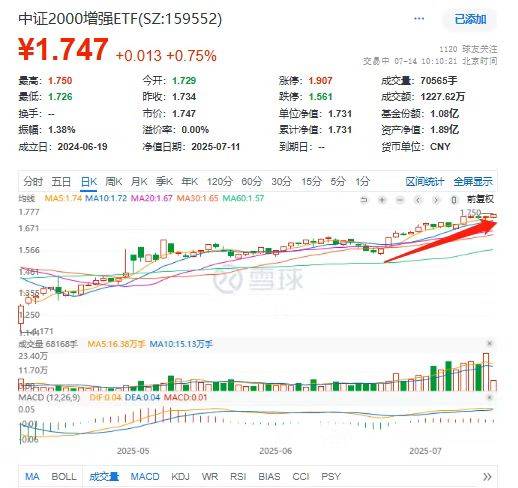
Group 1 - The small-cap stocks are showing an upward trend, with the China Securities 2000 Enhanced ETF (159552) increasing by 0.69% as of 10:11 AM on July 14, and it has gained 34.00% year-to-date and over 70% in the past year, marking its 24th new high of the year [1] - The fund has seen a continuous net inflow of capital for 10 days as of July 11, with a year-to-date growth in scale of 1071.33% [1] - According to China International Capital Corporation (CICC), despite the recent rise in small-cap stock valuations and potential short-term volatility, the trend of small-cap outperforming large-cap may not be over, indicating a favorable environment for small-cap style investments [1] Group 2 - The China Securities 2000 Enhanced ETF (159552) tracks the China Securities 2000 Index, which reflects the price performance of a group of small-cap stocks in the A-share market, aiming to achieve excess alpha while capturing the index beta [1] - The ETF offers higher capital utilization compared to off-market index enhancement funds, and its secondary market trading incurs lower costs than off-market subscription and redemption fees for general index enhancement funds, making it an effective investment tool for index enhancement strategies [1] - For investors without a brokerage account, the off-market fund options, such as the China Securities 2000 Index Enhancement (A: 019918 C: 019919), are recommended for investment [1]
大幅跑赢,发生了什么?
中国基金报· 2025-07-13 14:16
Core Viewpoint - The private equity stock strategy has achieved a return of 10% in the first half of the year, with quantitative strategies significantly outperforming subjective long strategies [1][2]. Summary by Sections Overall Performance - As of June 30, 2023, the average return of 10,041 private equity securities products was 8.32%, with over 80% achieving positive returns [3]. - Among various strategies, stock strategies led with an average return of 10%, followed by multi-asset strategies at 7.28%, and combination funds, bond strategies, and futures/derivatives strategies at 6.05%, 3.83%, and 3.82% respectively [3]. Quantitative vs. Subjective Strategies - Quantitative long strategies showed a remarkable return of 15.42%, while subjective long strategies had a return of 9.23% [9]. - In the first half of the year, 93.32% of quantitative long strategy products achieved positive returns, compared to less than 80% for subjective long strategies [9]. - The strong performance of quantitative strategies is attributed to their focus on small-cap stocks, which outperformed larger indices [9][10]. Market Conditions and Future Outlook - The market environment has been characterized by high trading volumes and volatility, benefiting quantitative strategies that capitalize on pricing discrepancies in small-cap stocks [9]. - Looking ahead, sectors such as military industry, artificial intelligence hardware and applications, and certain consumer electronics are expected to improve, presenting potential investment opportunities [7].

放量24%创近一年新高!“指增王”中证2000增强ETF(159552)盘中交投持续升温
Sou Hu Cai Jing· 2025-07-11 06:15
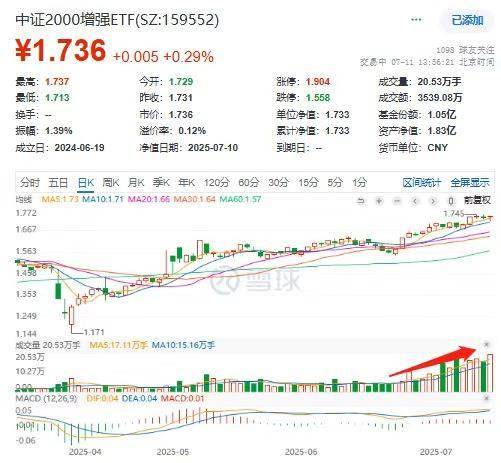
Core Insights - Small-cap stocks have regained momentum, with the CSI 2000 Enhanced ETF (159552) rising by 0.29% as of 1:57 PM, and showing a year-to-date increase of 33.23%, leading broad-based ETFs [1] - The trading activity is robust, with a turnover rate of 19.50% and a trading volume of approximately 35 million, reflecting a 24.45% increase compared to the previous day, marking a one-year high [1] - The CSI 2000 Enhanced ETF has seen net inflows for 10 consecutive days, indicating sustained investor interest [1] Fund Characteristics - The CSI 2000 Enhanced ETF tracks the CSI 2000 Index, which reflects the price performance of a selection of small-cap stocks in the Chinese A-share market [1] - This ETF aims to achieve excess alpha while capturing the index beta, offering higher capital efficiency compared to traditional index-enhanced funds [1] - The secondary market trading of ETFs incurs lower costs compared to off-market index-enhanced fund subscriptions and redemptions, making it an effective investment tool [1] Alternative Investment Options - For investors without a brokerage account, the off-market fund options such as the China Merchants CSI 2000 Index Enhanced Fund (A: 019918, C: 019919) are suggested for potential investment [1]
私募升温!上半年新备案产品环比翻倍,量化指增策略领跑市场
券商中国· 2025-07-09 01:24
Core Viewpoint - The recent decline in wealth management yields, combined with a recovery in the capital market, has led to a gradual increase in the sales of private securities investment products [1]. Group 1: Product Registration and Market Trends - A total of 5,461 new private securities investment products were registered in the first half of the year, representing a year-on-year increase of 53.61% and a month-on-month increase of 100.48% [2][3]. - In June alone, 1,100 private securities investment funds were registered, marking a monthly record high for the year with a month-on-month growth of 26.44% [3]. - Stock strategies remain the dominant force in private fund registrations, with 3,458 new stock strategy private products accounting for 63.32% of total registrations [3]. Group 2: Performance of Quantitative Strategies - Quantitative strategies have emerged as a mainstream direction in the market, with 2,448 registered quantitative strategy private products, of which 1,715 are stock quantitative strategies, making up 70.06% [3]. - The index enhancement strategy is particularly favored, with 1,061 registered products, representing 61.87% of stock quantitative strategies [3]. - The top three performing strategies in the first half of the year were the Tongpu 1000 Index Enhancement Private Index (+15.87%), the Tongpu Subjective Growth Private Index (+12.80%), and the Tongpu 500 Index Enhancement Private Index (+10.66%) [5]. Group 3: Market Outlook and Investment Focus - Private institutions are generally optimistic about the market in the second half of the year, focusing on technology, consumption, innovative pharmaceuticals, and dividend assets [9]. - Clear and favorable domestic policies are expected to maintain a relatively loose liquidity environment, reducing the likelihood of systemic risks [9]. - Investment strategies include a focus on high-quality companies in sectors such as AI applications, upstream resources, new consumption, and innovative pharmaceuticals [9].

权益因子观察周报第119期:上周小市值风格占优,本年中证2000指数增强策略收益18.84%-20250708
GUOTAI HAITONG SECURITIES· 2025-07-08 11:03
Group 1: Core Insights - The report highlights that small-cap stocks have outperformed in the recent week, with the CSI 2000 index showing a year-to-date excess return of 18.84% [1][6] - The report tracks the performance of public index-enhanced funds across major indices, including CSI 300, CSI 500, CSI 1000, and CSI 2000, providing insights into their excess returns [7][8] - The top-performing enhanced funds for the year are identified, with notable excess returns for various funds across different indices [3][12][20] Group 2: Fund Performance - As of July 4, 2025, the top three enhanced funds for the CSI 300 index have excess returns of 8.53%, 5.28%, and 5.07% respectively [8][10] - For the CSI 500 index, the leading funds have excess returns of 8.85%, 7.85%, and 6.92% [12][14] - The CSI 1000 index's top funds show excess returns of 13.1%, 12.65%, and 11.45% [16][18] - The CSI 2000 index's leading funds have excess returns of 12.78%, 12.71%, and 9.14% [20][22] Group 3: Factor Performance - The report tracks the performance of various single factors and broad categories, indicating that factors such as analyst forecasts and profitability metrics have shown strong excess returns in different stock pools [26][30][32] - For the CSI 300 stock pool, the best-performing factors over the past week include analyst forecast EP-FY3 and single-quarter operating profit, with excess returns of 1.3% each [30] - In the CSI 500 stock pool, the top factors include single-quarter non-recurring ROE change and analyst forecast ROE-FY3, with excess returns of 1.27% and 1.18% respectively [31]
上半年新备案私募证券产品环比翻倍 量化指数增强策略最受市场青睐
Zheng Quan Shi Bao· 2025-07-07 17:55
Group 1 - The core viewpoint is that the sales of private securities investment products are gradually increasing due to the continuous decline in financial product yields and a recovery in the capital market [1] Group 2 - In the first half of the year, a total of 5,461 new private securities investment products were registered, representing a year-on-year increase of 53.61% and a month-on-month increase of 100.48% [2] - In June alone, 1,100 private securities investment fund products were registered, marking a monthly increase of 26.44% and the second-highest monthly figure of the year [2] - Stock strategies remain the dominant force in private fund registrations, with 3,458 new stock strategy private products accounting for 63.32% of the total [2] - Quantitative stock strategies are particularly popular, with 1,715 registered products, making up 70.06% of the quantitative strategy private products [2] Group 3 - The decline in deposit rates, with one-year fixed deposit rates falling below 1%, has contributed to the growth in private product issuance as they offer relatively higher returns [3] - The top three performing strategies in the first half of the year were the Tangpu 1000 Index Enhanced Private Index (+15.87%), Tangpu Subjective Growth Private Index (+12.80%), and Tangpu 500 Index Enhanced Private Index (+10.66%) [3] - Among the 33 private institutions with at least 20 registered products, 27 are quantitative private institutions, with 18 being large-scale institutions managing over 10 billion [3] - As of June, 2,010 private products reached historical net asset value highs, representing approximately 45.68% of those with nearly one year of performance data [3] Group 4 - Private institutions are generally optimistic about the second half of the year, focusing on sectors such as technology, consumption, innovative pharmaceuticals, and dividend assets [4] - The liquidity environment is expected to remain relatively loose, reducing the probability of systemic risks [4] - A total of 751 private securities managers participated in A-share listed company research, covering 387 stocks across 28 industries, with a total of 1,769 research instances [4] - The strategy for future market positioning includes a focus on high-quality companies that are undervalued, particularly in the internet, electronics, and automotive sectors [4]