
脱碳

Search documents
葡萄牙化工组织:需投入300亿欧元推进行业脱碳
Zhong Guo Hua Gong Bao· 2025-11-21 03:38
Core Insights - The Portuguese chemical, petrochemical, and refining sectors need to increase decarbonization investments to achieve the net-zero emissions target by 2050, with an estimated investment requirement of €30 billion [1] Investment Requirements - The current annual investment in the Portuguese chemical industry is approximately €1 billion, primarily focused on business growth, production process optimization, and energy efficiency, with only a portion directed towards decarbonization efforts [1] - The €30 billion decarbonization cost estimate is based on a study conducted in collaboration with consulting firm Ernst & Young, marking the first time the industry has provided a specific figure for decarbonization costs [1] Decarbonization Strategy - The investment will be used for a structured plan to meet the carbon neutrality requirements outlined in UN and EU treaties, necessitating significant initial capital injection [1] - Key areas for investment include electrification upgrades, development of renewable gases (such as green hydrogen and biomass), and the application of carbon capture, utilization, and storage (CCUS) technologies [1] Regulatory Context - Achieving carbon neutrality is a legal obligation in Europe, and there is no doubt among APQuimica members regarding this requirement [1] - The chemical industry is capital-intensive, already investing substantial funds annually, and has the capacity to increase investments further [1] Emissions Data - The manufacturing sector in Portugal accounts for 26% of the country's total greenhouse gas emissions, with the chemical, petrochemical, and refining industries contributing over one-third of industrial emissions [1]
高盛:跨交易、大宗商品和股票研究的美国和全球天然气观点
Goldman Sachs· 2025-11-20 02:16
Investment Rating - The report indicates a bullish outlook for European natural gas prices in early 2025, but potential obstacles due to weather and EU storage rule relaxations [5] Core Insights - European natural gas prices are expected to decline to €29 in 2026 and further to €20 in 2027, while U.S. Henry Hub prices are forecasted at $4.60 in 2026 and $3.80 in 2027 [1][2] - The increase in LNG capacity will exceed the Russian gas supply gap, primarily from the U.S. and Qatar, which will help alleviate energy cost pressures in Europe [3] - The global LNG market is anticipated to face oversupply in the coming years, with Henry Hub prices potentially dropping below $2 in 2028 and 2029 [8] - Data centers are projected to significantly increase natural gas demand, with daily requirements potentially reaching 10 bcfa by 2030 [9] Summary by Sections LNG Supply and Demand - The LNG supply wave is expected to dominate the global natural gas market, easing supply-demand balance in Europe and globally [2] - If China increases its natural gas share in power generation and industry by 2% and 3% respectively, it could add approximately 10 billion cubic meters of demand annually [6][7] Market Dynamics - Current market focus includes storage capacity, electricity infrastructure, and supply-demand tightness, with a noted lack of new storage facilities over the past 20 years [4] - The first quarter of 2025 may see a tighter supply-demand balance, but long-term outlook remains bearish [5] Price Forecasts - Long-term price scenarios suggest that European prices could exceed $10 to $15 per million BTU by the mid-2030s due to decarbonization policies [10] - The construction of new storage facilities faces challenges due to high costs, making it difficult to alleviate current market concerns [11][12] Investment Strategies - Midstream companies like Kinder Morgan are viewed favorably due to their ability to benefit from infrastructure demand while being insulated from market volatility [15][18] - Low-cost producers such as EQT are recommended for active buying at around $50 per share, with caution advised near $60 [16][18]
Danaos(DAC) - 2025 Q3 - Earnings Call Transcript
2025-11-18 15:02
Financial Data and Key Metrics Changes - The company reported adjusted EPS for Q3 2025 of $6.75 per share, compared to $6.5 per share in Q3 2024, reflecting a slight increase [9] - Adjusted net income decreased by $2.7 million to $124.1 million in Q3 2025 from $126.8 million in Q3 2024, primarily due to increased operating costs and decreased dividend income [10] - Adjusted EBITDA increased by 1.5% to $181.6 million in Q3 2025 from $178.9 million in Q3 2024 [13] Business Line Data and Key Metrics Changes - Vessel operating expenses increased by $2.4 million to $52.3 million in Q3 2025, attributed to a higher average number of vessels in the fleet [11] - Daily operating costs slightly increased to $6,927 per vessel per day in Q3 2025 from $6,860 in Q3 2024 [11] - The container segment experienced a $4.3 million decrease in revenues due to lower contracted charter rates [10] Market Data and Key Metrics Changes - The charter market remains robust with an all-time low idle fleet, and demand for mid-size and larger vessels continues unabated [4][5] - The company has secured new charters for vessels extending as far out as early 2028, indicating strong future demand [5] Company Strategy and Development Direction - The company is selectively extending its new building program at below-market prices and has secured multi-year employment for new orders [5] - The company plans to opportunistically invest in the dry bulk Capesize market segment, expecting outsized returns due to supply constraints [8] - A quarterly dividend increase to $0.90 per share was announced, consistent with the policy of yearly increases [8][14] Management's Comments on Operating Environment and Future Outlook - The management noted that the war in Ukraine continues with no end in sight, impacting global trade dynamics [4] - The de-escalation of trade tensions between the U.S. and China has allowed trade to resume, contributing to high container traffic [4] - Management expressed uncertainty about the strength of the market in 2026, indicating that the situation remains fluid [22][23] Other Important Information - The company completed a $500 million unsecured seven-year bond offering with a 6.85% coupon, enhancing its financial flexibility [6][7] - As of September 30, 2025, the company reported cash of $596 million and total liquidity of $971 million [15] Q&A Session Summary Question: Insights on container shipping chartering activity and demand - Management noted that despite lower trade and tariffs, demand for charters remains high due to global production capacity and market dynamism outside traditional Western areas [20][22] Question: Update on Capesize vessel investment and future plans - The company aims to grow its investment in the dry bulk market selectively, focusing on high-quality second-hand vessels rather than new builds [25] Question: Share repurchase program activity - Management confirmed that the share buyback program continues, albeit at a smaller pace, as they believe the stock is undervalued [26][27] Question: Update on investment in Star Bulk and interest in other segments - Management expressed satisfaction with the investment in Star Bulk and indicated no current plans to expand into other segments like Panamaxes or Supramaxes [31]

欧盟贸易专员:欧盟计划限制废铝出口 防范供应危机
Wen Hua Cai Jing· 2025-11-18 10:27
Core Viewpoint - The European Commission plans to impose restrictions on the export of scrap aluminum to prevent significant outflow and ensure the availability of materials necessary for decarbonization in the industry [1] Group 1: Export Trends - The export volume of scrap aluminum from the EU is projected to reach a record 1.26 million tons in 2024, an increase of approximately 50% compared to five years ago, with most exports directed to Asia [1] - The situation has worsened due to the U.S. imposing a 50% import tariff on aluminum while only charging 15% on scrap, leading to increased U.S. imports of scrap aluminum and reduced exports from the EU [1] Group 2: Regulatory Actions - The European Commission began monitoring exports in July and is evaluating the necessity of taking action regarding scrap aluminum exports [1] - A new measure to address the issue of scrap aluminum outflow is being prepared, which is expected to be implemented in spring 2026, aiming for a balanced approach that considers the interests of producers, recyclers, and downstream industries [1] Group 3: Industry Impact - Scrap aluminum plays a crucial role in the decarbonization efforts of the industry, as recycling aluminum consumes 95% less energy compared to producing aluminum from bauxite ore [1] - The European Recycling Industries Confederation (EuRIC) opposes the restrictions, arguing that the export of scrap aluminum is a result of low regional demand and insufficient capacity for processing mixed waste within the EU [1]
Flowserve (NYSE:FLS) FY Conference Transcript
2025-11-12 18:25
Flowserve Conference Call Summary Company Overview - **Company**: Flowserve - **Industry**: Industrial manufacturing, specifically in pumps and valves Key Points and Arguments Financial Performance - **Q3 Results**: Flowserve reported strong results with bookings of approximately **$1.2 billion** and earnings per share (EPS) of **$0.90** [4][5] - **Bookings Composition**: Less than **10%** of bookings were from large projects, indicating a shift away from upstream oil and gas [5][35] - **Nuclear Market Potential**: Flowserve aims for a **$10 billion** bookings target over the next **10 years** in the nuclear sector, leveraging its presence in **75%** of global reactors [11][26] Strategic Initiatives - **3D Strategy**: The company focuses on **diversification, decarbonization, and digitization** as part of its long-term strategy [4][5] - **Operational Excellence**: Emphasis on lean manufacturing principles has driven margin expansion, with operational excellence being a key contributor to recent financial performance [7][52] - **80/20 Methodology**: Flowserve has committed to reducing complexity by cutting **45%** of its SKUs, resulting in a **150 basis points** margin improvement in its industrial pumps business [8][54] Market Dynamics - **Aftermarket Resilience**: The aftermarket segment now constitutes **8-9%** of total bookings, showcasing a shift towards more stable revenue sources [35][47] - **Project Environment**: The company has faced challenges in project bookings due to tariffs and geopolitical issues, but anticipates improvement moving into **2026** [33][34][38] - **Growth in Other Sectors**: Flowserve sees growth opportunities in pharmaceuticals and water projects, particularly in the U.S. [34] Margin and Revenue Outlook - **EBIT Margin Target**: Flowserve aims for an EBIT margin of **14-16%**, with confidence in achieving the high end of this range [48][52] - **Revenue Growth**: The company expects to grow revenue in **2026**, albeit with some downward pressure due to project delays [39][40] Capital Deployment - **Free Cash Flow**: Flowserve is positioned to deploy capital effectively, with a focus on share repurchases and potential programmatic M&A opportunities [62][71] - **Asbestos Liability Resolution**: The company has resolved a long-standing asbestos liability, freeing up resources for future investments [70] Industry Positioning - **Nuclear Sector**: Flowserve is well-positioned in the nuclear market, with strong relationships and a focus on both traditional and small modular reactor (SMR) technologies [14][24] - **Diverse End Markets**: The company is diversifying its business away from oil and gas, with general industries now becoming a significant segment [42][43] Additional Important Insights - **Cultural Shift**: Flowserve has fostered a culture of problem-solving and data-driven decision-making, enhancing employee buy-in for strategic initiatives [58][59] - **Future Growth**: The company is optimistic about its growth trajectory, particularly in the nuclear and aftermarket sectors, while remaining cautious about external market conditions [26][37][44]
中国环保债券创新高,谋求绿色主导权
3 6 Ke· 2025-11-10 07:56
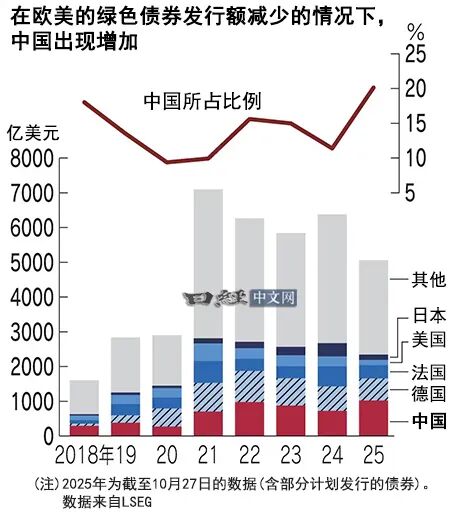
Core Insights - China's green bond issuance reached a record high of $101.8 billion by late October 2025, accounting for 20% of the global total, positioning China as the leader in this sector [1][4] - The increase in green bond issuance in China is part of a national strategy to promote economic growth through green industries amid a domestic economic slowdown [1][4] - The global green bond issuance totaled approximately $506 billion by late October 2025, showing an 11% year-on-year decline, with China leading the way [1][4] Group 1: Green Bond Issuance - China's green bond issuance increased by 92% year-on-year, surpassing the previous record of $97.7 billion set in 2022 [1][4] - Major financial institutions in China, such as Agricultural Bank of China and Industrial Bank, have issued significant amounts of green bonds, with the former issuing $60 billion in total [2][4] - The issuance of green bonds is primarily driven by financial institutions and state-owned enterprises in the energy sector [2][4] Group 2: Economic Context - The ongoing downturn in the real estate sector has contributed to a slowdown in China's economic growth, yet green bond issuance remains robust [4][5] - China's commitment to green industries is seen as a stable pillar for economic growth, contrasting with the fluctuating policies in countries like the U.S. [4][5] - China is projected to account for 48% of global photovoltaic capacity by 2024, reinforcing its position in renewable energy [4][5] Group 3: Regulatory Developments - In 2021, China excluded coal-related projects from its green bond support project catalog, aligning with international standards [5][6] - The Chinese government is actively working to attract foreign investment in green bonds, as evidenced by the issuance of its first green sovereign bond in London [5][6] - The standards for China's green bonds are increasingly aligning with international benchmarks, enhancing credibility in the global market [5][6] Group 4: International Implications - China's efforts to establish "green leadership" are being met with caution from Western countries, which have begun imposing tariffs on Chinese solar panels and electric vehicles [6] - As the largest emitter of greenhouse gases, China's actions in the green bond market are critical for global decarbonization efforts [6]

中国环保债券创新高,谋求绿色主导权
日经中文网· 2025-11-10 03:16
Core Viewpoint - China is seizing the opportunity to establish "green leadership" as the decarbonization efforts in Europe and the US face challenges, with a significant increase in green bond issuance reflecting this strategy [2][4][9]. Group 1: Green Bond Issuance - As of late October 2025, China's green bond issuance reached $101.8 billion, marking a 92% year-on-year increase and setting a historical record, accounting for 20% of the global total [4][5]. - The global green bond issuance for 2025 is approximately $506 billion, showing an 11% decline year-on-year, with China leading the way, followed by Germany at $63.7 billion and the US at $15.4 billion, which saw a 42% decrease [4][5]. - Major financial institutions in China, such as Agricultural Bank of China and Industrial Bank, have been key issuers of green bonds, with significant amounts raised for renewable energy and low-carbon projects [5][7]. Group 2: Economic Context and Strategy - The ongoing downturn in the real estate sector has contributed to a slowdown in China's economic growth; however, green bond issuance remains robust as the government positions green industries as a pillar for economic growth [7][8]. - China's commitment to green industries is consistent, unlike in the US, where policies may shift with political changes, reinforcing the stability of green investments in China [7]. Group 3: International Standards and Attracting Foreign Investment - China is aligning its green bond standards with international benchmarks, such as the EU Taxonomy, to enhance credibility and attract foreign investment [8][9]. - The issuance of China's first green sovereign bond in London, which attracted significant interest from European and Middle Eastern investors, exemplifies efforts to draw overseas capital [9]. - Despite over 90% of green bonds being purchased by domestic investors, the Chinese government is actively working to increase foreign participation in its green bond market [9]. Group 4: Global Impact and Challenges - China's advancements in renewable energy, particularly in photovoltaic capacity, position it as a key player in global decarbonization efforts, especially as the US faces setbacks in its climate policies [7][9]. - The rise of China's green bond market, as the largest globally, is crucial for achieving international climate goals, although it has raised concerns in the West regarding potential trade barriers and tariffs on Chinese green products [9].
CF(CF) - 2025 Q3 - Earnings Call Transcript
2025-11-06 17:02
Financial Data and Key Metrics Changes - For the first nine months of 2025, the company reported adjusted EBITDA of approximately $2.1 billion, with net earnings attributable to common stockholders of about $1.1 billion, or $6.39 per diluted share [5][22][23] - In the third quarter of 2025, net earnings attributable to common stockholders were $353 million, or $2.19 per diluted share, with EBITDA and adjusted EBITDA both around $670 million [22][23] - The trailing 12-month net cash from operations was $2.6 billion, and free cash flow was $1.7 billion, with a free cash flow to adjusted EBITDA conversion rate of 65% [22][23] Business Line Data and Key Metrics Changes - The ammonia utilization rate for the first nine months of 2025 was 97%, with expectations to produce approximately 10 million tons of gross ammonia for the full year [14] - Significant progress was made in strategic initiatives, including the full utilization of expanded diesel exhaust fluid rail load-out capabilities, leading to record DEF shipments [14][15] Market Data and Key Metrics Changes - The global nitrogen supply-demand balance remained tight in Q3 2025, with robust demand from North America, India, and Brazil, while product availability was constrained due to low global inventories and outages [17][18] - The company anticipates that the global nitrogen supply-demand balance will remain constructive, with continued strong demand and constrained supply availability [17][18] Company Strategy and Development Direction - The company aims to become the world's leader in clean ammonia and has reduced GHG emissions intensity by 25% from its original baseline [6][7] - Plans for the world's largest ultra-low emissions ammonia plant at the Bluepoint complex in Louisiana are underway, with expectations for significant financial and societal benefits [9][10] - The company is also preparing for the European Union's Carbon Border Adjustment Mechanism, which is expected to drive demand for low carbon nitrogen products [19][20] Management's Comments on Operating Environment and Future Outlook - Management expressed confidence in the strong demand dynamics for nitrogen, even amid challenges in the agricultural sector [11][12] - The company believes that its financial performance is not impacted by most factors affecting other agricultural companies, highlighting the inelastic demand for nitrogen [11][12] - Management noted that the current market conditions are above mid-cycle expectations, with a strong outlook for the fourth quarter and beyond [36][37] Other Important Information - The company returned $445 million to shareholders in Q3 2025 and approximately $1.3 billion for the first nine months [22][23] - The share repurchase program has been significant, with 37.6 million shares repurchased, representing 19% of outstanding shares at the start of the program [23][24] Q&A Session Summary Question: Market conditions and mid-cycle expectations - Management acknowledged that current conditions are above mid-cycle and expect full-year results to exceed mid-cycle numbers due to strong demand and pricing dynamics [36][37] Question: Pricing premiums for low carbon ammonia - The company is currently achieving a premium of $20-$25 per ton for low carbon ammonia sold in Europe, with expectations for this to increase as demand grows [39] Question: Concerns about the nitrogen outlook - Management indicated that supply constraints and strong demand are expected to continue, with no significant negative factors identified in the near term [44][46] Question: Valuation disconnect and investor perception - Management discussed the challenges in communicating the company's unique financial profile to investors and emphasized the importance of continued share repurchases to address valuation concerns [48][49] Question: Capital expenditures and maintenance - The company plans to maintain a capital expenditure range of approximately $550 million for its non-Bluepoint network, with adjustments based on project completions and inflation [53] Question: Impact of the Yazoo City incident - The ammonia plant at Yazoo City was not directly affected, and production is expected to continue as planned while investigations are conducted [54]

CF(CF) - 2025 Q3 - Earnings Call Transcript
2025-11-06 17:02
Financial Data and Key Metrics Changes - For the first nine months of 2025, the company reported adjusted EBITDA of approximately $2.1 billion, with net earnings attributable to common stockholders of about $1.1 billion, or $6.39 per diluted share [5][21][22] - In the third quarter of 2025, net earnings attributable to common stockholders were $353 million, or $2.19 per diluted share, with EBITDA and adjusted EBITDA both around $670 million [21][22] - The trailing 12-month net cash from operations was $2.6 billion, and free cash flow was $1.7 billion, with a free cash flow to adjusted EBITDA conversion rate of 65% [21][22] Business Line Data and Key Metrics Changes - The ammonia utilization rate for the first nine months of 2025 was 97%, with expectations to produce approximately 10 million tons of gross ammonia for the full year [14] - Significant progress was made in strategic initiatives, including the full utilization of expanded diesel exhaust fluid rail load-out capabilities, leading to record DEF shipments [14][15] Market Data and Key Metrics Changes - The global nitrogen supply-demand balance remained tight, with robust demand from North America, India, and Brazil, while product availability was constrained due to low global inventories and outages [17][18] - The company anticipates that the global nitrogen supply-demand balance will remain constructive, with strong demand expected to continue [17][18] Company Strategy and Development Direction - The company aims to become the world's leader in clean ammonia and has reduced GHG emissions intensity by 25% from its original baseline [6][7] - Plans for the development of the world's largest ultra-low emissions ammonia plant at the Blue Point Complex in Louisiana are underway, with expectations for significant financial and societal benefits [9][10] Management's Comments on Operating Environment and Future Outlook - Management expressed confidence in the strong demand for nitrogen, stating that nitrogen demand is largely inelastic and not significantly affected by grower profitability [11][12] - The company highlighted the misconception in the market regarding its valuation, noting that it trades at a low cash flow multiple compared to its strong free cash flow generation [13] Other Important Information - An incident at the Yazoo City, Mississippi complex was reported, but all employees and contractors were safe, and the investigation is ongoing [4][24] - The company returned $445 million to shareholders in the third quarter of 2025 and approximately $1.3 billion for the first nine months [22][23] Q&A Session Summary Question: Current market conditions and mid-cycle expectations - Management acknowledged that current conditions are above mid-cycle and expect full-year results to exceed mid-cycle numbers due to strong industry conditions [33][34] Question: Pricing premiums for low-carbon ammonia - The company is currently achieving a premium of $20-$25 per ton for low-carbon ammonia sold in Europe, with expectations for this to increase as demand grows [37] Question: Potential risks in the nitrogen outlook - Management indicated that while they assess market conditions daily, they see healthy demand growth and limited supply, making it difficult to identify significant risks [41][42] Question: Addressing the valuation disconnect - Management noted that the market does not fully recognize the company's financial strengths and that continued share repurchases will help address this valuation gap [46][70] Question: Future capital expenditures and maintenance - The company expects to maintain a capital expenditure range of approximately $550 million for its non-Bluepoint network, with additional investments for Bluepoint [50][51] Question: Impact of the Yazoo City incident on production - Management confirmed that the ammonia plant at Yazoo City was not directly affected and production plans remain on track [52]
Thermon(THR) - 2026 Q2 - Earnings Call Transcript
2025-11-06 17:00
Financial Data and Key Metrics Changes - Reported revenues increased by 15% year-over-year, reaching $131.7 million for the quarter [16] - Adjusted EBITDA rose by 29% to $30.6 million, with adjusted EBITDA margins at 23.2%, up from 20.8% last year [17][18] - Gross profit increased by 20% to $61 million, resulting in a gross margin of 46%, up from 44% [17] - GAAP earnings per share increased by 61% to $0.45, while adjusted earnings per share rose by 45% to $0.55 [18] Business Line Data and Key Metrics Changes - Large project revenue was $24.7 million, a 41% increase year-over-year, driven by several CapEx projects moving to execution [17] - OPEX revenues were $107 million, up 10% year-over-year, representing 81% of total revenues [16][17] - Organic revenue growth, excluding FOTI, was 9% year-over-year [16] Market Data and Key Metrics Changes - U.S. land sales increased by 8%, while Canada saw a 10% increase in revenue [19] - EMEA revenue doubled, driven by strong performance in organic business and contributions from FOTI [19] - APAC experienced a 4% decline, primarily due to uncertainties surrounding global trade policies with China [19] Company Strategy and Development Direction - The company is focused on a 3D strategy of decarbonization, digitization, and diversification to drive organic growth [9][25] - The establishment of a global engineering center in Mexico aims to handle increased project workloads [8] - The company is actively pursuing opportunities in the data center market, particularly with liquid-cooled data centers and medium voltage heaters [12][14] Management's Comments on Operating Environment and Future Outlook - Management expressed confidence in the company's ability to deliver strong second-half results and raised full-year 2026 financial guidance [23][24] - The company is well-positioned to benefit from favorable secular demand trends, including reshoring, electrification, and decarbonization [7][25] - Management noted that the current tariff structures are expected to remain stable, which is crucial for maintaining customer sentiment [24] Other Important Information - The company ended the quarter with total liquidity of $129 million and a net leverage ratio of 1.0 times [8][22] - The backlog increased by 17% year-over-year, with a 4% organic increase due to positive book-to-bill ratios [18][19] Q&A Session Summary Question: Expectations for large CapEx projects, particularly in LNG - Management indicated robust activity in the LNG market, with a 140% year-over-year increase in the LNG pipeline [29] Question: Details on digitization efforts and their impact - Management highlighted that digitization differentiates the company from competitors and enhances customer engagement, leading to recurring revenues [30][31] Question: Dynamics of gross margin in relation to large projects - Management acknowledged that large projects typically have lower margins but noted that increased volumes and productivity gains helped maintain solid margins [34][35] Question: Timing for other large projects to move to execution - Management confirmed that a broader range of projects across various sectors is moving to execution, not just LNG [38] Question: Impact of data center and medium voltage heater opportunities on results - Management stated that there was no impact in the second quarter, but they are beginning to book orders and see high-probability opportunities [39] Question: Balance between organic and inorganic growth investments - Management emphasized a priority on organic growth initiatives while also tracking potential inorganic opportunities [45]
