黄金消费

Search documents
中国黄金协会:前三季度我国金条及金币消费352.116吨 同比增24.55%
2 1 Shi Ji Jing Ji Bao Dao· 2025-11-10 04:26
Core Insights - The China Gold Association reported that gold consumption in the first three quarters of 2025 reached 682.730 tons, representing a year-on-year decrease of 7.95% [1][2] Summary by Category Overall Gold Consumption - Total gold consumption in China for the first three quarters of 2025 was 682.730 tons, down 7.95% compared to the previous year [1][2] Jewelry Consumption - Gold jewelry consumption amounted to 270.036 tons, showing a significant decline of 32.50% year-on-year [1][2] Gold Bars and Coins - Consumption of gold bars and coins was 352.116 tons, which marked a substantial increase of 24.55% year-on-year [1][2] Industrial and Other Uses - Industrial and other gold usage reached 60.578 tons, reflecting a modest growth of 2.72% year-on-year [1][2]

2025年前三季度国内黄金ETF增仓量为79.015吨,同比增长164.03%
Bei Jing Shang Bao· 2025-11-10 04:01
Group 1 - The core viewpoint of the article highlights a significant increase in domestic gold ETF holdings and production in China, indicating a strong market trend in the gold industry [1][3] - In the first three quarters of 2025, domestic gold ETF increased by 79.015 tons, a year-on-year growth of 164.03% compared to 2024 [1] - As of September 2025, the total domestic gold ETF holdings reached 193.749 tons [1] Group 2 - In the first three quarters of 2025, China's gold production amounted to 271.782 tons, reflecting a slight increase of 1.39% year-on-year [3] - The import of raw gold materials contributed an additional 121.149 tons, marking an 8.94% increase compared to the previous year [3] - The total gold production, combining domestic and imported raw materials, reached 392.931 tons in the same period [3] Group 3 - The gold industry in China is focusing on high-quality development, with several strategically significant exploration and development projects progressing steadily [3] - Major gold enterprises are actively pursuing overseas mining strategies, resulting in an 18.39% increase in production from overseas mines in the first three quarters of 2025 [3]

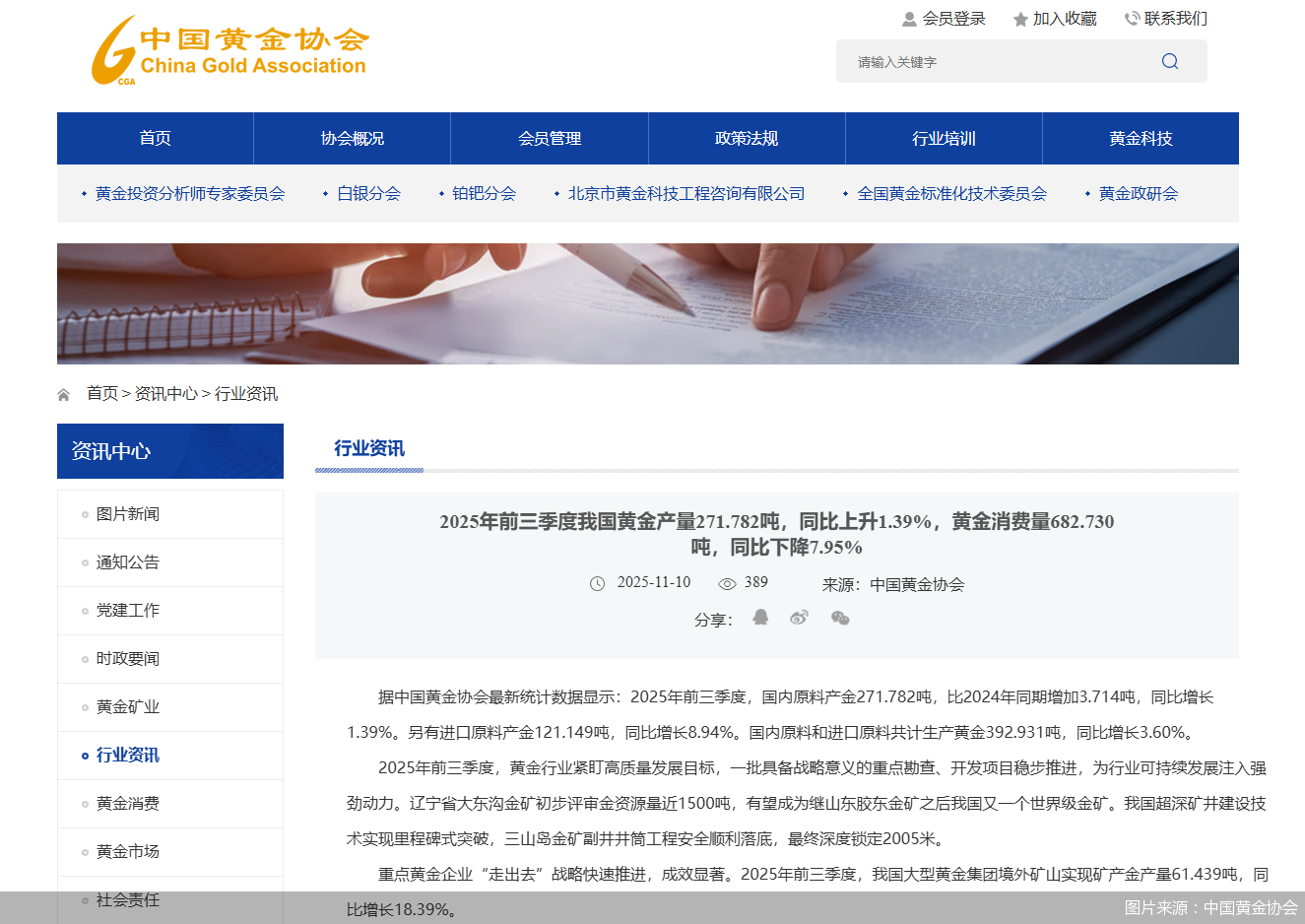
2025年前三季度中国黄金消费量682.730吨,同比下降7.95%
Jing Ji Guan Cha Wang· 2025-11-10 02:05
Group 1 - The core viewpoint of the article highlights the trends in gold production and consumption in China for the first three quarters of 2025, indicating a mixed performance in the gold market [1] Group 2 - Domestic raw gold production reached 271.782 tons, an increase of 3.714 tons compared to the same period in 2024, representing a year-on-year growth of 1.39% [1] - Imported raw gold production totaled 121.149 tons, showing a year-on-year increase of 8.94% [1] - The total gold production from domestic and imported raw materials amounted to 392.931 tons, reflecting a year-on-year growth of 3.60% [1] Group 3 - Gold consumption in China for the first three quarters of 2025 was 682.730 tons, which is a decrease of 7.95% year-on-year [1] - Gold jewelry consumption fell to 270.036 tons, marking a significant decline of 32.50% compared to the previous year [1] - Gold bars and coins consumption increased to 352.116 tons, showing a year-on-year growth of 24.55% [1] - Industrial and other gold usage reached 60.578 tons, with a year-on-year increase of 2.72% [1]
变天了!黄金新规出炉!每克蒸发300元,结婚已经不敢买三金了?
Sou Hu Cai Jing· 2025-11-09 09:09
Core Insights - The recent surge in gold jewelry prices is primarily due to a new tax policy implemented on November 1, which has restructured the gold market dynamics [1][3][23] Tax Policy Changes - The new policy differentiates between gold for investment and gold for non-investment purposes, effectively changing how gold is taxed and sold [3][7] - Previously, gold jewelry retailers received a special invoice allowing them to deduct 13% VAT, but this has now been replaced with a regular invoice that only allows a 6% deduction, increasing their tax burden by 7% [5][9] Impact on Retail Prices - Major brands like Chow Tai Fook and Lao Feng Xiang have raised retail prices to pass on the increased costs to consumers, leading to a significant price hike in gold jewelry [5][9] - For example, a typical wedding set of gold jewelry now costs approximately 2000 yuan more due to the new tax implications [9] Resale Market Challenges - Individuals selling gold jewelry face difficulties as they cannot provide a VAT special invoice, leading to lower buyback prices from recycling companies [11][13] - The disparity between market selling prices and buyback prices has widened, with individuals potentially receiving only 700 yuan for a gram of gold that sells for 1000 yuan in the market [13] Investment vs. Consumption - The new policy has effectively separated the investment and consumption aspects of gold, making gold jewelry less of a store of value and more of a luxury item [17][19] - Consumers are now encouraged to focus on the design and brand value of gold jewelry rather than its investment potential [19][21] Recommendations for Consumers - Consumers should prioritize purchasing from reputable sources that ensure the legitimacy of gold products, especially for wedding jewelry [19][21] - For those looking to invest, financial products like gold ETFs and bank-stored gold are recommended over physical gold bars due to lower transaction costs and better liquidity [17][21]
这届年轻人穿金戴银靠的就是省
Xin Lang Cai Jing· 2025-11-08 06:58
【#这届年轻人穿金戴银靠的就是省#】近期黄金市场热度不减,涨跌幅虽温和但整体处于历史高位。面 对高价门槛,年轻人的省钱攻略不断升级:租黄金平台迭代服务,推出定制化租赁套餐,覆盖日常佩戴 与特殊场合;打金成为"硬核选择",专业师傅手工打造+居家DIY并行,既规避品牌溢价,又能充分利 用闲置金料,让每一分钱都花在"黄金本身"上。金价持续高位,年轻人用务实与创意实现了"穿金戴 银"的生活向往。#年轻人想着法子也要穿金戴银自由# (来源:荔枝新闻) 转自:荔枝新闻 ...
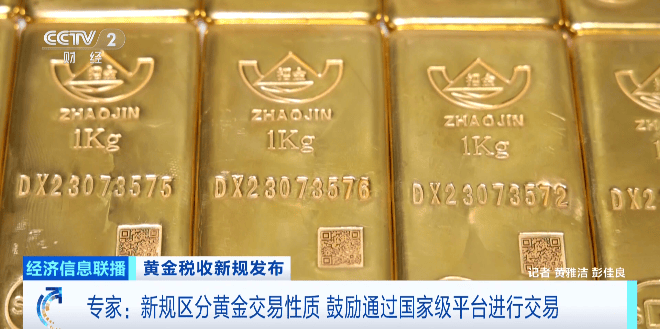
黄金税收新规落地!对个人购金有何影响?
2 1 Shi Ji Jing Ji Bao Dao· 2025-11-05 00:59
Core Points - The new tax policy on gold trading, effective from November 1, aims to reduce taxes for transactions conducted through exchanges while maintaining existing tax rules for non-exchange channels [1][3] - The policy differentiates between the "commodity nature" and "financial nature" of gold, encouraging investment through regulated exchange channels [1][3] Tax Policy Changes - Transactions of standard gold through the Shanghai Gold Exchange and Shanghai Futures Exchange will be exempt from value-added tax (VAT) when sold [1] - If gold is not withdrawn from the exchange, it is directly exempt from VAT; if physical gold is withdrawn, investment gold will enjoy a tax refund policy, while consumer gold can deduct VAT at a rate of 6% [1] Impact on Consumers - Personal sales of used gold jewelry are exempt from VAT, allowing individuals to sell items like old gold necklaces without tax implications [2] - The direct impact on retail prices of gold jewelry is minimal, but potential indirect effects may arise if investment demand shifts to exchanges, possibly leading to higher processing costs and retail prices [2] Investment Recommendations - For those looking to invest in gold for inflation hedging or asset preservation, it is advisable to prioritize exchange channels, such as gold futures, which offer convenience and no VAT [2] - Consumers interested in purchasing gold jewelry or bars for personal use can continue to buy from retail outlets without concern [2] Policy Background - The adjustment aims to create a more regulated and fair gold market, addressing previous lax tax management in non-exchange transactions and preventing tax loopholes [3] - The policy supports the gold industry and strengthens Shanghai's position as an international financial center for gold pricing [3]
黄金税收新规影响几何?
He Nan Ri Bao· 2025-11-04 22:38
Core Insights - The introduction of new tax regulations on gold is raising concerns among ordinary consumers and investors regarding its impact on the market [2][3] - The World Gold Council reported a 3% year-on-year increase in global gold demand for the first three quarters of this year, reaching 1,313 tons, with a significant 44% increase in total demand value, hitting a record high of $146 billion [2] - The new tax regulations aim to clarify the distinction between investment gold and non-investment gold, with specific tax exemptions for standard gold traded on exchanges [3] Group 1 - The new tax regulations highlight the difference between investment gold (bars, coins) and non-investment gold (jewelry), with the former exempt from value-added tax when purchased on exchanges [3] - The policy adjustment is seen as a refinement of existing regulations, promoting a clearer and healthier investment environment in the gold market [3] - The regulations are expected to discourage speculative behaviors and improve market order, benefiting long-term industry development [4] Group 2 - The recent fluctuations in gold prices have led to some investors being misled by the notion of "only rising" gold prices, emphasizing the importance of understanding the nature of gold as an investment versus a consumer product [3] - The new regulations serve as a warning to intermediaries in the gold market against misleading practices, such as misrepresenting non-investment gold as investment gold [3] - Maintaining a rational mindset and strategic planning is crucial for investors in navigating the inherent price volatility of gold [4]

黄金税新政落地:周大福等品牌紧急调价
Di Yi Cai Jing· 2025-11-04 13:16
Core Insights - The recent tax policy changes by the Ministry of Finance and the State Administration of Taxation have led to increased compliance costs for gold merchants, prompting them to raise prices to maintain profit margins [1][3] - The gold price in the Shui Bei market experienced a significant surge, reaching approximately 996 yuan per gram, marking the largest single-day increase in five years [1][2] - The new tax policy aims to differentiate tax management based on the investment and non-investment use of gold, which is expected to reduce speculative behavior in the market and promote healthy competition [3] Industry Impact - Merchants in the Shui Bei market are currently hesitant to engage in transactions, opting to observe market conditions due to the new tax regulations [1][2] - Major jewelry brands, including Chow Tai Fook, have begun adjusting their prices in response to the increased costs associated with the new tax policy [3] - A report from the World Gold Council indicates that global gold demand reached a record high in Q3 2023, driven primarily by investment demand, which surged by 47% year-on-year [3] Market Demand - In Q3 2023, China's retail gold investment and consumption demand totaled 152 tons, reflecting a year-on-year decline of 7% and a quarter-on-quarter drop of 38% [4] - Despite the decline in volume, the monetary value of China's retail gold investment and consumption demand reached 120.4 billion yuan, representing a 29% year-on-year increase and setting a record for Q3 [4]

黄金交易税收新规落地,买黄金饰品更贵了吗?业内人士分析→
Sou Hu Cai Jing· 2025-11-04 08:29
Core Viewpoint - The recent announcement by the Ministry of Finance and the State Taxation Administration regarding tax policies on gold trading aims to enhance the existing gold market policies, distinguishing between the commodity and financial attributes of gold [1] Summary by Relevant Sections Tax Policy Changes - From now until December 31, 2027, transactions of standard gold through the Shanghai Gold Exchange and Shanghai Futures Exchange will be exempt from value-added tax (VAT) for selling members or clients [1] - For physical delivery of gold, the tax treatment will differentiate between investment and non-investment uses, applying relevant policies accordingly [1] Impact on Market Participants - The new policy is expected to have three main effects: 1. Non-investment gold jewelry enterprises will face increased costs due to a reduction in input tax deductions from 13% to 6% [1] 2. Investment gold sales will benefit member units selling gold coins [1] 3. The price of gold jewelry for end consumers is likely to rise, depending on how much of the cost increase is passed on by jewelry companies [1] Investor Behavior - Investors purchasing investment gold bars from non-exchange channels will still be subject to the current 13% VAT, making exchange channels more attractive due to tax benefits [2] - The new policy may accelerate the concentration of investors towards exchange channels, especially for large investments, with ordinary investors likely preferring bank-represented exchange products like gold ETFs for convenience and tax efficiency [2] Consumer Impact - The tax burden for consumers purchasing gold jewelry remains unchanged, as the tax policies for non-exchange gold sales have not changed [2] - The price of gold jewelry will still be influenced by gold market price fluctuations, despite the tax structure remaining stable [2][3] Recommendations for Investors - From an investment perspective, products like paper gold and gold ETFs are recommended due to their structural tax advantages [3] - Consumers are advised to focus on brand-compliant merchants for gold purchases and to be cautious of market price fluctuations when buying gold jewelry [3]
黄金税收新政对黄金投资和消费有何影响?业内人士分析→
Sou Hu Cai Jing· 2025-11-02 14:54
Core Viewpoint - The new tax policy on gold, effective from November 1, 2023, aims to differentiate between investment and non-investment uses of gold, providing specific tax exemptions and incentives to encourage trading on regulated exchanges until December 31, 2027 [1][3]. Group 1: Tax Policy Details - The policy exempts value-added tax (VAT) on the sale of standard gold by member units or clients through the Shanghai Gold Exchange and Shanghai Futures Exchange, provided there is physical delivery [1]. - For investment purposes, a VAT refund policy will be implemented, while non-investment purposes will be exempt from VAT, with a 6% deduction rate for the buyer [1][8]. - The policy applies specifically to transactions occurring on the two designated exchanges, promoting regulated market activities [3][6]. Group 2: Market Impact - The new tax policy is expected to drive investors towards financial market investments, such as securities, gold ETFs, and futures options, increasing interest in these products [5]. - Traditional jewelry markets are likely to consolidate around larger, compliant brands due to the new regulations [6]. - The adjustments in the tax policy are seen as a refinement of existing regulations, enhancing the distinction between gold as a commodity and its financial attributes, leading to a more transparent and healthier investment environment [8].