区块链

Search documents
广东与新加坡跨境数据验证平台上线:数据跨境验证加速落地
GUOTAI HAITONG SECURITIES· 2025-12-03 08:23
Investment Rating - The report does not explicitly state an investment rating for the industry [2] Core Insights - The Shenzhen-Singapore cross-border data verification platform was launched on November 25, 2025, utilizing the FISCO BCOS blockchain technology to enhance data security and compliance in cross-border transactions [7][9] - The platform aims to facilitate two-way credit report verification between Guangdong and Singapore, leveraging the successful practices established in the Greater Bay Area [9][17] - FISCO BCOS serves as the underlying technology, providing a secure and efficient environment for digital asset applications and ensuring data integrity through hash verification [10][13] - The collaboration with Experian Singapore enhances the platform's credibility and acceptance in the international credit system, potentially becoming a key point for broader cross-border credit cooperation between the Greater Bay Area and ASEAN countries [16][17] Summary by Sections 1. Launch of the Shenzhen-Singapore Cross-Border Data Verification Platform - The platform operates on a model of "user self-transmission, platform hash verification," effectively separating original data from verification information to address compliance and security challenges in cross-border data flow [7][9] - It connects over 40 institutions and has implemented more than 15 use cases, covering the 9+2 city clusters in the Greater Bay Area [8][9] 2. FISCO BCOS as the Underlying Technology - FISCO BCOS is a domestic open-source blockchain platform designed for financial applications, supporting over 400 digital transformation projects across various sectors [10][11] - The platform's high performance and security features, including support for multiple consensus algorithms and privacy protection mechanisms, make it suitable for enterprise-level applications [11][12] 3. Experian Singapore's Role in ASEAN Cooperation - Experian Singapore, a key player in the local credit information infrastructure, enhances the platform's capability for cross-border credit verification [16][17] - The partnership is expected to improve the acceptance of verification results within Singapore's regulatory framework, facilitating broader credit cooperation in the region [17]
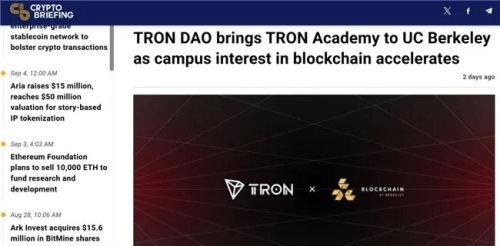
孙宇晨携手伯克利,共育区块链行业明日之星
Sou Hu Cai Jing· 2025-12-03 08:09
Core Insights - The collaboration between TRON and UC Berkeley marks a significant milestone in TRON's academic partnerships, emphasizing the commitment to blockchain education and talent cultivation in the Web3 space [1][3]. Group 1: Academic Collaborations - TRON, founded by Sun Yuchen, has established partnerships with several prestigious institutions, including Imperial College London, Yale University, Dartmouth College, Princeton University, MIT, Cornell University, Columbia University, and Harvard University [1]. - The recent workshop at UC Berkeley is part of TRON's global education initiative, TRON Academy, which aims to combine theoretical knowledge with practical blockchain applications for students [1]. Group 2: Workshop Details - The workshop featured Sam Elfarra from the TRON community, who engaged approximately 30 students in discussions about TRON's ecosystem and the development trends in the Web3 industry, including the role of PayFi in various payment scenarios [3]. - Elfarra highlighted the importance of educational collaborations in equipping students with practical skills, resources, and industry connections, reinforcing TRON's mission to nurture future innovators [3]. Group 3: Future Plans - Following the workshop, TRON's team engaged with student organization leaders to explore ways to enhance blockchain-related courses and activities, recognizing the critical role of universities in advancing blockchain education [5]. - TRON plans to continue its efforts in talent development, supporting student-led innovative projects and providing resources through initiatives like TRON Academy to strengthen the talent foundation for the Web3 industry [5].

航贸金融加速数智化转型
Jing Ji Ri Bao· 2025-12-02 22:03
Core Viewpoint - The eighth Hongqiao International Economic Forum highlighted the importance of maritime trade finance in supporting high-quality development of cross-border trade, showcasing its potential in stabilizing supply chains and enhancing international trade competitiveness [1][2]. Group 1: Industry Insights - Maritime trade finance is a cross-disciplinary field integrating shipping, trade, and finance, crucial for cross-border trade [1]. - In the first three quarters of this year, China's goods trade import and export reached 33.61 trillion yuan, a year-on-year increase of 4%, marking a new high [1]. - The growth rates for imports and exports in the first, second, and third quarters were 1.3%, 4.5%, and 6% respectively, achieving eight consecutive quarters of year-on-year growth [1]. Group 2: Technological Advancements - New technologies such as big data, blockchain, and artificial intelligence are driving innovations like electronic bills of lading and smart contracts in maritime trade finance [1][3]. - The "Jiaoyin Maritime Trade Connect" platform aims to provide a one-stop service integrating data resources from shipping, trade, and finance, enhancing efficiency in information flow, goods flow, and capital flow [2]. - The platform supports various transaction forms, including spot, forward, and swap foreign exchange transactions, and offers real-time updates on exchange rates and online contract signing [3]. Group 3: Challenges and Collaboration - The transition to digital maritime trade finance requires significant investment and faces challenges related to data privacy, security, and compliance costs [4]. - Industry experts emphasize the need for collaboration among financial institutions, government, shipping companies, foreign trade enterprises, and trading platforms to provide comprehensive financial services [2]. - A stable and lasting regulatory framework is essential for fair competition and effective cooperation in the current uncertain global environment [4].
五部门:加强人才队伍建设 促进数据领域产学研用协同
Zhong Guo Zheng Quan Bao· 2025-12-02 20:29
Group 1 - The core viewpoint of the news is the issuance of an opinion by multiple government departments aimed at strengthening the construction of data element disciplines and digital talent teams, promoting the integration of education, talent, industry, and innovation in the data field [1][2][3] Group 2 - The opinion emphasizes optimizing the setting of disciplines and majors related to data elements, encouraging universities and data enterprises to participate in the construction of relevant disciplines such as data science and engineering, and digital economy and management [1] - It proposes the establishment of a talent training mechanism that connects undergraduate, master's, and doctoral programs in data-related fields, and supports vocational schools in adjusting data-related majors based on industry needs [1] Group 3 - The opinion calls for accelerated research on major issues related to the market-oriented allocation of data elements, focusing on key topics such as data ownership, pricing, and trading, while also keeping pace with advancements in technologies like artificial intelligence and blockchain [2] - It highlights the importance of building typical application scenarios to promote deep integration of technological and industrial innovation in the data field, with a focus on cultivating composite, innovative, and practical digital talents [2] Group 4 - The opinion outlines the creation of a data element industry-education integration innovation platform, encouraging the establishment of interdisciplinary research teams to accelerate the development of key common technologies and cutting-edge technologies in the data field [3] - It emphasizes the need for collaboration among government departments to strengthen the organization and promotion of data element discipline construction and digital talent team building, fostering a conducive environment for the collaborative training of digital talents [3]
五部门:加强人才队伍建设促进数据领域产学研用协同
Zhong Guo Zheng Quan Bao· 2025-12-02 20:22
Group 1 - The core objective of the recent policy is to strengthen the construction of data element disciplines and the digital talent workforce, promoting the integration of education, talent, industry, and innovation in the data field [1][2] - The policy emphasizes optimizing the setting of academic disciplines related to data elements, encouraging universities and data enterprises to participate in the development of relevant programs such as data science and digital economy [1][2] - A talent cultivation mechanism that connects undergraduate, master's, and doctoral programs in data-related fields will be established, with vocational schools adjusting their programs based on industry needs [1][2] Group 2 - The policy aims to accelerate research on major issues related to the market-oriented allocation of data elements, focusing on key topics such as data ownership, pricing, and transactions [2] - It encourages the construction of typical application scenarios to promote deep integration of technological and industrial innovation in the data field, with enterprises playing a leading role [2][3] - The establishment of a data element industry-education integration innovation platform is proposed, relying on leading universities to foster interdisciplinary research teams and enhance the quality of research outcomes [3] Group 3 - The policy outlines the need for a collaborative environment among government, industry, academia, and research institutions to cultivate digital talent effectively [3] - It encourages the development of joint technology patents and the sharing of intellectual property benefits to accelerate the commercialization of technology [2][3] - The establishment of a regular working contact mechanism among relevant departments is emphasized to strengthen the organization and promotion of data element discipline construction and digital talent development [3]
形势严峻,我担心中国要为此而付出沉重代价!
Xin Lang Cai Jing· 2025-12-02 13:21
Core Insights - The article emphasizes the importance of manufacturing as the foundation of a country's economy and technological advancement, arguing that neglecting manufacturing in favor of newer concepts like big data and cloud computing is a significant misunderstanding [1][3][4] - It highlights that the U.S. has not abandoned manufacturing, with manufacturing contributing $2.36 trillion to the economy, representing 11% of the total economic output, while over 60% of the service sector is related to manufacturing [2][4] Manufacturing Development - The historical context of industrialization is outlined, noting that the first industrial revolution began in 1776 with the invention of the steam engine, leading to significant advancements in manufacturing [3][4] - The article discusses the rapid industrialization of China over the past 40 years, achieving a manufacturing system that is now the largest in the world, but also notes the significant gaps in technology and capabilities compared to developed countries [5][6] Current Challenges - Three major challenges facing China's manufacturing sector are identified: a weak industrial foundation, an incomplete industrial ecosystem, and a need for an improved industrial environment [6][8][10] - The lack of foundational research and reliance on foreign technology for critical components, such as high-end chips and industrial robots, is highlighted as a significant gap [7][9] Future Directions - The article calls for a focus on strengthening the foundational aspects of manufacturing, including research institutions and universities, to foster innovation and technological advancement [12][13] - It emphasizes the need for a complete industrial chain and the establishment of a robust talent system to support the manufacturing sector [13][14] - The importance of enhancing recognition of manufacturing processes and improving strategic guidance to avoid fragmented approaches is also discussed [15][16]

12项举措出台!数字人才培养迎来新支撑
Bei Jing Shang Bao· 2025-12-02 12:57
Core Viewpoint - The release of the "Opinions" by five major departments aims to strengthen the construction of data element disciplines and digital talent teams, providing comprehensive support for the development of the digital economy and promoting high-quality growth in this sector [2][3]. Group 1: Talent Development Initiatives - The "Opinions" propose 12 measures to enhance the construction of data-related disciplines and digital talent teams, focusing on integrating education, research, and industry needs [2][3]. - There is an emphasis on optimizing discipline settings, encouraging universities to establish data science and digital economy programs, and adjusting vocational education based on industry demands [3][4]. - The initiative supports the establishment of digital colleges within comprehensive universities and encourages specialized institutions to develop programs in areas like digital trade, data security, and health data management [4]. Group 2: Trends in Digital Talent Training - The current trends in digital talent training include accelerated interdisciplinary integration, a stronger emphasis on practical skills, and regional specialization in talent development [4][5]. - The focus is shifting from single-discipline training to a "data + profession" approach, enhancing hands-on capabilities to reduce the adaptation period for talent entering the workforce [4][5]. - Regions with active economies are encouraged to cultivate talents in digital marketing and planning to meet specific market needs [4]. Group 3: Research and Innovation - The "Opinions" call for accelerated research in key areas such as data marketization, data rights, and emerging technologies like AI and blockchain, aiming to establish a robust theoretical and policy framework for data elements [5][6]. - There is a push for collaboration between academia and industry to foster innovation, with enterprises taking a leading role in identifying technical needs and implementing solutions [6]. - The initiative encourages the development of application scenarios to enhance the synergy between education, research, and industry, promoting the cultivation of innovative and practical digital talent [6].


货币市场日报:12月2日
Xin Hua Cai Jing· 2025-12-02 12:49
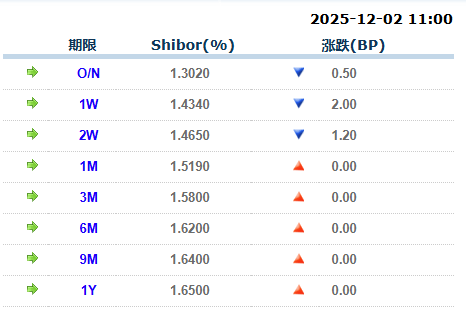
Core Points - The People's Bank of China conducted a 7-day reverse repurchase operation of 156.3 billion yuan at an interest rate of 1.40%, maintaining the previous rate, resulting in a net withdrawal of 145.8 billion yuan due to 302.1 billion yuan maturing on the same day [1] - Short-term Shibor rates showed a slight decline, with overnight Shibor down by 0.50 basis points to 1.3020%, and 7-day Shibor down by 2.00 basis points to 1.4340% [1][2] - The interbank pledged repo market saw a slight decrease in short-term rates, with DR001 and R001 weighted average rates down by 0.9 basis points and 1.0 basis points, respectively [6] Shibor Rates Summary - Overnight Shibor: 1.3020%, down 0.50 BP [2] - 7-day Shibor: 1.4340%, down 2.00 BP [2] - 14-day Shibor: 1.4650%, down 1.20 BP [2] Interbank Repo Market Summary - DR001 weighted average rate: 1.2973%, down 0.9 BP, with a transaction volume decrease of 58 billion yuan [6] - R001 weighted average rate: 1.3611%, down 1.0 BP, with a transaction volume increase of 245.9 billion yuan [6] - DR007 weighted average rate: 1.441%, down 1.7 BP, with a transaction volume increase of 34 billion yuan [6] Market Conditions - The funding environment was balanced and slightly loose, with overnight rates around 1.40% to 1.42% [10] - A total of 69 interbank certificates of deposit were issued, with an actual issuance amount of 135.28 billion yuan [11] - The overall yield trend for secondary certificates of deposit showed an upward movement, with 1M and 3M rates closing at approximately 1.60% [11]
加密货币市场急挫引发连锁反应,A股港股概念股集体承压
Di Yi Cai Jing· 2025-12-02 12:39
Core Viewpoint - The cryptocurrency market is experiencing significant downward pressure due to multiple factors, including macroeconomic policy expectations, institutional selling, and increased regulatory scrutiny, leading to a decline in both cryptocurrency prices and related stocks in A-shares and Hong Kong markets [1][2][5][6]. Market Performance - As of December 2, A-shares and Hong Kong stocks related to cryptocurrency continued to decline, with notable drops in companies like Jingbeifang, Hailian Jinhui, and Cuiwei Co., each down approximately 1% [1]. - Bitcoin saw a significant drop, falling to a low of below $84,000 on December 1, down nearly 30% from its all-time high of $126,251 in early October. Ethereum experienced an even larger decline, with a single-day drop exceeding 10% [1][2]. Institutional Behavior - Institutional investors have been a core factor in the current market adjustment, with over $20 billion in cryptocurrency assets sold since September. The year-end period has heightened the tendency for institutions to lock in profits, leading to increased selling pressure [3][5]. - The flow of funds into Bitcoin ETFs has also slowed, indicating a decrease in institutional risk appetite [3]. Leverage and Market Dynamics - The market experienced a significant leverage liquidation effect on December 1, with over 270,000 contracts forcibly liquidated, amounting to nearly $985 million, predominantly affecting long positions [2]. - The current market structure is characterized by a rapid liquidation process triggered by shifts in macroeconomic expectations, leading to a more pronounced decline in prices [2][4]. Macroeconomic and Regulatory Influences - The upcoming Federal Reserve meeting has created uncertainty, with officials emphasizing persistent inflation and the need for restrictive monetary policy, dampening expectations for interest rate cuts [5]. - Regulatory developments in China have also impacted market sentiment, with a recent meeting involving multiple regulatory bodies reaffirming strict policies against virtual currency trading and emphasizing the risks associated with stablecoins [6][7].




十大概念板块,去伪存真,一个是历史性机会!
Sou Hu Cai Jing· 2025-12-02 10:00
Market Overview - The market is currently experiencing weakness, with major indices falling below the 60-day moving average, indicating a lack of upward momentum [1] - Despite a favorable monetary environment, there are signs of weakness in the real economy, leading to cautious investor sentiment [1][2] Investment Strategy - Investors are advised to stabilize their positions and avoid leveraging, focusing instead on technology and new economy sectors rather than cyclical stocks [2] - The emphasis should be on long-term opportunities in leading AI companies, as the AI and computing chip sector is seen as a historic opportunity despite potential short-term valuation risks [4][5] Technology Sector Insights - AI and computing chips are identified as transformative technologies that could significantly enhance productivity over the next 20 years [4] - Brain-computer interfaces are viewed as a bubble, with current technology only providing limited functionality for disabled individuals [5][6] - Satellite internet is recognized as a genuine opportunity due to its proven technology and demand in remote areas, particularly in China [7][8] Emerging Technologies - Blockchain is considered a bubble, with concerns over the security of cryptocurrencies like Bitcoin, which may lead to a collapse in their valuation [8] - Human-like robots and low-altitude electric manned flying vehicles are also categorized as bubbles, with significant regulatory and technical challenges hindering their development [9][10] - Quantum communication and quantum computing are still uncertain, with significant technical hurdles to overcome [10][11] Established Technologies - 3D printing is seen as having potential for growth, especially as AI lowers design barriers, making it more accessible for home use [11] - Lithium batteries, particularly solid-state batteries, are viewed as having opportunities, although traditional lithium battery technology is reaching maturity [11]