互联网医疗

Search documents
放弃博士学位,50岁东北医生,干出一个IPO
创业邦· 2025-09-12 03:14
Core Viewpoint - Dingxiangyuan, a leading internet medical platform in China, is preparing for an IPO in Hong Kong, marking a significant milestone in its 25-year history and reflecting a renewed interest in the internet healthcare sector [8][14]. Group 1: Company Background and Development - Dingxiangyuan was founded in 2000 by Li Tiantian, inspired by the "Dingxiang" flower, initially as a medical literature retrieval website for medical students and professionals [6][10]. - The platform evolved from a BBS forum to the largest professional doctor platform in China, with over a million registered doctors by 2005 [8][11]. - The company shifted its focus to commercial services for doctors and hospitals, developing a "TO D" (Doctor) model, and later expanded to consumer services with a "D+C" dual-core strategy [13]. Group 2: Business Model and Revenue Generation - Dingxiangyuan's unique business model emphasizes health education and content-driven services rather than solely focusing on disease treatment and drug sales [13][18]. - The launch of the "Dingxiang Doctor" public account in 2014 significantly increased its visibility and user engagement, leading to a closed-loop business model integrating consultation, e-commerce, and educational services [16][18]. - The platform has established a strong presence in the e-commerce space, with various product categories and significant sales figures, including over 150,000 units sold for several products [18]. Group 3: Market Context and IPO Prospects - The recent surge in IPO activities among internet healthcare companies in Hong Kong indicates a favorable market environment for Dingxiangyuan's potential listing [8][22]. - The company faces challenges in maintaining its credibility and compliance, especially after past controversies that affected its public trust [20]. - The integration of AI into Dingxiangyuan's services is seen as a potential growth driver, but the company must navigate high costs and competition from larger players in the healthcare AI space [25][26].


AI提速 方舟健客发布杏石医疗大模型
Nan Fang Du Shi Bao· 2025-09-12 02:40
Core Insights - Fangzhou Jianke has achieved profitability with a revenue of 1.494 billion yuan, marking a 12.9% growth, and a net profit of 12.5 million yuan as of mid-2025 [3] - The company employs a "familiar doctor-patient" model, focusing on relationship reconstruction rather than merely chasing traffic [4][5] - The AI-powered "Xing Shi Medical Model" aims to enhance the efficiency of its H2H (Hospital to Home) healthcare ecosystem [6][9] Company Performance - Fangzhou Jianke's user base has grown to over 52.8 million registered users and 229,000 registered doctors by mid-2025, with a high repurchase rate of 84.7% among paying users [4] - The company’s growth is driven by value-based internal growth, reducing reliance on continuous traffic purchases [5] AI Integration - The "Xing Shi Medical Model" integrates a comprehensive knowledge base from the Chinese Medical Association, covering over 1.1 million articles across 170 core journals [6] - Five core AI products have been launched, creating a collaborative network across medical, patient, and enterprise sectors [7] Efficiency Improvements - The AI Doctor Assistant has saved over 60,000 hours of work for doctors by providing nearly 400,000 technical assists, allowing them to focus on more complex diagnoses [8] - The AI Health Manager has reduced average consultation times by over 70%, significantly enhancing patient experience [8] Future Vision - By 2025, the company aims to integrate AI assistants into daily medical practices, with daily usage exceeding 100,000 times [10] - The ultimate goal is to establish "Fangzhou Medical Smart Cloud" by 2027, serving as an authoritative clinical decision standard across the industry [10]

你的线上医生,要赴港IPO了?
Xin Lang Cai Jing· 2025-09-11 02:19
Core Viewpoint - The news discusses the potential IPO of Dingxiangyuan, a leading internet healthcare content platform in China, which may submit its prospectus for a Hong Kong listing by the end of the year. The company's business model has yet to be fully validated despite previous claims of significant profit growth [3][17]. Company Overview - Dingxiangyuan was founded in July 2000 and has evolved into a prominent digital healthcare technology enterprise in China, connecting various stakeholders in the healthcare ecosystem through professional content sharing and high-quality digital services [3][5]. - The platform has grown significantly, boasting 9 million registered professional users, including 4.05 million registered physicians, which represents 92% of the country's practicing doctors [8]. Business Development - The company initially focused on medical literature search and later expanded into the public health market with the launch of the "Dingxiang Doctor" app in 2012, responding to the public's demand for health knowledge [6][7]. - Dingxiangyuan has successfully developed a diverse range of services, including health education, online consultations, and e-commerce for health products, under various sub-brands like Dingxiang Doctor and Dingxiang Mama [16]. Market Context - The internet healthcare market in China is experiencing rapid growth, with the market size reaching 392.5 billion yuan in 2023 and projected to grow to 479.9 billion yuan by 2025. Online drug sales are also increasing, with sales expected to exceed 800 billion yuan by 2025 [12][13]. - The government is actively supporting the development of internet healthcare through various policies aimed at optimizing medical resource allocation and improving service quality [12]. IPO Potential - The Hong Kong stock market has become a preferred listing destination for many healthcare companies, with 15 related firms successfully listed since 2025 and 36 more in the pipeline, creating a favorable environment for Dingxiangyuan's potential IPO [15]. - If successful, the IPO could enable Dingxiangyuan to leverage capital market resources for deeper collaboration with upstream and downstream enterprises in the industry [15]. Competitive Landscape - Despite its large user base, Dingxiangyuan faces challenges in demonstrating the sustainability and potential of its business model to investors, especially in light of increased regulatory scrutiny in the online consultation and healthcare payment sectors [16][17]. - The company competes with strong players like JD Health and Alibaba Health, which have established advantages in logistics and data integration, respectively [17].

九安医疗:公司会继续努力做好经营管理工作,提升公司价值
Zheng Quan Ri Bao Wang· 2025-09-10 11:12
Core Viewpoint - The company has demonstrated a strong commitment to maintaining its market value through multiple share buybacks, despite short-term stock price fluctuations influenced by market and other factors [1] Group 1: Company Performance - The company's Continuous Glucose Monitoring (CGM) products are being actively promoted, indicating a focus on innovation and product development [1] - The internet healthcare segment is expanding, contributing to increasing revenue [1] - The company benefits from stable and continuous profits and cash flow through annual asset allocation [1] Group 2: Management Perspective - The management believes that the stock price will reflect the company's fundamentals in the long term [1] - The company is committed to improving operational management to enhance overall company value [1]

AI医疗,迎来DeepSeek时刻了吗?
3 6 Ke· 2025-09-05 08:46
Core Insights - The Chinese government is promoting the "AI+" initiative to enhance healthcare services through AI applications in diagnosis, health management, and insurance services, aiming to significantly improve the efficiency of grassroots healthcare [1] - Major tech companies like Ant Group, JD, Huawei, and ByteDance are entering the AI healthcare sector, focusing on core areas such as consultations, medication, and health management [1] - The AI healthcare market in China is projected to grow from 8.8 billion yuan in 2023 to 315.7 billion yuan by 2033, with a compound annual growth rate of 43.1% [1] - Globally, the AI healthcare market is expected to exceed $491 billion by 2032 [1] Group 1: AI Healthcare Potential - AI has the potential to become a "super entry point" in healthcare by integrating various services and managing family health needs, leveraging the high digitalization of the healthcare industry [4] - The introduction of AI could help address the core issue of insufficient quality healthcare providers, particularly in grassroots settings, by acting as a "smart doctor" to enhance diagnosis and management [2][12] - AI healthcare could reshape the existing medical system by systematically increasing the supply of doctors and improving the capabilities of grassroots healthcare providers [12][16] Group 2: Challenges in the Healthcare System - The global healthcare system faces challenges such as insufficient supply, resource imbalance, and high costs, with no country having a perfect model [5][6] - In China, despite reforms aimed at improving equity in healthcare access, the shortage of quality healthcare resources remains a significant issue [7][8] - Internet healthcare has struggled to address the core supply issues, often remaining on the periphery of the healthcare system without solving the fundamental problem of limited access to quality doctors [10][11] Group 3: AI Healthcare Development Conditions - Current advancements in AI technology, particularly in language models, have improved the potential for AI to assist in medical diagnosis and treatment [15] - The accumulation of high-quality healthcare data over the past two decades in China provides a solid foundation for the development of AI healthcare solutions [15] - AI is better positioned to serve as a replacement for general practitioners in grassroots settings rather than challenging specialized clinical roles [16] Group 4: Future Outlook for AI Healthcare - If widely adopted, AI could transform patient interactions with healthcare, enabling online consultations, automated data analysis, and efficient triage processes [19][20] - AI's integration into healthcare could lead to systematic data accumulation, improved medication practices, and potential changes in insurance and payment models [21][22][24] - Regulatory challenges remain a significant barrier to the widespread implementation of AI in healthcare, particularly concerning accountability and the legal implications of AI decision-making [25][26]

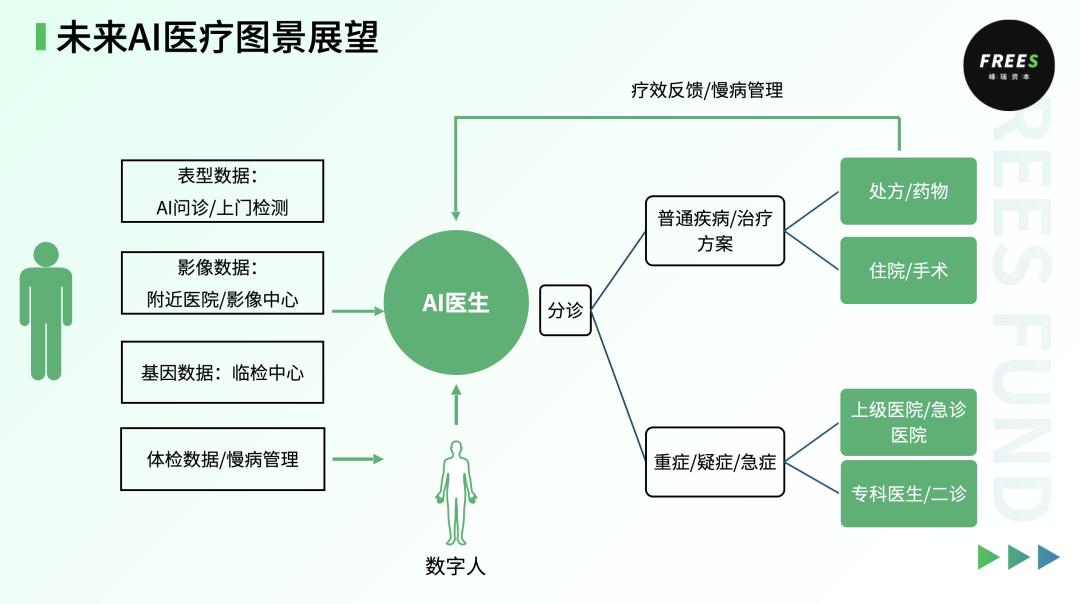
互联网医疗平台谋变,押注AI争夺下一个十年
3 6 Ke· 2025-09-01 08:28
Core Insights - The integration of AI has become essential for internet healthcare platforms, with companies like Alibaba Health, JD Health, and WeDoctor making significant investments in AI to enhance their business models and profitability [1][3][5] - AI is expected to transform the cost structure, service radius, and business models of the healthcare industry over the next decade, as evidenced by the increasing focus on AI in financial reports from major players like Ping An Good Doctor [3][5][8] Group 1: AI Adoption and Financial Impact - Major internet healthcare platforms are leveraging AI to escape low-margin business models centered around drug sales, advertising, and appointment bookings [5][6] - Ping An Good Doctor reported a slight increase in gross margin to 33.6% in the first half of the year, up from 32.2% the previous year, attributed to AI empowerment and business structure optimization [3][5] - JD Health's revenue from pharmaceutical and health product sales reached 488 billion RMB in 2024, a 6.9% increase from the previous year, demonstrating the positive impact of AI on operational efficiency and sales [11] Group 2: Market Trends and Valuation - The stock prices of companies prioritizing AI strategies, such as JD Health and Ping An Good Doctor, have surged significantly, with JD Health's stock increasing by 1225.68% since August 2022 [8] - The AI healthcare market in China is projected to grow from 27 billion RMB in 2019 to nearly 300 billion RMB by 2028, indicating a robust expansion driven by technological and policy support [8][9] - AI platforms are expected to enjoy higher valuations, transitioning from healthcare service providers to technology stocks, as the application of AI in healthcare is seen as highly undervalued [6][8] Group 3: Strategic Differentiation Among Platforms - Different platforms are adopting distinct strategies based on their resources, with Alibaba Health and JD Health focusing on operational efficiency while vertical platforms like WeDoctor and Ark Health aim for growth through technology [9][12] - Smaller platforms face challenges in profitability, as those not selling products often struggle to generate revenue, highlighting the importance of a clear business model [12][19] - The AI narrative in healthcare is complicated by high R&D costs and long return cycles, making it difficult for smaller players to compete effectively [17][19] Group 4: Challenges and Market Dynamics - The healthcare AI sector faces a trust deficit among consumers, which can hinder adoption and willingness to pay for AI services [23][25] - The high costs associated with AI products and limited reimbursement from insurance policies create barriers for healthcare institutions to invest in AI solutions [25][26] - The competitive landscape is characterized by a lack of differentiation among AI healthcare products, making it challenging for smaller platforms to establish a unique market position [25][26]

研判2025!中国在线问诊行业发展历程、政策汇总、产业链、发展现状、企业情况及发展趋势分析:国家政策的持续推动下,行业市场规模达到695.4亿元[图]
Chan Ye Xin Xi Wang· 2025-08-31 00:00
Core Insights - The online consultation market in China is experiencing explosive growth, driven by the fast-paced modern lifestyle and increasing health awareness among the population. The market size is projected to reach 69.54 billion yuan in 2024, reflecting a year-on-year increase of 23.4% [1][11]. Online Consultation Industry Overview - Online consultation refers to a medical service model that allows patients to communicate with doctors remotely via internet platforms, breaking geographical barriers and utilizing various communication methods such as video, text, and voice [2]. - The industry has evolved through three main stages: the nascent phase (2000-2014), the initiation phase (2015-2016), and the rapid development phase (2017-present) [4][5]. Industry Development and Trends - The COVID-19 pandemic has accelerated the acceptance of online consultations, leading to increased government support and policy initiatives aimed at promoting remote medical services [6]. - The number of healthcare institutions in China is projected to grow from 1,007,600 in 2019 to 1,093,600 in 2024, driven by rising healthcare demands due to an aging population and chronic disease prevalence [8][9]. Competitive Landscape - The online consultation industry features a diverse competitive landscape, including comprehensive medical platforms, specialized medical platforms, and pharmaceutical e-commerce platforms. Major players include Ping An Good Doctor, JD Health, and Alibaba Health [11][12]. Future Development Directions - The integration of advanced technologies such as artificial intelligence and big data is expected to enhance the efficiency and accuracy of online consultation services [13]. - Establishing a robust regulatory framework for medical service quality is crucial for the sustainable development of the online consultation industry, addressing challenges such as verifying medical qualifications and ensuring accurate diagnoses [14]. - Data security and privacy protection are paramount, as the industry handles sensitive patient information. Strengthening data management practices and employing advanced encryption technologies are essential for safeguarding patient data [15].



平安好医生(01833):利润率水平明显提升,B端企康及养老服务持续发力
Western Securities· 2025-08-27 06:06
Investment Rating - The report maintains a "Buy" rating for Ping An Good Doctor (1833.HK) [4][2] Core Insights - In H1 2025, the company achieved revenue of 2.502 billion RMB, representing a growth of 19.5%, with a gross margin of 33.6%, an increase of 1.4 percentage points [1] - The net profit attributable to shareholders reached 134 million RMB, a significant increase of 137%, with a net profit margin of 5.4% [1] - Adjusted net profit, excluding share-based payments and foreign exchange losses, was 165 million RMB, up 83.6%, with an adjusted net profit margin of 6.6%, an increase of 2.3 percentage points [1] - The company effectively controlled expenses, with sales expenses of 381 million RMB (up 3.9%) and a sales expense ratio of 15.2% (down 2.3 percentage points) [1] - The F-end revenue was 1.432 billion RMB, growing by 28.5%, with a paid user base of 20 million, an increase of 34.6% [1] - The B-end enterprise health revenue was 527 million RMB, up 35.2%, with over 3,500 paid service enterprises, an increase of 37.2% [1] - The elderly care service revenue reached 172 million RMB, with a gross margin of 37.6%, an increase of 20.7 percentage points [1] Financial Forecast - Revenue projections for 2025-2027 are 5.504 billion RMB, 6.276 billion RMB, and 7.074 billion RMB, with year-on-year growth rates of 14.5%, 14.0%, and 12.7% respectively [2] - Expected net profits for the same period are 263 million RMB, 360 million RMB, and 453 million RMB, with growth rates of 223.0%, 36.7%, and 25.9% respectively [2] - The report indicates a significant improvement in profitability metrics, with projected earnings per share (EPS) of 0.12 RMB in 2025, increasing to 0.21 RMB by 2027 [3]
机构风向标 | 东华软件(002065)2025年二季度已披露前十大机构累计持仓占比27.55%
Xin Lang Cai Jing· 2025-08-27 01:03
Group 1 - Donghua Software (002065.SZ) released its semi-annual report for 2025, showing that as of August 26, 2025, 11 institutional investors held a total of 883 million shares, accounting for 27.55% of the total share capital [1] - The top ten institutional investors include Beijing Donghua Chengxin Computer Technology Development Co., Ltd., Beijing Donghua Chengxin Investment Management Center (Limited Partnership), and several major banks and funds, with the top ten institutions holding a combined 27.55% of shares [1] - Compared to the previous quarter, the combined holding percentage of the top ten institutions decreased by 0.74 percentage points [1] Group 2 - In the public fund sector, five funds increased their holdings compared to the previous period, with a total increase of 0.22% [2] - One public fund, Bosera Financial Technology ETF, reported a decrease in holdings, while two new public funds were disclosed, including Huatai-PineBridge CSI Internet Medical Index (LOF) A and Hongde CSI 500 Index Enhanced A [2] - One foreign fund, Hong Kong Central Clearing Limited, reduced its holdings by 0.94% compared to the previous quarter [2]

【港股收评】三大指数拉升!恒科涨3.14%,有色金属股强劲
Sou Hu Cai Jing· 2025-08-25 08:58
Group 1 - Hong Kong stock indices rose again, with the Hang Seng Index up 1.94%, the Hang Seng China Enterprises Index up 1.85%, and the Hang Seng Tech Index up 3.14% [2] - Gold and non-ferrous metal stocks led the gains, with notable increases in companies such as Jinli Permanent Magnet (up 14.34%), Luoyang Molybdenum (up 10.47%), and Jiangxi Copper (up 8.35%) [2] - The expectation of a U.S. interest rate cut in September increased from 75% to 90% after comments from Federal Reserve Chairman Jerome Powell, supporting the rise in gold-related stocks [2] Group 2 - Short video, cloud computing, cloud office, SaaS, and gaming stocks continued to rise, with Weimob Group up 13.17% and Baidu Group-SW up 6.25% [3] - New internet platform pricing regulations aim to end "malicious competition," which may positively impact tech stocks [3] - Power equipment, wind power, nuclear power, and photovoltaic stocks also performed well, with Goldwind Technology rising 11.74% after reporting better-than-expected earnings [3] Group 3 - Consumer sectors such as home appliances, automobiles, holiday concepts, and film stocks showed good performance [4] - Education stocks were generally weak, with South China Vocational Education down 3.33% [5] - Chinese brokerage stocks declined, with Everbright Securities down 2.01% [6] Group 4 - Notable declines included Xirui, which fell 16.91% after being removed from the Hang Seng Composite Index [7] - Bluco dropped 13.53% due to underwhelming half-year results and a slowdown in revenue growth [8] - Dongfeng Motor Group surged 54.1% after proposing a distribution of its high-end electric vehicle subsidiary, Lantu, to shareholders [8]