产业结构优化

Search documents
流通“大动脉”畅通有力 多领域物流需求快速增长“含金量”十足
Yang Shi Wang· 2025-09-29 07:21
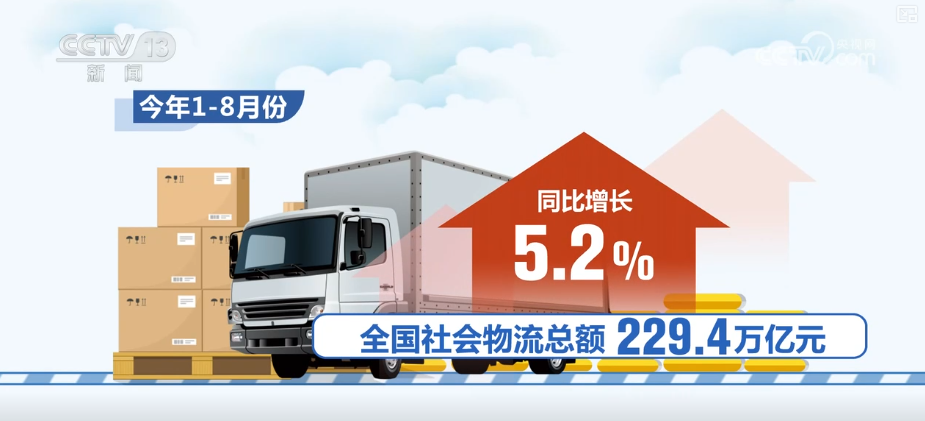
Core Insights - The logistics sector in China has shown stable growth in the first eight months of 2025, with a total social logistics volume reaching approximately 229.4 trillion yuan, reflecting a year-on-year increase of 5.2% [5][16]. Group 1: Overall Logistics Performance - The total social logistics volume for January to August 2025 is 229.4 trillion yuan, maintaining stable expansion and structural optimization [5]. - The logistics demand in the equipment manufacturing sector has been particularly strong, with a year-on-year growth of 8.1% [5]. - The logistics demand in the electronics, electrical machinery, and automotive sectors has also shown significant growth, with increases of 9.9%, 9.8%, and 8.4% respectively [5]. Group 2: Consumer and Household Logistics - The logistics volume for units and household goods has rebounded steadily, with a year-on-year growth of 6.5%, indicating a recovery in consumption-related logistics demand [8]. - The growth rate for this segment has improved by 0.3 percentage points compared to the previous month [8]. Group 3: International Logistics and Imports - International logistics is stabilizing, with an accelerated optimization of import logistics structure [13]. - The import logistics volume for intermediate goods and consumer products has shown stable growth, with year-on-year increases of 13.6% and 14.4% respectively for machine tools and integrated circuits [13][14]. - The logistics volume for consumer goods such as fresh fruits and nuts, as well as beauty and personal care products, has also seen positive growth, with increases of 14.4% and 9.7% respectively [14]. Group 4: Green Logistics and Recycling - The logistics volume for recycled resources has increased by 12.9% year-on-year, indicating a strong growth trend [19]. - The production of green products such as new energy vehicles and lithium-ion batteries continues to rise rapidly, supporting the ongoing transformation towards a greener economy [19].

工业企业利润明显改善
Jin Rong Shi Bao· 2025-09-29 01:07
Core Insights - The profits of large-scale industrial enterprises in China have shown significant improvement due to macroeconomic policies, the advancement of a unified national market, and a low base effect from the previous year [1][2] Group 1: Profit Improvement - From January to August, the profits of large-scale industrial enterprises shifted from a year-on-year decline of 1.7% in July to a growth of 0.9% [1] - In August alone, profits experienced a notable increase of 20.4%, reversing a 1.5% decline in July [1] - The revenue of large-scale industrial enterprises grew by 2.3% year-on-year from January to August, maintaining stability [1] Group 2: Sector Performance - The manufacturing sector saw a profit increase of 7.4% from January to August, accelerating by 2.6 percentage points compared to the previous month [2] - The electricity, heat, gas, and water production and supply sector grew by 9.4%, an increase of 5.5 percentage points [2] - The mining sector experienced a decline of 30.6%, but the rate of decline narrowed by 1.0 percentage point [2] Group 3: Industry Contributions - The equipment manufacturing sector was a significant contributor, with profits growing by 7.2% from January to August, accounting for a 2.5 percentage point increase in overall industrial profits [2] - In the raw materials manufacturing sector, profits increased by 22.1%, accelerating by 10.0 percentage points compared to the previous month [3] - The consumer goods manufacturing sector transitioned from a 2.2% decline to a 1.4% profit growth, driven by stable demand and policies aimed at boosting consumption [3] Group 4: Cost and Profitability - In August, the cost per hundred yuan of revenue for large-scale industrial enterprises decreased by 0.20 yuan year-on-year, marking the first decline since July 2024 [3] - The profit margin for large-scale industrial enterprises in August was 5.83%, an increase of 0.90 percentage points year-on-year [3]
中国制造业企业500强入围门槛再次提升
Ren Min Ri Bao· 2025-09-21 21:57
Core Insights - The threshold for entering the 2025 China Manufacturing Enterprises Top 500 list has increased to 17.365 billion yuan, up by 303 million yuan from the previous year [1] - The total revenue of the top 500 manufacturing enterprises reached 5.168 trillion yuan [1] - The top three companies on the list are China Petroleum & Chemical Corporation, China Baowu Steel Group, and Hengli Group [1] Innovation and R&D - The R&D intensity of the top 500 manufacturing enterprises is 2.45%, an increase of 0.03 percentage points from the previous year [1] - The number of effective patents held by these enterprises is 1.6632 million, with 803,800 being invention patents, representing increases of 11.34% and 12.07% respectively compared to the previous year [1] Industry Structure and Performance - Industries such as communication equipment manufacturing and computer & office equipment have seen average revenue growth exceeding 10% [1] - The semiconductor integrated circuit and panel manufacturing industries have experienced average profit growth of over 100% [1] Export Performance - The proportion of overseas revenue for the top 500 manufacturing enterprises has risen to 19.10%, an increase of 0.87 percentage points from the previous year [1]



福建第一城,没有悬念
Hu Xiu· 2025-09-18 12:37
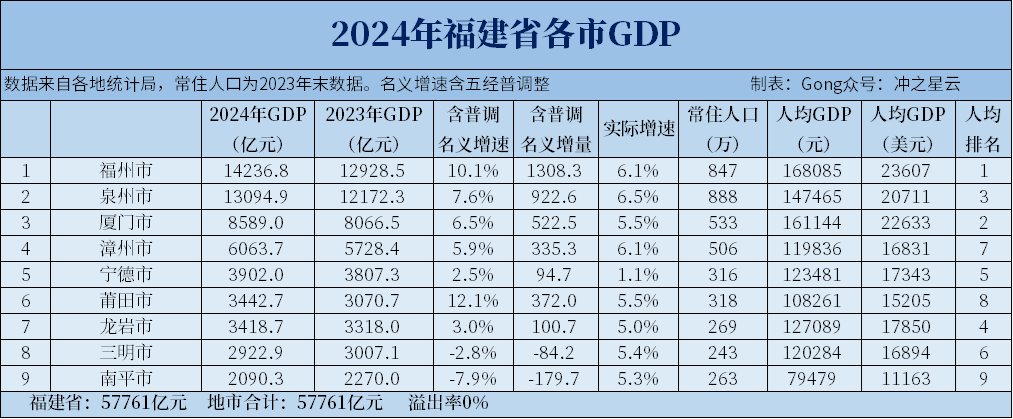
Core Viewpoint - The competition for the title of "First City of Fujian" is intensifying among Fuzhou, Xiamen, and Quanzhou, with Fuzhou currently leading in GDP and structural balance, while each city has its unique strengths and challenges [3][21][59]. Economic Scale - In 2024, the GDP of the three cities is projected to be: Fuzhou at 1,423.68 billion yuan, Quanzhou at 1,309.49 billion yuan, and Xiamen at 858.90 billion yuan [2]. - Per capita GDP figures are: Fuzhou at 168,100 yuan, Xiamen at 161,200 yuan, and Quanzhou at 147,400 yuan [2]. Industrial Structure - Fuzhou's industrial structure is diverse and high-end, with electronic information and high-end equipment manufacturing accounting for 41.6% of industrial added value in 2023, projected to slightly decrease to 38%-39% in 2024 [8]. - Xiamen has made progress in integrated circuits and biomedicine but faces challenges due to high land costs, resulting in fewer large-scale industrial enterprises compared to Fuzhou [9]. - Quanzhou is accelerating industrial transformation through technological upgrades, with traditional industries still making up about 35% of its industrial structure [10]. Tertiary Industry - Fuzhou's tertiary industry added value is 838.92 billion yuan, surpassing Quanzhou's 605.63 billion yuan and Xiamen's 541.53 billion yuan [11]. - Fuzhou's financial sector contributes 12% to its GDP, higher than Xiamen's 10% and Quanzhou's 8% [12]. Resource Allocation - Fuzhou has a larger urban area of approximately 11,968 square kilometers compared to Quanzhou's 11,015 square kilometers and Xiamen's 1,701 square kilometers, but geographical limitations affect development space [25][26]. - In terms of population, Quanzhou leads with 8.91 million residents, followed by Fuzhou with 8.50 million, and Xiamen with 5.35 million [29]. Financial Resources - In 2024, Xiamen's general public budget revenue is 93.32 billion yuan, leading Fuzhou's 75.05 billion yuan and Quanzhou's 57.28 billion yuan [42]. - Xiamen's per capita disposable income is 74,249 yuan, while Fuzhou's is 51,460 yuan and Quanzhou's is 52,214 yuan [43]. Financial Institutions - Fuzhou's financial institutions hold a total deposit balance of 25,209.67 billion yuan, significantly higher than Xiamen's 17,861.82 billion yuan and Quanzhou's 12,558 billion yuan [51]. - Fuzhou's direct financing scale reached 230 billion yuan in 2024, accounting for 48% of the province's total [54]. Conclusion - Fuzhou demonstrates a leading advantage across most core dimensions, including economic scale, industrial structure, resource allocation, and financial strength, positioning it as the current "First City of Fujian" [59].
中国企业500强揭晓!临汾这2家上榜→
Sou Hu Cai Jing· 2025-09-17 08:55
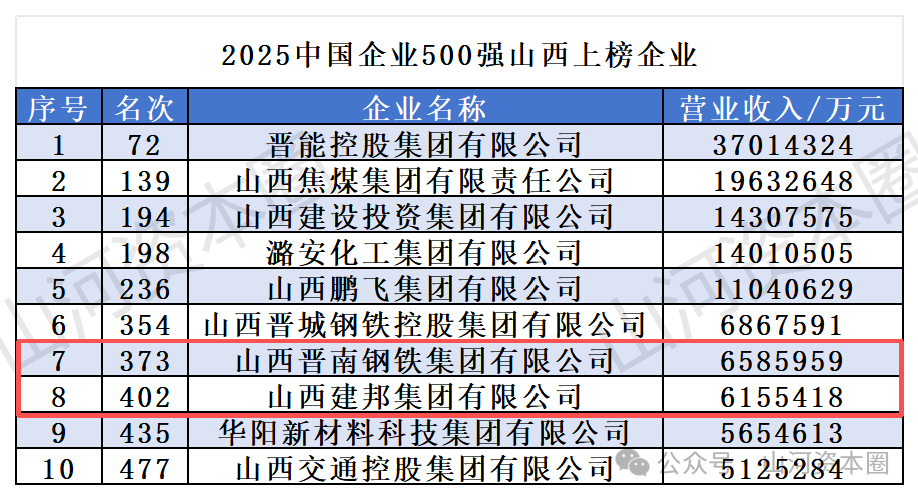
Group 1: Core Insights - The "China Top 500 Enterprises" list was released for the 24th consecutive time, highlighting the performance of major companies based on their 2024 revenue [1][2] - The total revenue of the Top 500 enterprises reached 110.15 trillion yuan, an increase from the previous year, with the entry threshold rising for 23 consecutive years to 47.96 billion yuan [2] - The total assets of these enterprises amounted to 460.85 trillion yuan, reflecting a growth of 7.46% [2] Group 2: Economic Performance - The net profit attributable to the owners of the parent company for the Top 500 enterprises totaled 4.71 trillion yuan, marking a growth of 4.39% [3] - The net profit margin improved to 4.27%, an increase of 0.17 percentage points [3] Group 3: Innovation and R&D - The Top 500 enterprises invested 1.73 trillion yuan in R&D, achieving a record R&D intensity of 1.95%, which has been increasing for eight consecutive years [4] - The number of valid patents held by these enterprises reached 2.2437 million, an increase of 10.54% from the previous year, with 1.0396 million being invention patents, up by 16.86% [4] Group 4: Industry Structure - The number of enterprises in advanced manufacturing and modern service industries has increased, with 39 new or returning companies on the list [5] - The contributions to total revenue growth from manufacturing, services, and other industries were 40.48%, 40.29%, and 19.23%, respectively [5] - In Shanxi province, 10 enterprises made the list, evenly split between state-owned and private enterprises [5][6]



今日视点:从“2025中国企业500强”看中国经济的稳与进
Zheng Quan Ri Bao· 2025-09-16 23:44
Core Insights - The "2025 China Top 500 Enterprises" list shows a total revenue of 110.15 trillion yuan, with the entry threshold rising to 47.96 billion yuan, indicating a continuous improvement in the strength of Chinese enterprises [1] - The list reflects the stable growth of the Chinese economy, with large enterprises playing a crucial role in supporting the stability and progress of the economy [1] Group 1: Scale and Economic Stability - The entry threshold for the "Top 500" has increased for 23 consecutive years, demonstrating the overall development level of Chinese enterprises [1] - The total revenue of the "Top 500" has reached a new milestone of 110 trillion yuan, showcasing the continuous expansion of large enterprises [1] - Large enterprises, such as State Grid and China Petroleum, not only have substantial scale but also play a stabilizing role in key sectors [1] Group 2: Innovation and Economic Progress - The "Top 500" invested 1.73 trillion yuan in R&D, with R&D intensity rising to 1.95%, marking an increase for eight consecutive years [2] - The number of invention patents has grown for six consecutive years, with a year-on-year increase of 2.50 percentage points, indicating improved patent quality [2] - Companies like Huawei and BYD are enhancing their core competitiveness through innovation, driving industry upgrades and economic transformation [2] Group 3: Structural Optimization - The number of enterprises in advanced manufacturing and modern service industries has been increasing, while those in coal mining and black metallurgy have decreased, indicating ongoing industrial structure optimization [2] - High-value-added industries such as new energy equipment manufacturing and semiconductor production are enhancing China's position in the global supply chain [2] - The rapid development of modern services supports the transformation of manufacturing, improving operational efficiency [2] Group 4: Coordination and Economic Resilience - Manufacturing contributes 40.48% and services contribute 40.29% to the total revenue of the "Top 500," reflecting a balanced and resilient modern industrial system [3] - The integration of manufacturing and service industries is being strengthened, with services providing comprehensive support to manufacturing [3] - Both state-owned and private enterprises are represented in the list, with state-owned enterprises playing a leading role in key sectors and private enterprises contributing to innovation and employment [3] Conclusion - The characteristics of scale growth, innovation drive, structural optimization, and coordinated development in the "2025 China Top 500 Enterprises" list highlight a positive trend of stability and progress in the Chinese economy [4] - The continued leadership of large enterprises is expected to facilitate steady advancement towards high-quality development [4]
从“2025中国企业500强”看中国经济的稳与进
Zheng Quan Ri Bao· 2025-09-16 16:17
Group 1 - The "2025 China Top 500 Enterprises" list shows a total revenue of 110.15 trillion yuan, with the entry threshold rising to 47.96 billion yuan, indicating a continuous improvement in the strength of Chinese enterprises [1] - The number of enterprises with revenue exceeding 100 billion yuan reached 267, reflecting the ongoing expansion of large enterprises and their role in stabilizing the industrial supply chain [1] - Major state-owned enterprises like State Grid, China Petroleum, and Sinopec play a crucial role in key sectors, acting as stabilizers in the economy [1] Group 2 - The top 500 enterprises invested 1.73 trillion yuan in R&D, with R&D intensity rising to 1.95%, marking an 8-year consecutive increase [2] - The number of invention patents increased by 2.50 percentage points year-on-year, indicating a significant improvement in patent quality [2] - Companies in strategic emerging industries, such as new energy vehicles and information technology, are driving economic transformation through innovation [2] Group 3 - The list indicates a growing number of enterprises in advanced manufacturing and modern service industries, while the number in coal mining and black metallurgy has decreased, signifying an optimization of industrial structure [2] - High-value-added industries like new energy equipment manufacturing and semiconductor production are enhancing China's position in the global supply chain [2] - The rapid development of modern services supports the transformation of manufacturing, improving operational efficiency and reducing costs [2] Group 4 - Manufacturing contributes 40.48% and services contribute 40.29% to the total revenue of the top 500 enterprises, showcasing a balanced and resilient modern industrial system [3] - The collaboration between state-owned and private enterprises enhances economic stability, with state-owned enterprises dominating critical sectors and private enterprises driving innovation and employment [3] - The coordinated development of various industries contributes to a stable economic ecosystem in China [3] Group 5 - The characteristics of scale growth, innovation-driven development, structural optimization, and coordinated growth in the "2025 China Top 500 Enterprises" list reflect a positive trend of "stability with progress" in the Chinese economy [4] - The continued leadership of large enterprises is expected to facilitate steady progress towards high-quality development in the future [4]
中国企业500强,广东为何总能输出“优等生”?
Nan Fang Du Shi Bao· 2025-09-16 11:45
Group 1 - The core viewpoint of the article highlights the transformation of Guangdong's economic structure, with a significant rise in technology and advanced manufacturing companies, as evidenced by the inclusion of 54 enterprises in the top 500 Chinese companies list [1][3]. - Huawei and BYD have notably improved their rankings, with Huawei entering the top 25 for the first time and BYD reaching the top 30. BYD's revenue for the first half of 2025 is projected to be 371.28 billion yuan, surpassing Tesla and solidifying its position as the global leader in electric vehicle sales [3][4]. - The innovation capability of enterprises is identified as a key factor for Guangdong's leapfrog development, with companies like Huawei, ZTE, and Midea ranking among the top ten in the "Top 100 Innovative Enterprises" list [3][4]. Group 2 - High R&D investments are driving growth, with Huawei's annual R&D expenditure reaching 179.69 billion yuan and BYD exceeding 53 billion yuan. This focus on technological innovation is replacing traditional growth models based on scale expansion [4]. - The vitality of the private economy in Guangdong is evident, with over half of the listed companies being private enterprises. Companies like Huawei, Tencent, and BYD are not only revenue contributors but also leaders in industry transformation [4]. - Globalization is a key factor for the success of Guangdong enterprises, shifting from product output to capability and ecosystem output. Companies like TCL and Tencent are enhancing their global operations, redefining the role of Chinese manufacturing in the global value chain [4][5]. Group 3 - The "Shenzhen-Hong Kong-Guangzhou" innovation cluster has recently topped the global innovation index, showcasing the regional advantages of resource aggregation and industrial chain collaboration [5]. - The shift from resource investment to technological innovation as the main growth engine reflects a new development path for Guangdong enterprises, emphasizing value creation over scale expansion [5]. - The economic development resilience and characteristics of Guangdong are attributed to the market environment, enterprise practices, and innovation exploration, providing a valuable regional model for China's high-quality economic development [5].

2025中国企业500强发布,河南这些企业上榜→
Sou Hu Cai Jing· 2025-09-16 04:17
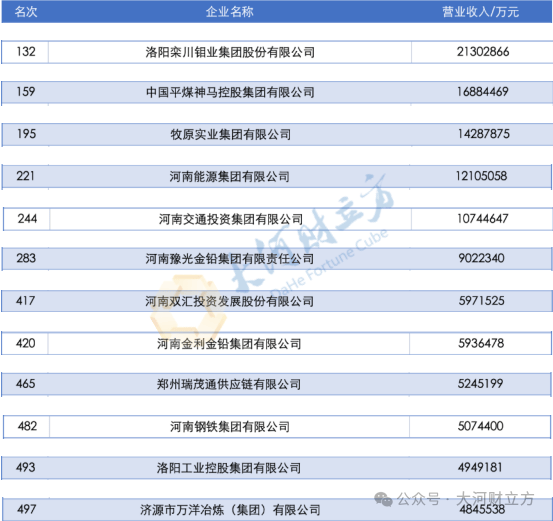
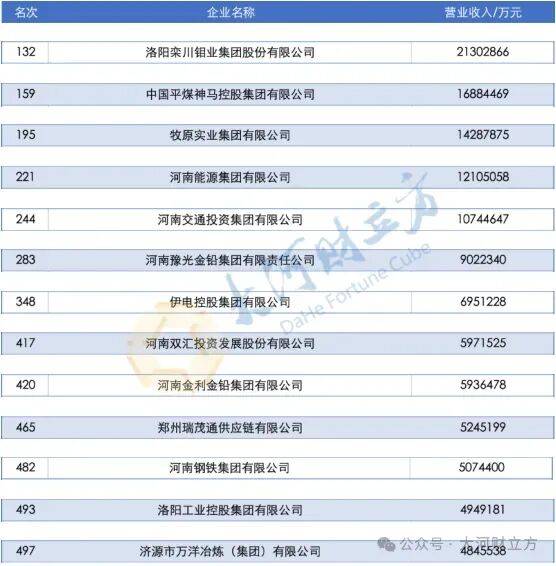
Core Insights - The "China Top 500 Enterprises" list was released, with State Grid Corporation, China National Petroleum Corporation, and China Petroleum & Chemical Corporation ranking as the top three [1][3]. Group 1: Rankings and Revenue - The list includes 13 companies from Henan province, with Luoyang Molybdenum Co., Ltd. at 132nd place and revenue of 21.30 billion yuan [2][3]. - The entry threshold for the list reached 47.96 billion yuan, marking a 5.79 billion yuan increase from the previous year [3]. Group 2: Overall Performance - The total revenue of the top 500 enterprises reached 110.15 trillion yuan, showing an increase from the previous year [3]. - The total assets of these enterprises amounted to 460.85 trillion yuan, reflecting a growth of 7.46% [3]. - The number of enterprises with revenues exceeding 100 billion yuan increased to 267, with 15 companies surpassing 1 trillion yuan in revenue [3]. Group 3: Economic Efficiency - The net profit attributable to shareholders of the parent company for the top 500 enterprises totaled 4.71 trillion yuan, a growth of 4.39% [3]. - The revenue net profit margin improved to 4.27%, an increase of 0.17 percentage points [3]. Group 4: Research and Development - The top 500 enterprises invested a total of 1.73 trillion yuan in research and development, achieving a research intensity of 1.95%, the highest in eight years [3]. Group 5: Industry Structure - The list saw 39 new or returning companies, with the automotive and logistics sectors seeing the most significant additions [3].

2025中国企业500强发布,南阳一企业上榜
Sou Hu Cai Jing· 2025-09-16 03:28
Group 1 - The "China Top 500 Enterprises" list was released, with State Grid Corporation, China National Petroleum Corporation, and China Petroleum & Chemical Corporation ranking the top three [1][3] - A total of 12 enterprises from Henan province made the list, including Luoyang Molybdenum (ranked 132), Pingmei Shenma (159), and Muyuan Foods (195) [1][2] Group 2 - The total revenue of the top 500 enterprises reached 110.15 trillion yuan, an increase from the previous year, with the entry threshold rising for 23 consecutive years to 47.96 billion yuan [3] - The total assets of these enterprises amounted to 46.085 trillion yuan, reflecting a growth of 7.46% [3] - The number of enterprises with revenues exceeding 100 billion yuan increased to 267, with 15 companies surpassing 100 billion yuan in revenue [3] - The net profit attributable to shareholders reached 4.71 trillion yuan, marking a growth of 4.39%, with a net profit margin of 4.27% [3] - Research and development expenditures totaled 1.73 trillion yuan, achieving a research intensity of 1.95%, the highest in eight years [3] - The industrial structure continues to optimize, with 39 new or re-entering companies, particularly in the automotive and logistics sectors [3]