
公司上市

Search documents
MANNER COFFEE据悉考虑最早2026年在香港上市
Di Yi Cai Jing· 2025-11-18 10:25
(文章来源:第一财经) 据外媒报道,MANNER COFFEE据悉考虑最早2026年在香港上市。 ...
北矿检测上市募1.9亿首日涨296% 被问业绩增长持续性
Zhong Guo Jing Ji Wang· 2025-11-18 08:26
Core Viewpoint - Beikong Testing Technology Co., Ltd. (Beikong Testing) was listed on the Beijing Stock Exchange, closing at 26.50 yuan with a significant increase of 295.52% on the first day of trading, indicating strong market interest and investor confidence in the company’s growth potential [1]. Company Overview - Beikong Testing specializes in inspection and testing services for non-ferrous metal resources, including research and development of testing technology, technical services, and instrument development [1]. - The company’s business scope includes testing of ores, smelting products, environmental samples, recycled resources, advanced materials, and testing agents [1]. Shareholding Structure - Prior to the IPO, Mining Technology Group Co., Ltd. (Mining Group) held 86.11% of Beikong Testing, with an additional 1.53% held indirectly through Beijing Mining Research Institute, totaling 87.64% [1]. - After the IPO, Mining Group remains the controlling shareholder with a reduced stake of 65.73% [1]. Financial Performance - Beikong Testing reported revenues of 91.74 million yuan in 2022, 110.47 million yuan in 2023, and projected revenues of approximately 148.02 million yuan for 2024 [4][6]. - The net profit attributable to the parent company was 31.96 million yuan in 2022, increasing to 45.58 million yuan in 2023, with projections for 2024 indicating further growth [5][6]. Fundraising and Investment Plans - The IPO raised a total of 189.74 million yuan, with a net amount of 172.48 million yuan after expenses [3]. - The funds will be allocated primarily to the development of advanced testing instruments and to supplement working capital, with 79.74% of the funds directed towards the R&D base [4]. Future Projections - For the first nine months of 2025, Beikong Testing anticipates revenues between 134 million yuan and 139 million yuan, representing a year-on-year growth of approximately 26.87% to 31.61% [7][8]. - The projected net profit for the same period is expected to be between 58 million yuan and 64 million yuan, indicating a growth rate of 25.08% to 38.02% [8].


导致上市失败的关键因素,触碰到上市的三条警戒线
Sou Hu Cai Jing· 2025-11-14 11:44
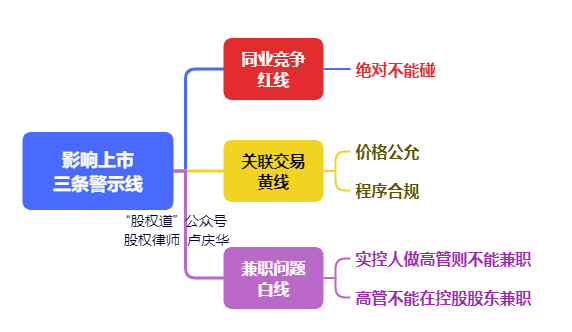
Core Viewpoint - The article discusses the reasons behind the failure of many companies to go public, highlighting the importance of avoiding conflicts of interest and compliance with regulations regarding related party transactions, industry competition, and executive roles. Group 1: Industry Competition (Red Line) - Companies applying for an IPO must not engage in the same business as their controlling shareholders or related entities, even if those entities are shell companies [2][3] - An example is provided with Changyou Technology, which faced delays in its IPO due to the need to deregister a shell company that was involved in similar business activities [4] - Companies are advised to promptly deregister non-operational shell companies and address any industry competition issues to avoid future IPO complications [5] Group 2: Related Party Transactions (Yellow Line) - Related party transactions are not prohibited but must meet two criteria: fair pricing and compliance with corporate governance procedures [6][9] - An example is given of Meiai Technology, which faced scrutiny over its pricing in transactions with a related company, Tianjia Environment, leading to multiple rounds of inquiries before successfully listing [8] - Companies must ensure that related party transactions are approved by the board or shareholders to avoid regulatory issues [10] Group 3: Executive Roles and Part-time Positions (White Line) - Controlling shareholders can hold positions in other companies as long as they are not in executive roles that could compromise independence [11][12] - High-level executives are also restricted from holding positions in the controlling shareholder's other companies to protect the interests of the listed company [13][14]

瑞幸,没有时间表地“积极”上市丨消费参考
2 1 Shi Ji Jing Ji Bao Dao· 2025-11-13 03:23
Group 1 - Luckin Coffee is actively working towards relisting on the US main board, which is seen as a significant event with international influence [1][7] - The company has not set a specific timeline for the relisting, focusing instead on executing its business strategy and development [2] - Luckin Coffee's past included a successful IPO on NASDAQ in May 2019, followed by a financial scandal that led to its delisting in June 2020 [3][4] Group 2 - The company has undergone significant changes, including a complete exit of the original shareholders and management team, and the establishment of a new management team under Dazhong Capital [5] - Luckin Coffee reported a revenue increase of 47.1% year-on-year to 12.36 billion yuan and a net profit increase of 43.6% to 1.25 billion yuan in the second quarter [5][6] - The total number of Luckin Coffee stores reached 26,206, with ongoing expansion into overseas markets [5] Group 3 - The company's performance indicates that a relisting on the main board would attract market interest [6] - Luckin Coffee's association with Xiamen highlights its confidence in returning to the US main board [7]


明基医院集团股份有限公司(02581) - 整体协调人公告-委任
2025-11-11 16:00
香港聯合交易所有限公司及證券及期貨事務監察委員會對本公告的內容概不負責,對其準確性 或完整性亦不發表任何聲明,並表明概不就因本公告全部或任何部分內容而產生或依賴該等內 容而引致的任何損失承擔任何責任。 香港交易及結算所有限公司及香港聯合交易所有限公司對本公告的內容概不負責,對其準確性 或完整性亦不發表任何聲明,並明確表示概不就因本公告全部或任何部分內容而產生或因依賴 該等內容而引致的任何損失承擔任何責任。 1 (a) 在聯交所網站登載本公告,並不會引致本公司、其聯席保薦人、整體協調 人、顧問或包銷團成員須於香港或任何其他司法管轄區進行發售或配售活動 的任何責任。本公司最終會否進行發售或配售仍屬未知之數; (b) 本公告所涉及的上市申請並未獲批准,聯交所及證監會或會接納、發回或拒 絕有關的公開發售及╱或上市申請; (c) 本公告不應被視為勸誘認購或購買任何證券,亦不擬構成該等勸誘; (d) 本公司或其任何聯屬人士、其顧問或包銷團成員概無通過刊發本公告而於任 何司法管轄區發售任何證券或招攬要約認購或購買任何證券; (e) 本公告(及其所載資料)僅供參考,並不構成或組成在美國(包括其領土及屬 地、美國任何州及哥倫比 ...
奔赴自然户外运动集团股份有限公司 (前称為伯希和户外运动集团股份有限公司)(H0398) - 整体协调人公告-委任
2025-11-06 16:00
香港聯合交易所有限公司以及證券及期貨事務監察委員會對本公告的內容概不負責,對其準確性或完整性亦 不發表任何聲明,並明確表示,概不就因本公告全部或任何部份內容而產生或因依賴該等內容而引致的任何 損失承擔任何責任。 Boxihe Outdoor Sports Group Co., Ltd. 伯 希 和 戶 外 運 動 集 團 股 份 有 限 公 司 ( 於中華人民共和國註冊成立的股份有限公司) 警告 本公告乃根據香港聯合交易所有限公司(「聯交所」)以及證券及期貨事務監察委員會(「證監 會」)的要求而刊發,僅用作提供信息予香港公眾人士。 您閱覽本公告,即表示您知悉、接納並向伯希和戶外運動集團股份有限公司(「本公司」)、 其聯席保薦人、整體協調人、顧問或承銷團成員表示同意: – 1 – (a) 在聯交 所網站 刊發本 公告並不 導致本 公司、 其聯席 保薦人 、整體協 調人、 顧問或 承銷 團成員 有任何 義務在 香港或任 何其他 司法權 區進行 發售或 配售。概 不保證 本公司 將進 行發售或配售; (b) 與本公 告有關 的申請 尚未獲批 准上市 ,聯交 所及證 監會可 接納、退 回或拒 絕有關 公開 發售及╱或 ...
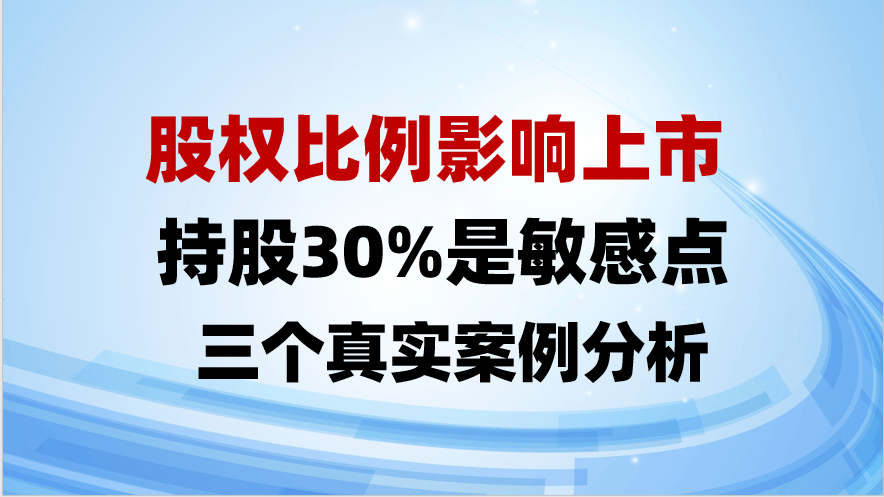
股权比例也影响上市,持股30%是个敏感点!三个真实案例分析
Sou Hu Cai Jing· 2025-11-04 12:31
Group 1 - The core point of the article emphasizes that having good performance alone is not sufficient for a company to go public; holding 30% of shares is a critical threshold that can significantly impact the listing process [10][11] - The case of Xin Yan Industrial illustrates that the major shareholder held 32% of shares, leading to a failed listing attempt on the ChiNext board despite meeting profit requirements [9][4] - The article discusses the importance of actual control recognition and the implications of shareholding structures on the listing process, highlighting that the major shareholder's control must be clearly defined [11][20] Group 2 - The case of Company A shows that the major shareholder held 34% of shares and faced three failed listing attempts due to issues related to share transfer pricing and actual control recognition [12][22] - The article points out that the low share transfer price raised suspicions of shareholding arrangements, which complicated the listing process [15][16] - The failure of Company A's listing attempts underscores the necessity of clear ownership and control structures to meet regulatory requirements [20][22] Group 3 - The case of Su Da Co., which initially failed its first listing attempt with a major shareholder holding 30%, demonstrates the impact of actual control and related party transactions on the listing process [29][58] - The company faced challenges due to potential conflicts of interest and competition with its major shareholder, which were critical factors in the rejection of its listing application [50][56] - After making necessary adjustments, Su Da Co. successfully listed on the main board, indicating that addressing regulatory concerns can lead to successful outcomes [58]

SK海力士考虑出售Solidigm
半导体行业观察· 2025-11-04 01:00
Core Viewpoint - There are speculations that SK Hynix may sell its U.S. subsidiary Solidigm, with insiders suggesting that selling could be the best option for the company [2][3]. Group 1: Company Background - Solidigm was established in 2021 by SK Hynix to acquire Intel's NAND flash memory business, focusing on the planning, design, and sales of NAND flash-based solid-state drives (SSDs) [2]. - The acquisition of Intel's NAND and SSD business was completed in two phases, with a total transaction value of approximately $9 billion, including the establishment of Solidigm to operate the acquired business [2]. Group 2: Challenges and IPO Plans - SK Hynix initially aimed to integrate production and sales within Solidigm and planned for an IPO in the U.S., but regulatory challenges regarding the Chinese subsidiary complicated this plan [3]. - As a result, Solidigm currently operates primarily as a sales-focused entity without production capabilities, which diminishes its attractiveness for an IPO [3]. - Despite these challenges, some industry insiders believe that Solidigm could still pursue a listing on NASDAQ if its performance improves significantly over the coming quarters [4].
奥特曼否认OpenAI明年上市
Cai Jing Wang· 2025-11-03 02:40
Core Viewpoint - OpenAI CEO Sam Altman denied reports about the company's plans to go public next year, stating that there are no specific plans or arrangements in place for an IPO [1] Summary by Relevant Sections - **Company Plans** - Altman emphasized that while he believes an IPO will eventually happen, there are currently no specific dates or board resolutions regarding this matter [1] - **Industry Context** - The discussion reflects the broader trend in the tech industry where companies are often speculated to go public, but concrete plans may not be in place [1]

OpenAI明年上市?奥尔特曼回应
Di Yi Cai Jing· 2025-11-03 00:47
Core Viewpoint - OpenAI CEO Sam Altman denied reports about the company planning to go public next year, stating that there is no specific date for an IPO and the board has not made any decisions regarding it. He believes that the company will eventually move in that direction [1] Financial Performance - OpenAI's annual revenue significantly exceeds the rumored $13 billion [1]