
可控核聚变

Search documents
能量奇点完成A轮融资 “洪荒70”实现1337秒稳态长脉冲等离子体运行
Sou Hu Cai Jing· 2026-02-06 08:49
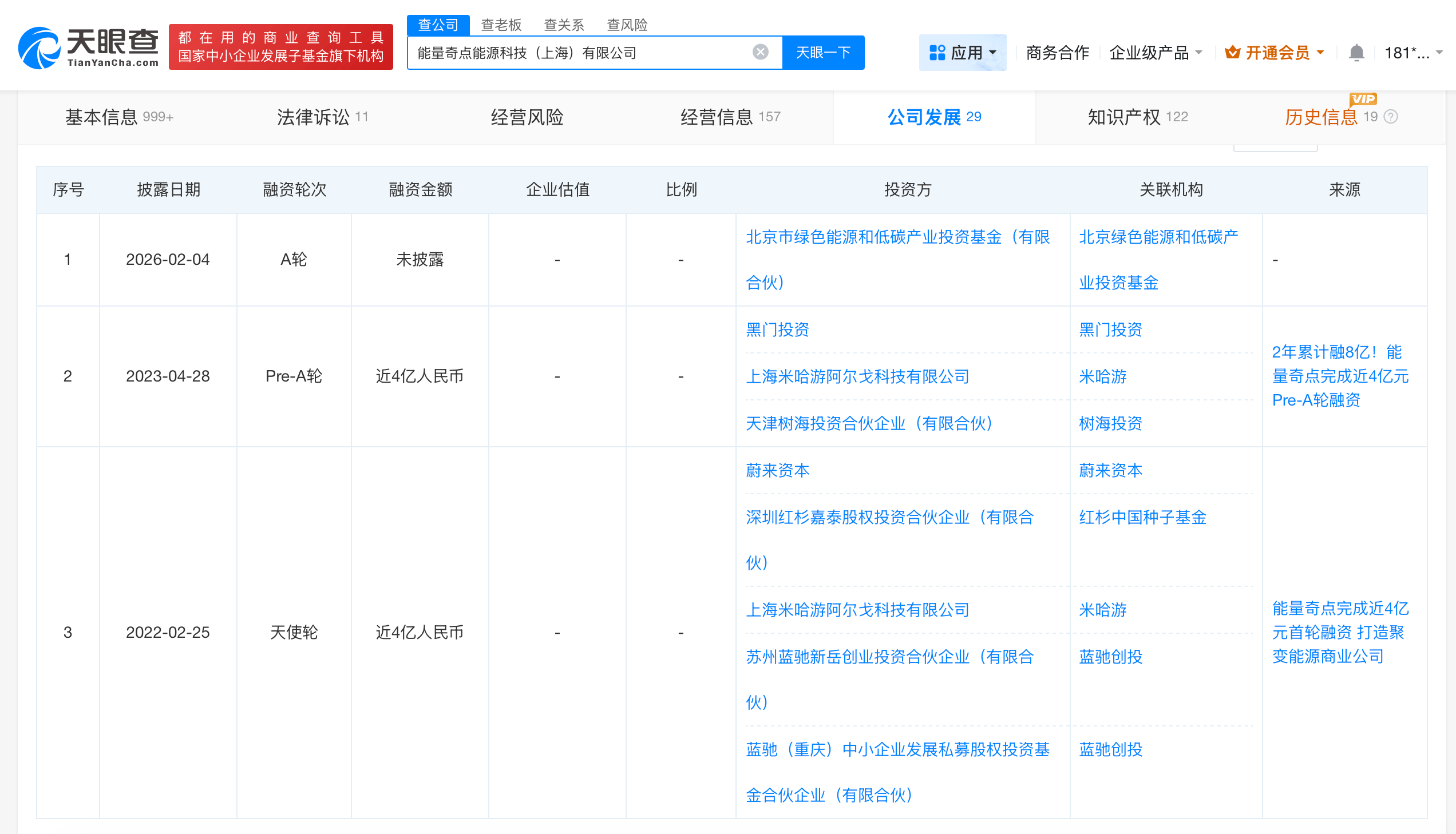
Core Viewpoint - Energy Singularity has successfully completed its Series A financing round, increasing its registered capital to 1.9681 million yuan, while achieving a significant breakthrough in its "Honghuang 70" high-temperature superconducting Tokamak, demonstrating 1337 seconds of steady-state long-pulse plasma operation in its 5755th experiment [1][2][4]. Financing and Company Background - Energy Singularity, established in 2021, is the first commercial private nuclear fusion energy device company in China [2]. - The Series A financing round involved investors such as the Beijing Government Guidance Fund and other local investment funds, following previous financing rounds that raised nearly 400 million yuan each in the angel and Pre-A rounds [2][4]. - The company aims to provide commercially viable Tokamak systems, subsystems, components, and operational control software for future nuclear power plant owners [5]. Technological Achievements - The recent experiment marked a significant milestone, exceeding the initial target of 600 seconds for steady-state plasma operation, which is a critical indicator of device maturity and control capability in controlled nuclear fusion research [4]. - The advancements are attributed to the optimization of AI-based plasma feedback control technology, which has significantly enhanced plasma operation control capabilities [4]. - The performance of high-temperature superconducting magnets and associated power systems has shown strong stability under long-duration complex operating conditions, meeting design expectations [4].

中国能建:氢能产业园正式投产运行,积极布局可控核聚变领域-20260206
GUOTAI HAITONG SECURITIES· 2026-02-06 04:25
Investment Rating - The report maintains a rating of "Buy" for the company [9] Core Insights - The company's net profit attributable to shareholders for the first three quarters of 2025 decreased by 12.4%, while new contracts signed in 2025 increased by 2.9% [2][4] - The first phase of the Songyuan Hydrogen Energy Industrial Park has officially commenced operations, and the company is actively expanding into the controllable nuclear fusion sector [6] Financial Performance Summary - For Q1-Q3 2025, the company's revenue reached 323.54 billion yuan, an increase of 9.6% year-on-year [4] - The gross profit margin for the same period was 10.9%, a decrease of 0.6 percentage points [4] - The net profit attributable to shareholders was 3.16 billion yuan, down 12.4% year-on-year [4] - The company’s operating cash flow net outflow decreased to 9.11 billion yuan from 12.52 billion yuan in the same period of 2024 [5] Contract and Order Insights - In 2025, the total new contracts signed amounted to 1,449.38 billion yuan, reflecting a year-on-year increase of 2.9% [5][18] - The engineering construction segment saw new contracts of 1,346.48 billion yuan, up 5.6%, while the industrial manufacturing segment experienced a significant decline of 60.3% [5][18] - Domestic new contracts totaled 1,098.71 billion yuan, an increase of 1.1%, while overseas contracts reached 350.67 billion yuan, up 9.1% [5] Future Earnings Forecast - The report forecasts EPS of 0.21 yuan for 2025, with a growth of 3.7%, and 0.22 yuan for 2026, with a growth of 7.2% [3][7] - The target price is set at 2.96 yuan, corresponding to a PE ratio of 13.5 times for 2026 [3][9] Valuation Metrics - The current dividend yield is 1.1%, with a projected dividend payout ratio of 19.2% for the 2024 annual report [6] - The company’s price-to-book ratio is 0.92, which is at the 28.9th percentile of the past ten years [6]

中国能建(601868):氢能产业园正式投产运行,积极布局可控核聚变领域
GUOTAI HAITONG SECURITIES· 2026-02-06 02:45
Investment Rating - The report maintains a rating of "Buy" for the company [9] Core Insights - The company's net profit attributable to shareholders for Q1-Q3 2025 decreased by 12.4%, while revenue increased by 9.6% [2][4] - The first phase of the Songyuan Hydrogen Energy Industrial Park has officially commenced operations, and the company is actively expanding into controllable nuclear fusion [6] - The company has adjusted its earnings per share (EPS) forecasts for 2025-2026 to 0.21 and 0.22, reflecting increases of 3.7% and 7.2% respectively, with a projected EPS of 0.24 for 2027, an increase of 6.0% [3] Financial Performance Summary - For Q1-Q3 2025, total revenue reached 323.54 billion, with a year-on-year increase of 9.6%. The net profit attributable to shareholders was 3.16 billion, down 12.4% [4] - The gross margin for the same period was 10.9%, a decrease of 0.6 percentage points, while the operating expense ratio was 7.7%, also down by 0.6 percentage points [4] - The company signed new contracts worth 1,449.38 billion in 2025, representing a 2.9% increase year-on-year [5][18] Operational Highlights - The company achieved a significant milestone with the official launch of the Songyuan Hydrogen Energy Industrial Park, which is expected to produce 45,000 tons of green hydrogen and 200,000 tons of green ammonia and green methanol annually [6] - The company has also made strides in its nuclear power business, with contract signings exceeding 10 billion in the first half of 2025 [6] Market Position and Valuation - The current dividend yield stands at 1.1%, with a projected dividend payout ratio of 19.2% for the 2024 annual report [6] - The target price for the company's stock is set at 2.96 yuan, corresponding to a price-to-earnings (PE) ratio of 13.5 times for 2026 [3][9]
三重逻辑引爆电网设备ETF(159326),开年流入超125亿,光伏ETF华夏(515370)翻红
Ge Long Hui A P P· 2026-02-06 02:23
Core Insights - A-shares opened lower but rebounded, with the space photovoltaic and ultra-high voltage sectors leading the gains, driven by significant capital inflows into related ETFs [1] Group 1: Market Performance - The electric grid equipment ETF rose by 1.33%, with a net subscription of 58 million units during the session [1] - The photovoltaic ETF from Huaxia increased by 0.1%, following a net inflow of over 4 million from the previous day [1] Group 2: Investment Trends - Over 12.5 billion yuan has flowed into the electric grid equipment ETF since the beginning of the year, supported by three main factors: the surge in AI-driven electricity demand, a global upgrade of power grids, and a 4 trillion yuan investment plan by the State Grid [1] - The demand for electricity is expected to rise significantly due to AI, with an estimated 18 GW required for new GPU computing power by 2025, equivalent to the annual output of 15 nuclear power plants [1] - A global upgrade of power grids is anticipated, with the U.S. power supply gap projected to widen to 182 GW by 2030, prompting equipment manufacturers to expand internationally [1] - Domestic investments in the power grid are accelerating, with the State Grid's fixed asset investment expected to reach 4 trillion yuan during the 14th Five-Year Plan, a 40% increase from the previous plan [1] Group 3: Industry Developments - SpaceX's acquisition of xAI aims to create a space-ground-computing ecosystem, indicating significant cross-industry advantages for domestic photovoltaic leaders, with space photovoltaic expected to emerge as a new business model [1] - The photovoltaic industry is set to focus on "anti-involution" strategies by 2026, as indicated in a recent meeting [1] Group 4: ETF Composition - The electric grid equipment ETF (159326) has a high weight of 66.28% in ultra-high voltage, 55% in smart grid, and 14% in controllable nuclear fusion, featuring leading companies like Guodian NARI, TBEA, and Siyuan Electric [2] - The Huaxia photovoltaic ETF (515370) includes major players such as TBEA, LONGi Green Energy, and Sungrow Power, covering high-purity photovoltaic industries [2]
【公告臻选】核电+可控核聚变+军工+高端装备!公司在核岛主管道设备等细分市场处于国内外领先地位
Xin Lang Cai Jing· 2026-02-05 16:09
Group 1 - The company’s wholly-owned subsidiary has won a project worth 100 million yuan from China General Nuclear Power Group [1] - The company has made early investments in the fields of power management chips, fast charging protocol chips, automotive chips, and brain-computer interface chips [1] - The company plans to raise 5 billion yuan through a private placement to fund a project aimed at producing 20 GWh of power batteries annually [1]
浙富控股:以子公司浙富核电为核心主体,重点布局可控核聚变核心部件研制与关键装备研发
Ge Long Hui· 2026-02-05 14:43
Core Viewpoint - The company, Zhejiang Fu Holdings, is focusing on the development of key components and equipment for controlled nuclear fusion through its subsidiary, Zhejiang Fu Nuclear Power [1] Group 1: Core Layout in Controlled Nuclear Fusion - The company is primarily concentrating on three key segments within the controlled nuclear fusion field [1] - The first segment involves collaborating with research institutions to develop ultra-high thermal load components [1] - The second segment focuses on advancing the research and development of key equipment for the cooling agent circulation system in controlled nuclear fusion reactors, including lithium-lead pumps and liquid metal electromagnetic pumps [1] - The third segment entails the development and validation of critical components such as blanket shielding blocks, fully entering the manufacturing domain of core equipment for controlled nuclear fusion [1]

浙富控股(002266.SZ):以子公司浙富核电为核心主体,重点布局可控核聚变核心部件研制与关键装备研发
Ge Long Hui A P P· 2026-02-05 14:41
Core Viewpoint - The company, Zhejiang Fu Holdings, is focusing on the development of key components and equipment for controlled nuclear fusion through its subsidiary, Zhejiang Fu Nuclear Power [1] Group 1: Core Layout in Controlled Nuclear Fusion - The company is primarily concentrating on three key segments within the controlled nuclear fusion field [1] - The first segment involves collaborating with research institutions to develop ultra-high thermal load components [1] - The second segment focuses on advancing the research and development of key equipment for the cooling agent circulation system in controlled nuclear fusion reactors, including lithium-lead pumps and liquid metal electromagnetic pumps [1] - The third segment entails the development and validation of critical components such as blanket shielding blocks, fully entering the core equipment manufacturing sector for controlled nuclear fusion [1]
行业洞察丨2026上海核聚变“全链布局”,“多维联动”擘画“人造太阳”蓝图
Xin Hua Cai Jing· 2026-02-05 14:12
新华财经上海2月5日电(郭慕清 张天源)岁末年初,中国可控核聚变商业化进程迎来重要节点——上海接连见证多起标志性事件:由清华大学技术成果转 化而来的星环聚能完成由上海国资领投的10亿元A轮融资,并落地嘉定;由复旦科创、上海市未来产业基金等孵化的东昇聚变亦获红杉中国、高瓴、鼎晖百 孚等顶级机构数亿元注资;此外,聚焦核聚变产业链关键系统的超磁新能(上海)科技有限公司近日完成数亿元天使轮融资。 可控核聚变产业已上升为国家战略。国家"十五五"规划建议提出,前瞻布局未来产业,推动量子科技、生物制造、氢能和核聚变能等成为新的经济增长点。 我国核能领域首部基础性法律《中华人民共和国原子能法》也于今年1月15日正式施行,其中明确,国家鼓励和支持受控热核聚变的科学研究与技术开发。 伴随技术突破与政策利好持续释放,核聚变赛道热度再创新高,众多立足高校成果转化和高水平科研人员输出的优质企业在这个冬季悄然发力。 业内人士表示,上海正迅速崛起为全球聚变企业融资"首选地",在商业化前夜抢占全球能源变革先机。这三起标志性融资共同勾勒出上海的"终极能源"雄 心:不只要参与全球竞速,更要成为聚变能源从科学走向产业的核心引擎。 产业生态"三位一 ...

浙富控股:2026年起招标体量将显著提升
Zheng Quan Ri Bao Wang· 2026-02-05 13:11
证券日报网2月5日讯,浙富控股(002266)在接受调研者提问时表示,可控核聚变是未来终极能源,当 前行业已进入招标拐点,2026年起招标体量将显著提升,多区域反应堆项目陆续启动,行业发展前景广 阔。公司将重点采取三项措施应对:一是持续加大研发投入,聚焦核心部件技术攻关,提升产品竞争 力;二是深化与科研机构、产业联盟的合作,密切跟踪各地招标动态,积极参与项目竞标;三是依托现 有核级装备制造产能,提前布局产能储备,满足行业规模化发展需求。 ...
浙富控股:公司以子公司浙富核电为核心主体,重点布局可控核聚变核心部件研制与关键装备研发
Zheng Quan Ri Bao Zhi Sheng· 2026-02-05 13:09
(编辑 丛可心) 证券日报网2月5日讯 ,浙富控股在接受调研者提问时表示,公司以子公司浙富核电为核心主体,重点 布局可控核聚变核心部件研制与关键装备研发,主要聚焦三大细分环节:一是与科研机构联合研制超高 热负荷部件;二是推进可控核聚变堆冷却剂循环系统关键装备研发,包括锂铅泵、液态金属电磁泵等; 三是开展包层屏蔽块等关键部件的研制与验证,全面切入可控核聚变核心装备制造领域。 ...