
市场估值

Search documents
时报观察丨两融余额重上两万亿 这次有何不同?
Zheng Quan Shi Bao· 2025-08-07 00:17
Group 1 - The current margin financing balance in A-shares has reached 2 trillion yuan, marking a significant increase compared to the previous peak in May 2015, but the context and implications are different this time [1][2] - The proportion of margin financing balance to the circulating market value of A-shares is currently 2.31%, which is lower than the 4.16% recorded in May 2015, indicating that the growth of margin financing is more aligned with the overall market value increase [1] - The financing buy-in amount as a percentage of A-share trading volume is 10.23% as of August 5, compared to 14% in 2015, suggesting that while leveraged trading is active, it has not reached excessive speculative levels [1] Group 2 - The current rolling price-to-earnings (P/E) ratio of the Shanghai Composite Index is between 15 and 16, significantly lower than the 19 to 20 range in May 2015, with the peak exceeding 23 [2] - The market valuation has not experienced rapid increases; the P/E ratio has only risen from 14 to 16 this year, contrasting with the rise from 15 to 23 during the same period in 2015 [2] - The recent China Securities Regulatory Commission meeting emphasized the need to consolidate the market's recovery and improve market monitoring and risk response capabilities, indicating a more robust regulatory environment [2]
时报观察丨两融余额重上两万亿,这次有何不同?
证券时报· 2025-08-07 00:12
Core Viewpoint - The current A-share margin financing balance of 20 trillion yuan is fundamentally different from the previous instance in 2015, due to variations in market conditions, leverage levels, and valuation metrics [2][3]. Summary by Sections Margin Financing Balance - As of August 5, the A-share margin financing balance reached 20,002.59 billion yuan, marking a new high since May 20, 2015, during a bull market [2]. - The current margin financing balance accounts for 2.31% of the A-share circulating market value, significantly lower than the 4.16% recorded in 2015 [2]. Leverage and Trading Activity - The proportion of margin buying to total A-share trading volume is currently 10.23%, compared to 14% in 2015, indicating that while leveraged trading is active, it has not reached speculative extremes [2]. - Historical data shows that this ratio typically ranges from 6% to 10%, with a peak of 19.26% [2]. Fund Flow and Sector Focus - Since July, margin funds have primarily flowed into sectors such as pharmaceuticals, electronics, and power equipment, with notable stocks including Kweichow Moutai, CATL, and BYD [2]. - In contrast, during the 2014-2015 period, financing funds were more concentrated in the financial sector [2]. Market Valuation - The rolling price-to-earnings (P/E) ratio of the Shanghai Composite Index is currently between 15 and 16, compared to 19 to 20 in May 2015, with a peak exceeding 23 [3]. - From early to mid-2015, the P/E ratio increased from 15 to 23, whereas this year it has only risen from 14 to 16, indicating a lack of rapid valuation increase [3]. Regulatory Environment - The recent China Securities Regulatory Commission meeting emphasized the need to consolidate the market's recovery and improve market monitoring and risk response capabilities [3]. - The regulatory framework has become more robust, enhancing the awareness and ability to mitigate risks, which supports the belief in a sustained market recovery [3].


两融余额重上两万亿,这次有何不同?
Sou Hu Cai Jing· 2025-08-06 22:10
其次是资金流向不同。7月以来,两融资金主要流向的行业是医药生物、电子、电力设备等。主要流向 的个股包括贵州茅台、宁德时代、胜宏科技、新易盛、比亚迪、药明康德等。相比之下,2014年至2015 年期间,融资资金更偏向于金融板块。 最后是市场估值不同。以上证指数的滚动市盈率为例,当前的市盈率在15倍至16倍,而2015年5月时市 盈率在19倍至20倍,高峰时期超过23倍。拉长时间来看,2015年年初到2015年年中,市盈率从15倍上升 到23倍。而今年只是从14倍上升到16倍。市场估值并没有快速提升。 证券时报记者 刘艺文 截至8月5日,A股两融余额已经达到了20002.59亿元,再次突破2万亿元。上轮行情两融余额首次突破2 万亿元,还要追溯到2015年5月20日,当时正值一轮大牛市。同样是2万亿元,这次有何不同? 首先是占比不同。一方面,两融余额占A股流通市值的比重不同。8月5日,两融余额占A股流通市值的 比重为2.31%,明显低于2015年5月20日的4.16%,表明当前两融余额的增长与市场整体市值的增长相匹 配。 另一方面,融资买入额占A股成交额的比重不同。8月5日这一比重是10.23%,2015年时是14 ...
时报观察 两融余额重上两万亿,这次有何不同?
Zheng Quan Shi Bao· 2025-08-06 22:07
Group 1 - As of August 5, the margin trading balance in A-shares reached 2,002.59 billion yuan, surpassing 2 trillion yuan again, which is a significant milestone compared to the previous peak in May 2015 during a bull market [1] - The proportion of margin trading balance to the A-share circulating market value is currently 2.31%, significantly lower than the 4.16% recorded on May 20, 2015, indicating that the growth of margin trading balance is aligned with the overall market value growth [1] - The financing buy-in amount accounted for 10.23% of A-share transaction volume on August 5, compared to 14% in 2015, suggesting that while leveraged trading is active, it has not reached excessive speculation levels [1] Group 2 - The current rolling price-to-earnings (P/E) ratio of the Shanghai Composite Index is between 15 and 16, whereas it was between 19 and 20 in May 2015, with peaks exceeding 23, indicating that market valuations have not rapidly increased [2] - The recent funds from margin trading have primarily flowed into sectors such as pharmaceuticals, electronics, and power equipment, with key stocks including Kweichow Moutai, CATL, and BYD, contrasting with the financial sector focus during the 2014-2015 period [1] - The recent meeting of the China Securities Regulatory Commission emphasized the need to consolidate the market's recovery and improve market monitoring and risk response capabilities, suggesting a more robust regulatory environment [2]






时报观察 | 两融余额重上两万亿 这次有何不同?
Zheng Quan Shi Bao· 2025-08-06 18:35
Group 1 - The core viewpoint is that the current A-share margin financing balance has reached 2 trillion yuan, but the market environment and conditions differ significantly from the previous peak in 2015 [1][2] - The margin financing balance as a percentage of A-share circulating market value is 2.31%, which is lower than the 4.16% recorded in May 2015, indicating a more balanced growth relative to the overall market [1] - The proportion of financing purchases to A-share transaction volume is 10.23%, compared to 14% in 2015, suggesting that while leveraged trading is active, it has not reached excessive speculation levels [1] Group 2 - The current rolling price-to-earnings (P/E) ratio of the Shanghai Composite Index is between 15 and 16, lower than the 19 to 20 range in May 2015, indicating that market valuations have not rapidly increased [2] - The recent funding flow has primarily targeted sectors such as pharmaceuticals, electronics, and power equipment, with key stocks including Kweichow Moutai, CATL, and BYD, contrasting with the financial sector focus seen in 2014-2015 [1] - The China Securities Regulatory Commission has emphasized the need to consolidate the market's recovery and improve market monitoring and risk response capabilities, suggesting a more robust regulatory environment [2]
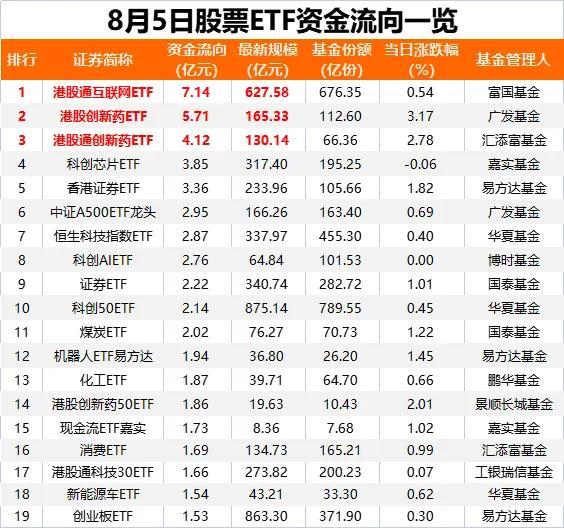
股票ETF市场净流入资金13.57亿元,港股市场ETF净流入居前
Zhong Guo Ji Jin Bao· 2025-08-06 06:56
Core Viewpoint - The A-share market continues to show strong performance with a mixed trend among the three major indices, while the stock ETF market sees a net inflow of 1.357 billion yuan on August 5 [1][2]. ETF Market Overview - As of August 5, the total scale of 1,166 stock ETFs in the market reached 3.80 trillion yuan, with an increase of 2.031 billion shares on that day, resulting in a net inflow of 1.357 billion yuan [2]. - The leading categories for net inflow included Hong Kong stock ETFs and industry-themed ETFs, with net inflows of 3.186 billion yuan and 1.447 billion yuan, respectively [2]. - The Hong Kong Stock Connect Internet ETF saw the highest net inflow of 729 million yuan on August 5, while the recent inflow into the Hang Seng Technology Index exceeded 9.3 billion yuan [2]. Sector Performance - The top five sectors attracting capital inflow were Hong Kong pharmaceuticals (1.28 billion yuan), Hong Kong internet (730 million yuan), Hong Kong technology (710 million yuan), securities (400 million yuan), and Hong Kong finance (370 million yuan) [2]. - Specific products such as the Hong Kong Stock Connect Internet ETF, Hong Kong Innovation Drug ETF, and Hong Kong Stock Connect Innovation Drug ETF were particularly favored by investors [2]. Fund Flow Dynamics - Southbound funds resumed a net inflow trend, with a single-day net purchase reaching 23.426 billion Hong Kong dollars, marking the highest single-day net inflow since April 10 [2]. - The overall liquidity expectations have improved, and the high valuation cost-effectiveness has made Hong Kong technology stocks attractive to investors [2]. ETF Inflows and Outflows - While the overall stock ETF market experienced net inflows, some indices saw net outflows, particularly broad-based ETFs, which had a net outflow of 3.624 billion yuan [5]. - The Shanghai Stock 50 Index recorded the highest net outflow of 1.364 billion yuan, as some funds began to take profits after the Shanghai Index surpassed 3,300 points [5]. Fund Management Insights - According to Huaxia Fund, the current A-share market does not appear overheated, with trading activity indicators showing a turnover rate at a historical medium level [6]. - The overall market valuation is considered low, and if liquidity and profit expectations improve, the market has strong upward momentum [7].
螺丝钉股市牛熊信号板来啦:当前还在低估吗|2025年8月份
银行螺丝钉· 2025-08-06 05:35
Core Viewpoint - The article discusses the "Screw Nail Stock Market Bull and Bear Signal Board," which helps investors understand market valuation and potential investment opportunities through quantitative and qualitative indicators [1][5]. Group 1: Quantitative Indicators - The star rating system indicates market valuation, with 4-5 stars suggesting undervaluation and 80% below indicating a cheap market [3][7]. - The Buffett Indicator, which compares total market capitalization to GDP, shows that below 80% indicates a low valuation area [27]. - The price-to-book ratio percentile indicates the market's valuation level, with lower percentiles suggesting cheaper valuations [9][29]. - The stock-bond valuation ratio is currently at 2.93, indicating a favorable investment opportunity when above 2 [34][33]. Group 2: Qualitative Indicators - The financing balance and trading volume reflect market activity, with lower values indicating a cooler market [12][37]. - The number of new stock issuances and their break rate are higher in bear markets, with a significant decrease in IPOs noted recently [42][15]. - The relationship between the CSI All Share Total Return Index and M2 indicates market liquidity, with lower values suggesting a more depressed market [44][17]. - The scale of old funds has decreased significantly, indicating a bearish market sentiment, with many funds down by 50-60% from their peak [48][18]. Group 3: Market Sentiment and Trends - The article notes two significant market lows during the current bear market, both around a star rating of 5.9, followed by brief rebounds [63][26]. - As of August 5, 2025, the market remains around a 4.7 star rating, suggesting it is still relatively cheap [64]. - Recent market conditions have been characterized by a predominance of positive news, despite overall low sentiment [58][66].

DLSM外汇平台:周一一轮暴涨之后,美股真的又“安全”了吗?
Sou Hu Cai Jing· 2025-08-05 10:05
Group 1 - The major U.S. stock indices experienced significant gains, with the Dow Jones Industrial Average, S&P 500, and Nasdaq rising by 1.34%, 1.47%, and 1.95% respectively, marking the largest single-day percentage increase since May 27 [1] - The market's rebound is driven by the "bad news is good news" logic, particularly in response to disappointing employment data, which is interpreted as increasing the likelihood of interest rate cuts by the Federal Reserve [3] - Technology stocks, especially the Nasdaq, benefited significantly from this sentiment, with Tesla's stock rising due to Elon Musk receiving a new round of stock options, signaling management's confidence in the company's long-term value [3] Group 2 - Despite strong performances from major tech companies during the earnings season, there is structural differentiation, with Spotify rising 5% due to a price adjustment announcement, while Berkshire Hathaway fell 2.7% after disclosing a $3.8 billion write-down, highlighting the risks even for stable companies [4] - The S&P 500 and Nasdaq have reached historical highs, but valuations are nearing the top of the past decade's range, raising concerns about sustainability amid high U.S. Treasury yields and ongoing global geopolitical risks [4] - The current market rally appears to be a technical correction rather than a trend reversal, with ongoing volatility expected as investors need to remain rational and identify assets with fundamental support rather than chasing high prices blindly [4]

危险信号?美股7月大涨,公司高管却避之不及
Jin Shi Shu Ju· 2025-08-05 09:13
Core Insights - Corporate executives are showing a cautious stance towards their own companies' stocks, contrasting with the general bullish sentiment in the market as the S&P 500 index reached multiple record highs in July [2][4] - The number of insider purchases in July was the lowest since 2018, with only 151 executives buying shares, indicating a significant drop in buying activity compared to previous months [2] - The S&P 500 index's price-to-earnings ratio is nearing 23 times, significantly above the ten-year average of approximately 18 times, suggesting executives may be concerned about high valuations [2] Market Sentiment - There is a divergence in market sentiment, as corporate executives exhibit a lack of enthusiasm for their own stocks, which contrasts sharply with the overall risk appetite observed on Wall Street [4] - Recent economic data indicates a slowdown in the labor market, with employment growth decelerating and a slight increase in the unemployment rate, adding to the cautious outlook [3] Corporate Actions - Corporate buyback activities have also slowed, with the latest data showing a decline below typical seasonal levels for four consecutive weeks as of July 25 [5] - The hesitation in buybacks suggests that companies are prioritizing balance sheet protection over market confidence, reflecting concerns about high valuations and interest rates [5] - Analysts believe that corporate buyback data may serve as a more significant sentiment indicator than insider selling, as executives are signaling that most positive news has already been priced into the market [5]

市场观察|3600点附近,全市场的估值水平如何?
Sou Hu Cai Jing· 2025-08-05 08:31
Group 1 - The latest Federal Reserve did not cut interest rates, leading to a rebound in the US dollar, prompting observations on new movements from foreign capital [1] - Recent fluctuations in the bond market are related to expectations regarding interest rate trends [1] - Gold remains a direction for allocation moving forward [1] Group 2 - The market valuation level around 3600 points is assessed, with certain industries identified as relatively undervalued [1]