稳定币

Search documents
俄罗斯央行计划在 2026 年对创建俄罗斯本国稳定币的可行性开展研究
Xin Lang Cai Jing· 2026-02-14 00:56
Core Viewpoint - The Central Bank of Russia plans to conduct a feasibility study on the creation of a domestic stablecoin by 2026, indicating a potential shift in its stance on such financial products [1] Group 1: Central Bank's Position - The First Deputy Governor of the Central Bank, Vladimir Chistyukhin, stated that the bank has traditionally opposed the issuance of stablecoins but will reassess the risks and prospects based on the experiences of other countries [1] - The Central Bank intends to submit the conclusions of this study for public discussion, suggesting a more open approach to the topic [1]
孙宇晨官宣Kolo支持波场TRON,加密货币买买买更加便捷
Sou Hu Cai Jing· 2026-02-13 20:45
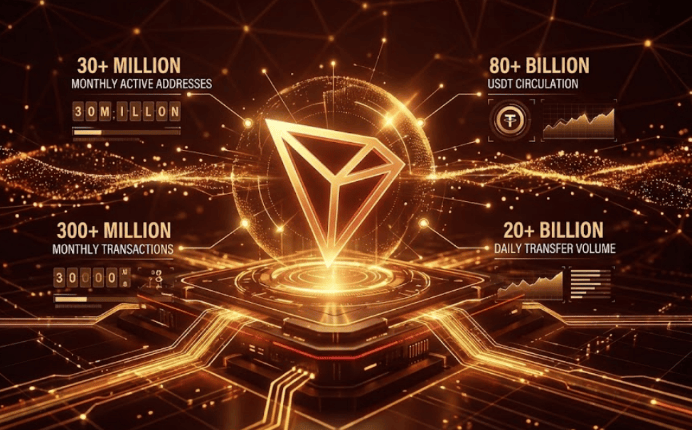
Core Insights - Kolo has officially integrated with TRON, enhancing digital asset payments and providing a seamless experience for users to convert USDT into real-time payment methods for everyday purchases like coffee [1][3] - The integration leverages TRON's high throughput and low-cost advantages, significantly reducing the lengthy process of converting digital assets into fiat currency for transactions [3][4] - The role of stablecoins is shifting from merely being a "store of value" to becoming a primary "medium of payment," with Kolo ensuring compliance with international standards for transparency in transactions [4][6] Group 1 - The integration allows for near-instant settlement from blockchain to card, enabling users to access their funds quickly at millions of merchants globally [1][3] - TRON's monthly active addresses exceed 30 million, with monthly transaction volumes surpassing 300 million, indicating strong market reliance on the network [1][3] - The average daily transfer amount on TRON's USDT exceeds $20 billion, showcasing the scale of funds flowing through the network [1][3] Group 2 - Kolo's payment system utilizes TRON's low transaction fees, addressing the high costs associated with cross-border payments and small transfers [3][4] - In emerging markets like Latin America, Africa, and Southeast Asia, TRON has become a key channel for low-cost cross-border remittances, with over 60% of transactions under $1,000 being cross-border [3][4] - The partnership aims to transition blockchain payments from niche markets to mainstream adoption, enhancing user accessibility to financial services [6]

Coinbase(COIN) - 2025 Q4 - Earnings Call Transcript
2026-02-12 23:32
Financial Data and Key Metrics Changes - In 2025, total revenue reached $7.2 billion, a 9% year-over-year increase [14] - Subscription and services revenue hit $2.8 billion, up 23% year-over-year, and more than 5.5 times higher than the peak in 2021 [14][16] - Q4 total revenue was $1.8 billion, down 5% quarter-over-quarter [17] - Q4 transaction revenue was $983 million, down 6% quarter-over-quarter, while subscription and services revenue was $727 million, down 3% quarter-over-quarter [18] - Adjusted EBITDA in Q4 was $566 million, and adjusted net income was $178 million [19] - The company ended the year with $11.3 billion in cash and cash equivalents, and total available resources of approximately $14.1 billion [20] Business Line Data and Key Metrics Changes - The company has 12 products generating over $100 million in annualized revenue, with half of those exceeding $250 million [17] - Subscription and services revenue reached all-time highs, up 5.5 times from the peak in 2021 [6] - Derivatives volume and revenue hit all-time highs in Q4, indicating strong growth in this segment [9] Market Data and Key Metrics Changes - Global trading volume and market share doubled year-over-year, reaching new all-time highs [3] - The crypto market cap was down 11% quarter-over-quarter, but the company outperformed the market on total trading volume [16] Company Strategy and Development Direction - The company aims to grow the Everything Exchange, which integrates various asset classes including crypto, equities, and commodities [8] - Focus on scaling stablecoins and payments, with USDC reaching an all-time high market cap of about $75 billion [10] - The strategy includes bringing the world on-chain, emphasizing DeFi and self-custodial wallets [12] - The company is positioned to capitalize on the transformation of financial services through crypto [4] Management's Comments on Operating Environment and Future Outlook - Management remains optimistic about regulatory clarity and the growth of crypto adoption [3] - The company is prepared for market volatility and has diversified its revenue streams [16] - Management believes that stablecoins will become the default payment method for AI agents [11] Other Important Information - The company has repurchased $1.7 billion of its common stock to offset dilution from stock-based compensation [20] - The company is exploring a Base token and improving developer tools to incentivize builders [28] Q&A Session Summary Question: Are you making any headway on positive outcomes regarding the CLARITY Act? - Management is optimistic about progress on the CLARITY Act and appreciates the efforts of the Senate and administration [24][25] Question: What percentage of overall subscription and services revenue do you expect Layer 2 activity from Base to contribute in 2026? - Base revenue is monetized both directly and indirectly, but no specific forecast was provided [26] Question: What product or platform initiative are you most excited about that investors may be underestimating today? - Management highlighted the Everything Exchange and stablecoin payments as key initiatives [29][30] Question: Could your economic relationship with Circle change depending upon language in a market structure bill? - Management does not foresee changes in the economic relationship with Circle due to the market structure legislation [34][35] Question: How does Coinbase think about the opportunities in larger scale buybacks and M&A? - The company is focused on buybacks and opportunistic M&A, having completed 10 acquisitions in 2025 [37][38] Question: What have you seen in terms of prediction market adoption to date among Coinbase customers? - Prediction markets were recently rolled out to all customers, and initial interest has been positive [39][40] Question: Do you think we're heading into another crypto winter? - Management does not predict the future but emphasizes the importance of building great products regardless of market conditions [41][42] Question: Can you talk about your 2026 spending plans? - The company plans to be prudent with spending, focusing on flat expenses in Q1 2026 [44][45] Question: Was the Coinbase issue just a tech mishap and not a more severe issue? - A technical issue caused brief interruptions for some users, but it was unrelated to trading volume or market conditions [46][48] Question: How do you work with Circle and USDC on real-world volume commercialization? - The company is focused on driving payments verticals and creating a strong go-to-market strategy for USDC [66]

香港财库局陈浩濂:Consensus 预计带来超 3 亿港元效益,首批稳定币牌照拟本季发出
Xin Lang Cai Jing· 2026-02-12 09:41
Core Insights - The Web3 conference Consensus will be held in Hong Kong for the second consecutive year, expected to generate over HKD 300 million in direct economic benefits, an increase from HKD 280 million last year [1] - The conference is anticipated to attract between 12,000 to 15,000 attendees, with approximately three-quarters coming from outside Hong Kong, and will feature over 400 related events throughout the week [1] - The Hong Kong Monetary Authority is actively processing applications for stablecoin licenses, with the first batch expected to be issued within the current quarter; regulatory legislative proposals for over-the-counter (OTC) and custodial services are targeted for submission to the Legislative Council this summer [1]
OSL 集团 CEO Kevin Cui: USDGO 旨在解决企业真实支付结算需求
Xin Lang Cai Jing· 2026-02-12 04:08
Core Viewpoint - The newly launched stablecoin USDGO by OSL Group aims to address real business needs such as instant global fund allocation, supplier payments, and cross-border settlements [1] Group 1: Company Initiatives - OSL Group will establish the GO Alliance, a stablecoin ecosystem alliance, to collaborate with various partners including payment, custody, market-making firms, and financial infrastructure [1] - The company is providing an initial ecosystem incentive of 20 million USD to support the GO Alliance [1] Group 2: Industry Perspective - Stablecoins are evolving beyond being merely viewed as crypto assets and are becoming a critical component of global financial infrastructure [1] - The essence of stablecoins is not as a new form of currency, but rather as a new foundational infrastructure behind the funds [1]
Tether 预计成为“前 10 大美国国债买家”,USAT 稳定币推动增长
Xin Lang Cai Jing· 2026-02-12 01:03
Core Insights - Tether plans to significantly increase its U.S. Treasury bill (T-bill) purchases by 2026, aiming to become one of the "top 10 T-bill buyers" [1] - Currently, Tether holds over $122 billion in T-bills, surpassing Germany, which constitutes 83.11% of its reserves [1] - The demand for Tether's flagship stablecoin USDT continues to grow, with the recent launch of the USAT stablecoin compliant with the GENIUS Act expected to further boost T-bill purchases [1] - Tether has approximately 530 million users, growing by 30 million users each quarter [1] - The company also holds around $6.3 billion in excess reserves and ranks as the 13th largest holder of gold globally [1]
摩根大通调查:地缘政治紧张局势料是今年金融市场波动的首要诱因
Ge Long Hui A P P· 2026-02-11 14:33
Core Insights - The annual electronic trading survey by JPMorgan reveals that 41% of respondents believe geopolitical tensions will have the greatest impact on financial markets this year, more than doubling from 2025 [1] - Technological innovations, such as AI, rank second at 19%, while interest rate policies come in third at 13% [1] - Chi Nzelu, head of the newly established quantitative trading and research team at JPMorgan, indicates that the market is highly focused on ongoing geopolitical tensions, suggesting that a quick resolution is not anticipated [1] Market Opportunities - Tokenized assets are viewed as the largest opportunity in the digital market, with 48% of sell-side respondents and 33% of buy-side respondents selecting this option, surpassing cryptocurrencies, stablecoins, and deposit tokens [1] - The survey, conducted in January, included responses from 955 institutional and professional traders globally, reflecting their sentiment heading into early 2026 [1]

Messari:BNB 年末市值达 1189 亿美元,同比增长 17.8%
Xin Lang Cai Jing· 2026-02-11 14:26
Core Insights - Messari's report indicates that BNB Chain's market capitalization is projected to reach $118.9 billion by the end of 2025, reflecting a year-on-year growth of 17.8%, positioning it as the third-largest cryptocurrency asset [1] Group 1: Market Performance - The average daily transaction volume in Q4 increased by 30.4% to 17.3 million transactions [1] - The number of daily active addresses rose to 2.6 million [1] Group 2: Growth Drivers - Real World Assets (RWA) emerged as a primary growth engine, with on-chain scale reaching $2 billion, marking a quarter-on-quarter increase of 228% and a year-on-year increase of 555%, second only to Ethereum [1] - The market capitalization of stablecoins increased by 9.2% to $15.2 billion [1] Group 3: DeFi Metrics - The Total Value Locked (TVL) in DeFi reached $6.6 billion, with PancakeSwap accounting for 33.5% of this total [1]
北水净买入腾讯超7亿,净卖出阿里巴巴超5亿
Ge Long Hui· 2026-02-11 12:19
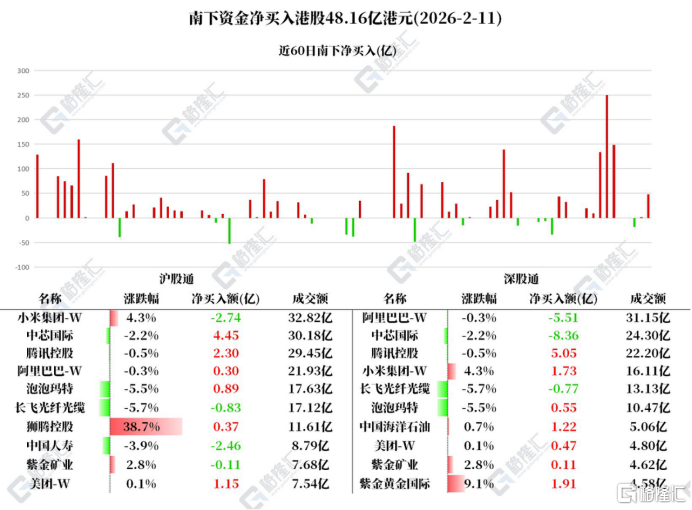
Group 1 - Southbound funds net bought Hong Kong stocks worth HKD 4.816 billion on February 11, with notable net purchases in Tencent Holdings (HKD 735 million), Zijin Mining International (HKD 191 million), Meituan-W (HKD 162 million), Pop Mart (HKD 144 million), and China National Offshore Oil Corporation (HKD 122 million) [1] - Significant net sales were observed in Alibaba-W (HKD 520 million), SMIC (HKD 390 million), China Life (HKD 246 million), Yangtze Optical Fibre and Cable (HKD 159 million), and Xiaomi Group-W (HKD 100 million) [1] Group 2 - Meituan announced plans to invest approximately USD 717 million to acquire Dingdong Group's "Dingdong Grocery" business in China, which Morgan Stanley believes will create synergies with Meituan's existing Xiaoxiang Supermarket and strengthen its position in the fresh food delivery market in East China [5] - CNOOC is influenced by geopolitical tensions, particularly regarding U.S.-Iran relations, which may affect short-term oil price volatility [5] Group 3 - Xiaomi is rumored to use the Snapdragon 8 Elite Gen6 for its standard version, with potential costs exceeding USD 300, approximately CNY 2074, amid rising DRAM and NAND prices increasing pressure on smartphone manufacturers [7] Group 4 - Lion Group Holdings is positioned to benefit from Hong Kong's growing status as a global Web3 and cryptocurrency innovation hub, supported by the implementation of the Stablecoin Regulation and the upcoming issuance of licenses for stablecoin issuers [6]


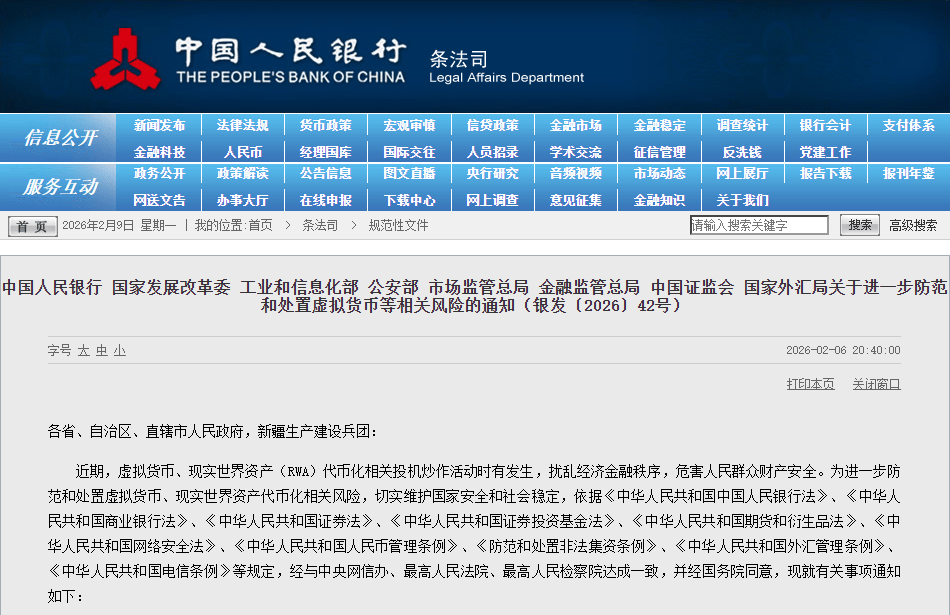
金融啄木鸟小讲堂|关于进一步防范和处置虚拟货币等相关风险的通知
Sou Hu Cai Jing· 2026-02-11 12:03
Core Viewpoint - The recent notice issued by the People's Bank of China and other regulatory bodies aims to prevent and address risks associated with virtual currencies and the tokenization of real-world assets, emphasizing that these activities disrupt economic order and threaten public financial security [3][4][5]. Group 1: Nature of Virtual Currencies and Tokenization - Virtual currencies do not have the same legal status as fiat currencies and should not be circulated as money in the market [3][4]. - Activities related to virtual currencies and the tokenization of real-world assets are classified as illegal financial activities, including exchanges between fiat and virtual currencies, and the issuance of tokens without approval [4][5]. Group 2: Regulatory Framework and Coordination - A collaborative mechanism among various government departments, including the People's Bank of China, is established to oversee and manage risks associated with virtual currencies and tokenization [6][13]. - Local governments are responsible for risk prevention and management within their jurisdictions, working in coordination with financial regulatory bodies and law enforcement [6][13]. Group 3: Risk Monitoring and Management - Financial institutions are prohibited from providing services related to virtual currencies, including account opening and transaction facilitation [7][8]. - Internet companies are not allowed to support virtual currency activities through marketing or operational services, and must report any illegal activities [8][9]. Group 4: Enforcement and Legal Responsibility - Strict penalties will be imposed on entities engaging in illegal financial activities related to virtual currencies and tokenization, with criminal charges applicable for severe violations [14]. - Individuals and organizations that assist foreign entities in providing virtual currency services within China will also face legal consequences [14].