长三角一体化

Search documents
市发改委:五大突破,推动全市经济社会高质量发展
Qi Lu Wan Bao· 2026-01-21 06:33
Core Viewpoint - The Jining Development and Reform Commission aims to implement the government's work report and plan for 2026 by focusing on five major breakthrough directions to promote high-quality economic and social development in the city [1] Group 1: Economic Operation - The report outlines the expected economic and social development goals for 2026, with the Development and Reform Commission collaborating with relevant departments to support key industries, enterprises, and major projects, especially during the favorable "window period" of national and provincial policies [2] - The "Huiqi Tong" platform will be utilized to ensure policies are effectively delivered and enjoyed, transforming policy advantages into developmental strengths to achieve simultaneous growth in quantity and quality for the city's economy [2] Group 2: Key Projects - The implementation of the "1212" project will accelerate the construction of 1,250 key projects at provincial, municipal, and county levels, with a focus on major projects like Ningde Times, Laisail, and Komatsu, ensuring over 250 billion yuan in investment stimulation for the year [3] - Aiming to promote 407 projects scheduled to start in the first quarter, the commission will enhance the "elements follow the project" mechanism to allocate land, funds, and energy efficiently, addressing funding issues through multiple channels [3] Group 3: Productive Service Industry - The commission will implement actions to enhance the service industry, targeting 400 leading high-growth enterprises with robust support measures, aiming for a service industry value-added growth rate of over 6% [4] - Ten key actions will be executed to improve commerce, logistics, and financial support, with a goal of achieving a revenue scale of approximately 530 billion yuan in the productive service industry [4] Group 4: Major Strategies - The commission will actively implement the ecological protection and high-quality development strategy for the Yellow River basin, aligning with the construction of the Beijing-Tianjin-Hebei region, the Yangtze River Delta, and the Guangdong-Hong Kong-Macau Greater Bay Area [5] - Efforts will be made to enhance strategic cooperation with cities along the Huai River ecological economic belt and to establish a northern inland waterway shipping center [5] Group 5: County Economy - The commission will promote high-quality development in county economies through urbanization, with a focus on national new urbanization pilot projects in Jiaxiang, Liangshan, and other counties [6] - The aim is to elevate the economic scale of counties to 50 billion, 70 billion, and 100 billion yuan, fostering the growth of 2-3 leading industries at the hundred billion or even thousand billion level [6]

东方盛虹涨2.05%,成交额2.85亿元,主力资金净流入606.53万元
Xin Lang Zheng Quan· 2026-01-21 05:42
Group 1 - The core stock price of Dongfang Shenghong increased by 2.05% on January 21, reaching 11.47 CNY per share, with a total market capitalization of 758.31 billion CNY [1] - The company has seen a year-to-date stock price increase of 5.33%, with a 6.11% rise over the last five trading days, an 11.36% increase over the last 20 days, and a 25.91% rise over the last 60 days [1] - Dongfang Shenghong's main business includes the research, production, and sales of civil polyester filament, with revenue contributions from various segments: 61.04% from other petrochemical and chemical new materials, 18.82% from refined oil products, 17.68% from polyester filament, and 1.71% from others [1] Group 2 - As of September 30, the number of shareholders for Dongfang Shenghong was 73,300, a decrease of 11.60% from the previous period, while the average circulating shares per person increased by 13.12% to 90,104 shares [2] - For the period from January to September 2025, Dongfang Shenghong reported operating revenue of 92.162 billion CNY, a year-on-year decrease of 14.90%, while net profit attributable to shareholders increased by 108.91% to 1.26 billion CNY [2] - The company has distributed a total of 4.429 billion CNY in dividends since its A-share listing, with 1.322 billion CNY distributed over the last three years [3]

豪威集团涨2.02%,成交额13.43亿元,主力资金净流入7430.32万元
Xin Lang Cai Jing· 2026-01-21 03:01
Group 1 - The core viewpoint of the news is that Haowei Group has shown a positive stock performance with a 2.02% increase in intraday trading, reaching a price of 131.59 yuan per share, and a total market capitalization of 165.25 billion yuan [1] - As of January 21, 2025, Haowei Group's stock has increased by 4.52% year-to-date, with a 3.04% rise over the last five trading days and a 4.69% increase over the last 20 days, while it has decreased by 1.04% over the last 60 days [1] - The company specializes in semiconductor products, including the research and design of discrete semiconductor devices and power management ICs, with 82.92% of its revenue coming from semiconductor design sales [1] Group 2 - Haowei Group belongs to the electronic-semiconductor-digital chip design industry and is associated with several concept sectors, including GDR concept, optics, MSCI China, Yangtze River Delta integration, and autonomous driving [2] - For the period from January to September 2025, Haowei Group achieved a revenue of 21.783 billion yuan, representing a year-on-year growth of 15.20%, and a net profit attributable to shareholders of 3.210 billion yuan, which is a 35.15% increase [2] Group 3 - Since its A-share listing, Haowei Group has distributed a total of 2.146 billion yuan in dividends, with 1.253 billion yuan distributed over the past three years [3] - As of September 30, 2025, Haowei Group had 170,500 shareholders, an increase of 18.31% from the previous period, with an average of 7,074 circulating shares per shareholder, a decrease of 16.23% [2][3]

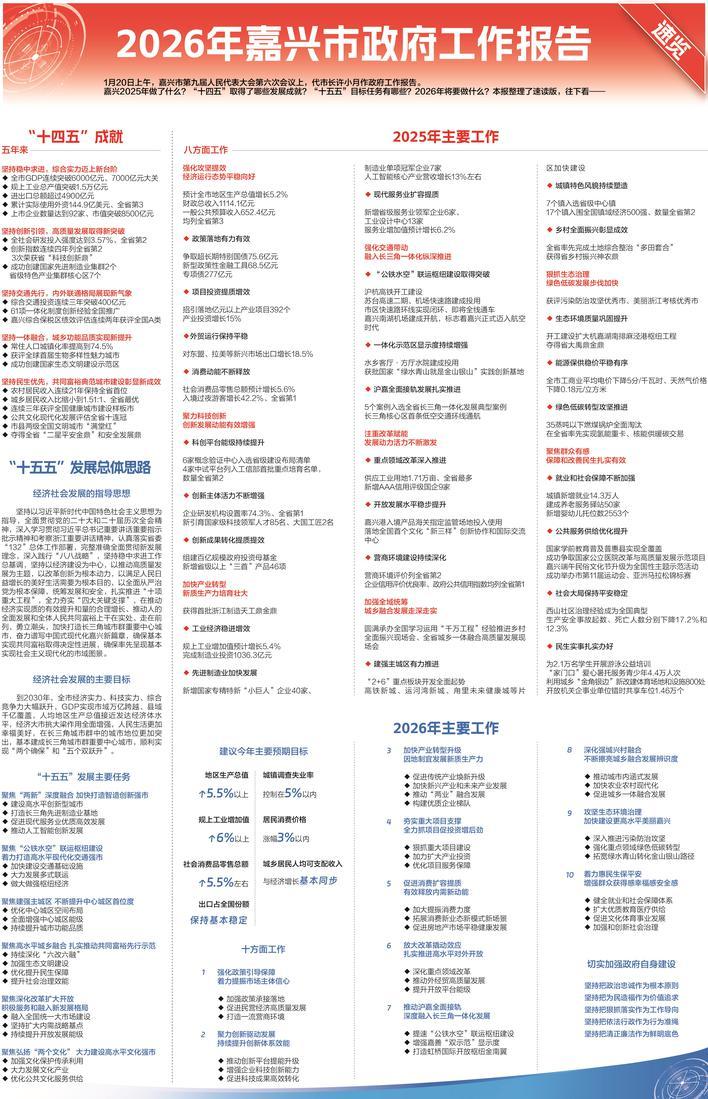
2026年嘉兴市政府工作报告速览
Xin Lang Cai Jing· 2026-01-21 00:01
Group 1 - The core viewpoint of the article highlights the achievements and future goals of Jiaxing City as outlined in the government work report for 2026, emphasizing economic growth, innovation, and infrastructure development [2][4][5] - Jiaxing's GDP has consistently surpassed 600 billion yuan, reaching over 700 billion yuan, with a stable economic operation and an industrial output value of 1.5 trillion yuan [2][5] - The total import and export volume exceeded 490 billion yuan, with a fiscal revenue of 111.41 billion yuan, ranking third in the province for actual foreign investment [2][5] Group 2 - The report outlines the "14th Five-Year Plan" achievements, including a 13% growth in the core artificial intelligence industry and the establishment of 92 listed companies with a market value exceeding 850 billion yuan [2][5] - The "15th Five-Year Plan" aims for significant advancements in economic strength, technological capability, and overall competitiveness, targeting a GDP of over 1 trillion yuan by 2030 [4][5] - Key tasks include fostering innovation, enhancing service industry quality, and developing a high-level transportation network, with a focus on integrating various modes of transport [4][5][10] Group 3 - Jiaxing has successfully created two national advanced manufacturing clusters and has made significant progress in green and low-carbon development [2][5] - The city aims to enhance urban functionality and quality, with ongoing projects to improve public services and social governance [4][6] - The report emphasizes the importance of cultural development and the promotion of a high-level cultural city, alongside efforts to improve the business environment for private enterprises [9][10]

市政协组织港澳委员和海外侨胞代表人士 开展“同心行”考察活动
Xin Lang Cai Jing· 2026-01-21 00:01
Group 1 - The core viewpoint of the news is the successful integration and development of the Yangtze River Delta region, highlighted by the "Same Heart Action" inspection activity organized by the local political advisory body, showcasing the collaborative efforts in innovation and infrastructure [1][2] - The inspection team visited the "Water Town Living Room" and the "Fangting Water Institute," which serve as a model for the integrated development of the Yangtze River Delta, emphasizing cross-regional connectivity and cultural exchange [1] - Members of the inspection team expressed confidence in the high-quality development of the Yangtze River Delta, noting that the collaborative efforts reflect a commitment to shared governance and innovation [1] Group 2 - The team also explored the Zhejiang University Yangtze River Delta Smart Oasis Innovation Center, which is a high-level scientific innovation platform focusing on future food, health, cities, and environment [2] - The exhibition showcased numerous cutting-edge technologies and products, indicating significant progress in transforming innovative results from laboratories to production lines [2] - Representatives from the overseas Chinese community expressed pride in the rapid development of Jiaxing's technological innovation, emphasizing the need for traditional industries to embrace change and accelerate their transformation [2]
杭州城西科创大走廊步入高质量融合发展快车道
Hang Zhou Ri Bao· 2026-01-20 03:32
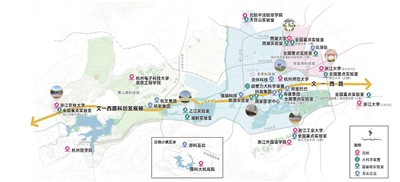
浙大超重力实验室记者 强脑科技智能仿生手 城西科创大走廊动能涌动 岁末年初,站在临安区相府路与科技大道交叉口,变化的痕迹清晰可辨——绿化带正为文一西路西 延工程(三期)"让路"、施工围挡沿街肃立、大型机械陆续进场……一派热火朝天的建设景象。 文一西路的最后一块"拼图",落定了!2025年年底,文一西路西延工程三期全线启动建设,向着 2028年全线拉通的目标全速前进。对城西科创大走廊乃至杭州而言,这不只是一条交通干道。这条曾止 步于西湖区边界的"断头路",随着城市发展浪潮与省市区各级的合力推动,不断向前延伸——它穿过五 常水乡,催生沿线蝶变,如今又将下穿南湖,一路向西连接临安青山湖,贯通城西科创大走廊,串联起 沿途的科研智库、智能制造、未来产业。 交通是发展的先行官。这条路所见证的,是一座城市破局向前、创新不止的坚定意志,也是一条科 创廊道从蓝图迈向现实、从断点走向贯通的生动叙事。 从交通串联到发展赋能 一条路牵引未来城市"新能级" 文一西路科创发展轴 然而十余年前,这里还是另一番景象。"那时文一西路不过是条窄马路,周边一片空旷,招商时连 地址都不敢报全,就怕人家一听就觉得太远。"作为文一西路上最早扎根的产业园 ...
5年后长三角会是啥样?全在这里了
Xin Lang Cai Jing· 2026-01-20 00:25
Core Viewpoint - The article discusses the development strategies and economic goals of the Yangtze River Delta (YRD) region during the 14th and 15th Five-Year Plans, highlighting the collaborative efforts of Shanghai, Jiangsu, Zhejiang, and Anhui to achieve high-quality growth and integration [3][5][6]. Economic Performance - Shanghai's economic total ranks among the top five global cities, with a projected GDP nearing 7 trillion yuan by 2025 [3][6]. - Jiangsu aims to exceed 14 trillion yuan by 2025, showcasing significant growth potential [3]. - Zhejiang's GDP is expected to surpass 9 trillion yuan, with per capita GDP projected to exceed 140,000 yuan [3]. - Anhui has reached a new milestone of 5 trillion yuan, indicating its emerging role in the YRD [3]. Long-term Economic Goals - By 2035, Shanghai aims to double its per capita GDP compared to 2020 levels [6]. - Jiangsu targets higher per capita GDP and income levels by 2035 [6]. - Zhejiang plans to reach per capita GDP levels comparable to developed economies by 2035 [6]. - Anhui's goal is to align its per capita GDP with the national average by 2035 [6]. Key Development Areas - The integration of technology and industry innovation is emphasized as a critical focus for the YRD [8][10]. - The construction of world-class airport and port clusters is highlighted as essential for regional connectivity and economic growth [16][19]. - The YRD aims to establish itself as a global leader in high-end industrial clusters, particularly in the aviation sector [21]. Collaborative Efforts - The article underscores the importance of collaboration among the four regions to enhance their competitive advantages and achieve common goals [9][11]. - The concept of "urban agglomeration" is frequently mentioned, indicating a focus on developing interconnected metropolitan areas [13][15]. - The YRD is recognized as a world-class urban cluster, with plans for further integration and development of urban spaces [14]. Infrastructure Development - The YRD is advancing its transportation infrastructure, including high-speed rail and airport facilities, to improve regional connectivity [16][17]. - The construction of the "North Along the Yangtze River High-Speed Railway" is a significant project aimed at enhancing travel efficiency within the region [17]. Innovation and Technology - The establishment of an international technology innovation center in the YRD is a priority, with Shanghai leading the initiative [9][10]. - Jiangsu and Zhejiang are also committed to fostering technological advancements and industrial innovation [10][11].

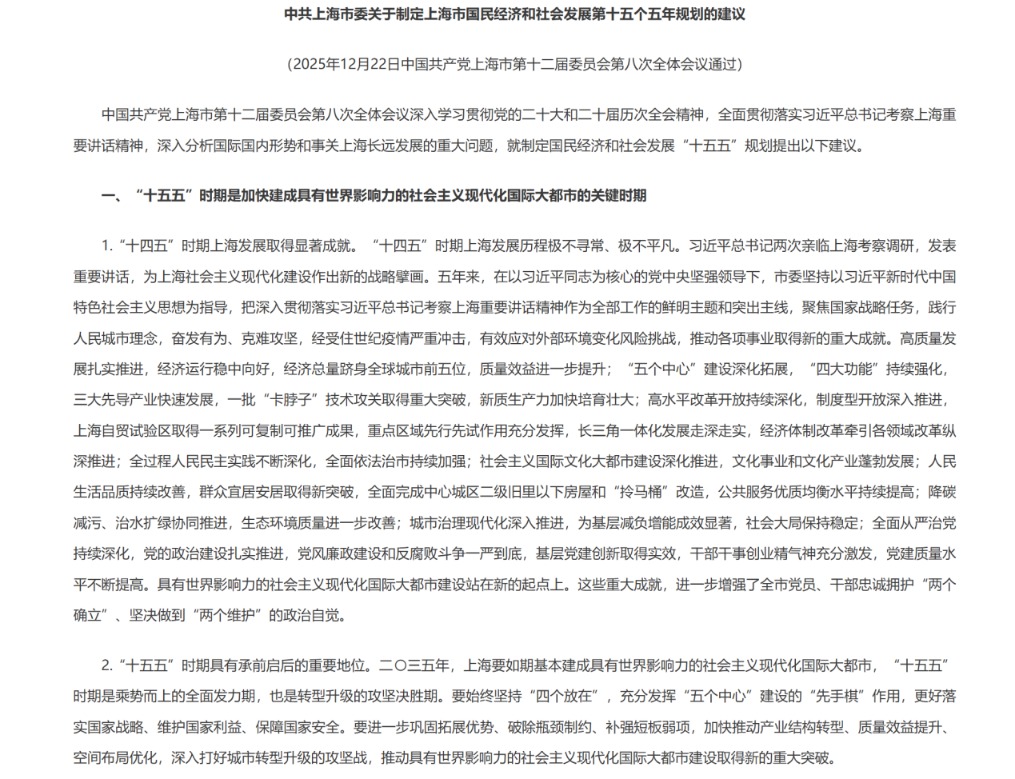
从长三角一体化,看上海“十五五”规划建议
Guo Ji Jin Rong Bao· 2026-01-19 12:39
Core Viewpoint - The Shanghai Municipal Party Committee has released a proposal for the 15th Five-Year Plan, aiming to transform Shanghai into a world-class socialist modern international metropolis by 2035, with a focus on high-quality development and regional integration in the Yangtze River Delta [1]. Group 1: Five Centers Upgrade - Shanghai aims to upgrade its "Five Centers" by 2035, achieving international leading levels in key development indicators, including doubling per capita GDP from 2020 levels [2]. - During the 14th Five-Year Plan, Shanghai's GDP surpassed 5 trillion yuan, becoming the first city in China to achieve this milestone and ranking among the top five global cities [2]. - The upgrade of the "Five Centers" will enhance resource allocation for the Yangtze River Delta, transitioning from single-function enhancement to system integration [2][3]. Group 2: Implementation Paths - The proposal outlines three implementation paths: leveraging financial support for innovation, creating regulatory innovations, and fostering new productive forces to reshape industrial chains [3]. - Shanghai's economic growth is projected to remain reasonable and synchronized with national trends, with a steady increase in total factor productivity [3]. Group 3: Key Industries - The three leading industries—integrated circuits, biomedicine, and artificial intelligence—will further solidify their positions, focusing on overall breakthroughs in the industrial chain [4]. - The artificial intelligence sector is expected to grow significantly, with projected revenues exceeding 550 billion yuan by 2025, reflecting a growth rate of over 30% [4]. Group 4: Institutional Innovation - High-level openness is a core advantage for Shanghai, with institutional innovations aimed at enhancing regional development dynamics [6]. - The proposal emphasizes the role of the Pudong New Area and Lingang New Area in driving institutional innovation and creating replicable models for the Yangtze River Delta [6][7]. Group 5: Collaborative Development - The proposal aims to establish a "power community" in the Yangtze River Delta, focusing on collaborative technological innovation, ecological protection, and spatial optimization [10]. - Specific paths for collaboration include deepening the integration of innovation chains and enhancing cooperation in key technology areas [11]. Group 6: Environmental and Spatial Optimization - The proposal highlights the importance of ecological protection and spatial layout optimization to enhance collaborative capacity in the Yangtze River Delta [12]. - Shanghai will promote the construction of a metropolitan area with a multi-node structure, facilitating coordinated development with surrounding regions [12]. Group 7: Social Welfare and Integration - The proposal emphasizes the sharing of public services across the Yangtze River Delta, enhancing the quality of life for residents in education, healthcare, and other areas [13]. - Shanghai's successful experiences in community services will be extended to the Yangtze River Delta, ensuring that high-quality development benefits a broader population [13].
长三角议事厅·周报|沪苏杭“人工智能+”从竞速走向协同
Xin Lang Cai Jing· 2026-01-19 10:21
Core Insights - The integration of "Artificial Intelligence+" is becoming a new competitive advantage for cities in China, particularly in the Yangtze River Delta region, with Suzhou, Shanghai, and Hangzhou each playing distinct roles in the AI industry chain [1][2][3] Group 1: City Roles in AI Development - Shanghai serves as the upstream "source" of the AI industry, with 394 AI enterprises and an industry scale of 435.49 billion yuan by the end of 2025, supported by a strong R&D investment of approximately 4.35% [2] - Suzhou acts as the "largest workshop" for AI applications, with an expected industrial output value of 4.89 trillion yuan in 2025, leveraging its dense manufacturing environment and nearly 2,500 AI-related enterprises [2] - Hangzhou functions as the "product accelerator," rapidly transforming cutting-edge technologies into marketable products, with the number of high-tech enterprises increasing from 2,844 in 2017 to 16,000 by 2024 [3] Group 2: Challenges and Bottlenecks - Shanghai faces challenges in converting strong research capabilities into market-ready products, requiring better collaboration between research institutions and enterprises [4] - Suzhou needs to evolve from strong applications to robust platform capabilities, focusing on creating reusable industrial data systems and AI models [5] - Hangzhou's limitation lies in its reliance on external support for hard technology supply chains, necessitating improvements in precision manufacturing and key component production [5] Group 3: Collaborative Framework for AI Advancement - The transition from a "division of labor" to a "collaborative network" is essential, with Shanghai needing to enhance its product transformation capabilities, Suzhou to build platform strengths, and Hangzhou to strengthen its hard technology support [6] - Effective collaboration requires institutional design to facilitate shared resources, including computational power, data flow, and talent development across cities [7][8][9]
构建“2+3+6+6”体系 上海市“十五五”规划确立产业布局新航线
Zhong Guo Jing Ying Bao· 2026-01-19 08:51
Core Viewpoint - Shanghai aims to accelerate the construction of "five centers" to enhance its urban capability and core competitiveness, marking the "14th Five-Year Plan" period as crucial for becoming a globally influential socialist modern metropolis by 2035 [3][4]. Group 1: Five Centers - The "five centers" include international economic, financial, trade, shipping, and technological innovation centers, which are deemed essential for Shanghai's modernization efforts [4]. - The plan emphasizes innovation-driven development and the importance of a coordinated approach between central and local governments to enhance global resource allocation and technological innovation [4]. Group 2: Industrial Structure - Shanghai will implement a "2+3+6+6" industrial structure, focusing on the digital and green transformation of traditional industries and accelerating the development of integrated circuits, biomedicine, and artificial intelligence [4]. - The city aims to establish six emerging pillar industry clusters in electronic information, life health, automotive, high-end equipment, advanced materials, and fashion consumer goods [4]. Group 3: Regional Coordination - The plan calls for higher quality integration of the Yangtze River Delta region, emphasizing cross-regional collaboration in technological and industrial innovation [5]. - By 2035, the functions of the "five centers" are expected to be fully upgraded, with key development indicators reaching international leading levels, and per capita GDP projected to double compared to 2020 [5].