3D打印技术

Search documents
奇德新材:公司当前主营的高性能改性塑料(如尼龙等)尚未应用于3D打印技术
Zheng Quan Ri Bao Zhi Sheng· 2025-11-26 11:45
Core Viewpoint - The company, Qide New Materials, has indicated that its current main products, high-performance modified plastics (such as nylon), are not yet applied in 3D printing technology. However, the company possesses the technical potential to develop materials specifically for 3D printing due to its strong expertise in polymer material modification [1]. Group 1 - The company is actively monitoring downstream technological trends and customer demands to promote the technical extension and innovation of related materials in the future [1].

厦大团队激光打印技术获重大突破
Xin Lang Cai Jing· 2025-11-26 05:07
Core Insights - The research team led by Professor Wu Dezhi at Xiamen University's Saben Dong Institute of Micro-Nano Science and Technology has made a breakthrough in 3D printing technology by developing the "laser in-situ induced direct writing" technique, significantly reducing the curing time of thermosetting materials for 3D flexible devices from the traditional 48 hours to just 0.25 seconds [1] Group 1 - The new technology addresses key challenges in the field, such as slow forming, complex steps, and difficulty in performance control [1] - The research findings have been published in the prestigious journal "Nature Electronics," highlighting their significance in the scientific community [1] - This advancement is expected to create new paradigms in areas requiring complex 3D additive manufacturing and multifunctional integration, including flexible electronics, soft robotics, organ chips, and biological scaffolds [1]
智能派获大疆投资的更多细节:三年内年营收要超50亿 | 36氪首发
3 6 Ke· 2025-11-22 01:34
Core Viewpoint - Shenzhen Intelligent Technology Co., Ltd. (ELEGOO) has completed a new round of strategic financing worth hundreds of millions of RMB, with DJI as the investor, and has shown a compound annual growth rate (CAGR) of over 40% in the past three years [1][5] Company Overview - Founded in 2015, the company focuses on the research, production, and sales of consumer-grade 3D printers and laser engraving machines, aiming to lower the creative threshold for global users through high cost-performance and intelligent products [2][4] - The company plans to achieve annual revenue exceeding 5 billion RMB within the next three years, with projected total revenue of 1.6 billion RMB in 2024 and a growth of 30% to 50% in 2025, potentially surpassing 2.5 billion RMB [1][2] Product Lines - The core product lines include both light curing (LCD/SLA) and fused deposition modeling (FDM) technologies, maintaining a leading position in global consumer LCD 3D printer shipments for several consecutive years [2][4] - The Mars series, launched in 2019, was among the first in the global market to offer devices priced at $300 with 2K printing precision, and the upcoming Mars 5 Ultra is expected to enhance printing efficiency and quality [2][3] Market Position and Strategy - The company has successfully penetrated the dental medical field with its high-precision light curing 3D printers, which can print detailed dental models for surgical planning and teaching [3] - The OrangeStorm Giga, part of the FDM series, represents the company's entry into the industrial-grade 3D printing sector, successfully raising over $3 million on Kickstarter [3][4] Software and Ecosystem Development - The company is committed to providing integrated solutions, with the launch of its self-developed slicing software, SatelLite, designed specifically for light curing 3D printing, set to release in November 2024 [3][4] - In 2025, the company will introduce the Matrix APP for remote device management and the Nexprint 3D model platform, completing its 3D printing ecosystem [4] Global Expansion - The company has diversified its sales platforms, including independent sites and Amazon, with products sold in over 150 countries and regions, achieving cumulative shipments of over 1 million units [4] - Following its rise to the top of the consumer LCD 3D printer market, the company is positioned to leverage DJI's strategic investment for global expansion, technology integration, and supply chain optimization [5]
南风股份(300004) - 300004南风股份投资者关系管理信息20251119
2025-11-20 08:14
Group 1: Company Overview - Southern Wind Power Co., Ltd. is engaged in 3D printing technology, focusing on high-precision manufacturing and complex geometric structures [2] - The company is currently in the process of expanding its production capabilities, including facility renovations and equipment procurement [3] Group 2: Market Insights - The liquid cooling market in China is projected to reach CNY 184 billion in 2024, with expectations to grow to CNY 1,300 billion by 2029 [3] - 3D printing technology offers significant advantages over traditional manufacturing, including material savings and design flexibility [2] Group 3: Business Development - Southern Additive is primarily providing 3D printing services for various materials, including stainless steel and titanium alloys, targeting sectors like aerospace and military [3] - The company is currently in the negotiation and sample delivery stages for its 3D printing business, which is not expected to significantly impact this year's financial performance [3] Group 4: Talent Development - Southern Additive is enhancing its R&D capabilities through external recruitment and partnerships with universities and research institutions [3]

两种新技术融合,新型3D打印微型机器人
Xuan Gu Bao· 2025-11-19 15:06
Core Insights - A new 3D printing technology developed by scientists at Carnegie Mellon University has successfully created microDeltas, miniature delta robots, which are expected to play significant roles in micro-manipulation, micro-assembly, minimally invasive surgery, and wearable haptic devices [1] - The technology utilizes advanced nano-manufacturing techniques, focusing laser to precisely cure photosensitive materials and depositing thin metal layers to create complex 3D structures and actuators without manual folding or assembly [1] - The 3D printing industry is on the verge of a transformative phase, with increasing applications across various sectors such as manufacturing, healthcare, education, and construction, driven by cost reduction, improved standards, and rising demand [1] Industry Summary - The performance and cost advantages of 3D printing are becoming more pronounced, accelerating the technology's penetration rate [1] - The Chinese 3D printing market is projected to exceed 63 billion yuan in 2024, representing a 30-fold increase over the past decade, with expectations to surpass 100 billion yuan by 2029, driving the upstream and downstream industry chain to exceed 300 billion yuan [1] Company Summary - Relevant A-share concept stocks include Hongchang Electronics and AVIC Heavy Machinery, which are associated with the advancements in 3D printing technology [1]

晚报 | 11月20日主题前瞻
Xuan Gu Bao· 2025-11-19 14:52
3D Printing - A new 3D printing technology developed by Carnegie Mellon University has successfully created microDeltas, miniature delta robots, which could play significant roles in micro-manipulation, micro-assembly, micro-surgery, and wearable haptic devices [1] - The 3D printing market in China is expected to exceed 63 billion yuan in 2024, growing 30 times over the past decade, and is projected to surpass 100 billion yuan by 2029, driving the upstream and downstream industry chain to exceed 300 billion yuan [1] AI Toys - The Ministry of Industry and Information Technology of China is promoting the high-quality development of AI toys, focusing on policy support and product innovation [2] - The domestic toy market retail sales are expected to reach 97.85 billion yuan in 2024, with AI toys, trendy toys, and educational toys being the three core growth engines [2] Down Jacket Prices - The price of down jackets is surging due to a significant increase in the cost of down feathers, with white duck down prices rising from 170,000 yuan per ton to approximately 580,000 yuan [3] - The cost of producing a short adult down jacket has approached 1,000 yuan due to soaring raw material prices [3] MLCC Price Increases - Fenghua Advanced Technology has announced price increases for various MLCC products due to rising costs of raw materials, with price hikes ranging from 5% to 30% [4] - The demand for passive components is being driven by AI servers and electric vehicles, with the usage of MLCCs in AI servers being eight times that of traditional servers [4] Flash Memory Price Increases - Flash wafer prices have seen significant increases, with 1Tb QLC rising by 25% to $12.5 and 512Gb TLC increasing by 38.46% to $9 [5] - NAND product demand is expected to exceed supply, with inventory turnover days decreasing from 135 to 115 days [5] Electric Vehicle Charging Infrastructure - As of October 2025, the total number of electric vehicle charging facilities in China reached 18.645 million, a year-on-year increase of 54% [6] - The National Development and Reform Commission has launched a plan to double charging service capacity by 2027, which is expected to drive over 200 billion yuan in investment in charging facility manufacturing and construction [6] Sustainable Aviation Fuel (SAF) - The Indian government is set to release a national SAF policy, with aviation fuel demand expected to reach 15-16 million tons by 2030 [7] - SAF prices have been rising, with European SAF prices reaching $2,900-$2,920 per ton, a 58% increase since the beginning of the year [7] Hong Kong-Shenzhen Financial Technology Cooperation - The Hong Kong and Shenzhen governments have announced a plan to establish a global fintech center, aiming to implement over 20 cross-border data verification platforms by the end of 2027 [8] Satellite Launch Success - China successfully launched three satellites for space environment detection and technology verification, marking the 608th flight of the Long March series rockets [8] C919 Aircraft Operations - China Southern Airlines has commenced commercial operations of the domestically produced C919 aircraft on the Guangzhou-Ningbo route, featuring a customized cabin layout [9] Apple Foldable iPhone - Apple is internally testing its first foldable iPhone with a battery capacity of 5,400-5,800mAh, which would surpass the iPhone 17 Pro Max's 5,088mAh [9]


苹果再讲3D打印再生钛金属Apple Watch背后故事 引领科技环保双重革命
Xin Lang Cai Jing· 2025-11-18 14:46
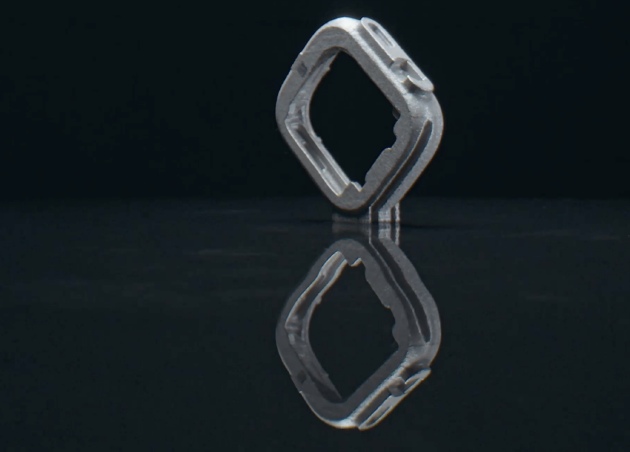
Core Insights - Apple has successfully transitioned its 3D printing technology from prototyping to mass production for the Apple Watch Ultra 3 and titanium Apple Watch Series 11, marking a significant advancement in the consumer electronics industry and contributing to its 2030 carbon neutrality goal [3][6] Group 1: Technological Innovation - The new 3D printing process allows for a 50% reduction in titanium material usage compared to previous models, with an expected saving of over 400 tons of titanium by 2025, enabling the production of two watches with the material previously used for one [3][4] - The 3D printing technique involves atomizing titanium into 50-micron powder and using six lasers for simultaneous operation, resulting in over 900 layers printed, with each layer precisely controlled at 60 microns [4] Group 2: Environmental Impact - The implementation of 3D printing technology supports Apple's "Apple 2030" carbon neutrality plan, with the production of Apple Watches now fully powered by renewable energy sources [6] - The use of recycled titanium in the manufacturing process enhances the environmental attributes of the products, showcasing a significant leap in sustainability [6] Group 3: Design and Functionality - The new technology allows for the printing of specific textures in areas inaccessible by traditional forging methods, optimizing the waterproof structure of the antenna in the honeycomb network version of the watch [6] - The same recycled titanium 3D printing technology has been applied to the new iPhone Air's USB-C port, achieving a balance of thinness and durability [6] Group 4: Market Positioning - The introduction of the two new Apple Watch models with 3D printed cases sets a dual benchmark for technology and sustainability in the smartwatch industry, indicating a potential for disruptive changes in the consumer electronics sector [7]

纺织用“巧手” 火箭有“慧心”(迈向“十五五”的创新图景)
Ren Min Ri Bao· 2025-11-17 22:01
Group 1 - The core viewpoint emphasizes the necessity of technological transformation and digitalization in traditional industries to enhance competitiveness and efficiency [2][3] - The company Wuxi Cotton Textile Group has implemented intelligent inspection and connection robots to address production challenges, improving efficiency and product quality [2][3] - The digital transformation has led to a reduction in labor intensity by 30%, a decrease in production costs by 11%, and an increase in production efficiency by 15% [3] Group 2 - The high-end textile industry cluster in Wuxi has surpassed a scale of 200 billion yuan, driven by intelligent, green, and integrated development [3] - The aerospace sector, represented by Deep Blue Aerospace, is utilizing 3D printing technology for manufacturing rocket engines, significantly reducing costs and delivery times [3] - The upcoming attempt for in-orbit recovery of rockets could lower launch costs by over 70%, with the potential for the Wuxi base to produce 10 liquid launch vehicles and 100 rocket engines annually, generating over 3 billion yuan in revenue [4]
继美团、高翎之后,大疆杀入3D打印赛道
21世纪经济报道· 2025-11-17 15:04
Core Viewpoint - The article discusses the recent investment by DJI in a 3D printing company, highlighting the growth potential of the consumer-grade 3D printing market and the competitive landscape dominated by Shenzhen-based companies [1][6][10]. Group 1: Investment and Market Dynamics - DJI's investment in a 3D printing company is confirmed, reflecting its confidence in the growth potential of consumer-grade 3D printing technology [1][6]. - The consumer-grade 3D printer prices have decreased by 60% over the past three years, making entry-level models available for under 2000 yuan [3][6]. - The global entry-level 3D printer shipment is expected to exceed 1 million units by Q1 2025, with Chinese suppliers contributing 95% of this market, primarily from companies like拓竹科技 and 创想三维 [6][10]. Group 2: Competitive Landscape - Four Shenzhen companies, including 拓竹科技, 创想三维, 纵维立方, and 智能派, hold 90% of the global entry-level 3D printer market share, earning the nickname "Four Little Dragons of Shenzhen" [5][6]. - 拓竹科技 is projected to achieve revenues between 55 billion to 60 billion yuan in 2024, with a net profit nearing 20 billion yuan [7][8]. - 智能派 is rapidly increasing its market presence, with expected sales of 1.6 billion yuan and a shipment of 550,000 3D printers in 2024 [8][10]. Group 3: Industry Trends and Innovations - The 3D printing industry is evolving from a niche market to a mainstream business, with applications expanding into education, customized toys, and small part manufacturing [8][10]. - The establishment of a comprehensive 3D printing ecosystem in Shenzhen, including modeling systems, materials, equipment, and application services, is enhancing the region's competitive edge [6][11]. - The community aspect, such as 拓竹科技's MakerWorld, plays a crucial role in user retention and lowering usage barriers, with nearly 10 million monthly active users and over a million models available [11][12].

飞机发动机都能造,仪器制造迎来新工具
仪器信息网· 2025-11-14 09:07
Core Viewpoint - The successful flight test of the 3D-printed simplified turbojet engine by China Aviation Engine Group marks a significant breakthrough in the global aviation manufacturing sector, indicating a new path in aircraft engine manufacturing in China [2] Group 1: Technological Breakthroughs - Traditional engine manufacturing involves thousands of parts, while 3D printing allows for whole component formation, greatly simplifying the structure [3] - The manufacturing cycle has been reduced from years to weeks, representing a qualitative leap in production efficiency [3] - Costs are expected to be significantly lowered, with a potential 50% reduction in overall costs due to fewer assembly steps and improved material utilization [3] - The design freedom is enhanced, enabling the creation of complex structures that traditional methods cannot achieve [3] Group 2: Impact on High-End Manufacturing - This technology is set to reshape the manufacturing industry, benefiting not only aviation but also sectors like energy and healthcare [4] - Precision instrument manufacturing will gain new tools, as complex internal structures will no longer be limited by traditional processes [4] - The mold industry will undergo transformation, with 3D printing facilitating rapid prototyping and shortening research and development cycles [4]