AI编程

Search documents
Node.js之父:手写代码已死
3 6 Ke· 2026-01-21 11:08
Core Viewpoint - The era of human-written code is coming to an end, as AI is fundamentally changing programming practices and roles within the industry [1][4][14]. Group 1: Key Figures and Contributions - Ryan Dahl, the creator of Node.js, emphasized that the age of human coding is over, having previously revolutionized backend development with his framework [3][4]. - Salvatore Sanfilippo, co-founder of Redis, highlighted that programming has been permanently altered by AI, marking a significant shift in the industry [4][5]. - The AI programming tool Copilot, based on OpenAI Codex, has reportedly accelerated development speed by over 50% [8]. Group 2: AI Programming Trends - AI programming and concepts like Vibe Coding have gained significant traction, with tools like Claude Code enabling full-stack development and optimization [8][9]. - ByteDance's native programming tool TRAE generated 100 billion lines of code in 2025, equivalent to the output of 3 million programmers working continuously for a year [10]. - A Stack Overflow report indicated that 84% of developers use AI tools, with 69% believing these tools enhance productivity [10]. Group 3: Future of Programming Roles - The programming landscape is shifting from syntax-focused coding to intent-driven development, where human roles are evolving from code writers to requirement editors [7][20]. - Despite the rise of AI, industry leaders assert that programmers will not be replaced but will instead focus on maintaining and improving AI-generated code [16][20]. - Linus Torvalds, initially critical of AI-generated code, acknowledged its potential as a valuable entry point for new programmers, reinforcing the idea that human oversight remains essential [18][20].

你们问了一万遍的票据风图片提示词,它终于来了!
歸藏的AI工具箱· 2026-01-21 10:21
Core Viewpoint - The article introduces a new skill for generating images and covers for articles, emphasizing its utility in content production and the various styles available for image generation [3][8]. Functionality Overview - The skill supports analysis of any document format in the current folder and can generate images in bulk for each section [5]. - It includes three built-in styles: ticket style, vector illustration style, and gradient glass card style, allowing users to choose their preferred image style [8]. - Users can select image resolution (2K, 4K) and aspect ratio (16:9, 3:4), and can opt for a summary cover image [10]. Usage Instructions - Installation of the skill can be done via terminal using a specific command, followed by entering an API key from AI Studio [11][12]. - After installation, users can interact with the AI to generate images based on their document content and preferences [13][14]. Design Style Requirements - The article outlines specific design style requirements for generating a cover poster, including the use of varying font sizes, a black-and-white color scheme, and a layout reminiscent of tickets or boarding passes [17]. - It emphasizes the importance of visual flow, whitespace, and the integration of Eastern and Western design aesthetics [17]. Conclusion - The article encourages readers to explore the GitHub project for the skill and engage with the content by liking or sharing [18][19].

Node.js之父官宣:人类手写代码时代真的结束了
3 6 Ke· 2026-01-21 07:52
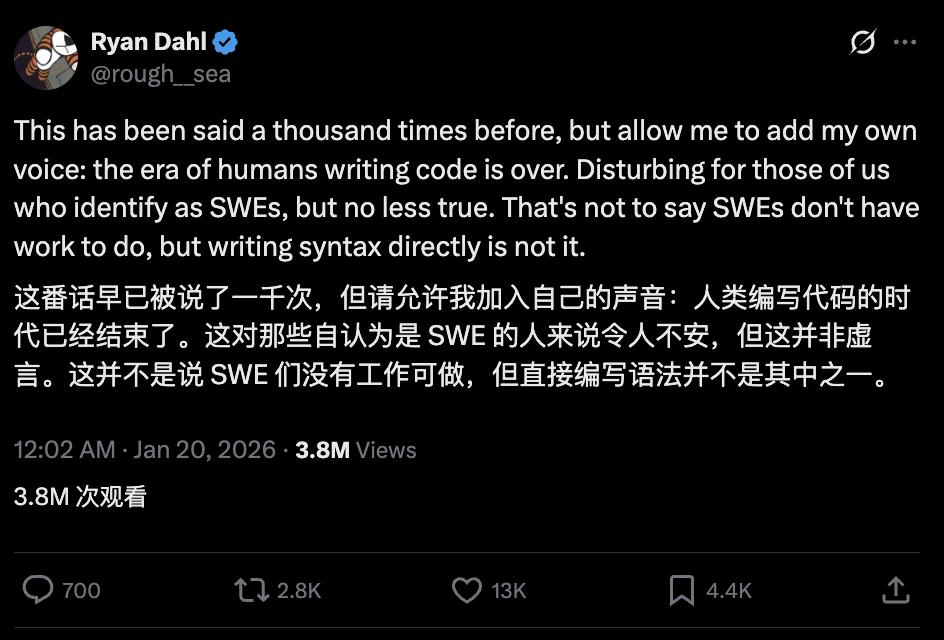
Node.js之父Ryan Dahl今天发推宣布:人类手写代码的时代已经终结!与此同时,Stability AI创始人Emad Mostaque预测:现在每月200美元的顶级AI编 程体验,两年后将跌至不到1美元。 Node.js之父Ryan Dahl今天发了一条推文,直接把程序员圈子炸了: 人类手动编写代码的时代已然终结! 一场关于AI编程的剧变,正在逼近。 这条帖子获得了近100万的观看。大佬们纷纷评论区留言表示赞同。 而AI写代码将变得足够便宜,便宜到你无法想象! 两年后,现在每月200美元的顶级AI编程体验,将跌至不到1美元! 这不是瞎猜,而是Stability AI创始人Emad Mostaque刚刚给出的判断。 他的逻辑是:「思考Tokens即将崩盘」。 1000:1,AI编程「思考」的惊人代价 想让AI帮你写出一行生产级代码,需要付出多少代价? 答案可能超出你的想象。 让我们先明确下定义: 思考Tokens(Thinking Tokens):指AI在输出最终答案前进行的推理过程。 代码Tokens(Code Tokens):指最后写出来的实际代码。 Emad Mostaque给出了一个数字:10 ...
Node.js之父:人类写代码的时代已经结束了~马斯克开源 X 平台推荐算法
菜鸟教程· 2026-01-21 03:30
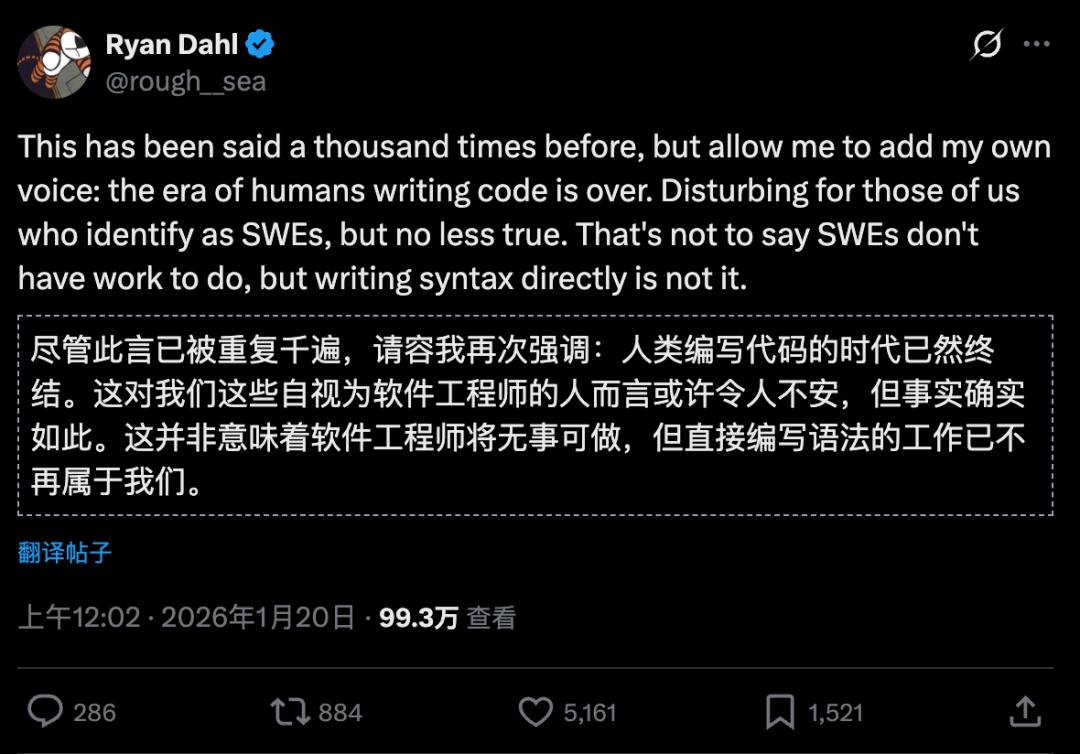
Group 1: AI in Software Development - The era of human-written code is ending, with a shift in the role of software engineers towards code review and high-level decision-making rather than direct syntax writing [1][2] - AI programming tools like Claude Code are significantly enhancing developer productivity, with efficiency improvements of 30-55% and a reduction in entry barriers for beginners [3] - Developers are increasingly delegating 70-90% of routine coding tasks to AI, allowing them to focus on system design, requirement analysis, and code review [3][4] - The future of programming is evolving into "vibe coding," where developers communicate requirements in plain language, and AI generates the necessary code [6][7] - The primary role of developers will shift to interacting with AI, refining outputs, and ensuring the final product meets requirements [7][8] Group 2: Open Source Algorithm by X Platform - Elon Musk has committed to open-sourcing the recommendation algorithm of the X platform, with updates every four weeks to enhance transparency [9][10] - The new X algorithm has been released, utilizing the same Transformer architecture as the Grok model from xAI, and is available on GitHub [12][13][14] - Key factors influencing post visibility on the X platform include comment replies, link placement, viewing duration, niche focus, and managing user engagement [17][18]
硅谷深夜不写一行代码,放羊大叔Ralph引爆奇点,睡一觉AI全跑通
3 6 Ke· 2026-01-21 02:52
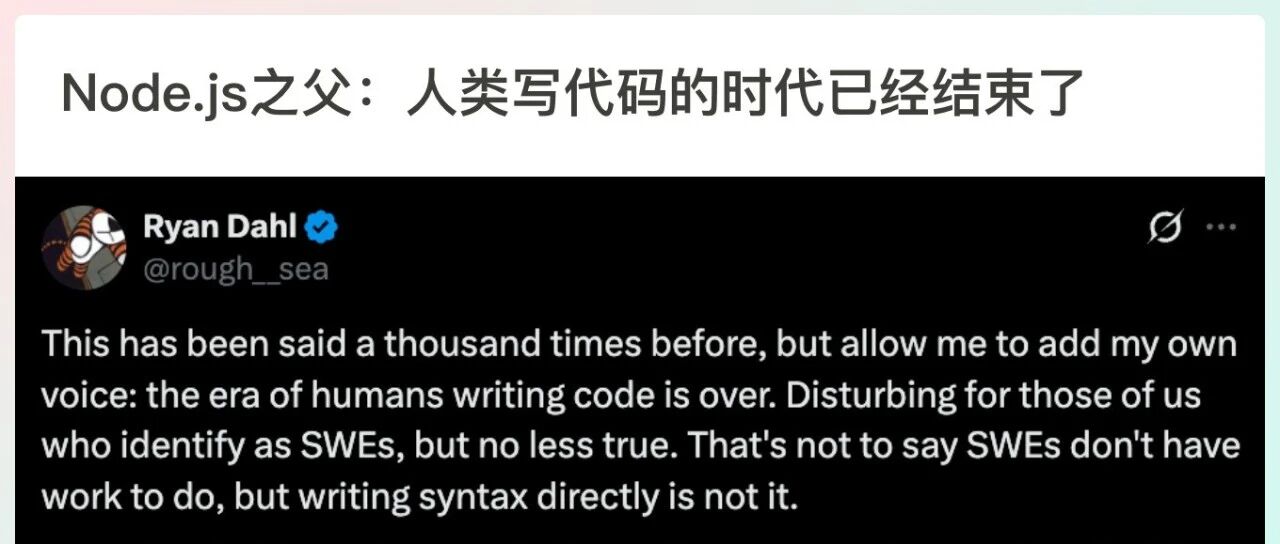
放羊大叔的Ralph Loop,让硅谷都不用在深夜编程了!无需手写一行代码,睡一觉,AI搞定全部软件开发。 不用手写一行代码,睡一觉,项目全部跑通。 放羊大叔的Ralph Loop「魔咒」正席卷全网,将掀起指数级生产力爆炸的革命。 今天,一位AI初创的创始人Damian Player发出肺腑之言—— 从现在开始掌握这项技能的人,3个月后将无人能及。 事情是这样的。 前一晚,Damian工作流干了一半,实在没力气弄了。所以,他启动了Ralph,合上电脑,直接睡觉。 今天早上醒来一看:6次更新,全部搞定,运行完美。 他特别强调,「我一行代码都没写」。 仿佛一夜之间,所有人都能睡着觉把活儿轻轻松松干完了。 不得不感慨,有些工具一旦学会用了,真的会让生产力发生断层式的跃升。 这个「死循环」,让AI 7x24编程 在接下来的长文中,Damian具体分享了使用Ralph的一些技巧以及感受。 Ralph的名字,来源于《辛普森一家》中,那个永远天真却无比执着的角色Ralph Wiggum。 在编程中,Ralph本质就是一个AI智能体——人类离开电脑之后,依然会无限构建软件的AI。 它的工作方式,非常简单粗暴: 给它一堆小任务 ...
AI开始指挥人类写代码,记忆也能永存了?全球顶级资本涌入
第一财经· 2026-01-20 14:32
Core Viewpoint - Anthropic, a major competitor to OpenAI, is gaining significant attention and investment due to its innovative AI tools, particularly Claude Code and Claude Cowork, which are transforming software development and collaboration [2][4]. Group 1: AI Tools and Innovations - Claude Code, an AI programming tool, enables non-technical users to easily create software, completing complex projects in a fraction of the time previously required [2]. - The recent launch of Claude Cowork introduces a "digital colleague" that can collaborate on tasks and retain long-term memory, enhancing productivity and task execution [4]. - The ability of AI to possess "long-term memory" is a significant advancement, allowing it to reference a knowledge base for context rather than starting from scratch each time [4]. Group 2: Market Impact and Investment - Anthropic is expected to raise up to $25 billion in its upcoming funding round, potentially increasing its valuation to $350 billion [2][5]. - Following a previous funding round that raised $13 billion, Anthropic's valuation reached $183 billion, indicating strong investor confidence and market potential [5]. - The company is poised to become the second-largest AI "unicorn" after OpenAI and is anticipated to go public this year, with projections suggesting it may capture a larger market share among enterprise users than OpenAI by mid-2025 [5].
ST宏达:1月19日召开董事会会议
Mei Ri Jing Ji Xin Wen· 2026-01-20 11:30
每经AI快讯,ST宏达1月20日晚间发布公告称,公司第七届第八次董事会会议于2026年1月19日在公司 会议室以现场与通讯相结合方式召开。会议审议了《关于2026年度日常关联交易预计额度的议案》等文 件。 每经头条(nbdtoutiao)——"一周干完一年的活",一款AI编程工具让硅谷程序员集体"上瘾"!科技公 司CEO:一辈子钻研的技能被它一次性解决,让人兴奋又恐惧 (记者 王瀚黎) ...

安诺其:1月16日召开董事会会议
Mei Ri Jing Ji Xin Wen· 2026-01-20 09:29
Group 1 - The company Anuoqi announced that its 24th meeting of the 6th board of directors was held on January 16, 2026, via communication methods [1] - The meeting reviewed a proposal regarding the company's wholly-owned subsidiary to engage in financing leasing business and to provide guarantees for it [1]

“擦边”哪有AI编程香?马斯克终于想通了
Tai Mei Ti A P P· 2026-01-19 04:53
Core Viewpoint - The controversy surrounding Grok's ability to generate explicit content has led to regulatory scrutiny and a shift in focus towards AI programming capabilities, as companies like xAI aim to find sustainable revenue streams in the competitive AI landscape [4][22][29]. Group 1: Regulatory and Market Response - xAI has announced restrictions on Grok's ability to generate explicit content, responding to public criticism and investigations from multiple countries [4][5]. - The controversy has attracted attention from ten countries, including the UK, EU, and Australia, highlighting the global implications of Grok's operations [4]. - Despite the controversies, Grok has seen significant user growth, with monthly active users surpassing 30 million, indicating a strong demand for its services [4]. Group 2: Financial Performance and Business Model - xAI's revenue is projected to reach approximately $500 million by 2025, significantly lower than competitors like OpenAI and Anthropic, which are estimated at $13 billion and $7-9 billion respectively [28]. - The current revenue model for xAI heavily relies on consumer subscriptions, with efforts to expand into B2B products like Grok Business and Grok Enterprise [28][29]. - OpenAI's revenue structure is approximately 70% from consumer subscriptions, while Anthropic's is about 70-80% from enterprise clients, indicating a more stable income source [24][25]. Group 3: Competitive Landscape in AI Programming - xAI is shifting its focus towards AI programming, acknowledging that the consumer market may not provide a sustainable revenue model [6][22]. - Competitors like Anthropic and OpenAI are enhancing their programming capabilities, with Anthropic's Claude Code being positioned as a virtual engineer that integrates deeply into engineering workflows [17][20]. - The AI programming sector is becoming increasingly competitive, with major players like Google and ByteDance also investing heavily in this area, indicating a shift from consumer-focused applications to enterprise solutions [21][30]. Group 4: Future Directions and Challenges - xAI plans to enhance Grok's programming capabilities with significant updates, aiming to compete more effectively in the AI programming space [7][29]. - The challenges of entering the AI programming market include high stakes for error-free performance, as mistakes can lead to significant production issues [30]. - The competitive landscape is evolving, with companies needing to demonstrate not just model capabilities but also a deep understanding of engineering needs and product integration [30][31].
当“AI编程”越来越容易,新浪潮正出现:人人可做的“微应用”和一人顶团队的“超级程序员”
硬AI· 2026-01-18 13:03
Core Viewpoint - The article discusses the transformation in the software industry driven by AI, highlighting the emergence of "Cracked Engineers" and the rise of micro applications, which are reshaping the landscape of software development and employment dynamics in Silicon Valley [1][2][3][4]. Group 1: The Rise of Micro Applications - The software development barrier is significantly lowered, allowing non-coders to create personalized micro applications using AI tools like Claude and ChatGPT [2][5]. - Micro applications are characterized by their extreme verticality and immediate problem-solving capabilities, often lacking commercial intent [6][10]. - A notable example is Rebecca Yu, who created a restaurant recommendation app in just seven days without any technical background, showcasing the ease of development with AI assistance [6][8]. Group 2: The Emergence of "Cracked Engineers" - "Cracked Engineers" are defined as highly skilled, young professionals who leverage AI to maximize their productivity, often replacing entire development teams [4][16]. - The demand for these engineers is intensifying, with companies like Gradient canceling internship programs due to a lack of sufficiently skilled candidates [4][16]. - The productivity of these engineers is remarkable; for instance, one employee was able to complete a project in weeks that would have taken a community a year without AI support [20] [21]. Group 3: Changing Employment Dynamics - The competition among professional engineers is becoming fierce, with a shift towards hiring "super programmers" who can deliver exceptional results [4][16]. - The traditional middle layer of software developers is disappearing, leaving only those who can effectively utilize AI tools [3][23]. - There is a cultural shift where young engineers may adopt anti-social behaviors to fit the "Cracked" persona, raising concerns about communication and teamwork in the industry [21][23].