智能制造

Search documents
工业和信息化部:到2030年行业整体数智化发展达到较高水平 数字化与业务深度融合
Xin Lang Cai Jing· 2025-12-30 11:04
来源:上海证券报·中国证券网 上证报中国证券网讯 据工业和信息化部12月30日消息,工业和信息化部等四部门印发《汽车行业数字 化转型实施方案》,其中提到,到2027年,整车标杆企业智能制造能力成熟度等级提升一档,零部件企 业数字化水平显著提升,研发设计工具普及率超95%,关键工序数控化率超70%;行业全员劳动生产率 较2025年提升10%,产品研发周期及交付周期缩短20%;打造可复制推广的智能工厂样板,培育20家以 上行业智能制造系统解决方案供应商;形成适合产业特征、国际先进的数字化转型和智能制造标准体 系、技术供给体系与人才培训体系。到2030年,行业整体数智化发展达到较高水平,数字化与业务深度 融合;大中小各类企业数字化协调发展,供应商体系不断健全;基本建成匹配行业发展水平的数字化公 共服务体系,支撑保障水平大幅提升。 来源:上海证券报·中国证券网 上证报中国证券网讯 据工业和信息化部12月30日消息,工业和信息化部等四部门印发《汽车行业数字 化转型实施方案》,其中提到,到2027年,整车标杆企业智能制造能力成熟度等级提升一档,零部件企 业数字化水平显著提升,研发设计工具普及率超95%,关键工序数控化率超 ...
利好来了!四部门联合发布!
中国基金报· 2025-12-30 10:49
Core Viewpoint - The article discusses the implementation plan for the digital transformation of the automotive industry in China, aiming to enhance smart manufacturing capabilities and promote new industrialization by 2027 and 2030 [1][5]. Overall Requirements - The plan emphasizes high-quality development in the automotive sector, focusing on smart manufacturing and the release of data value, while promoting digital transformation for small and medium-sized enterprises [6]. - It aims to support the construction of 5G factories and the establishment of a trusted data space for the automotive industry [6][7]. Key Tasks Diagnosis and Improvement Action - Establish a comprehensive evaluation system for digital transformation and smart upgrades tailored to different types of automotive enterprises [8]. - Encourage enterprises to conduct self-assessments and diagnostics to identify weaknesses in their digital transformation efforts [8]. Empowering Digital Transformation for SMEs - Promote cloud services and digital upgrades for small and medium-sized automotive parts enterprises [9]. - Support the construction of industry-level industrial internet platforms to enhance collaboration across the supply chain [10]. Typical Scenarios and AI Application Demonstration - Develop a list of typical scenarios for digital transformation in the automotive industry and encourage collaboration between leading enterprises and service providers [11]. - Promote the integration of AI technologies in various operational aspects, including research, design, and manufacturing [11]. Gradual Cultivation and Matrix Construction - Implement a tiered approach to cultivate smart factories, supporting leading enterprises in creating exemplary facilities [12]. - Build a resource matrix of specialized service providers to support digital transformation efforts [12]. Standard System Improvement and Interconnectivity Assurance - Strengthen the standard system for digital transformation and smart upgrades, ensuring comprehensive coverage across the industry [14]. - Focus on establishing key data standards to facilitate effective interconnectivity and data security within the supply chain [14]. Key Technology Research and Basic Capability Enhancement - Prioritize research on critical technologies and products, including simulation design and intelligent equipment [15]. - Enhance communication infrastructure to support smart manufacturing needs, including the deployment of 5G networks [15]. Implementation Assurance - Establish a comprehensive support system encompassing organization, policy, talent, and security to facilitate the digital transformation process [17]. - Encourage collaboration between enterprises and educational institutions to enhance talent development and ensure a skilled workforce for the digital transition [17].


沃镭智能由董事长郭斌夫妇控股35%,妻子赵静工程师出身、任总经办主任
Sou Hu Cai Jing· 2025-12-30 09:50
Core Viewpoint - Hangzhou Wolai Intelligent Technology Co., Ltd. has received acceptance for its IPO on the Sci-Tech Innovation Board, indicating a significant step in its growth and development in the intelligent manufacturing sector [2]. Company Overview - Wolai Intelligent focuses on the research, development, production, sales, and service of intelligent detection equipment and intelligent manufacturing production lines, providing comprehensive solutions for emerging industries such as new energy vehicles and power semiconductors [2]. - The company is recognized as a national key "little giant" enterprise in its field [2]. Financial Performance - Revenue projections for Wolai Intelligent are as follows: CNY 262 million in 2022, CNY 377 million in 2023, CNY 734 million in 2024, and CNY 267 million for the first half of 2025 [2]. - Net profit forecasts are CNY 26.8 million for 2022, CNY 34.8 million for 2023, CNY 84.9 million for 2024, and CNY 20.2 million for the first half of 2025 [2]. Assets and Equity - Total assets as of June 2025 are projected to be CNY 1.857 billion, up from CNY 1.563 billion in 2024, CNY 1.199 billion in 2023, and CNY 1.055 billion in 2022 [3]. - The equity attributable to the parent company is expected to reach CNY 665.7 million in June 2025, compared to CNY 518.6 million in 2024, CNY 431.5 million in 2023, and CNY 394.0 million in 2022 [3]. Profitability Metrics - The company’s net profit for the first half of 2025 is projected at CNY 20.2 million, with a basic earnings per share of CNY 0.14 [4]. - The return on equity is expected to be 3.42% for the first half of 2025, down from 17.92% in 2024, indicating a potential shift in profitability [4]. Research and Development - Research and development expenses are projected to account for 13.7% of revenue in the first half of 2025, reflecting the company's commitment to innovation [4]. Ownership Structure - The actual controllers of the company are Guo Bin and Zhao Jing, who together control 35.36% of the shares, with Guo Bin being the largest shareholder [6]. - Guo Bin has a background in measurement technology and has been involved in the intelligent detection and manufacturing field for over 20 years [6][7].
《汽车行业数字化转型实施方案》解读
Xin Lang Cai Jing· 2025-12-30 09:46
《中共中央关于制定国民经济和社会发展第十五个五年规划的建议》中指出"推动技术改造升级,促进 制造业数智化转型"。近年来,《新能源汽车产业发展规划(2021—2035年)》《汽车行业稳增长工作 方案(2025—2026年)》等文件先后出台,推进人工智能技术深度应用,引导产业链供应链数字化协同 改造,我国汽车行业数字化转型持续深化,加速向数字化、网络化、智能化演进。当前,汽车行业技术 创新日新月异,人工智能推动汽车科技研发范式革命性突破,数智化转型成为助推行业创新发展的重要 加速器。同时,智能网联新能源汽车作为载体性战略性新兴产业,推进行业整体数智化转型价值大、作 用强、带动广,亟需制定《实施方案》,完善转型顶层设计,引导大中小型企业数字化协同发展,促进 汽车行业高质量发展。 二、《实施方案》的基本思路是什么? 以习近平新时代中国特色社会主义思想为指导,深入贯彻落实党的二十大和二十届历次全会精神,认真 落实全国新型工业化推进大会部署要求,以推动汽车行业高质量发展为目标,以智能制造为主攻方向, 充分释放数据要素价值,深化新一代信息技术与汽车行业融合应用,提升产业链供应链韧性和安全水 平,为构建高端化、智能化、绿色化 ...
工信部等四部门:到2027年整车标杆企业智能制造能力成熟度等级提升一档
Hua Er Jie Jian Wen· 2025-12-30 09:24
市场有风险,投资需谨慎。本文不构成个人投资建议,也未考虑到个别用户特殊的投资目标、财务状况或需要。用户应考虑本文中的任何 意见、观点或结论是否符合其特定状况。据此投资,责任自负。 工信部等四部门印发《汽车行业数字化转型实施方案》,到2027年,整车标杆企业智能制造能力成熟度 等级提升一档,零部件企业数字化水平显著提升,研发设计工具普及率超95%,关键工序数控化率超 70%;行业全员劳动生产率较2025年提升10%,产品研发周期及交付周期缩短20%。 风险提示及免责条款 ...
华东重机:货币资金余额8.18亿元,拟建设智能制造基地项目
Sou Hu Cai Jing· 2025-12-30 01:05
Core Viewpoint - The company, Huadong Heavy Machinery, has a robust cash flow and plans to invest in the construction of an intelligent manufacturing base to enhance its position in the port container handling equipment sector [1] Group 1: Financial Position - As of the end of Q3 2025, the company's cash balance is 818 million yuan [1] Group 2: Strategic Initiatives - The company aims to strengthen its leading position in port machinery products by seizing opportunities from the historical upgrades in port equipment and benefiting from national policies on smart ports and inland transportation system upgrades [1] - The company is planning to build the "Huadong Heavy Machinery Intelligent Manufacturing Base Project" at the southern end of the east port pool in the Lusi operation area of Nantong Port [1] - The construction and necessary permits for the project are progressing in an orderly manner [1]

瞄准“全年红” 浙江余杭经济开发区靶向发力拼经济促发展
Zhong Guo Jin Rong Xin Xi Wang· 2025-12-30 01:05
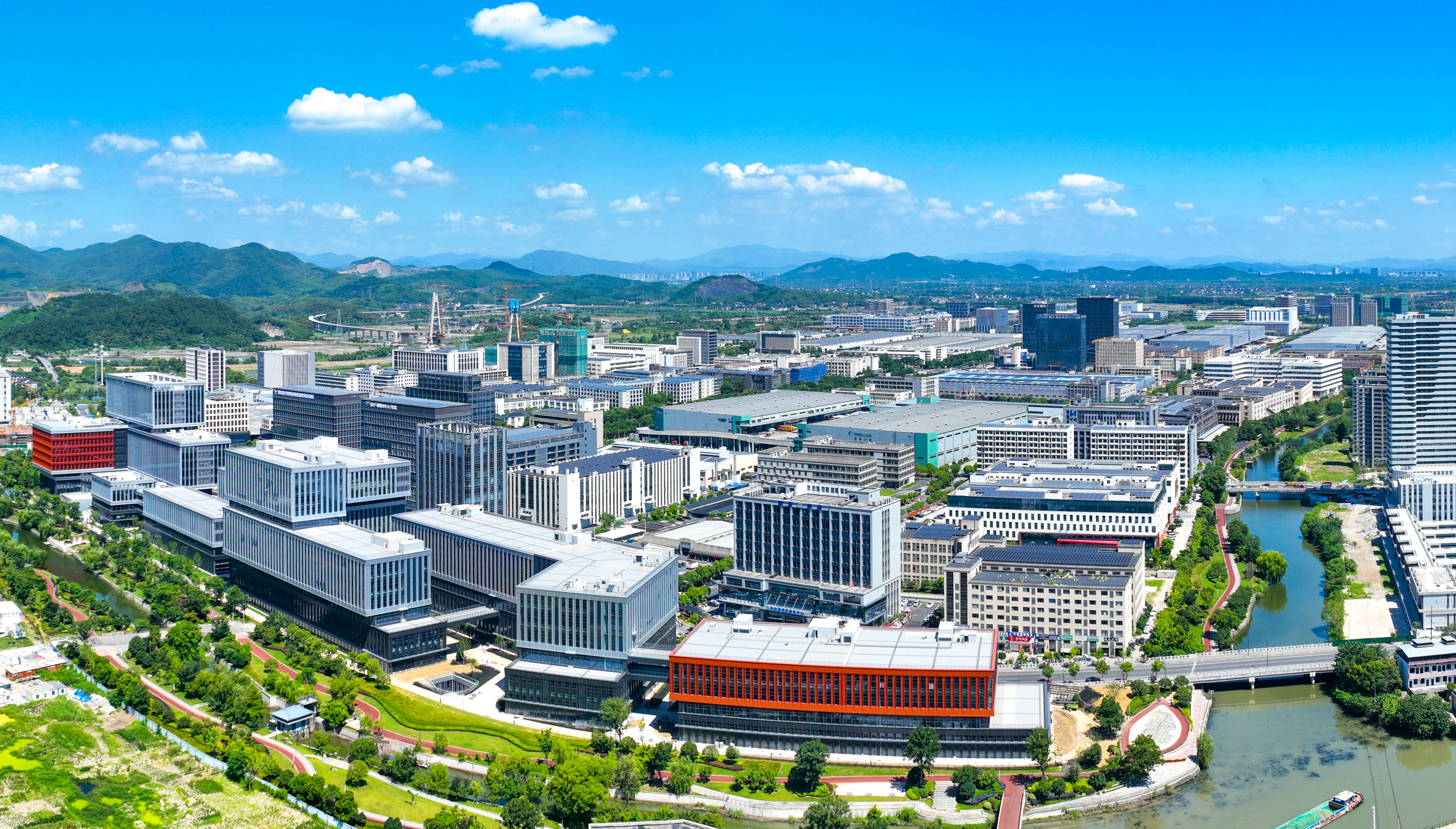
Core Viewpoint - The Yuhang Economic Development Zone is experiencing significant growth and development, with a focus on attracting investment, enhancing industry quality, and accelerating project construction, leading to high-quality economic development. Investment and Economic Performance - From January to November, the Yuhang Economic Development Zone achieved an industrial output value of 20.337 billion yuan, a year-on-year increase of 6.3% [1] - Fixed asset investment reached 6.193 billion yuan, marking a substantial year-on-year growth of 47.7% [1] Investment Attraction and Talent Development - In the first three quarters, the zone signed 45 projects with a total investment exceeding 9 billion yuan [6] - The "Hai Chuang Wei Lai" high-level talent innovation and entrepreneurship program saw 36 projects pass the evaluation, with 35 classified as high-level leading talent projects, setting a historical record [6] - The Zhangtian Intelligent Logistics System project was recognized as an excellent talent project, focusing on addressing labor challenges in domestic factories [6] Industry Support and Development - The Yuhang Economic Development Zone is implementing targeted services to support enterprise development, including a full-cycle support mechanism for project cultivation [8] - Recent achievements include the successful selection of several projects for provincial technology plans and recognition of multiple enterprises as key research institutes [8] Infrastructure and Project Construction - Key projects are progressing steadily, with significant improvements in living and transportation facilities, enhancing the quality of the industrial city [9] - The construction of various projects, such as the intelligent manufacturing base for Hangzhou Guipin Intelligent Shade Technology Co., is ahead of schedule, with completion rates of 100% for basement work and 99% for main structure [10] - A total of 15 projects have been completed, with 11 ongoing projects expected to contribute additional production capacity to the region [10]
中国企业社会化用工趋势分析报告
艾瑞咨询· 2025-12-30 00:07
Core Viewpoint - The trend of socialized employment is expanding, driven by macroeconomic fluctuations, labor shortages, and rising costs, particularly in manufacturing and retail sectors, which are the most receptive to this model [1][2][6]. Group 1: Concept and Environment - Socialized employment refers to various forms of employment outside standard labor relations, including outsourcing, labor dispatch, hourly pay, platform-based flexible employment, and shared employment [1][3]. - The macroeconomic environment is characterized by a decline in the working-age population, leading to dual pressures of labor shortages and rising costs for enterprises [1][16]. - The retail sector utilizes a mix of outsourcing, hourly pay, and platform-based flexible employment to adapt to sales fluctuations and market demands, with high employee turnover being a core pain point [1][29]. Group 2: Trends and Policy - The scale of socialized employment continues to grow, with supportive policies expected to improve further [2][9]. - Socialized employment is becoming a standard for enterprises, with human resource service providers upgrading towards specialization and digitalization [2][9]. - The relationship between individuals and organizations is shifting from dependency to symbiosis, requiring a more diverse skill set from individuals [2]. Group 3: Macro Environment - The digital economy is projected to reach 63.2 trillion yuan by 2024, accounting for 46.8% of GDP, driving high-quality economic development and transforming the employment market [6]. - National policies have been introduced to encourage the development of socialized employment, pushing enterprises to balance efficiency and risk management [9]. Group 4: Industry Penetration - As of 2024, over 240 million flexible employment individuals exist in China, with socialized employment penetrating various industries deeply and qualitatively [19]. - Business outsourcing has a penetration rate exceeding 50%, while labor dispatch accounts for 20%-30%, and platform-based employment is below 20%, indicating a diverse employment landscape [19]. Group 5: Micro Environment - External competition and internal management demands are driving enterprises to adopt socialized employment strategies, allowing for agile organizational structures and flexible cost control [23]. - Socialized employment effectively balances the need for cost efficiency in enterprises with the personal development needs of workers [26]. Group 6: Sector-Specific Characteristics - In the retail sector, socialized employment is characterized by high employee turnover, with rates exceeding 30% for frontline positions, leading to management challenges [37]. - Manufacturing enterprises prefer socialized employment for its flexibility in adjusting workforce size in response to production capacity fluctuations, with outsourcing becoming more common [44][49]. Group 7: Emerging Job Demands - The rise of AI and instant retail is creating new job roles in digital operations and intelligent supply chains, necessitating a workforce skilled in both traditional and emerging technologies [40][54]. - Socialized employment in manufacturing is increasingly requiring cross-disciplinary and composite talents to adapt to technological advancements [54].

“点”上突破、“线”上贯通、“面”上蔓延 AI驱动中国智造跃升
Zheng Quan Ri Bao· 2025-12-30 00:00
Core Insights - China's manufacturing industry is rapidly transitioning into a new era driven by artificial intelligence (AI), with significant advancements in smart manufacturing and industrial transformation [1][8] - The integration of AI into manufacturing processes is reshaping the industry, moving from scale advantages to intelligent advantages, and enhancing productivity and efficiency across various sectors [1][8] Group 1: Smart Manufacturing Developments - Over 35,000 basic-level, 7,000 advanced-level, and 230 excellent-level smart factories have been established in China since the start of the 14th Five-Year Plan, promoting innovation in processes, equipment, and software [1] - In Changan Automobile's smart factory, a "digital eye" monitors welding points, collecting and analyzing data to ensure quality, with a new car rolling off the assembly line every 60 seconds [2] - Haier's COSMOPlat platform enables large-scale personalized customization, allowing user orders to directly reach production lines, fundamentally transforming manufacturing from a one-size-fits-all approach to tailored solutions [2] Group 2: Regional and Technological Innovations - Sichuan's manufacturing transformation showcases advanced practices, such as the world's first unmanned blade processing workshop by China Dongfang Electric Group, and AI quality inspection technologies applied in over 100 smart manufacturing enterprises [3] - The "smart transformation" platforms act as digital supermarkets, providing verified solutions and services to enterprises, facilitating their transition to smart manufacturing [3] Group 3: Robotics and Automation - Human-like robots are increasingly being integrated into manufacturing, performing tasks such as precise material handling and assembly, significantly improving production efficiency [4][5] - ProRobot's flexible solutions address the challenges of small-batch, multi-variety production, featuring adaptable robots with high precision and full-process intelligence [5] Group 4: Sustainability and Digital Integration - Lenovo's zero-carbon factory exemplifies the integration of green and smart manufacturing, utilizing digital twin technology for precise carbon management and achieving high efficiency in warehouse operations [6] - The combination of AI, 5G, and edge computing enhances manufacturing flexibility and quality while reducing energy consumption and carbon emissions [6] Group 5: Global Integration and Market Positioning - Chinese manufacturing is increasingly integrating into global supply chains, with companies establishing R&D centers abroad and adapting to local standards, thereby enhancing their competitive edge [7] - The narrative of Chinese manufacturing is shifting towards sustainability, with solar energy, energy storage, and electric vehicles becoming key components of its global identity [7] Group 6: Policy and Future Directions - The Ministry of Industry and Information Technology emphasizes the importance of digital transformation and AI integration in manufacturing, driving high-quality and sustainable development [8] - The need for industry-wide AI models and skilled professionals who understand both manufacturing processes and AI algorithms is critical for successful transformation [8] - The transition from a manufacturing power to a manufacturing stronghold is underway, with AI becoming integral to all aspects of production and supply chain management [9]
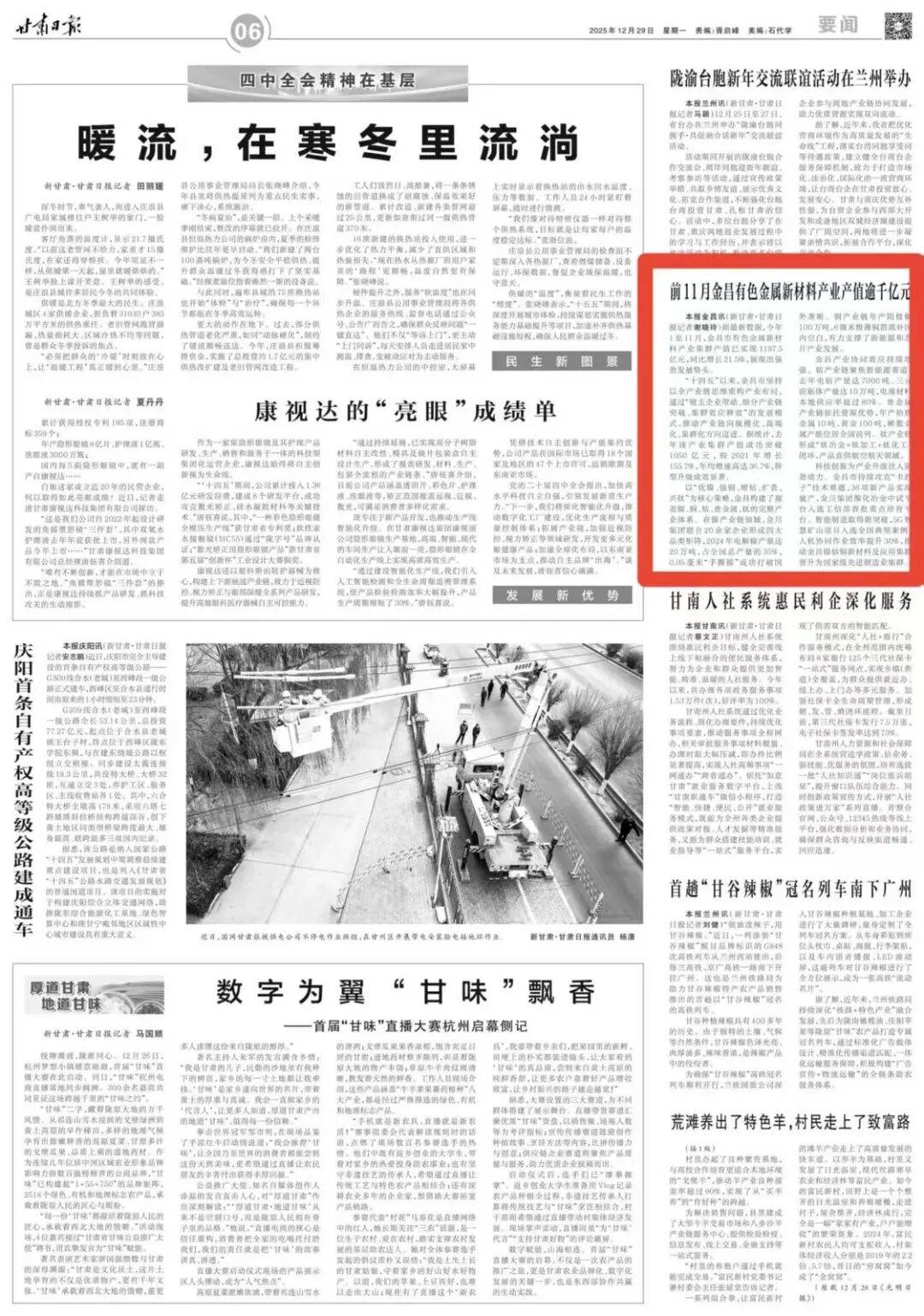
《甘肃日报》报道:前11月金昌有色金属新材料产业产值逾千亿元
Sou Hu Cai Jing· 2025-12-29 23:20
Group 1 - The total output value of the non-ferrous metal new materials industry cluster in Jinchang has reached 119.75 billion yuan from January to November, showing a year-on-year growth of 21.5% [14] - Since the "14th Five-Year Plan," Jinchang has restructured its industrial layout with a full industry chain approach, achieving a breakthrough in the industry chain and releasing cluster effects [14] - The output value of this industry cluster exceeded 105 billion yuan last year, with a year-on-year increase of 155.7% compared to 2021, and an average annual growth rate of 36.7% [14] Group 2 - The industry has established a complete industrial system covering nickel, copper, cobalt, precious metals, and titanium, focusing on core strategies of "optimizing nickel, strengthening copper, increasing cobalt, expanding precious metals, and promoting titanium" [14] - In the nickel industry chain, Jinchuan Group has formed a matrix of four major categories with over 20 enterprises, aiming for an electrolytic nickel output of 200,000 tons in 2024, accounting for 35% of the national total [14] - The copper industry chain is expected to produce 1 million tons of cathode copper annually, with 6-micron ultra-thin copper foil filling domestic gaps, significantly supporting the development of the new energy and chip industries [14] Group 3 - The cobalt industry chain focuses on the new energy track, achieving an output of 7,000 tons of electric cobalt and 100,000 tons of ternary precursors last year, with a local supply rate of over 80% for battery materials [15] - The precious metals industry chain, leveraging resource advantages, produces 10 tons of platinum group metals and 100 tons of gold annually, with rare metal production capacity ranking among the top in the country [15] - The titanium industry chain has formed a closed loop of "titanium metallurgy + titanium processing + titanium chemical," with products directly supplied to the aerospace sector [15] Group 4 - Technological innovation has injected strong momentum into industrial upgrades, with 36 new products achieving mass production and the Jinchuan Group's carbonyl metallurgy pilot platform being selected as one of the first key cultivation platforms by the Ministry of Industry and Information Technology [15] - Smart manufacturing has made new breakthroughs, with the 5G smart mining project being recognized as a national typical case, improving human-machine collaboration efficiency by 30% [15] - The Jinchang nickel-cobalt-copper new materials and application cluster has been upgraded to a national advanced manufacturing cluster [15]