普惠金融

Search documents
湖北“十五五”规划建议:优化企业挂牌上市服务体系,推动企业上市增量提质
Zheng Quan Shi Bao Wang· 2025-12-05 00:36
人民财讯12月5日电,中共湖北省委关于制定全省国民经济和社会发展第十五个五年规划的建议发布, 其中提到,推动金融改革创新。加快构建股权投资引导体系、债权融资增信体系、多层次资本市场公开 募资培育体系,为各类创新主体、产业主体提供全业态、全链条金融服务。大力发展科技金融、绿色金 融、普惠金融、养老金融、数字金融,服务实体经济高质量发展。完善供应链金融服务平台、中小企业 融资信用平台,着力提升金融资源配置效率。优化企业挂牌上市服务体系,推动企业上市增量提质。面 向全球招引头部金融机构和专业化金融服务中介,广泛吸引各类基金资源、集聚新兴金融业态,高水平 推进武汉科技金融中心建设。 ...
数说“十四五”成绩单,看金融之笔绘就美好生活新画卷
21世纪经济报道· 2025-12-05 00:29
Group 1 - The article emphasizes the role of financial support in enhancing various industries and improving the livelihoods of individuals during the "14th Five-Year Plan" period in China [1][31] - The establishment of 12,900 non-heritage workshops has created over 1.2 million jobs, showcasing the impact of financial assistance on traditional crafts like Yi embroidery [3][4] - Agricultural Bank has introduced specialized financial products such as "Xiu Niang Loan" and "Park Loan" to address the financing challenges faced by artisans and small businesses [4][5] Group 2 - The article highlights the importance of supply chain finance in improving the efficiency of the dairy industry, with Agricultural Bank providing over 1.85 trillion yuan in supply chain financing by September 2025, benefiting 300,000 clients, primarily small and micro enterprises [10][9] - The average annual growth rate of inclusive agricultural loans reached 14.6% during the "14th Five-Year Plan," contributing to a historic grain production of 1.4 trillion jin and an increase in rural residents' disposable income to 23,000 yuan [12][15] - The number of new specialized and innovative small and medium-sized enterprises exceeded 100,000, with a total of over 140,000, indicating a robust growth in the sector supported by tailored financial products [24][26] Group 3 - The article notes that the number of new 5A-level tourist attractions has increased, with a total of 58 new sites and approximately 2,600 new A-level attractions, enhancing the supply of quality cultural and tourism products [18] - Agricultural Bank has expanded its financial services to remote areas, achieving over 98% coverage of township bank outlets, ensuring accessibility for rural communities [21][22] - The article mentions the significant increase in the number of individual businesses and enterprises, with nearly 2 million new enterprises and over 3.3 million new individual businesses during the "14th Five-Year Plan" [28][30]



阜宁农商银行“做小做散”深耕普惠金融
Jiang Nan Shi Bao· 2025-12-04 23:26
机制建设中,该行成立"三台六岗"专班,细化41项任务销号管理,建立领导班子带头、机关部室参与、 支行行长主抓、客户经理落实的四级联动营销机制,实行每两周垂直复盘确保动作标准化。同时严把客 户经理准入退出关,搭建"年度+专项+月度"三维考评体系,上线"阜易融"小程序前置续贷流程,战略落 地成效显著。 2025年起,阜宁农商银行锚定"做小做散"核心战略,通过29项重点工作挂图作战,构建"组织、营销、 流程、责任、考评"五大体系及"人力、科技"两大支撑,打造差异化发展路径。 下阶段,该行将深化协同机制,推行"部室帮办""特事特办",建立跨部门联席会议与基层需求快速响应 通道;强化科技赋能,组建大数据专班整合政务与行业数据,创新"线上+线下"融合出额模式,提升申 贷通过率;优化队伍建设,树立"业绩+风控"双导向,完善晋升考核机制,引导资源向小微、三农领域 倾斜。 未来,阜宁农商银行将坚守"支农支小"定位,以机制创新、科技赋能、队伍优化持续深耕普惠金融,走 好"小而散、小而美、小而强"的可持续发展之路,书写金融为民新篇章。 ...
扎根中原沃土 书写金融为民新篇章——中国银联河南分公司扎实推进“五篇大文章”实践纪实
Zheng Zhou Ri Bao· 2025-12-04 13:43
Core Viewpoint - The Central Financial Work Conference has outlined a strategic deployment focusing on five key areas: technology finance, green finance, inclusive finance, pension finance, and digital finance, guiding the financial industry towards high-quality development [1]. Technology Finance - Henan UnionPay leverages technology to enhance financial services and risk management, collaborating with local banks to implement solutions like "Fire Eye" and "Sky Shield," which have identified risks for over 315 million personal loans and 55 million small business loans [2]. - The introduction of a service for querying deceased individuals' bank accounts has improved efficiency, covering 33 banks and significantly reducing the need for public visits [2]. - A comprehensive anti-fraud campaign has been launched, achieving 15,000 downloads of promotional materials, reinforcing public financial security [2]. Green Finance - Henan UnionPay promotes green finance through initiatives like the "1 penny bus ride" program, investing over 400,000 yuan to encourage eco-friendly transportation [3]. - A partnership with the Bank of Communications has created a comprehensive green benefits system, investing 700,000 yuan to reduce consumer costs across various transportation modes [3]. - The organization is expanding green consumption initiatives, integrating eco-friendly practices into consumer behavior [3]. Inclusive Finance - Henan UnionPay focuses on rural and small business support, facilitating sales of local agricultural products that generated over 16 million yuan through targeted marketing efforts [4]. - A merchant platform has been established to connect small businesses directly with UnionPay, with 11 payment institutions participating, and a subsidy policy has been introduced to lower operational costs for small merchants [4]. - The "One Minute Life Circle" project has issued small consumption vouchers, resulting in over 2.81 million transactions and boosting consumption by over 105 million yuan [4]. Pension Finance - Henan UnionPay has developed a senior-friendly financial service ecosystem, launching a comprehensive subsidy program for elderly consumers, distributing nearly 20 million yuan in benefits [5]. - The organization has partnered with over 800 senior meal service providers to facilitate various payment methods, addressing payment challenges for the elderly [5]. - The "Caring Version" of the UnionPay app has been optimized for seniors, simplifying the user interface and enhancing accessibility to digital payment services [6]. Digital Finance - Henan UnionPay is building a digital financial ecosystem tailored to the needs of small banks and rural revitalization, enhancing merchant capabilities and promoting integrated payment solutions [7]. - The "Jinxiu Action 2025" initiative aims to improve the acceptance environment for merchants, with 59,400 merchants currently enabled for card and code payments [7]. - The organization is fostering collaboration between government and industry resources to support the digital transformation of small banks and contribute to rural financial development [7]. Conclusion - Henan UnionPay is committed to integrating financial services with community needs, focusing on technology, green initiatives, inclusivity, elder care, and digital transformation to enhance the quality of life and economic development in the region [8].

金融活水浇灌民族沃土 甘肃银行酒泉分行赋能少数民族地区高质量发展
Cai Jing Wang· 2025-12-04 13:03
Core Viewpoint - Gansu Bank's Jiuquan Branch is committed to serving ethnic regions and promoting local economic development through tailored financial services, thereby contributing to national strategies and enhancing ethnic unity [1][5]. Group 1: Financial Services Initiatives - Gansu Bank's Jiuquan Branch has established a "Mobile Financial Service Team" to address the financial service gaps in remote areas, providing convenient services to over 3,000 frontline workers in the Su Bei region [2]. - The bank has formed a "Party Member Service Team" to assist herders by setting up temporary service points in summer pastures and winter settlements, facilitating financial transactions for over 800 households [2]. - The bank's services have significantly improved the accessibility of financial support for local residents, as evidenced by positive feedback from herders regarding the convenience of receiving subsidies [2]. Group 2: Industry Development Support - The bank has focused on supporting local industries, providing a 10 million yuan loan to a refractory materials production company to aid in its transformation and upgrade [3]. - In response to a dairy cooperative's funding challenges, the bank quickly provided 200,000 yuan through its "Micro Loan" product, stabilizing the livelihoods of local herders [3]. - Over the past three years, the two branches have issued nearly 400 million yuan in loans, enhancing the confidence of local businesses in developing their unique industries [5]. Group 3: Community Engagement and Cultural Integration - Gansu Bank emphasizes the importance of culturally sensitive financial services, engaging with local communities during traditional festivals to strengthen relationships and promote financial literacy [5]. - The bank's employees work diligently to ensure timely distribution of subsidies to local workers, demonstrating a commitment to community welfare and support [5]. - The bank aims to continue fostering ethnic unity and economic prosperity in the region through dedicated financial services and community involvement [7].

为江西高质量发展提供招商银行高质量金融服务
Zhong Guo Jin Rong Xin Xi Wang· 2025-12-04 12:22
Core Viewpoint - China Merchants Bank Nanchang Branch has been committed to serving the local economy and social welfare in Jiangxi for 27 years, focusing on differentiated, refined, intelligent, and professional financial services to support economic development and improve people's livelihoods [1] Financial Development and Services - The bank has implemented the "1269" action plan during the 14th Five-Year Plan period, aiming to achieve over 100 billion yuan in loans and over 140 billion yuan in deposits by September 2025, serving over 4.34 million personal customers and nearly 70,000 corporate customers [1] - The bank has established a "six specialized" mechanism in technology finance, providing differentiated financial services to tech enterprises, with a technology finance loan balance exceeding 11.6 billion yuan and an annual increase of nearly 3.2 billion yuan by September [2] - In green finance, the bank promotes various green loan products, achieving a green loan balance of over 8 billion yuan with an annual increase of nearly 1.8 billion yuan [2] - The bank has set up a working group for small and micro enterprise financing, resulting in a balance of inclusive loans exceeding 23.3 billion yuan and an annual increase of nearly 1.1 billion yuan [2] Support for Key Industries - The bank focuses on supporting key industries such as non-ferrous metals, electronic information, equipment manufacturing, new energy, and pharmaceuticals, with a target loan growth rate exceeding the average growth rate of corporate loans by 13.5 percentage points [3] - By 2025, the bank plans to invest over 10.7 billion yuan in 12 key industrial chains, enhancing support for regional quality industries [3] Rural Revitalization Initiatives - The bank emphasizes support for rural areas, particularly in renewable energy projects, with nearly 100 million yuan in loans for rural infrastructure and over 3 billion yuan in new loans for agriculture and rural development by 2025 [4] - The bank actively supports specific villages in Jiangxi, enhancing local industries and community projects to improve residents' income [4] Innovation and Customer Service - The bank prioritizes customer-centric service, implementing a "one-hour response" mechanism to enhance customer satisfaction and service experience [5] - The bank integrates counter and lobby services to create a seamless service experience, recognized as a model for civilized service [5] Product and Business Innovation - The bank promotes various digital products such as "Salary Welfare," "E-Catering," and "Financial Management Cloud," providing comprehensive solutions for enterprises [6][7] - The bank has developed innovative financing products based on government procurement contracts, supporting over 500 suppliers [7]

核心价值观我践行 | 临沭农商银行“红薯贷”带动居民致富“大丰收”
Xin Lang Cai Jing· 2025-12-04 11:25
Core Viewpoint - The sweet potato planting industry in Qingyun Town, Linshu County, is a traditional and significant economic activity for local residents, facing financial challenges during the harvest season despite its large scale and profitability [1][4]. Group 1: Industry Overview - Sweet potato planting is a traditional industry in Qingyun Town, with a cultivation area exceeding 50,000 acres and an annual output value of over 100 million jin [1][4]. - The local community has a long-standing tradition of sweet potato cultivation, with various product types developed over the years, including "Sweet Potato No. 5," "Sweet Potato No. 18," and others [1][4]. Group 2: Financial Support Initiatives - Linshu Rural Commercial Bank has identified the financial needs of sweet potato growers, particularly during the harvest season, and has launched the "Sweet Potato Loan" series to support them [2][5]. - The bank has processed 158 loans related to the sweet potato industry, amounting to over 12 million yuan, facilitating the financial flow necessary for the growers [2][5]. Group 3: Economic Impact - The financial support has led to an increase in the number of farmers participating in sweet potato cultivation, creating a clustering effect that attracts both local and external customers [2][5]. - The collective income of the village has doubled, indicating a positive economic impact from the sweet potato industry and its financial backing [2][5]. Group 4: Future Plans - The bank plans to continue innovating financial products and optimizing services to further support local specialty industries, contributing to rural revitalization through "green finance" [3][6].
工行德州分行探索“以链带群”服务模式
Qi Lu Wan Bao· 2025-12-04 10:12
Group 1 - The core focus of the Industrial and Commercial Bank of China (ICBC) Dezhou Branch is to support the new industrialization of Dezhou City by integrating into the new development pattern, particularly emphasizing manufacturing and strategic emerging industries [1] - As of the end of September, the total loan balance reached nearly 68 billion yuan, an increase of approximately 5.6 billion yuan since the beginning of the year, marking a historic breakthrough [1] - The bank has implemented a dynamic project list update mechanism, ensuring timely financing solutions through a "one project, one plan, one team" approach, which has effectively supported the stability and growth of industrial clusters [1] Group 2 - ICBC Dezhou Branch has introduced specialized products like Park e-loans and Industry e-loans to alleviate the financial pressure faced by small and medium-sized enterprises (SMEs) within the industrial chain [2] - Specific examples include a 500,000 yuan Industry e-loan that enabled a company in the HVAC industry park to launch a new energy-saving fan, and a 4.9 million yuan loan that supported a textile company in introducing waterless dyeing equipment, increasing product value by nearly 30% [2] - By the end of September, the Park e-loan and Industry e-loan programs had covered 2 national-level parks and 11 provincial-level parks, providing nearly 200 million yuan in loans to around 100 enterprises [2] Group 3 - ICBC Dezhou Branch has visited over 11,000 enterprises this year, completing credit approvals of approximately 12 billion yuan and disbursing loans of 9.2 billion yuan to over 9,400 enterprises, including about 150 million yuan in supply chain loans [3] - The implementation of industrial chain finance has empowered the entire industrial chain, alleviating financing difficulties for SMEs and accelerating the development of industrial clusters, thereby providing robust support for local industrial transformation [3]

解码广州农商银行的新打法和成绩单
Xin Hua Wang· 2025-12-04 08:10
Core Insights - The article discusses the strategic shift of Guangzhou Rural Commercial Bank towards focusing on small and medium-sized asset businesses in response to competitive pressures and internal transformation needs [1][2][3] Group 1: Strategic Shift - Guangzhou Rural Commercial Bank is reallocating resources towards smaller, more diversified credit areas, moving away from a focus on large clients due to changing market dynamics and internal restructuring [1][2] - The bank's strategy is driven by the need to enhance asset efficiency rather than merely expanding scale, as the net interest margin has been narrowing [1][2][3] Group 2: Market Context - The competitive landscape has changed, with large state-owned banks and some joint-stock banks penetrating the small and micro-enterprise sector, creating a "siphoning effect" that challenges traditional growth models of smaller banks [2] - Regulatory guidance is pushing banks to return to their core functions, emphasizing support for the real economy and financial inclusion, making refined and differentiated operations essential for smaller banks [2] Group 3: Local Economic Support - The economic structure of Guangdong, particularly Guangzhou, provides a solid foundation for the bank's transformation strategy, with a diverse range of small businesses and emerging tech enterprises creating a substantial "long-tail demand" for small and medium-sized asset services [3] - The bank's focus on small and medium-sized assets is not just a competitive response but a strategic path to build a unique "geographical and relational moat" that larger banks cannot replicate [3] Group 4: Implementation Challenges - The execution of the strategy requires systemic restructuring of asset allocation, approval processes, organizational mechanisms, and channel capabilities [5][6] - The bank aims to enhance its core competitiveness in small and medium-sized asset businesses and improve the comprehensive competitiveness of its branches [5][6] Group 5: Key Performance Indicators - By mid-2025, the bank's small and medium-sized asset business has become a core growth engine, with significant year-on-year growth in small company loans, micro-loans, and retail loans [9][10] - Key structural indicators show improvements in average daily loan size per branch and the proportion of small and medium-sized loans in total company loans, indicating enhanced asset quality and operational resilience [10][11] Group 6: Long-term Strategy - The bank's transformation strategy is shifting from volume to quality, resulting in a more balanced asset structure, reduced risk concentration, and increased revenue resilience [11] - The practice of Guangzhou Rural Commercial Bank illustrates that smaller banks should focus on depth rather than size, optimizing their structure to better align with real economic activities [11]
再度升级, “指数直通车”小程序可以加自选了
Xin Lang Cai Jing· 2025-12-04 07:25
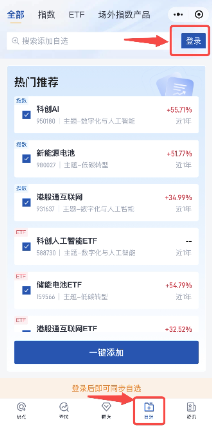
用户进入小程序后,首先点击"自选"模块,再点击页面右上方出现"登录"入口,即可通过手机号验证, 快速完成账号注册与登录。 图1:"注册登录"示意图 成功登录后,用户可以方便地将关注的指数和产品纳入专属的"自选列表",还可以自定义查看指标,聚 焦跟踪关键指标数值和走势变化,打造自己专属的"投资空间"。 此外,在精选专区浏览热门精选和配置策略的产品时,也可直接将产品添加到自选列表。 图2:"精选专区"添加自选示意图 "指数直通车"微信小程序由易方达基金打造,致力于为投资者提供"市场行情实时同步、产品灵活筛 选、多渠道高效交易"的一站式指数投资服务,是其践行普惠金融的探索实践。自推出以来,小程序以 投资者需求为导向,不断进行功能优化迭代,为投资者了解指数、用好指数提供更便捷的工具和更优质 的服务。 MACD金叉信号形成,这些股涨势不错! 近日,易方达基金旗下"指数直通车"微信小程序正式上线"自选"功能,投资者注册登录后,可以将感兴 趣的指数或产品加入自选列表,方便进行观察、比较和跟踪,支持后续投资决策,为投资者提供更具个 性化的指数投资新体验。 图1:"注册登录"示意图 成功登录后,用户可以方便地将关注的指数和产品 ...