金融科技

Search documents
港深重磅发布!
Zhong Guo Ji Jin Bao· 2025-11-19 12:52
金博会上,港深联合发布《关于携手打造港深全球金融科技中心的行动方案(2025—2027年)》(以下 简称《行动方案》)。 在不久前召开的深港金融合作委员会第三次会议上,香港特区政府财经事务及库务局(以下简称香港财 库局)与深圳市委金融委员会办公室(以下简称深圳金融办)签署了《关于推进深港黄金领域合作的备 忘录》(以下简称《备忘录》)。 上述两份文件为港深联手打造全球金融科技中心与深度融合的区域黄金生态圈,擘画了切实可行的蓝 图。这有助于进一步巩固提升香港国际金融中心地位,加快深圳建设具有全球重要影响力的产业金融中 心,推动深港金融合作迈向更高水平、更深层次、更广领域,为建设金融强国作出新的更大贡献。 六大举措力促深港共同打造 全球金融科技中心 《行动方案》聚焦两地业界需求和政策协同,强调两地互补优势、同向发力,勾画了两地金融科技企业 集聚、技术领先、场景丰富、创新活跃的美好合作未来。 《行动方案》提出六大重点任务: (一)引育集聚金融科技主体。争取国家金融监管部门及其直属机构发起设立科研中心、测评中心和服 务中心等;鼓励香港支付机构在深设立跨境支付技术服务主体;依托出海联盟拓展海外市场,共建"金 融科技联合孵 ...
港深发布行动方案共同打造全球金融科技中心
Xin Hua Cai Jing· 2025-11-19 11:53
此外,行动方案也会推动两地共同培育金融科技人才,并加强与业界的联系及合作,包括推进"深港澳 金融科技师"专才计划、鼓励两地行业协会及金融机构合办金融科技活动;以及加强两地大型金融科技 活动联动合作等。 (文章来源:新华财经) 许正宇提到,香港财库局将联同金融监管机构,与深圳市地方金融管理局积极落实行动方案的各项措 施,共同促进粤港澳大湾区金融科技高质量发展。目标是在2027年年底前,落地超过20个深港跨境数据 验证平台金融领域应用场景,务求进一步巩固提升香港的国际金融中心地位和助力深圳建设具有全球重 要影响力的产业金融中心。 据悉,行动方案的重点措施包括推动深圳金融机构在港成立金融科技子公司;支持两地共建金融科技联 合孵化器;鼓励深圳科技企业利用香港"生物科技公司上市通道""特专科技公司上市通道"及"科企专 线"等便利政策来港融资;鼓励深圳企业在港发行可持续发展离岸人民币债券;推动数字人民币应用场 景持续创新;以及支持两地共同参与"多种央行数码货币跨境网络"(mBridge)项目的研究与应用。 新华财经香港11月19日电(记者林迎楠)香港特区政府财经事务及库务局与深圳市地方金融管理局19日 联合发布《关于携手 ...
腾讯金融,藏不住的“赚钱巨兽”
Xin Lang Cai Jing· 2025-11-19 11:11
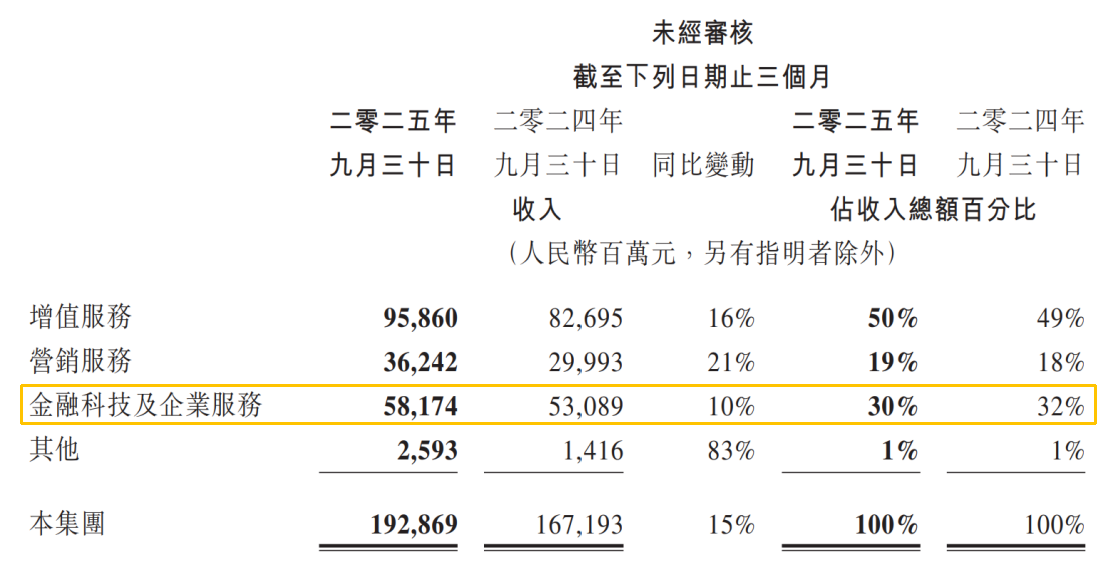
Core Viewpoint - Tencent has reported strong financial performance for Q3 2025, with revenue reaching 192.87 billion yuan, a 15% increase year-on-year, and net profit of 63.13 billion yuan, up 19% from the previous year [1] Financial Performance - Revenue for Q3 2025 was 192.87 billion yuan, an increase of 25.68 billion yuan compared to the same period last year, representing a 15% growth [1] - Net profit attributable to shareholders was 63.13 billion yuan, an increase of nearly 10 billion yuan year-on-year, reflecting a 19% growth [1] - The Financial Technology and Enterprise Services segment generated revenue of 58.17 billion yuan, a 10% increase year-on-year, contributing approximately 30% to total revenue [1][4] Financial Technology Overview - Tencent's financial services are characterized by a diverse range of offerings, including payment, banking, credit, insurance, and wealth management, which are integrated into daily life [6] - WeChat Pay, launched in 2013, is a key component of Tencent's financial ecosystem, with over 1.4 billion monthly active accounts and an average daily usage frequency of about 2.7 times [6] - By Q1 2025, WeChat Pay is projected to surpass Alipay in market share, reaching 59.7% compared to Alipay's 36.2% [6] Strategic Positioning - Tencent's financial strategy emphasizes the role of WeChat Pay as a "super entry point" for data collection and user engagement, which supports its various financial services [7] - The company has established a comprehensive financial ecosystem, including WeBank, which is China's first private and internet bank, and has achieved significant profitability [10][12] - Tencent's wealth management platform, LiCaiTong, has evolved from a tool to a habit for users, indicating strong user engagement and retention [12] International Expansion - Tencent is actively pursuing international opportunities, with investments in digital banks and fintech companies across various countries, including the UK, Brazil, and Germany [15][16] - The company has established a presence in cross-border payments and digital banking, indicating a strategic focus on global financial markets [15][16] Financial Technology Growth - From 2018 to 2024, the revenue from the Financial Technology and Enterprise Services segment grew from 73.14 billion yuan to 211.96 billion yuan, with a compound annual growth rate of nearly 20% [17] - Financial technology is estimated to account for approximately 80% of the revenue in the Financial Technology and Enterprise Services segment, highlighting its significance to Tencent's overall financial performance [20] Cautious Approach - Tencent's financial growth is characterized by a cautious and restrained approach, focusing on stability and compliance in a highly regulated environment [23][29] - The company has not pursued a public listing for its financial services, maintaining a close integration with its core platform [28] - Tencent's strategy involves acting as a "connector" within its financial ecosystem, collaborating with various partners while minimizing direct control to mitigate risks [26][27]


聚焦六方面发力 深圳打造产业金融中心
2 1 Shi Ji Jing Ji Bao Dao· 2025-11-19 09:48
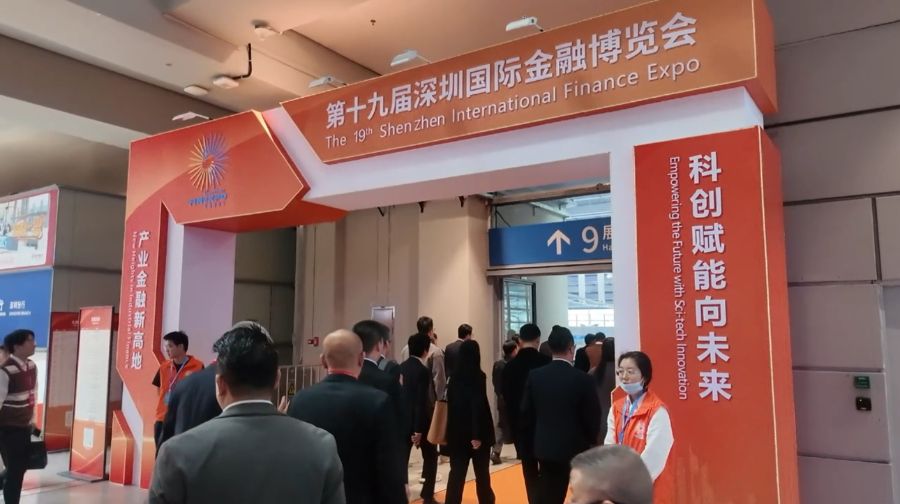
Core Insights - The 19th Shenzhen International Financial Expo focuses on "New Heights of Industrial Finance, Empowering Future with Science and Technology" and features a "1+3+N" model, showcasing Shenzhen's efforts in integrating industry and finance and building a global financial center [2] Group 1: Strategic Directions - Shenzhen aims to establish itself as a globally influential industrial financial center, focusing on six key areas: a world-class technology industry financial development hub, an innovation capital formation center, a financial technology center, a cross-border RMB service hub, a wealth management center, and a financial security demonstration area [3] - The People's Bank of China emphasizes the role of digital technology and data elements in driving financial supply-side structural reform and high-quality financial development [3] Group 2: Major Announcements - The expo saw the release of several significant initiatives, including a joint action plan between Shenzhen and Hong Kong to create a global financial technology center and a memorandum on gold sector cooperation [4] - New AI service practices were introduced by Ping An Group, including "AI Super Customer Service," "AI Family Doctor," and "AI Elderly Care Manager," promoting AI integration in finance, healthcare, and elder care [4] Group 3: Financial Innovations - The China Financial Electronic Group presented collections on financial application innovations and digital financial security, highlighting the practical outcomes of large models in financial services [5] - Shenzhen's cross-border RMB business has seen growth in volume and scope, with new payment service projects launched to enhance payment settlement and support high-quality economic development [6] Group 4: Financial Ecosystem Development - The expo featured various financial sectors, including cross-border finance with over twenty participating institutions, and showcased over thirty financial technology companies demonstrating cutting-edge technologies [7] - A government-guided fund exhibition highlighted 29 star enterprises and included activities aimed at fostering connections between investment and industry, illustrating Shenzhen's approach to integrating investment with industrial growth [7]
重磅!港深联合发布三年行动方案 剑指全球金融科技中心
证券时报· 2025-11-19 09:03
Core Viewpoint - The Hong Kong and Shenzhen governments have jointly released an action plan to establish a global fintech center, aiming to enhance collaboration in the fintech sector over the next three years, thereby driving high-quality financial development in the Guangdong-Hong Kong-Macao Greater Bay Area [1]. Group 1: Industry Foundation and Technological Innovation - The action plan focuses on nurturing fintech entities and establishing various research and evaluation centers in both regions, encouraging Hong Kong payment institutions to set up cross-border payment services in Shenzhen, and fostering specialized fintech companies [3]. - There will be increased support for foundational and key technology research in fintech, promoting collaboration between universities and enterprises to explore applications of technologies like artificial intelligence in finance [3]. Group 2: Expanding Application Scenarios - The action plan aligns with the construction requirements of the "Five Major Articles," promoting deep integration of fintech with various fields, including supporting Shenzhen tech firms in utilizing Hong Kong's unique listing channels for financing [5]. - In green finance, the plan aims to deepen the application of corporate carbon accounts and promote sustainable offshore RMB bond issuance [5]. - The initiative also focuses on enhancing digital inclusive finance, optimizing financing services for small and micro enterprises, and expanding the coverage of products like "Credit Ease" and "Micro Loan" [5]. Group 3: Regulatory Ecosystem Optimization - To create a conducive development environment, both regions will deepen innovative regulatory pilot cooperation and enhance the financial risk monitoring and early warning systems [7]. - The plan includes the introduction of specialized talent policies to attract professionals and the establishment of a "Shenzhen-Hong Kong-Macao Fintech Specialist" program [7]. - The release of this action plan signifies a new phase of systematic and normalized fintech cooperation between Hong Kong and Shenzhen, leveraging their respective advantages to enhance global resource allocation capabilities [7].

中国普惠金融研究院院长贝多广:普惠金融在中国走出独特快车道,下一步是构建高质量生态体系
Xin Lang Cai Jing· 2025-11-19 08:13
Core Viewpoint - The Chinese financial system is at a historical juncture, with a focus on building a strong financial nation and enhancing the quality and resilience of the financial system, particularly in the context of the upcoming "14th Five-Year Plan" [1] Group 1: Development of Inclusive Finance - Inclusive finance in China has developed uniquely and rapidly, driven by policy guidance that fosters collaboration among various financial entities [2][3] - The integration of financial technology has created an ecosystem that leverages "scenarios + data + technology," making China one of the most active markets for fintech applications globally [2] - The "last mile" problem is being addressed through deep coverage of underserved groups, such as small and micro enterprises and farmers, by lowering barriers to access financial services [3] Group 2: Achievements and Challenges - Since the formal introduction of inclusive finance in 2013, China has made significant progress, ranking high in various indicators such as account ownership and mobile payment penetration [4] - The current challenges for small and micro enterprises include unstable cash flow and significant accounts receivable, necessitating improved liquidity through bank loans [5] Group 3: Balancing Sustainability and Commercial Viability - The "impossible triangle" in inclusive finance—balancing coverage, affordability, and low risk—remains a challenge, requiring breakthroughs in market rules, top-level design, and technological empowerment [6][7] - Digitalization has proven essential in enhancing the accessibility and efficiency of inclusive finance services, particularly for underserved groups [7] Group 4: Future Directions - High-quality inclusive finance should evolve into a comprehensive ecosystem that includes not only credit but also insurance and investment services, addressing both production and consumption needs [8][9] - The development of inclusive insurance products is crucial, as all economic entities face risks, and insurance can be more critical than credit for low-income households [9] - Green inclusive finance is essential for sustainable rural development, particularly in achieving carbon neutrality goals while addressing the environmental impacts of rural economic activities [9]
香港财库局与深圳市地方金融管理局联合发布《关于携手打造港深全球金融科技中心的行动方案(2025-2027年)》
智通财经网· 2025-11-19 07:32
Core Insights - The Hong Kong Financial Services and the Treasury Bureau and the Shenzhen Local Financial Supervision Bureau jointly released an action plan to establish a global fintech center between Hong Kong and Shenzhen from 2025 to 2027, leveraging the strengths of both regions in fintech [1][2] Overall Requirements - The plan emphasizes the importance of data flow and digital technology innovation to enhance financial services and deepen cooperation between Hong Kong and Shenzhen, aiming to implement over 20 cross-border data verification platforms by the end of 2027 [3] Key Tasks - Attract and gather fintech innovation entities, encouraging the establishment of research and service centers, and supporting Hong Kong payment institutions to set up cross-border payment services in Shenzhen [4][5] - Support original technology research and collaboration between higher education institutions and industry associations to enhance fintech capabilities [6] - Promote the development of technology finance, green finance, inclusive finance, and pension finance through various supportive measures [7][8] Application Scenarios - Innovate in digital RMB application scenarios, expanding its use in retail, transportation, and trade, while enhancing international cooperation [10] - Develop financial innovations based on data assets, exploring services like data asset trusts and data security insurance [11] Regulatory Environment - Strengthen cross-border fintech innovation cooperation and explore regulatory sandbox mechanisms to support fintech applications [12][13] - Improve the financial technology governance system to ensure ethical practices and industry self-regulation [13] Industry Development Ecosystem - Enhance talent supply quality by implementing policies to attract and cultivate fintech professionals [14] - Foster industry collaboration through forums and events to showcase fintech achievements and enhance international influence [18][19]
香港财库局、深圳市地方金融管理局:依法依规支持深圳科技企业用好香港政策赴港交所融资
Zheng Quan Shi Bao Wang· 2025-11-19 07:30
Core Viewpoint - The joint action plan between Hong Kong's Financial Services and the Treasury Bureau and Shenzhen's Local Financial Supervision Bureau aims to enhance the quality and efficiency of fintech in the region from 2025 to 2027 [1] Group 1: Policy Support - The plan supports Shenzhen technology companies in utilizing Hong Kong's listing channels for biotech and specialized technology companies, as well as the "Tech Company Special Line" for financing on the Hong Kong Stock Exchange [1] - Financial institutions are encouraged to leverage internal and external data, along with big data technologies, to create comprehensive profiles of technology enterprises, thereby improving client selection and marketing efficiency [1] Group 2: Financial Products and Services - The initiative promotes the development of innovative financial products and services that align with the lifecycle characteristics of technology enterprises [1] - There is a focus on advancing innovative business models such as "Tech Startup Pass" and "Innovation Credit Loan" to enhance financial service accessibility for early-stage and growth-stage technology companies [1]
QFIN(QFIN) - 2025 Q3 - Earnings Call Transcript
2025-11-19 01:30
Financial Data and Key Metrics Changes - Total net revenue for Q3 was RMB 5.21 billion, slightly down from RMB 5.22 billion in Q2 but up from RMB 4.37 billion a year ago [16] - Non-GAAP net income reached RMB 1.51 billion in Q3, compared to RMB 1.85 billion in Q2 [20] - Non-GAAP net income per fully diluted ADS was RMB 11.36 in Q3, down from RMB 13.63 in Q2 [20] - The effective tax rate for Q3 was 20.9%, higher than the typical rate of approximately 15% due to withholding tax provisions [20] Business Line Data and Key Metrics Changes - Revenue from credit-driven services was RMB 3.87 billion in Q3, up from RMB 3.57 billion in Q2 [16] - Revenue from platform services was RMB 1.34 billion in Q3, down from RMB 1.65 billion in Q2 [17] - The average internal rate of return (IRR) for loans originated was 20.9%, compared to 21.4% in Q2 [17] Market Data and Key Metrics Changes - The number of new credit line users grew by 9% to 1.95 million in Q3, while the average cost per credit line user declined by 8% [9] - The 90-day delinquency rate increased to 2.09% in Q3 from 1.97% in Q2 [18] - The day-one delinquency rate rose to 5.5% in Q3 from 5.1% in Q2 [18] Company Strategy and Development Direction - The company aims to prioritize risk management and enhance AI capabilities to better serve inclusive finance needs [4] - The focus will be on onboarding high-quality users and optimizing the overall user mix, supported by AI-driven data models [10] - The company is exploring international expansion opportunities while maintaining a commitment to shareholder returns [15] Management Comments on Operating Environment and Future Outlook - The management noted persistent headwinds in China's economy and consumer finance sector, with a decline in short-term consumer loans [4] - The company expects the competitive environment to become more sustainable and healthier in the long run due to regulatory changes [26] - For Q4, the company anticipates generating non-GAAP net income between RMB 1 billion and RMB 1.2 billion [23] Other Important Information - The company issued RMB 4.5 billion in asset-backed securities (ABS) during Q3, up 29% year-over-year [9] - The total cash and cash equivalents and short-term investments amounted to RMB 14.35 billion in Q3, compared to RMB 13.34 billion in Q2 [21] - The company has executed a share repurchase program, purchasing approximately 7.3 million ADSs for a total of $281 million [23] Q&A Session Summary Question: Impact of new loan facilitation rules on business model and take rates - Management indicated that the new rules will impact market size, risk levels, and profitability in the near term, but will lead to a healthier competitive environment in the long run [25][26] Question: Competitive landscape after loan facilitation rules - Management noted a major shakeout in the high-pricing segment, with expectations of reduced competition for traffic and potential market consolidation benefiting the company [28][29] Question: Shareholder return and buyback plans - Management confirmed the resumption of the share repurchase program after the earnings call, with a goal of gradually increasing dividend payouts [31][32] Question: Asset quality trends and expectations - Management observed early signs of stabilization in asset quality, with a focus on optimizing risk strategies and improving collection efficiency [33][34] Question: Implications of potential APR regulations - Management assessed that while direct impact from APR regulations is limited, there may be indirect effects leading to increased liquidity pressure and risk volatility [37][39]

首席信息官密集“换届”,金融科技成券商招聘重头戏;国盛证券研究所三员大将即将离职 | 券商基金早参
Mei Ri Jing Ji Xin Wen· 2025-11-19 01:29
Group 1 - The core viewpoint highlights the rapid turnover of Chief Information Officers (CIOs) in the brokerage industry, indicating an accelerated digital transformation within the sector [1] - Over 20 brokerages have experienced CIO changes this year, a significant increase from fewer than 10 in the same period last year, reflecting a growing emphasis on technology [1] - The recruitment focus on fintech talent among leading brokerages suggests a strategic push towards enhancing operational efficiency and market confidence in the long-term growth of brokerage stocks [1] Group 2 - The departure of three key analysts from Guosheng Securities Research Institute signals an accelerated talent flow within the sell-side research industry [2] - The analysts are moving to different firms, which may reshape the competitive landscape in the electronic, pharmaceutical, and computer sectors [2] - This trend indicates an intensifying talent competition among brokerages, potentially leading to a differentiation in research capabilities among smaller firms [2] Group 3 - Multiple public fund institutions have recently warned about the high premium risks associated with cross-border ETFs, particularly those tracking overseas indices [3] - The high premium phenomenon reflects an overheated market sentiment, suggesting that investor enthusiasm for overseas assets may have surpassed rational valuations [3] - Investors should be cautious of potential price corrections as the market sentiment cools, which could impact the flow of funds in the A-share market [3] Group 4 - Despite a decline in market risk appetite, stock ETFs have seen significant inflows, with nearly 110 billion yuan net inflow recorded over two consecutive trading days [4] - This trend indicates a strong willingness among investors to position themselves in the market, potentially providing liquidity and supporting the growth of related ETF products [4] - The expansion of ETF scales is expected to enhance management fee income for brokerages and asset management firms, optimizing their business structures [5]