
数据要素市场化配置改革

Search documents
强数字动能 拓发展新局——贵州推动数字经济高质量发展
Zhong Guo Jin Rong Xin Xi Wang· 2025-09-13 05:37
Core Viewpoint - Guizhou is leveraging its digital economy to drive high-quality development, showcasing significant growth in data-driven industries and infrastructure [1]. Group 1: Digital Economy Growth - Guizhou's digital economy has maintained a growth rate among the top in the country for nine consecutive years, with over 30,000 enterprises utilizing cloud services and software and information technology service revenue surpassing 100 billion yuan [1]. - The province is actively promoting the digital industrialization and industrial digitalization pathways, broadening its development landscape and building new advantages [1]. Group 2: Computing Power Development - The computing power in Guizhou has tripled, with outbound bandwidth expanded by 180 times and the number of servers increased by 700 times over the past decade [3]. - Guizhou has established a high-speed network connecting over 20 major cities, providing extensive storage and computing services to various sectors, including government and finance [3]. - As of July 22, Guizhou's computing power scale reached 85 EFLOPS, with intelligent computing accounting for over 98% [3]. Group 3: Data Value Extraction - Guizhou has been approved as a pilot province for data intellectual property in the industrial and information sectors, exploring data registration, pledge financing, and multi-scenario applications [4]. - A tourism company successfully secured 40 million yuan in pledge financing by registering its core data, demonstrating the potential of data as an asset [5]. - The province is developing a data factor ecosystem to optimize resources and unlock data value, collaborating with financial institutions for credit assessments based on energy consumption data [5][6]. Group 4: Industry Upgrading through Digitalization - Guizhou Tire Co. has implemented IoT and AI technologies in its manufacturing processes, significantly improving production efficiency and reducing quality defects [7]. - The company has achieved a 68% increase in labor productivity and a 34% reduction in inventory levels through digital transformation [7]. - Guizhou is focusing on key industries such as coal, chemicals, and power, creating high-quality data sets and replicable digital transformation solutions [8].
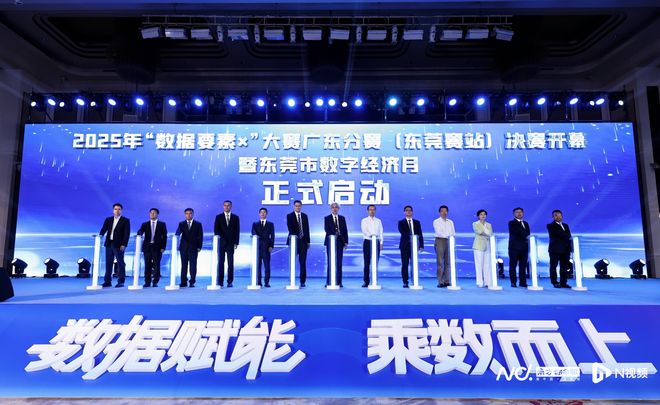
东莞计划到2027年,集聚数据企业不少于200家
Nan Fang Du Shi Bao· 2025-09-11 12:11
Core Insights - The 2025 "Data Element ×" competition's Guangdong division finals were held in Dongguan, marking the launch of the Dongguan Data Industry Cluster Area [1][5] - Dongguan's government released the "Dongguan Data Element Marketization Reform Action Plan (2025-2027)", aiming to establish a comprehensive reform framework and achieve specific targets by 2027 [4][5] Summary by Categories Event Overview - The finals featured over 100 teams competing across four tracks: industrial manufacturing, commercial circulation, meteorological services, and emergency management [3][8] - The event is part of Guangdong's strategy to promote data empowerment in the economy, with Dongguan hosting the most teams and tracks in the province [8] Government Initiatives - Dongguan's government has issued 77 policies related to data industry development since initiating the first round of data element reforms in 2022 [4] - A new funding policy system was established to reduce data conversion costs for enterprises, focusing on key sectors like industrial manufacturing and financial services [4] Reform Framework - The "1+4+15" reform framework aims to enhance data supply, infrastructure, industry ecology, and application scenarios [4] - By 2027, the plan targets the creation of at least 30 high-quality industry-level data sets, 10 exemplary cases of "data elements ×", and the establishment of at least 200 data enterprises [4][5] Data Industry Cluster Development - The Dongguan Data Industry Cluster Area is designed to attract leading data companies and foster high-level applications of data elements, particularly in AI [7] - The project aims for cumulative data industry revenue exceeding 20 billion yuan and output value over 10 billion yuan by the end of 2027 [7] Competition Structure - Each competition track will have awards including first, second, and third prizes, along with special awards, promoting sustainable development in data innovation [9] - The competition encourages teams to present solutions addressing industry pain points, enhancing the integration of data and intelligence [8][9]

北京数据集团揭牌成立
Zhong Guo Zheng Quan Bao· 2025-09-11 04:57
Core Insights - The establishment of Beijing Data Group marks a significant step in Beijing's efforts to implement the national strategy for market-oriented allocation of data elements, aiming to enhance public data resource value and foster a robust data industry ecosystem [1][2] Group 1: Development Strategy - Beijing Data Group aims to serve as a data resource provider, infrastructure builder, and data circulation service provider, focusing on creating an open and collaborative industrial ecosystem [2][3] - The group will explore market-oriented paths for data elements, ensuring efficient circulation and optimization of data resources while maintaining compliance and security [3][4] Group 2: Business Framework - The business structure of Beijing Data Group is based on a "1+4+1" development blueprint, which emphasizes the smooth flow of data supply, circulation, application, and security [4][5] - The group will focus on key areas such as digital government construction, enterprise digital transformation, and the development of a national-level data trading center [5][6] Group 3: Infrastructure and Collaboration - Beijing Data Group plans to enhance its data infrastructure by building a collaborative network for data circulation and utilization, as well as a trusted data space and a common platform for government models [5][6] - Strategic partnerships have been established with various enterprises and institutions, including China Mobile, China Telecom, and several financial institutions, to foster collaboration in data utilization and innovation [7]
国家数据局:推动数据要素市场化配置改革和“人工智能+”同频共振
Mei Ri Jing Ji Xin Wen· 2025-09-06 10:27
每经AI快讯,9月6日,据国家数据局微信公众号,2025世界智能产业博览会昨日在重庆开幕,国家数 据局党组书记、局长刘烈宏出席开幕式并致辞。下一步,国家数据局将把深化数据要素赋能人工智能创 新发展作为数据领域的重点工作,通过一系列政策组合拳和体系化布局,持续推动数据要素市场化配置 改革和"人工智能+"同频共振,实现数据要素市场化价值化,为产业创新和升级提供新动能。同时,也 呼吁全社会共同强化对数据要素价值的认同,投资行业高质量数据,培育"为优质数据买单"的市场共 识。 ...
数聚产业动能 智启发展新篇——二〇二五中国国际大数据产业博览会综述
Ren Min Ri Bao· 2025-09-02 07:55
Group 1 - The 2025 China International Big Data Industry Expo concluded in Guiyang, attracting over 55,000 attendees and featuring 375 domestic and international exhibitors [1] - The expo focused on creating a platform for supply-demand matching in digital economy innovation, showcasing digital solutions and experiences [1][2] - A significant theme was the market-oriented reform of data element allocation, highlighted by the Data Trading Ecology Conference co-hosted by three data exchanges [1][3] Group 2 - The expo featured over 1,300 new products, technologies, and solutions, with a professional exhibition area of 60,000 square meters [2] - Key themes included smart infrastructure, smart services, and smart applications, with 91,000 visitors attending the exhibitions [2] - The event also included the release of 90 theoretical reports, industry standards, and technical achievements, alongside planning for 100 digital economy projects attracting investments of 46.336 billion yuan [3]
数聚产业动能 智启发展新篇——2025中国国际大数据产业博览会综述
Ren Min Ri Bao· 2025-09-02 03:23
Group 1 - The 2025 China International Big Data Industry Expo concluded in Guiyang, attracting over 55,000 attendees and 16,000 registered guests from around the world, with 375 domestic and foreign enterprises participating [1] - The expo aimed to create a supply-demand matching platform for innovative digital economy solutions, featuring an international supply-demand cooperation exhibition area [1] - The event emphasized the market-oriented reform of data elements, with a focus on the value release of data as a new production factor driving high-quality development [1][3] Group 2 - The expo showcased over 1,300 new products, technologies, and solutions across six thematic exhibition halls, covering an area of 60,000 square meters, with 91,000 visitors [2] - Various activities were held, including supply-demand matching, corporate roadshows, technical seminars, and product launches, creating a comprehensive platform for technology exchange and business opportunities [2] - The Southern Power Grid Company highlighted its integration of data elements and AI technologies, achieving 292 industry-specific AI applications [2] Group 3 - This year marked the 11th successful hosting of the expo, which released 90 items including theoretical reports, industry standards, and technical achievements [3] - The event also hosted key competitions focusing on data industry, computing power, and artificial intelligence, planning 100 digital economy projects that attracted investments totaling 46.336 billion yuan [3]
数聚产业动能 智启发展新篇
Ren Min Ri Bao· 2025-09-01 22:41
Group 1 - The 2025 China International Big Data Industry Expo concluded in Guiyang, attracting over 55,000 attendees and featuring 375 exhibitors from around the world [1] - The expo focused on creating a platform for supply-demand matching in digital economy innovation, showcasing digital solutions and experiences [1] - A key theme was the market-oriented reform of data factor allocation, highlighted by the Data Trading Ecology Conference co-hosted by three major data exchanges [1] Group 2 - The expo featured over 1,300 new products, technologies, and solutions, with a total exhibition area of 60,000 square meters [2] - Various activities such as supply-demand matching, corporate roadshows, and technical discussions were held to facilitate technology exchange and business opportunities [2] - Notable innovations included AI applications and data integration showcased by Southern Power Grid, which has developed 292 industry-specific AI applications [2] Group 3 - This year marked the 11th successful hosting of the expo, with 90 reports, industry standards, and technical achievements released during the event [3] - The expo also hosted key competitions focusing on data industry and AI security, planning 100 digital economy projects that attracted investments totaling 46.336 billion yuan [3]
数聚产业动能 智启发展新篇 ——二〇二五中国国际大数据产业博览会综述
Ren Min Ri Bao· 2025-09-01 22:07
Group 1 - The 2025 China International Big Data Industry Expo concluded in Guiyang, attracting over 55,000 attendees and featuring 375 domestic and international exhibitors [1] - The expo focused on creating a platform for supply-demand matching in digital economy innovation, showcasing digital solutions and experiences [1] - A key theme was the market-oriented reform of data factor allocation, highlighted by the Data Trading Ecology Conference co-hosted by three data exchanges [1] Group 2 - The expo featured over 1,300 new products, technologies, and solutions, with a professional exhibition area of 60,000 square meters [2] - Attendees experienced cutting-edge technologies such as AI models, data security, and smart terminals, with 91,000 visitors participating in the exhibition [2] - The Southern Power Grid Company showcased its integration of data elements and AI technologies, claiming to have developed 292 industry-specific AI applications [2] Group 3 - This year marked the 11th successful hosting of the expo, which released 90 items including theoretical reports, industry standards, and technical achievements [3] - The event also hosted three key competitions focused on data industry and AI security, planning 100 digital economy projects that attracted investments totaling 46.336 billion yuan [3]
事关深化要素市场化改革,国常会作出新部署
第一财经· 2025-08-30 10:43
Core Viewpoint - The article discusses the new deployment of factor market-oriented reform in China, emphasizing its importance in building a high-level socialist market economy and addressing issues like "involution" in competition [3][5]. Group 1: Reform Objectives and Background - The State Council aims to deepen factor market-oriented reform as a crucial measure for constructing a high-level socialist market economy [3]. - The government report highlights the need to advance the construction of a unified national market, eliminate local protectionism, and address barriers to economic circulation [5]. - Despite 97.5% of commodity and service prices being market-determined, the development of factor markets such as land, labor, capital, technology, and data remains relatively lagging [5]. Group 2: Implementation and Focus Areas - The recent State Council meeting emphasized the need to focus on key areas and encourage differentiated reform explorations in pilot regions [6]. - The goal is to facilitate the smooth flow of advanced production factors towards new productive forces, thereby stimulating market vitality and expanding development space [6][7]. - The reform aims to enhance the efficiency of factor allocation and further unleash societal creativity and market vitality [5][7]. Group 3: Challenges and Progress - Current challenges in the factor market include an inadequate pricing mechanism, particularly in land, technology, and data markets, due to systemic barriers and administrative interference [7][8]. - The article notes that significant progress has been made in various areas, including land supply methods and the establishment of technology and data markets [7]. - The need for a unified assessment system in the technology market is highlighted, as the lack of such a system hampers the realization of market value for innovative achievements [8]. Group 4: Data Market Development - The article emphasizes the importance of data as a new production factor, with ongoing reforms aimed at establishing a national integrated data market and improving data property rights [9]. - The National Data Bureau is actively promoting data market-oriented reforms, introducing policies to enhance data sharing and utilization [9]. - The establishment of a credible data infrastructure is crucial for ensuring efficient data circulation and application in various scenarios [9].

事关深化要素市场化改革,国常会作出新部署
Di Yi Cai Jing· 2025-08-30 08:19
Group 1 - The core viewpoint emphasizes the importance of deepening factor market-oriented reforms as a crucial measure for building a high-level socialist market economy system [1][3] - The State Council meeting highlighted the need for differentiated reform explorations in pilot areas to break down institutional barriers and enhance market efficiency [1][3] - The government aims to address the challenges of "involution" competition and create a fairer market environment to stimulate endogenous economic growth [1][2] Group 2 - The report indicates that 97.5% of commodity and service prices in China are now market-determined, but factor markets such as land, labor, capital, technology, and data remain underdeveloped [2][4] - The 2021 pilot program aims to complete the reform tasks by 2025, achieving significant results in factor market-oriented allocation [2][3] - The current pricing mechanisms for land, technology, and data markets are inadequate, leading to challenges in realizing the value of these factors [4][5] Group 3 - The government is focusing on enhancing the innovation vitality of technology factors, promoting efficient land allocation, and improving the flow of human resources [5][6] - The reform of data as a new production factor is a key focus, with initiatives aimed at establishing a national integrated data market and improving data property rights [5][6] - The National Data Bureau is actively promoting data factor market-oriented reforms, with policies aimed at enhancing data sharing and utilization [6]