
智慧医疗

Search documents
卫星战略升级与外资开年抢筹中国资产,市场迎来多重利好催化
Jin Rong Jie· 2026-01-12 00:44
Satellite Internet - China has applied to the International Telecommunication Union (ITU) for over 200,000 satellite frequency resources, indicating that the application for satellite frequency resources has reached a national strategic level [1] - The initiative is led by the "national team" Radio Innovation Institute, aiming to integrate resources and leverage market advantages to accelerate the industry’s catch-up with SpaceX [1] Robotics Industry - Tesla's Optimus supply chain primary supplier, Hangzhou Xinjian Electromechanical Transmission Co., Ltd., has initiated IPO counseling, attracting significant market attention due to its high profile in the supply chain [2] Data Security and AI Governance - The National Internet Information Office has publicly solicited opinions on the "Regulations on the Collection and Use of Personal Information by Internet Applications (Draft for Comments)," aimed at regulating personal information collection and usage activities by apps [3] - The initiative seeks to protect personal information rights [3] Artificial Intelligence Frontiers - Yang Zhilin, founder of Moon's Dark Side, stated plans for long-term iterations to the K100 model, focusing on continuous optimization of architecture and data quality to advance AGI/ASI development [3] - The Yangtze River Delta Integration Large Model (YRD-P1) has been officially released to provide AI decision support for regional development [4] Smart Healthcare - The National Medical Insurance Administration has launched a pilot project for "Personal Medical Insurance Cloud," aiming to create a new model for smart medical insurance management that covers the entire population and lifecycle [5] Technology Giants Dynamics - Elon Musk announced that his platform X will open-source its latest content recommendation algorithm within a week and commit to updating the code every four weeks [5] Foreign Capital Dynamics - Since the beginning of 2026, foreign institutions have frequently increased their holdings in Chinese assets, with JPMorgan intensively increasing its holdings in companies like CATL, Ganfeng Lithium, and Sinopharm in the Hong Kong market [6] - Several US-listed Chinese technology ETFs continue to attract capital inflows, reflecting international capital's optimism towards the Chinese economy and technology sector [6] Policy Guidance for Medium to Long-term Capital - The China Securities Regulatory Commission stated it will continue to improve the institutional environment to promote the scale and proportion of various medium to long-term funds entering the market, optimizing arrangements for qualified foreign investors to attract and retain long-term capital [7] Low-altitude Economy/Unmanned Transport - The "Tianma-1000" unmanned transport aircraft developed by China Weapon Industry Group has successfully completed its maiden flight, featuring high-altitude adaptability, short-distance takeoff and landing, and dual-mode switching for cargo/airdrop, with a maximum load of 1 ton and a range of 1,800 kilometers [8] Market Strategy Observation - The market remains active under multiple favorable factors such as policy support, foreign capital inflow, and industry catalysts, with the strategic status of satellite internet confirmed by officials, potentially strengthening the main market trend [8] - Expectations for medium to long-term capital entering the market and actual foreign capital increases provide a space for incremental capital imagination [8] - Continuous events in technology frontiers such as robotics, AI, and low-altitude economy create abundant rotation opportunities [8]
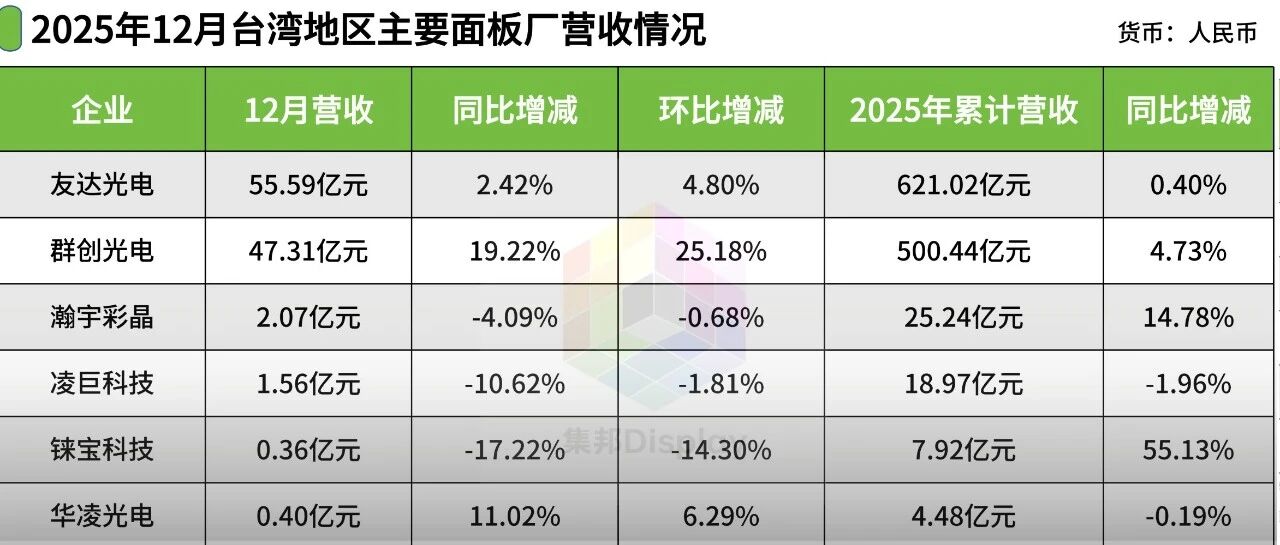
友达、群创等6家面板厂公布12月营收
WitsView睿智显示· 2026-01-09 09:51
Core Viewpoint - The revenue performance of major Taiwanese panel manufacturers in December 2025 shows strong growth for large-size panels, while small and medium-sized manufacturers exhibit mixed results [1][2]. Group 1: Revenue Performance - AUO's December revenue reached NT$ 55.59 billion (approximately RMB 5.559 billion), with a month-on-month increase of 4.8%, marking a nine-month high [2]. - Innolux reported December revenue of NT$ 47.31 billion (approximately RMB 4.731 billion), a significant month-on-month increase of 25.18% and a year-on-year increase of 19.22%, achieving a 45-month high [2]. - Han's Semiconductor's revenue in December was NT$ 2.07 billion (approximately RMB 0.207 billion), showing a year-on-year decrease of 4.09% [1]. - Lianji Technology's December revenue was NT$ 1.56 billion (approximately RMB 0.156 billion), down 10.62% year-on-year [1]. - Ralco Technology's December revenue was NT$ 0.36 billion (approximately RMB 0.036 billion), with a year-on-year decrease of 17.22% but an impressive annual cumulative revenue growth of 55.13% [1][2]. - Hualing's December revenue was NT$ 0.40 billion (approximately RMB 0.04 billion), with a month-on-month increase of 6.29% [1]. Group 2: Business Developments - In December, AUO showcased smart medical solutions at the Taiwan Medical Technology Exhibition, with a compound annual growth rate of 20% in its smart medical business over the past five years, expecting to maintain double-digit growth [3]. - On December 2, Innolux completed the acquisition of Pioneer, aiming to leverage its advantages in audio, HMI, and software platforms to create a comprehensive smart cockpit system [4]. - Innolux announced the termination of its collaboration with Japan Display (JDI) due to the inability to reach a commercialization agreement [4]. - Han's Semiconductor announced the closure of its Nanke plant, focusing on reallocating resources to areas with lower capital expenditure needs and higher profit margins [4]. Group 3: Market Outlook - Looking ahead to January 2026, the market is expected to see a rise in television panel prices, supported by strong procurement momentum from TV brands and pre-holiday stockpiling, while notebook panel demand is anticipated to weaken, impacting related companies' revenues [5][8].

非凡“十四五” 四川简阳交出温暖“健康答卷”
Zhong Guo Fa Zhan Wang· 2026-01-08 08:33
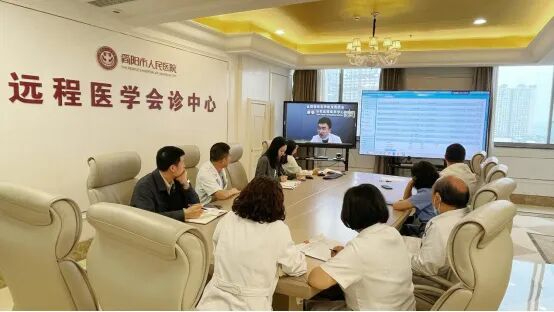
Core Insights - Since the "14th Five-Year Plan," Jianyang City has focused on health-centered reforms in the medical and health system, achieving significant progress in service capacity, system efficiency, and health security, laying a solid foundation for a modern urban-rural integrated demonstration city centered on people [1] Group 1: Enhanced Grassroots Service Capacity - Jianyang City has systematically strengthened its grassroots medical and health service network, establishing a tiered diagnosis and treatment system centered on a tightly-knit county medical community, promoting the extension of quality resources to grassroots levels through expert support and remote collaboration [2] - The successful completion of a complex surgery for a 76-year-old patient with multiple chronic diseases at He Feng Central Health Center demonstrates the effectiveness of this system, with expert assistance and remote multidisciplinary consultations ensuring safe and standardized treatment [2] Group 2: Breakthroughs in Emergency and Critical Care - Jianyang People's Hospital successfully treated a 43-year-old patient in critical condition using VA-ECMO technology, marking a significant advancement in its emergency and critical care capabilities [4] - The hospital has established a comprehensive emergency rescue system, including trauma, chest pain, stroke, and critical maternal and neonatal care centers, and has joined the National Trauma Rescue Alliance [4] - The city's smart emergency network operates efficiently, achieving a 98.24% average response rate within 3 minutes for emergency calls by 2025, ensuring seamless coordination between pre-hospital and in-hospital care [4] Group 3: Dual Track of Smart and Traditional Medicine - Jianyang People's Hospital and Jianyang Traditional Chinese Medicine Hospital have established internet hospitals, enabling online follow-ups and prescription transfers, with electronic medical record systems reaching level 4 across major hospitals [6] - The implementation of a "Health Card" allows for unified access across major medical institutions, promoting mutual recognition of examination and testing results [6] - The Traditional Chinese Medicine Hospital has developed key specialties and has made significant advancements in traditional medicine services, with over 55% of grassroots services in traditional medicine by 2025 [6] Group 4: Strengthening Health Security Foundations - Jianyang's Disease Control Center has achieved a tertiary level, significantly enhancing public health monitoring and emergency response capabilities [8] - The city has established two municipal-level key specialties and 25 county-level key specialties during the "14th Five-Year Plan," with a steady increase in residents' health literacy, reaching 35.5% by 2025 [8] - Jianyang has been recognized as a national sanitary city, with 22 towns awarded provincial-level sanitation status, indicating ongoing improvements in health environments [8] - The city aims to continue strengthening public health safety nets and promoting the construction of tightly-knit medical communities, enhancing comprehensive service capabilities in prevention, treatment, rehabilitation, and management [8]
中科信息(300678.SZ):与强脑科技、脑虎科技暂无合作
Ge Long Hui· 2026-01-08 07:52
Core Viewpoint - The company, Zhongke Information (300678.SZ), has clarified that it has no collaboration with Qiangnao Technology and Nao Hu Technology, focusing instead on its partnership with the Suzhou Institute of Nano-Tech and Nano-Bionics of the Chinese Academy of Sciences to develop brain-like intelligence and smart medical applications [1] Group 1 - The company is collaborating with the Suzhou Institute of Nano-Tech and Nano-Bionics to establish a research center for brain-like intelligence and smart medical applications [1] - The partnership aims to conduct research on key technologies and innovative applications in various medical fields [1] - The focus areas include clinical auxiliary diagnosis and treatment, clinical scientific research, and regional health and wellness applications [1] Group 2 - The company plans to develop high-end intelligent medical and rehabilitation equipment, high-end smart wearable devices, and clinical research and auxiliary diagnosis systems and equipment [1] - These products are aimed at promoting domestic innovation in the medical technology sector [1]
超研股份涨5.15%,成交额1.66亿元,今日主力净流入1242.75万
Xin Lang Cai Jing· 2026-01-08 07:34
Core Viewpoint - The company, Shantou Ultrasonic Instrument Research Institute Co., Ltd., has shown significant growth in its stock performance and is benefiting from various market trends, including the pet economy and medical device sector, as well as the depreciation of the RMB [1][2]. Company Overview - Shantou Ultrasonic Instrument Research Institute Co., Ltd. specializes in the research, production, and sales of medical imaging equipment and industrial non-destructive testing equipment, with a focus on ultrasound technology [2][3]. - The company was established on November 15, 1982, and went public on January 22, 2025 [7]. - The main revenue sources for the company are medical ultrasound (71.16%), industrial ultrasound (17.30%), accessories (5.72%), X-ray (4.56%), and other (1.26%) [7]. Financial Performance - For the period from January to September 2025, the company reported a revenue of 254 million yuan, a year-on-year decrease of 2.90%, and a net profit attributable to shareholders of 88.94 million yuan, down 3.66% year-on-year [7][8]. - As of September 30, 2025, the company had a total market capitalization of 10.151 billion yuan [1]. Market Position and Trends - The company has a significant overseas revenue share of 55.26%, benefiting from the depreciation of the RMB [3]. - The stock has experienced a recent increase of 5.15% in value, with a trading volume of 166 million yuan and a turnover rate of 12.02% [1]. Shareholder Information - As of September 30, 2025, the number of shareholders decreased by 23.90% to 17,000, while the average number of circulating shares per person increased by 39.99% to 3,438 shares [7]. - The largest shareholder is Huabao Zhongzheng Medical ETF, holding 1.5245 million shares, which is a decrease of 388,200 shares compared to the previous period [9].
迪安诊断涨2.04%,成交额9771.20万元,主力资金净流出130.59万元
Xin Lang Cai Jing· 2026-01-08 02:27
Group 1 - The core viewpoint of the news is that Dian Diagnostics has shown a positive stock performance recently, with a year-to-date increase of 10.35% and a 13.42% rise over the last five trading days [1] - As of January 8, the stock price reached 17.49 yuan per share, with a total market capitalization of 10.931 billion yuan [1] - The company primarily provides medical diagnostic services, with revenue composition of 65.34% from channel products and 34.66% from diagnostic services [1] Group 2 - As of September 30, the number of shareholders decreased by 5.45% to 45,700, while the average circulating shares per person increased by 5.76% to 10,974 shares [2] - For the period from January to September 2025, Dian Diagnostics reported a revenue of 7.566 billion yuan, a year-on-year decrease of 18.28%, and a net profit attributable to shareholders of 56.7048 million yuan, down 56.67% year-on-year [2] - The company has distributed a total of 1.099 billion yuan in dividends since its A-share listing, with 712 million yuan distributed in the last three years [3]

港通医疗:持续关注AI医疗发展,努力提高产品智慧化水平
Sou Hu Cai Jing· 2026-01-07 22:42
Group 1 - The core viewpoint of the article is that the company, 港通医疗, is focused on providing medical gas equipment and systems, as well as clean medical equipment and systems, which are integral to the construction of smart hospitals [1] - The company is actively monitoring the development of AI in healthcare and is committed to enhancing the intelligence level of its products to meet the growing demands of modern hospital construction [1] - 港通医疗's response indicates a dedication to addressing medical gas supply and infection control issues within healthcare institutions [1]
在追求美好生活路上阔步而行
Xin Lang Cai Jing· 2026-01-07 18:15
Core Viewpoint - During the "14th Five-Year Plan" period, Wuhai City has focused on a people-centered approach, systematically building a multi-level social security system to improve public services, living conditions, and social governance, resulting in significant improvements in people's livelihoods [5][12]. Public Safety and Social Governance - Wuhai City has achieved a notable decline in crime rates, with criminal cases down by 26.2%, property crimes by 39.1%, and traditional theft and fraud cases by 53.7% [5]. - The city has established standardized community governance centers in all three districts and 20 towns, effectively resolving conflicts and disputes [5]. Education and Health - A total of 101.97 billion yuan has been invested in education, with 181 projects implemented, significantly improving school conditions [5]. - The coverage rate of inclusive kindergartens remains above 97%, with 62.9% of children attending public kindergartens, an increase of nearly 10 percentage points compared to the previous five-year plan [6]. - Wuhai City has built a tight-knit medical group system, with over 2,600 expert visits and 47,000 patient transfers, while also reducing medical costs for residents by 140 million yuan since 2021 [7][11]. Employment and Social Security - The city has created 27,100 new urban jobs over five years, exceeding targets, and has provided job placement for 2,161 individuals through public service positions [8]. - The minimum living guarantee standard has increased by 21.45% since 2020, benefiting over 441,600 people with a total of 380 million yuan distributed [8]. Elderly Care and Community Services - Wuhai City has established a comprehensive elderly care service network, achieving 100% coverage of urban and rural elderly facilities ahead of schedule [9]. - A total of 94 elderly service centers have been built, enhancing the quality of life for the elderly population [9]. Urban Development and Transportation - The city's road network has expanded to 1,151 kilometers, with a density of 65.6 kilometers per 100 square kilometers, significantly above the regional average [10]. - Wuhai Airport has seen a 17.5% increase in passenger throughput, surpassing 800,000 for the first time, with 23 cities now connected by air [10]. Healthcare and Insurance Reforms - The number of people covered by basic medical insurance has increased from 384,600 to 421,500, with a coverage rate of over 95% [11]. - The reimbursement rates for inpatient care under employee and resident insurance have exceeded expectations, benefiting over 322,300 individuals and reducing costs by 11.573 million yuan [11].
去年西城人均期望寿命达85.05岁
Xin Jing Bao· 2026-01-07 09:57
新京报讯(记者戴轩)西城区两会于近日开幕,记者从会上获悉,去年西城区人均期望寿命达到85.05 岁,孕产妇死亡率0/10万。 在医疗服务体系方面,该区在北京市率先建成覆盖11家区属医院的一体化信息系统,全面打通数据壁 垒,累计落地20余项智慧医疗应用场景,居民非诊疗就医时间平均缩短30-40分钟。 2026年,该区将开展"卫生健康数智赋能行动",依托一体化平台,构建健康大数据与人工智能底座,围 绕"居民少跑腿、监管更智能"目标,推动更多"AI +医疗"健康应用场景落地。 西城区委卫健工委书记、区卫健委主任焦扬介绍,2025年,西城区人均期望寿命达到85.05岁,孕产妇 死亡率0/10万,婴儿死亡率1.38‰,法定传染病发病率较2024年同期下降27.5%,在全国率先落实育儿 补贴政策,惠及0-3岁婴幼儿3万余名。 ...
宣武医院房山院区启动建设
Xin Lang Cai Jing· 2026-01-06 22:38
本报讯(记者 陈强 孙乐琪)昨天上午,首都医科大学宣武医院房山院区暨国家医学中心建设工程建设 动员会在房山区长阳镇举行,标志着该项目正式启动建设。作为本市重点推进的公共服务工程,项目预 计2029年投用,建成后将成为房山区首家三级甲等综合医院,有效提升京西南优质医疗服务能力。 宣武医院现址位于西城区,此次启动的房山院区东片区占地14.3万平方米,总建筑面积19.89万平方米, 规划床位800张。 宣武医院房山院区将打造集智慧、韧性、绿色于一体的"智慧健康生态综合体"。建筑设计独具匠心,南 北两组主体建筑通过放射状交通体系连接中央大厅,形成高效诊疗动线,实现临床、教学、科研、康复 等功能区无缝衔接。这一设计形似神经元共生形态,既凸显了宣武医院在神经科学领域的特色优势,也 为多学科协同发展提供支撑。 智慧医疗是新院区一大亮点。宣武医院房山院区将搭建与宣武医院西城院区同源的数字化诊疗平台,全 面落地远程会诊、人工智能辅助诊断等技术,并引入核磁共振等尖端医疗设备。同时深度融合"互联网 +医疗"模式,患者通过"掌上宣武医院"平台,即可完成在线复诊、医保实时结算、药品配送到家等全流 程服务。 该院区距离地铁房山线广阳城站 ...