AI编程

Search documents
编程从此不再有门槛!Claude Code火爆出圈,接近“ChatGPT的横空出世”
硬AI· 2026-01-18 13:03
Core Insights - Claude Code, particularly its latest version Claude Opus 4.5, is revolutionizing AI applications, enabling non-technical users to easily build software, thus reshaping perceptions of AI capabilities [1][5][6] - The tool has gained significant traction beyond programmers, with users employing it for diverse tasks such as health data analysis, expense report organization, and even monitoring plant growth [1][2][5] User Experience and Impact - Users report completing complex projects in a fraction of the time, with one user finishing a task that typically takes a year in just one week, highlighting the tool's efficiency [2][5] - The user base has expanded dramatically, with Claude's audience more than doubling year-over-year as of last December, and a 12% increase in global daily active users on desktop [3] Technological Advancements - Unlike most existing chatbots, Claude Code operates autonomously, accessing user files and applications, marking a significant step towards the anticipated AI "agent" era [6] - The development of a user-friendly version called Cowork, built using Claude Code itself, indicates a shift towards broader accessibility and usability for non-programmers [6][7] Market Position and Future Outlook - Anthropic, the company behind Claude Code, is focusing on enterprise clients, with expectations of capturing a larger market share in the business AI sector by mid-2025 [7] - The competitive landscape includes OpenAI, which has a larger consumer user base, while Anthropic is carving out its niche in enterprise solutions [7]


编程从此不再有门槛!Claude Code火爆出圈,一周干完一年的活,一人顶一个团队
华尔街见闻· 2026-01-18 11:59
Core Insights - Anthropic's Claude Code is initiating a significant AI application wave, likened to the advent of generative AI [2] - The latest version, Claude Opus 4.5, allows non-technical users to easily build software, reshaping perceptions of AI capabilities [3] Group 1: AI Programming Revolution - The ease of "AI programming" is leading to a new wave of "micro-apps" and "super programmers" who can outperform entire teams [4][11] - Users are leveraging Claude Code for diverse tasks, from analyzing health data to developing personal software, democratizing software development [4][10] Group 2: User Experiences and Industry Impact - Users report significant productivity boosts, with some claiming a fivefold increase in efficiency due to Claude Code [8][21] - The tool's ability to autonomously run and access various applications marks a shift in user interaction with AI, providing a glimpse into future possibilities [9] Group 3: Changing Software Development Landscape - A new consumer habit is emerging where individuals create personalized "micro-apps" instead of relying on traditional SaaS solutions [12][13] - These micro-apps are characterized by their specific use cases and immediate problem-solving capabilities, shifting software from a purchased commodity to a self-made tool [14][16] Group 4: The Rise of "Cracked Engineers" - The term "Cracked Engineers" describes highly skilled software engineers who can leverage AI tools for exceptional output, leading to intense competition in the industry [17][20] - Companies are increasingly seeking these "super programmers," with some reporting that one individual can now produce work equivalent to a 15-person team [21][22] Group 5: Challenges and Concerns - The pursuit of "Cracked Engineers" raises concerns about the mental health and social behaviors of young engineers, as they may adopt unhealthy work habits to fit this mold [23][24] - Some founders are using the hiring of "Cracked Engineers" as a superficial solution to deeper business model issues [24]

当“AI编程”越来越容易,新浪潮正出现:人人可做的“微应用”和一人顶团队的“超级程序员”
Hua Er Jie Jian Wen· 2026-01-18 06:53
Core Insights - The emergence of "Cracked Engineers" reflects a shift in the tech industry where traditional hiring practices are failing due to the AI boom, leading to a demand for highly skilled engineers who can leverage AI tools to maximize productivity [1][6] - The software industry is experiencing a bifurcation where the barrier to entry for programming is lowering, allowing non-coders to create personalized "micro apps," while competition among professional engineers intensifies [1][2] Group 1: Micro Apps and Consumer Behavior - A new consumer trend is forming where individuals prefer to create their own software solutions, termed "micro apps," rather than purchasing traditional SaaS products [2][3] - Micro apps are characterized by their extreme specificity and immediate problem-solving capabilities, often lacking commercial intent [2][3] - The development of micro apps is filling a market gap between simple Excel sheets and full-featured SaaS products, making software development as accessible as spreadsheet creation [3] Group 2: The Rise of Cracked Engineers - "Cracked Engineers" are defined as young, highly motivated software engineers who utilize AI tools to achieve outputs that previously required large teams [5][6] - The demand for these engineers is so high that some companies, like Gradient, have stopped hiring interns, citing a lack of sufficiently skilled candidates [6][11] - The productivity of these engineers can surpass that of traditional teams, with reports indicating that a few skilled individuals can achieve what a 15-person team could do without AI assistance [8][11] Group 3: Challenges and Market Dynamics - Despite the lowered barriers for web app development, mobile app creation still faces challenges such as the "Apple tax," which can be prohibitive for one-time applications [4] - Startups are emerging to address these challenges, indicating a growing recognition of the potential in the micro app market [4] - The pursuit of "Cracked Engineers" may lead to unhealthy work cultures, with some engineers adopting extreme work habits and neglecting social interactions [11][12]
Cursor一夜翻车,AI 300万代码写浏览器被打假!全网群嘲「AI泔水」
猿大侠· 2026-01-18 04:11
Core Viewpoint - The claims made by Cursor regarding the development of a browser using GPT-5.2 have been debunked, revealing that the code produced is non-functional and lacks engineering logic, described as "AI Slop" [2][8][37]. Group 1: Claims and Debunking - Cursor announced that their AI coding agents, powered by GPT-5.2, created a browser with 3 million lines of code in 7 days, which generated significant excitement in the AI community [4][5]. - Upon investigation, developers found that the code could not even compile, indicating that the project was misrepresented [6][10]. - The technical community criticized Cursor for using misleading marketing tactics, creating an illusion of success without actual evidence [9][12]. Group 2: Analysis of Cursor's Project - The official blog post from Cursor outlined their goal to push the boundaries of AI coding agents, but it failed to provide concrete evidence of success [17][18]. - Despite claiming significant progress, Cursor did not demonstrate that the browser was functional or could run basic tasks [22][27]. - The project was found to be riddled with errors, with no successful commits that could compile, indicating a lack of genuine engineering effort [32][34]. Group 3: Community Reaction - The developer community expressed outrage over Cursor's presentation of incomplete work as a milestone, highlighting the disconnect between investor perceptions and actual coding realities [43][46]. - Discussions on platforms like Hacker News revealed skepticism about the project's authenticity, with many pointing out that the claims were exaggerated and misleading [47][48]. - The incident has sparked a broader conversation about the quality of AI-generated code and the importance of engineering rigor in AI applications [60][71]. Group 4: Future Implications - The failure of Cursor's project emphasizes the need for clear roles and structured collaboration among AI agents to achieve meaningful outcomes [62][73]. - The emergence of "Cracked Engineers," who effectively leverage AI while maintaining engineering standards, is seen as a necessary evolution in the software development landscape [68][72]. - The incident serves as a cautionary tale about the potential pitfalls of relying solely on AI for coding without proper oversight and validation [70][75].

编程从此不再有门槛!Claude Code火爆出圈,接近“ChatGPT的横空出世”
Hua Er Jie Jian Wen· 2026-01-18 03:50
Core Insights - Anthropic's Claude Code is revolutionizing AI applications, likened to the advent of generative AI, enabling non-technical users to easily build software [1] - The latest version, Claude Opus 4.5, has demonstrated remarkable capabilities, allowing users to complete complex projects in a fraction of the time previously required [2] - The user base for Claude has significantly expanded, with a reported over 100% year-on-year growth in audience since December last year [1] Group 1: User Experience and Impact - Users are leveraging Claude Code for diverse applications beyond programming, including health data analysis and photo restoration, showcasing its versatility [1] - Vercel's CTO reported completing a project in one week that would typically take a year, highlighting the tool's efficiency [2] - Users express a mix of awe and concern, realizing that Claude Code can replicate skills honed over years of experience [2] Group 2: Technological Advancements - Unlike most current AI chatbots, Claude Code can autonomously operate and access user files and applications, marking a significant step towards AI "agents" [3] - The development of a user-friendly variant called Cowork reflects the growing interest from non-programmers, indicating a shift in the target audience for AI tools [4] - Anthropic's strategy focuses on mastering AI programming and expanding its "tooling" capabilities, positioning it as a leader in the programming model space [4] Group 3: Market Position and Future Outlook - Anthropic and OpenAI are both significant players in the AI model startup space, with Anthropic focusing on enterprise clients and expected to capture a larger market share by mid-2025 [5] - The broader implications of AI tools like Claude Code extend beyond software engineering, suggesting potential disruptions across various sectors [5]
Cursor一夜翻车,AI 300万代码写浏览器被打假!全网群嘲「AI泔水」
程序员的那些事· 2026-01-17 12:39
Core Viewpoint - The claims made by Cursor regarding the development of a browser using GPT-5.2 have been debunked, revealing that the code produced is non-functional and lacks engineering logic, described as "AI Slop" [4][7][35]. Group 1: Project Claims and Findings - Cursor announced that their AI coding agents, powered by GPT-5.2, generated a browser with 3 million lines of code over 168 hours [3][4]. - The project was marketed as a breakthrough, suggesting that AI could autonomously create complex software [4][5]. - However, developers found that the code could not even compile, indicating that the project was misrepresented [5][9][30]. Group 2: Technical Analysis - A technical blog dissected Cursor's claims, revealing that the code lacked coherent engineering intent and was essentially unusable [7][36]. - The analysis showed that the GitHub repository had multiple failed builds and numerous compiler errors, indicating that the project had never been in a runnable state [30][32]. - The lack of a successful commit or demonstrable functionality further undermined Cursor's assertions of progress [52][53]. Group 3: Community Reaction - The developer community reacted strongly against Cursor's misleading claims, expressing frustration over the portrayal of incomplete work as a significant achievement [41][44]. - Discussions on platforms like Hacker News highlighted the deceptive nature of the project's marketing, with many pointing out the reliance on existing libraries rather than true innovation [45][46]. - The incident has sparked a broader conversation about the integrity of AI-generated code and the importance of verifiable results in software development [41][68]. Group 4: Lessons and Future Implications - The failure of the Cursor project illustrates the necessity for clear role definitions and structured collaboration among AI agents to avoid chaos in software development [58][59]. - The emergence of the term "Cracked Engineer" reflects a shift towards valuing skilled developers who can effectively leverage AI while maintaining rigorous engineering standards [64][68]. - The incident serves as a cautionary tale about the potential pitfalls of over-relying on AI without proper oversight and validation [67][69].

Cursor一夜翻车,AI 300万代码写浏览器被打假!全网群嘲「AI泔水」
3 6 Ke· 2026-01-17 07:26
【新智元导读】GPT-5.2连肝7天造出浏览器的事,刚刚被打假了!一位开发者发文证实,Cursor这个项目就是个「AI泔水」,代码根本无法 编译。Cursor这次可太心急了。 无论是操作系统、办公软件还是游戏引擎,只要算力足够,AI似乎都能给你「肝」出来。 前几天,整个AI圈都被Cursor的一则重磅消息给炸晕了。 事情是这样的: Cursor声称,他们让GPT-5.2驱动的编码智能体连续运行了整整7天,也就是168个小时。 结果,这群AI智能体居然从零开始,写出了一个包含300万行代码、功能堪比Chrome的浏览器! 这听起来实在是太诱人了—— 随着Token变得像水电一样廉价,AI可以无限期地自我迭代,直到完成目标。 然而,就在大家还没从震惊中缓过神来的时候,技术社区的「列文虎克」们出手了。 他们仔细扒了扒Cursor开源的这个项目代码,结果发现了一个惊天大瓜—— 这个所谓的「AI浏览器」,其实连最基本的编译都通过不了! 在一篇技术博客中,作者犀利地指出: Cursor口中所谓的「突破性进展」,本质上就是一堆缺乏工程逻辑的「AI泔水」(AI Slop)。 他们所做的,其实在宣传上玩了一手漂亮的「障眼法」, ...
没KPI反而爆了?Cursor大神一人敲出核心功能!CEO上手7天不宕机,AI编程玩法被打假
AI前线· 2026-01-17 06:25
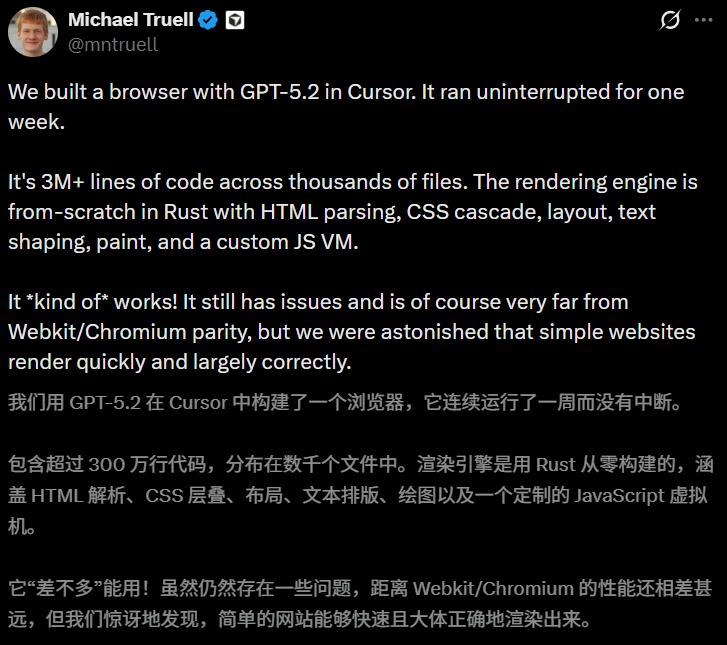
Core Insights - Cursor has developed a browser based on GPT-5.2, which has run continuously for a week and contains over 3 million lines of code, featuring a rendering engine built from scratch in Rust [2][3] - The development of coding agents has evolved significantly over the past year, transitioning from simple code completion to more complex interactions and multi-file management [7][8] - The acceptance and trust in coding agents have increased among developers, leading to a shift in how they interact with coding tools [9][10] Development and Features - The browser's capabilities include HTML parsing, CSS cascading, layout, text formatting, and rendering, along with a customized JavaScript virtual machine [2] - The coding agent has been able to autonomously write over 1 million lines of code across 1,000 files during its testing phase [3] - The team is focusing on enhancing multi-agent collaboration, allowing agents to work concurrently while minimizing conflicts and redundancy [8][9] User Interaction and Experience - Developers are increasingly relying on agents for coding tasks, with some top engineers using multiple agents simultaneously for efficiency [11][12] - The introduction of a debugging mode allows agents to generate logs for self-evaluation, enhancing the debugging process [12][13] - The interaction model is evolving towards a more natural dialogue-like experience, reducing the need for manual operations [23][24] Future Directions - The company anticipates that the trust in agents will lead to longer operational periods and more complex task handling [18][19] - The design of the integrated development environment (IDE) is crucial for the software development lifecycle, facilitating seamless integration of various functions [19] - Future developments may include more intuitive interaction modes, allowing users to communicate with agents in a more conversational manner [23][24] Internal Processes and Feedback - The internal workflow emphasizes high-frequency feedback and collaboration among engineers, which accelerates product iteration [25][26] - The product roadmap is influenced by both internal needs and external user feedback, with a significant portion driven by the desire to improve team efficiency [26][27] - The company maintains a lean operational structure, allowing for rapid development and deployment of new features [27][28]

“Vibe Coding” 风靡全球,AI应用浪潮势不可挡!AI编程新星估值四个月翻三倍
Zhi Tong Cai Jing· 2026-01-16 14:01
Core Viewpoint - Replit Inc., an AI programming startup, is nearing a financing agreement of approximately $400 million, which is expected to raise its valuation to nearly $9 billion, tripling its previous valuation of $3 billion from a financing round last year [1][2]. Group 1: Company Overview - Replit, founded ten years ago, has become a leader in the "vibe coding" sector, providing tools that enable both professional developers and beginners to use AI for writing and debugging software [1][4]. - The company offers a browser-based integrated development environment (IDE) that allows users to write, run, debug, and deploy programs without needing to install software or configure local environments [4]. - Replit's core products focus on AI programming assistants, such as Replit Agent and Ghostwriter, which can automatically generate code and deploy applications based on user input in natural language [4][5]. Group 2: Market Trends - AI programming is rapidly becoming a standard in the tech industry, with GitHub's Octoverse 2025 reporting that 80% of new developers use AI tools like Copilot within their first week [3]. - The concept of "vibe coding" emphasizes using natural language prompts for AI to generate and modify code, shifting the developer's role from writing code to describing goals and providing iterative feedback [2][5]. - The global AI application wave is accelerating, with AI programming being one of the hottest technology segments, indicating a strong trend towards AI integration in both B2B and B2C markets [1][7]. Group 3: Competitive Landscape - Replit faces intense competition from emerging AI programming startups and major tech companies, all of which view AI software engineering as a high-profit potential market [6]. - Other companies, such as OpenAI and Microsoft, are also providing comprehensive AI programming tools to simplify software development processes [6]. Group 4: Future Outlook - The recent valuation increase of Replit signals a positive growth trend in the AI application narrative, suggesting a validation of AI application stories and a potential acceleration in growth trends post-2026 [7]. - The demand for AI applications is expected to continue growing, with significant investments flowing into software companies that leverage AI capabilities [8][9].
裁员50%后,他靠AI编程大逆袭,ARR破亿,估值直冲600亿
3 6 Ke· 2026-01-16 12:30
智东西1月16日报道,今天,据彭博社报道,美国Vibe Coding(氛围编程)独角兽Replit即将完成一笔新的融资交易,计划筹集大约4亿美元(约合人民币 27.87亿元)的资金,其投后估值或将达到约90亿美元(约合人民币627.15亿元),大约是上轮融资时估值的3倍。 去年9月,Replit刚刚完成一轮2.5亿美元(约合人民币17.42亿元)的融资,估值为30亿美元(约合人民币209.05亿元)。自2016年成立以来,Replit已经完 成了10次融资,累计融资总额为4.72亿美元(约合人民币32.89亿元)。 Replit还在2025年迈入了"1亿美元ARR(年度经常性收入)俱乐部"。在AI应用赛道,能迈过这一门槛的企业屈指可数,都是头部玩家,比如Perplexity、 Character.AI等。而具体到Vibe Coding这一赛道,目前仅有Cursor、Lovable和Replit三家实现了这一目标。 与传统编程依赖开发者逐行编写代码不同,Vibe Coding更强调表达意图,用户只需描述想做什么,AI会自动完成需求拆解、代码生成、调试、部署甚至 数据库配置等完整流程。 不过,Replit并非一开 ...