
算力

Search documents
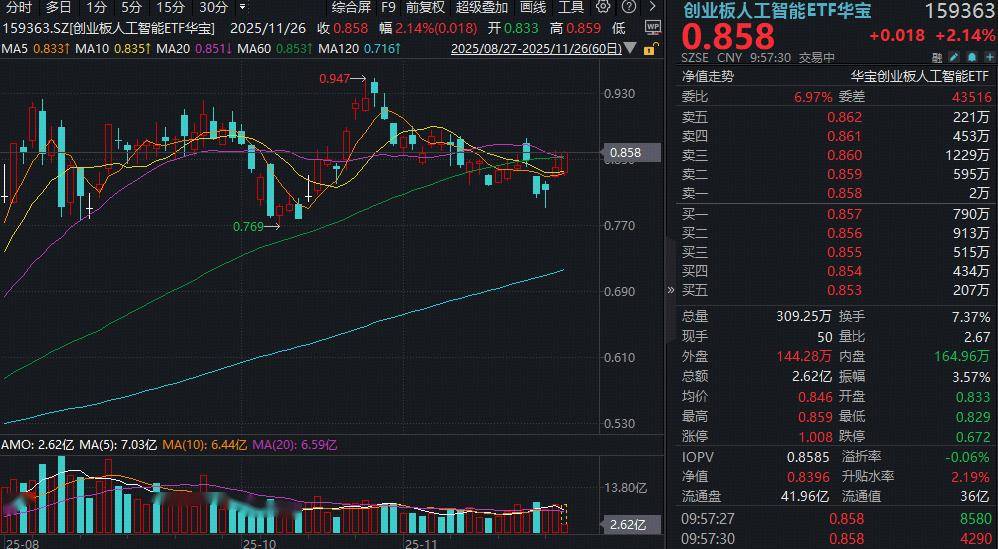
光模块集体大涨!含“光”量超54%的创业板人工智能ETF(159363)火速冲高逾3.4%
Mei Ri Jing Ji Xin Wen· 2025-11-26 02:33
近期,谷歌TPU与英伟达GPU引发市场争议,从国内供应链机会来看,其实无论是谷歌TPU基于3D Torus和OCS的架构,还是英伟达GPU基于NVLink和CLOS网络的架构,在构建超大规模AI算力集群 时,都不可避免地要使用光模块来突破通信瓶颈。光模块作为数据中心内部的"信息高速公路",确保了 计算潜力能被完全释放。因此,光模块已成为支撑英伟达GPU和谷歌TPU这两大AI算力巨头迈向未来的 共同基石。 从光模块配置上,创业板人工智能ETF(159363)基金经理近期表示,在美股开始底部显著反弹之际, 虽然调整会反复,但主跌浪或已结束,泛科技ETF配置价值凸显;同时A股高位板块也死守箱体,低位 板块位置调整充分。从空间角度,市场已经达到"低吸"的较好"击球点",配置上关注以光模块为代表的 创业板人工智能ETF(159363),目前就相当于成长板块指数增强。 11月26日,光模块CPO集体大幅拉升,中际旭创领涨超6%,新易盛涨超5%,光库科技涨超4%。热门 ETF方面,光模块含量超54%的创业板人工智能ETF(159363)低开高走,场内价格快速冲高逾3.4%, 盘中站上所有均线,实时成交额快速突破4.4亿元。 ...

ETF盘中资讯 | 光模块:英伟达GPU与谷歌TPU的算力基石!含“光”量超54%的创业板人工智能ETF(159363)再涨逾2%
Sou Hu Cai Jing· 2025-11-26 02:27
| 分时 多日 1分 5分 15分 30分 7 | 综合屏 F9 前复权 超级叠加 回线 工具 (2) | 159363 | 创业板人工智能印文字 | 159363.SZ[创业板人工智能ETF华宝] 2025/11/26 收 0.858 幅 2.14%(0.018) 开 0.833 高 0.859 低 | 0-8 | OHE | +0.018 +2.14% | | --- | --- | --- | --- | --- | --- | --- | --- | | 10 10 | MA5 0.8331 MA10 0.8351 MA20 0.851 MA60 0.8537 MA120 0.7167 | 2025/08/27-2025/11/26(60日) | SZSE CNY 9:57:30 交易中 | 十八 六 · | | | | | 净值走势 | 华宝创业板人工智能ETF | 0.930 | 製化 | 6.97% === | 43516 | | | | 菜五 | 0.862 | 221万 | 題 要要要要是 | 0.861 | 453万 | | | | 0.858 | 0.860 | 1229万 | 0.85 ...



2025全省算力和大数据产业供需对接活动举行 让“算力浪潮”奔向算力高地
Si Chuan Ri Bao· 2025-11-26 00:19
Group 1 - Computing power is becoming an essential resource for the digital economy, with overall growth rates in China maintaining between 20% and 30%, and intelligent computing power growth reaching 50% to 100% [1][2] - Sichuan is accelerating the construction of a national integrated computing power network, forming a new development pattern centered around the Tianfu data center cluster, with collaboration from cities like Ya'an, Deyang, and Dazhou [1][5] - The recent supply-demand matching event in Sichuan gathered over a hundred upstream and downstream enterprises, aiming to build bridges for the computing power and big data industry [1] Group 2 - The integration of computing power in food safety and smart transportation is highlighted, with companies showcasing intelligent devices that rely on strong computing power for data analysis and risk management [2] - The Ministry of Industry and Information Technology has issued plans to promote the collaborative layout of computing power networks, aiming to integrate computing power into urban infrastructure [2] Group 3 - Sichuan is leveraging its advantages in clean energy, educational strength, and industrial foundation to develop a computing power and big data industry, with plans to establish a collaborative development framework by 2027 [5] - The "East Data West Computing" initiative is being utilized to create a computing power hub with national influence [5] Group 4 - The manufacturing sector faces challenges in digital transformation, with companies struggling to implement mature industrial models and application scenarios [6] - New hardware solutions, such as advanced cooling systems, are being developed to support the evolving demands of high-density and high-power computing environments [6]
润建股份(002929.SZ):筹划发行H股股票并在香港联合交易所上市
Ge Long Hui A P P· 2025-11-25 11:35
Core Viewpoint - The company is planning to issue overseas shares (H-shares) and list on the Hong Kong Stock Exchange to enhance its global development strategy and strengthen its AI and computing power business layout [1] Group 1 - The company aims to consolidate its industry-leading position by leveraging resources and mechanisms from international capital markets [1] - The company is actively seeking to diversify its financing channels to improve its overall strength [1] - Discussions with relevant intermediaries regarding the specifics of the H-share listing are currently underway, with details yet to be finalized [1] Group 2 - The H-share listing will not result in any changes to the company's controlling shareholder or actual controller [1]
刚刚,集体飙涨,“AI新王”诞生
3 6 Ke· 2025-11-25 10:23
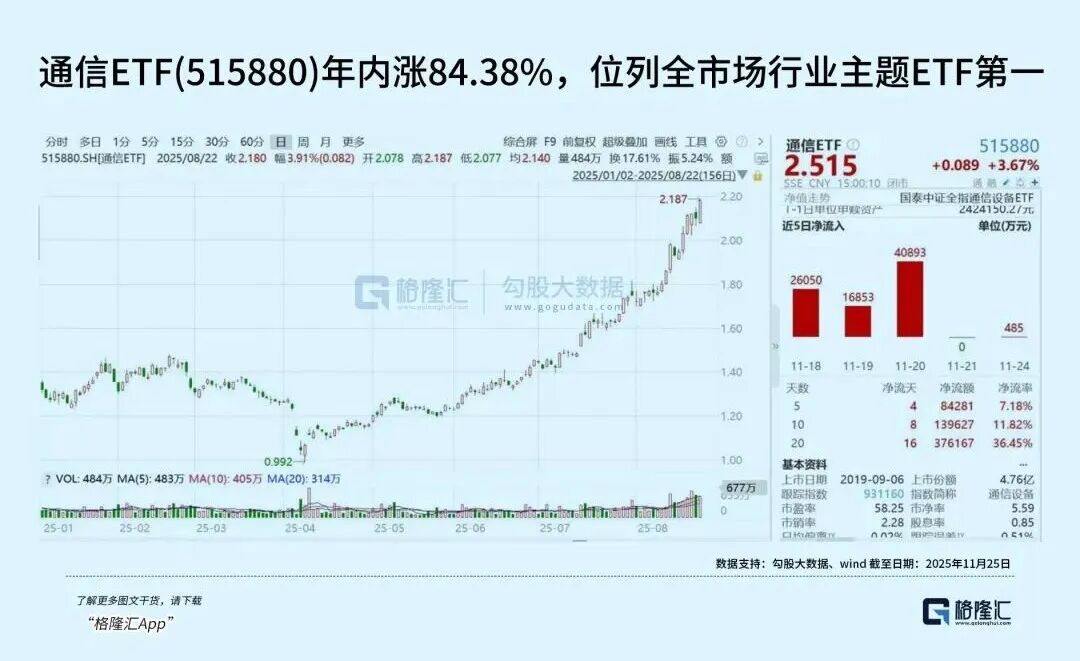
Core Viewpoint - The A-share market experienced a collective rise, driven by the strong performance of Google and Broadcom, signaling a rebound in AI-related stocks. The focus is on Google's advancements in AI technology and its implications for the industry [1][5][16]. Group 1: AI Developments - Google is positioning itself as a leader in the AI sector, with its self-developed TPU chips expected to capture 10% of Nvidia's annual revenue, potentially generating billions in new income [6]. - The recent release of Google's Gemini 3 Pro model has set a new industry benchmark, outperforming competitors like OpenAI's GPT-5.1 in various key tasks [19]. - Anthropic's Claude Opus 4.5 has emerged as a strong competitor, indicating the rapid pace of innovation in the AI field [7]. Group 2: Market Reactions - The technology sector, particularly AI hardware stocks, saw significant gains, with the Communication ETF (515880) rising by 3.67% and achieving an 84.38% increase year-to-date, making it the top-performing industry theme ETF in the A-share market [1][21]. - Meta's potential investment in Google's TPU for its data centers has further bolstered Google's stock performance, contributing to a broader tech sector rebound [5][16]. Group 3: Industry Implications - Google's advancements in AI and its comprehensive technology ecosystem are expected to drive increased capital expenditures in computing power and chip procurement in the coming years [16][20]. - The communication equipment sector is benefiting from the ongoing global AI arms race, with companies in this space experiencing growing business demand [21]. - The Communication ETF provides investors with a convenient way to gain exposure to the communication sector, which is heavily weighted towards optical modules and servers [21][22]. Group 4: Future Outlook - The AI model development cycle is entering a new phase, with increasing demand for computing power reinforcing the growth narrative for the communication sector [27]. - Despite recent market adjustments, the underlying demand for AI-driven computing remains strong, suggesting that current pullbacks may present investment opportunities [29].
计算机ETF(512720)涨超0.5%,AI驱动云与算力投资逻辑强化
Mei Ri Jing Ji Xin Wen· 2025-11-25 07:11
Core Insights - AI technology has become a core driving force in the computer and software development industry, with significant capital expenditures from major cloud providers [1] - The combined investment of Amazon, Microsoft, Google, and Meta in AI-related infrastructure is expected to exceed $110 billion by Q3 2025, primarily for data centers and AI infrastructure [1] - AI is significantly boosting cloud business revenues, with Amazon AWS backlog orders exceeding $200 billion, Microsoft Azure experiencing a growth rate of 40%, and Google Cloud revenue share increasing to 14.8% [1] - NVIDIA's data center business achieved a record revenue of $51.2 billion in a single quarter, with future quarters expected to generate $500 billion [1] - AI technology is also driving revenue growth for SaaS companies, with firms like ServiceNow and Palantir seeing substantial income increases through AI platforms [1] - Overall, AI's deep penetration in cloud computing, computing power, and software applications is continuously reshaping the industry landscape and creating new growth momentum [1] Industry Overview - The Computer ETF (512720) tracks the CS Computer Index (930651), which selects listed companies involved in software development, IT services, and hardware manufacturing from the Shanghai and Shenzhen markets [1] - The index reflects the overall performance of publicly listed companies related to computing, with a focus on the information technology sector and a growth-oriented style [1]
A股,大反攻!
中国基金报· 2025-11-25 05:02
Market Overview - A-shares opened higher and continued to rise, with the ChiNext Index reaching a gain of 3% at one point. As of the midday close, the Shanghai Composite Index was at 3880.22 points, up 1.13%, the Shenzhen Component Index rose 2.04%, and the ChiNext Index increased by 2.6% [3][4]. Sector Performance - The technology growth sector showed strong performance, with significant rebounds in computing hardware and AI applications. The communication equipment and electronic components sectors led the gains, particularly in optical modules (CPO), optical chips, optical communications, and ASIC chip concepts [5][11]. - Precious metals and education sectors also performed well, with stocks related to cross-strait integration and automotive chips rising [6]. - Conversely, the previously high-performing aquaculture sector experienced a notable pullback, with the shipbuilding and shipping sectors weakening [7][28]. Notable Stocks - The optical module sector saw a surge, with the CPO concept rising by 9%. Several stocks hit the daily limit up, including Dekoli, Changguang Huaxin, and Guangke Technology, all achieving a 20% increase [11][12]. - Precious metals stocks also saw significant gains, with Huaxi Nonferrous Metals nearing the limit up, and Shengda Resources rising over 6%. Other notable performers included Xibu Gold and Zhongjin Gold, both up over 5% [21][22]. - In the photovoltaic equipment sector, Guosheng Technology hit the limit up, while Yangguang Electric Power rose nearly 6% [25][26]. Market Sentiment - The market sentiment was buoyed by expectations of a potential interest rate cut by the Federal Reserve, which contributed to the rise in gold prices, reaching a weekly high of $4155.9 per ounce [23][20].

A股午评 | 三大指数集体走高 全市场近4900股上涨 算力硬件、AI应用概念爆发
智通财经网· 2025-11-25 03:51
Market Overview - The market showed a strong performance in the morning session, with the Shanghai Composite Index rising by 1.13%, the Shenzhen Component Index by 2.04%, and the ChiNext Index by 2.6%, with nearly 4,900 stocks in the market experiencing gains [1] - Various sectors saw active trading, including significant gains in optical modules, PCB, AI applications, storage chips, and commercial aerospace concepts, while only a few sectors, such as aquaculture and military industry, faced declines [1] Hot Sectors CPO Concept - The CPO concept gained momentum, with stocks like Guangku Technology, Dekeli, and Changguang Huaxin hitting the 20% limit up [2] - The positive sentiment was driven by Google's Gemini 3 Pro receiving favorable reviews, and an increase in ASIC chip shipments is expected to boost the global market for optical modules [2] Consumer Electronics - The consumer electronics sector saw significant gains, with stocks like Kewan Technology hitting the limit up and Chunqiu Electronics following suit [3] - Huawei announced a product launch event on November 25, which is anticipated to drive growth in the sector, with AI becoming a core engine for development [3] AI Applications - AI application stocks experienced repeated strength, with stocks like Bojie Co. hitting the limit up and Haitan Ruisheng rising over 14% [4] - The rapid growth of Alibaba's AI assistant app, which surpassed 10 million downloads in a week, indicates a strong market for AI applications [4] Computing Power - The computing power sector performed strongly, with stocks like Pingao Co. hitting the limit up and Aibulu rising over 14% [5] - Meta Platforms is reportedly considering a significant investment in Google's TPU, indicating a robust demand for computing power solutions [5] Storage Chips - The storage chip sector was active, with stocks like Shenkong Co. rising over 14% [6] - A report from Morgan Stanley highlighted a growing shortage in the memory market, leading to a "fully sold out" status among suppliers [6] Market Outlook - Guotai Junan expressed optimism about the Chinese stock market, suggesting it will stabilize and embark on a cross-year rally, presenting a good opportunity for investors to increase their positions [7] - CITIC Securities noted that the market is currently in a consolidation phase, with a focus on strategic positioning ahead of key economic meetings in December [8] - Huatai Securities indicated that the market valuation is approaching a "reasonable" level, suggesting that if there is an overshoot, investors could consider increasing their positions [9]
中银金租胡文勇:未来5年是人工智能技术全面落地与产业深度融合的关键阶段
Di Yi Cai Jing· 2025-11-25 03:34
11月25日上午,2025租赁业产融生态大会在上海召开。中银金租党委书记、董事长胡文勇在主旨演讲中 表示,未来5年是人工智能技术全面落地与产业深度融合的关键阶段,算力作为AI的心脏,基础设施投 资巨大,技术迭代飞速。目前,中银金租正对接多个国家级算力节点和大型数据中心项目,重点支持液 冷技术、绿电供应的绿色低碳算力中心。 责任编辑:秦艺 ...
美股科技巨头亚马逊投资500亿美元加码算力,科创100ETF华夏(588800)、科创半导体ETF(588170)强势上涨
Mei Ri Jing Ji Xin Wen· 2025-11-25 03:11
Group 1 - The Shanghai Stock Exchange Sci-Tech Innovation Board 100 Index rose by 2.65%, with notable increases in stocks such as Lingyun Optics (up 11.72%) and Yuanjie Technology (up 10.23%) [1] - The Sci-Tech Innovation Board Semiconductor Materials and Equipment Theme Index increased by 1.34%, with key stocks like Shenkong Co. (up 7.48%) and Oulaine Materials (up 3.60%) showing strong performance [1] - The U.S. stock market saw significant gains in popular tech stocks, with Tesla and Google A both rising over 6%, indicating a positive sentiment in the tech sector [1] Group 2 - Huajin Securities highlighted the release of Huawei's reports, predicting that general artificial intelligence will be a transformative technology driver over the next decade, with a projected 100,000-fold increase in total computing power by 2035 [2] - The Sci-Tech 100 ETF closely tracks the Sci-Tech 100 Index, focusing on high-growth sectors including semiconductors, pharmaceuticals, and new energy [2] - The Sci-Tech Semiconductor ETF encompasses 61% semiconductor equipment and 23% semiconductor materials, indicating a strong focus on domestic substitution in these critical sectors [2]