
大数据

Search documents
以强投研优配置赢得高质量发展未来
Zhong Guo Zheng Quan Bao· 2025-12-19 20:10
Core Viewpoint - The banking wealth management industry is experiencing unprecedented challenges despite reaching a historical high in scale, primarily due to shifts in customer demand and an increasing "asset shortage" phenomenon [1] Group 1: Industry Challenges - The primary pressure on the banking wealth management sector comes from the customer demand side, where individual investors predominantly have a low to medium risk appetite [1] - On the supply side, the "asset shortage" is becoming more severe, complicating traditional operational strategies for wealth management companies [1] - The transition to fully net value-based products has led to inevitable fluctuations in product net values, posing significant challenges to traditional business models [1] Group 2: Opportunities in the Industry - There is a "golden window period" for the shift of residents' deposits towards wealth management products, as these products demonstrate relative yield advantages amid declining deposit rates [1] - Institutional clients are increasingly transitioning from being "borrowers" to "investors," indicating substantial potential in corporate wealth management [1] - The structural changes in social financing present rare opportunities for wealth management companies to leverage their value [1] Group 3: Company Strategy - The company aims to transform its operational philosophy to prioritize investor interests in the new development stage [2] - It plans to enhance its investment research capabilities through integrated investment research construction and by expanding multi-asset strategies [2] - The company is focused on accelerating the development of an integrated digital empowerment system, applying technologies like AI and big data to improve customer service and investment management [2]
紧急!某运营商前10月还有8家省公司这项重要业务收入负增长 海南辽宁天津在列 一年可都要结束了
Xin Lang Cai Jing· 2025-12-19 19:17
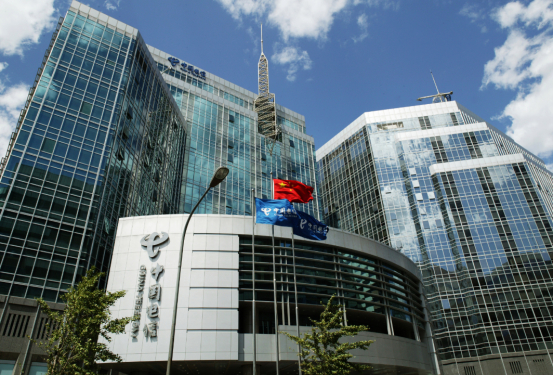
运营商财经网 吴碧慧/文 近期,据知情人士独家透露,在今年前10个月中,中国电信云底座发展情况向好,已实现双位数增长。 然而在这一背景下,集团仍有8家省公司收入为负增长,且下滑程度不小。 近年来,云底座作为人工智能、大数据等新技术应用的基础平台,为各行业数字化转型提供基础设施支 持,运营商能够基于云平台推出行业解决方案,实现从传统通信业务向数字化服务领域转型,开辟新的 收入渠道。 但如今一年都快要结束了,这8家省公司的增速水平与集团平均水平相差甚远。 运营商财经网通信业务部主任刘庆表示,云底座收入呈负增长也就意味着相关政企业务场景支撑受限, 无法满足相关客户需求,市场竞争力下降,也会进一步导致公司政企业务收入下滑,形成恶性循环。 (转自:运营商观察) 特别声明:以上文章内容仅代表作者本人观点,不代表新浪网观点或立场。如有关于作品内容、版权或其它问 题请于作品发表后的30日内与新浪网联系。 据悉,这8家省公司分别是海南电信、辽宁电信、天津电信、西藏电信、河南电信等等,这几家省公司 云底座收入同比降幅已超10%,远低于集团平均水平。 这之中大多为北方省公司以及小规模省公司,情况不容乐观。 ...


上海汇智通贸贸易有限公司成立,注册资本200万人民币
Sou Hu Cai Jing· 2025-12-19 17:35
Company Overview - Shanghai Huizhi Tongmao Trading Co., Ltd. was recently established with a registered capital of 2 million RMB [1][2] - The legal representative of the company is Zhen Changhua, and it is wholly owned by Shanghai Yuanjing Zhihui Cultural Media Co., Ltd. [1][2] Business Scope - The company’s business scope includes import and export of goods, import and export agency, technology import and export, and software development [1] - Specific projects include sales of aviation transport equipment, civil aviation materials, intelligent robots, industrial robots, consumer service robots, artificial intelligence hardware, cameras and equipment, mobile communication devices, network equipment, and internet sales [1] - Additional services offered include technical services, technology development, consulting, and promotion, as well as big data services, data processing, and storage support [1] Industry Classification - The company is classified under the national standard industry of transportation, warehousing, and postal services, specifically in the aviation transportation sector [2] - The registered address is located in Pudong New District, Shanghai [2]
又一家未盈利企业,冲刺创业板!
Xin Lang Cai Jing· 2025-12-19 15:04
Core Viewpoint - Yu Xin Semiconductor Technology Co., Ltd. has officially submitted its IPO application to the Shenzhen Stock Exchange, aiming to raise 7.5 billion yuan, with GF Securities as the sponsor [1][8]. Company Overview - Yu Xin Semiconductor, established in 2017, focuses on providing 12-inch wafer foundry services and specialized process solutions for domestic and international chip design companies [12]. - The company has achieved a comprehensive technology matrix covering "perception, transmission, computation, storage, control, and display," establishing core competitive advantages in various fields [12]. - As of June 30, 2025, Yu Xin Semiconductor holds 681 authorized patents, including 312 invention patents [12]. Financial Performance - The company reported revenues of 1.545 billion yuan in 2022, 1.044 billion yuan in 2023, 1.681 billion yuan in 2024, and 1.053 billion yuan in the first half of 2025, with a significant revenue increase of 61.09% from 2023 to 2024 [11][12]. - Yu Xin Semiconductor is the second unprofitable company accepted by the Shenzhen Stock Exchange for IPO [11]. Market Position and Strategy - The company has become a leading foundry for capacitive fingerprint recognition chips globally and ranks third among mainland wafer manufacturers for high-voltage display driver chips in 2024 [12]. - The IPO proceeds will primarily fund the development of specialized process technology platforms, including projects related to silicon photonics and memory chips [13]. - Yu Xin Semiconductor aims to transition from pure analog foundry services to a composite technology platform that integrates analog, mixed-signal, and optoelectronic processes [12][13]. Industry Outlook - The global silicon photonics market is projected to reach $10.26 billion by 2029, with a compound annual growth rate of nearly 40% from 2023 to 2029, indicating significant market opportunities for Yu Xin Semiconductor [14]. - The company is recognized as the first 12-inch wafer manufacturing enterprise in Guangdong Province, marking a breakthrough in local chip manufacturing capabilities [14].

又一家未盈利企业 冲刺创业板!
Shang Hai Zheng Quan Bao· 2025-12-19 14:22
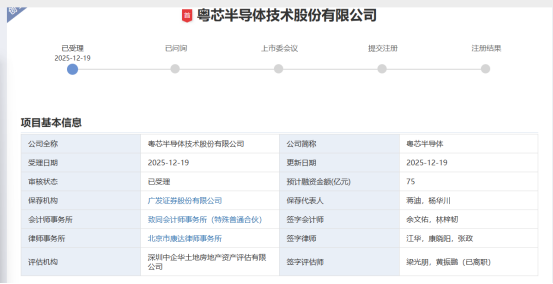
12月19日,粤芯半导体技术股份有限公司(简称"粤芯半导体")的创业板IPO申请正式获深交所受理, 本次粤芯半导体拟募集资金75亿元,保荐机构为广发证券。 | LOP . | | ■ 粤芯半导体技术股份有限公司 | | | | --- | --- | --- | --- | --- | | 已發現 | 已同响 | 上市委会议 | 提交注册 | 注册结果 | | 2025-12-19 | 0 | 0 | œ | | | 项目基本信息 | | | | | | 公司全称 | 电芯半导体技术股份有限公司 | 公司道称 | | 电芯半导体 | | 受理日期 | 2025-12-19 | 更新日期 | | 2025-12-19 | | 章被状态 | 已受理 | 预计融资金额(乙元) | | 75 | | 倡積机构 | 广发证券股份有限公司 | 假荷代表人 | | 聘曲,杨俐川 | | 会计师事务所 | 致园会计师事务所(特殊善通合伙) | 签字会计师 | | 余文佑,林梓树 | | 律师事务所 | 北京市康达律师事务所 | 签字律师 | | 江华,康晓阳,张政 | | 评估机构 | 深圳中企华土地房地产资产评估有限 公司 ...
国务院国资委主任张玉卓:深入开展新一轮中央企业数字化转型行动
Xin Lang Cai Jing· 2025-12-19 13:19
Core Viewpoint - The State-owned Assets Supervision and Administration Commission (SASAC) emphasizes the need for central enterprises to focus on their main responsibilities and develop the real economy during the 14th Five-Year Plan period, aiming for a transition towards high value-added and high-tech industries [1] Group 1: Industry Focus - Central enterprises will be guided to enhance their roles in modern industrial systems, particularly in upgrading traditional industries [1] - A new round of digital transformation initiatives will be launched, focusing on integrating technologies such as AI, big data, cloud computing, 5G, and the Internet of Things with traditional industries [1] Group 2: Technological Integration - The emphasis will be on deep integration of information technology throughout the entire process and elements of traditional industries [1] - Continuous promotion of technological upgrades and large-scale equipment renewal will be prioritized [1] Group 3: Sustainability and Innovation - Central enterprises are expected to implement carbon peak plans in key sectors, promoting efficient resource recycling [1] - There will be a focus on accelerating product iteration and upgrading, enhancing the supply of high-end products, and fostering intelligent, green, and integrated development [1]
贯彻落实党的二十届四中全会精神权威访谈丨不断增强国有企业核心功能、提升核心竞争力——访国务院国资委党委书记、主任张玉卓
Xin Hua Wang· 2025-12-19 12:44
Core Viewpoint - The article discusses the strategic initiatives and reforms that state-owned enterprises (SOEs) in China will undertake to enhance their core functions and competitiveness in alignment with the 15th Five-Year Plan, focusing on innovation, industrial upgrades, and the establishment of world-class enterprises [1][7]. Group 1: Innovation and Technology - State-owned enterprises are positioned as the national team for technological innovation, with R&D investments exceeding 1 trillion yuan for three consecutive years, targeting critical technologies in areas like industrial machinery and software [2][3]. - The focus will be on increasing high-quality technological supply, particularly in areas where other enterprises lack the capability or willingness to invest, ensuring breakthroughs in foundational and key common technologies [2]. - Efforts will be made to enhance the efficiency of technology transfer and application, including the establishment of major pilot verification platforms and increasing procurement of first sets of products to promote market entry [3]. Group 2: Industrial Upgrades - The strategy emphasizes the transformation of traditional industries and the cultivation of emerging industries, with an average annual investment growth rate of over 20% in new industries during the 14th Five-Year Plan [4][5]. - SOEs will focus on digital transformation and the integration of advanced technologies like AI, big data, and 5G into traditional industries to promote smart, green, and integrated development [5]. - The cultivation of new and future industries will be prioritized, with a focus on sectors such as renewable energy, aerospace, and quantum technology, ensuring sustained growth and innovation [5][6]. Group 3: Reform and Governance - The next phase of SOE reform will focus on enhancing core functions and competitiveness, with an emphasis on aligning with national strategic needs and improving governance structures [7][8]. - A specialized regulatory framework will be developed to enhance the effectiveness of state asset supervision, ensuring a balance between flexibility and control [8]. - The goal is to foster world-class enterprises by improving value creation, innovation capabilities, and modern governance practices, while also strengthening the role of the Communist Party in corporate governance [9][10].
苏豪弘业:重点围绕节能环保、化工新材料等领域布局
Zheng Quan Ri Bao Wang· 2025-12-19 11:43
Core Viewpoint - The company, Suhao Hongye (600128), is implementing a restricted stock incentive plan that includes multiple performance assessment indicators to enhance its core competitiveness and drive innovation [1] Group 1: Incentive Plan Details - The performance assessment indicators of the incentive plan include basic earnings per share, weighted average return on net assets, total profit, and the proportion of cash dividends to distributable profits for the year [1] Group 2: Strategic Initiatives - The company aims to enhance its core competitiveness through innovation-driven development and increased R&D investment [1] - Plans include upgrading the toy design and R&D center of its subsidiary to strengthen independent innovation capabilities and accelerate the transition from OEM to ODM [1] - The company will advance cross-border e-commerce technological innovation by utilizing AI, big data, and cloud computing to continuously improve platform functionality and service levels [1] - Focus areas for potential mergers and acquisitions include energy conservation, environmental protection, and new chemical materials, aiming to develop new business segments with growth potential [1]

大湾区模拟芯片龙头粤芯半导体IPO获深交所受理,借助资本市场实现企业跨越式发展
Zheng Quan Shi Bao Wang· 2025-12-19 11:38
Core Viewpoint - YuXin Semiconductor has received approval for its IPO application from the Shenzhen Stock Exchange, aiming to raise 7.5 billion yuan to accelerate its development in the semiconductor industry [1][2]. Group 1: Company Overview - YuXin Semiconductor specializes in analog and mixed-signal wafer foundry services, serving major semiconductor design companies both domestically and internationally [1][2]. - The company has established a comprehensive technology matrix covering sensing, transmission, computation, storage, control, and display, achieving a leading position in various product categories [2][3]. - YuXin Semiconductor is recognized as the first 12-inch wafer manufacturing enterprise in Guangdong Province, marking a significant milestone in the region's semiconductor industry [5][6]. Group 2: IPO and Funding Utilization - The company plans to use the 7.5 billion yuan raised from the IPO primarily for expanding production capacity and developing specialized technology platforms [3]. - Key projects include the development of silicon photonics technology based on 65nm logic, MCU technology based on eNVM, and integrated storage-computing chips based on 22nm logic and RRAM technology [3]. Group 3: Market Opportunities - The global silicon photonics market is projected to reach $10.26 billion by 2029, with a compound annual growth rate of nearly 40% from 2023 to 2029, indicating significant market potential for YuXin Semiconductor [4]. - The company aims to enhance its technology advantages and transition from consumer-grade to industrial-grade and automotive-grade processes, focusing on applications in artificial intelligence and near-storage computing [2][3]. Group 4: Industry Impact - The transformation and listing of YuXin Semiconductor will help complete the integrated circuit industry chain in the Greater Bay Area, providing a crucial platform for the localization of upstream and downstream sectors such as equipment, materials, and EDA [6].
人民网舆情数据中心发布《第八届中国国际进口博览会传播影响力报告》
Ren Min Wang· 2025-12-19 11:06
进博会兼顾中国之需与世界之盼,传播影响力报告亦为此助力。作为进博会召开后的重磅盘点,人 民网舆情数据中心已连续8年与中国国际进口博览局合作编制此项报告,积累了丰富的数据与研究经 验,成为各方了解进博会传播情况的重要渠道,受到广泛关注与充分认可,也为记录进博会传播轨迹、 展现中国高水平对外开放实践提供支撑。 人民网北京12月19日电 (记者郭亚飞)12月19日,《第八届中国国际进口博览会传播影响力报 告》正式发布。 《报告》显示,第八届进博会传播影响力突出,总数据量超60亿次。境内传播方面,热度高、周期 长、渠道广。展会传播呈现"贯穿全年、多峰叠加"的特点,以主流媒体为核心,社交媒体、资讯平台联 动,合力形成传播矩阵。监测数据显示,社交平台相关话题,累计浏览量约30亿次;各级各类媒体报 道,累计阅读量超20亿次;全网信息量超过220万条。国际传播方面,影响力持续提升,展现了坚持对 外开放的筹办底色。路透社、彭博社、法新社、德新社、意大利安莎社、日本共同通信社、韩联社、英 国《金融时报》、新加坡《联合早报》等媒体,高频报道进博会,相关内容触达近100个国家和地区, 覆盖海外受众约12亿人次,境外信息超4.5万条。 ...
