物联网

Search documents
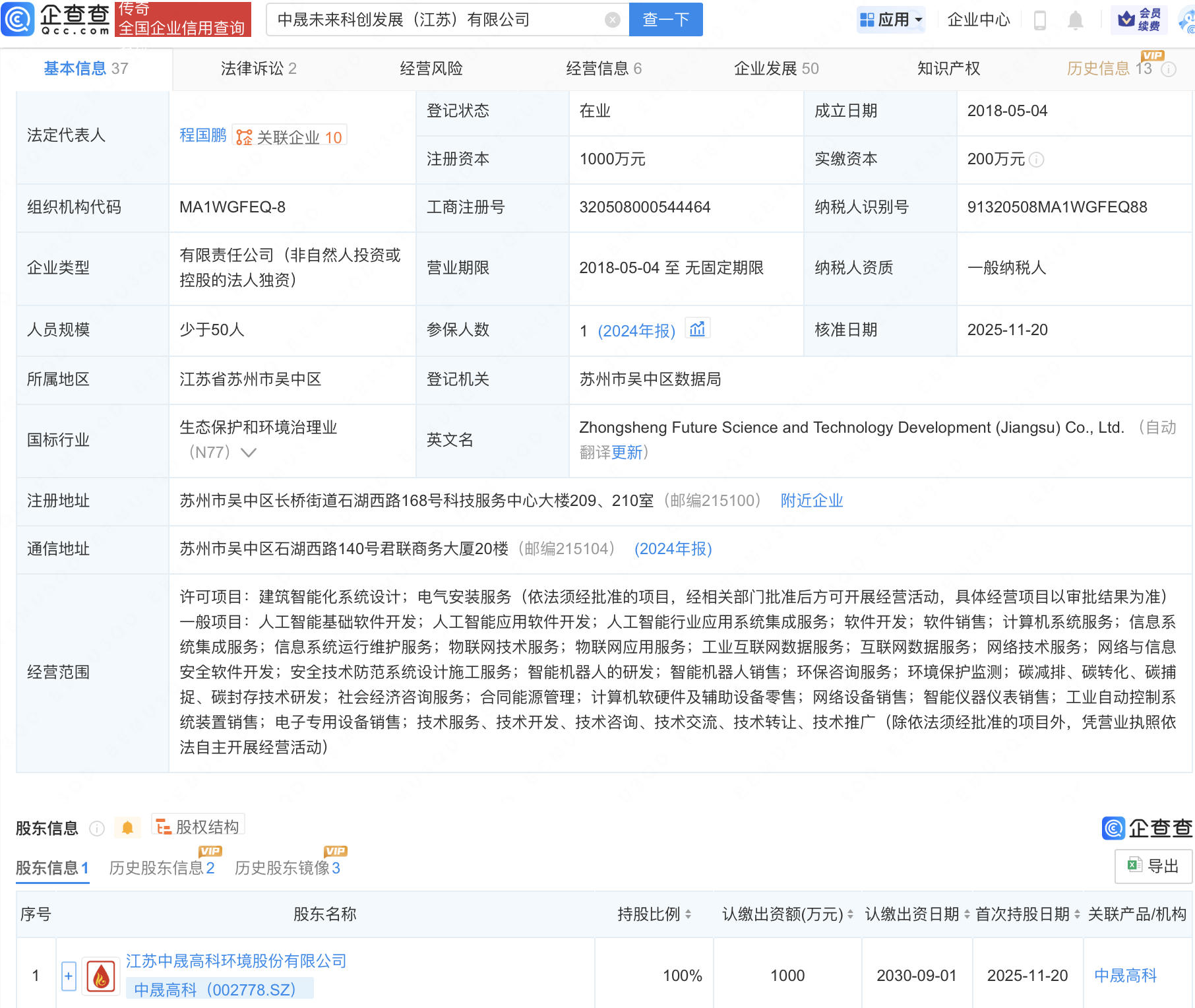
中晟高科控股公司经营范围变更为AI及智能机器人等
Qi Cha Cha· 2025-11-27 01:56
Core Viewpoint - The company formerly known as Suzhou Zhongsheng New Environment Management Co., Ltd. has undergone a name change to Zhongsheng Future Science and Technology Development (Jiangsu) Co., Ltd. and has shifted its business focus towards artificial intelligence and robotics [1][3]. Company Information - The new registered name is Zhongsheng Future Science and Technology Development (Jiangsu) Co., Ltd. with a registered capital of 10 million yuan [2]. - The legal representative is Cheng Guopeng, and the company was established in May 2018 [2]. - The company is located in Suzhou, Jiangsu Province, and operates as a limited liability company [2]. Shareholder Changes - Suzhou Zhongsheng Environmental Restoration Co., Ltd. has exited the shareholder list, and Zhongsheng High-Tech (002778) has become the sole shareholder [1][3]. - The ownership structure now reflects 100% ownership by Jiangsu Zhongsheng High-Tech Environmental Co., Ltd. [2]. Business Scope - The business scope has been updated to include artificial intelligence application software development, AI industry application system integration services, IoT technology services, and research and sales of intelligent robots [1][3]. - The company is also involved in various other services such as environmental consulting and energy management [2].


研判2025!中国漏泄电缆行业产业链、市场规模、企业分析及发展趋势分析:应用场景持续拓宽,漏泄电缆行业年复合增长率16.4% [图]
Chan Ye Xin Xi Wang· 2025-11-27 01:15
Core Viewpoint - The leakage cable industry is a significant segment of the cable sector, focusing on the production of specialized cables with signal transmission and antenna functions, experiencing continuous growth due to rapid advancements in mobile communication and rail transit sectors, supported by favorable national policies [1][9]. Industry Overview - Leakage cables, also known as leakage coaxial cables, are designed with periodic slots in the outer conductor, allowing electromagnetic wave transmission and radiation, making them essential for wireless communication in confined spaces like subways and tunnels [3][4]. - The leakage cable market in China reached a size of 2.9 billion yuan in 2019, projected to grow to 6.21 billion yuan by 2024, with a compound annual growth rate (CAGR) of 16.4% [1][10]. Industry Chain - The leakage cable industry consists of three main segments: upstream (raw material suppliers), midstream (manufacturing), and downstream (application fields). The upstream includes suppliers of metals like copper and aluminum, while the midstream focuses on the production processes, and the downstream involves applications in various sectors such as transportation and security [6][7]. - Copper is the primary raw material for leakage cables, with China's copper production maintaining over 20 million tons annually. In 2023, copper production decreased by 3.04%, but is expected to rebound by 6.01% in 2024 [7]. Market Dynamics - The urban rail transit sector is a major application area for leakage cables, with the total operational mileage of urban rail transit in China expected to increase from 7,973.41 kilometers in 2020 to 12,160.77 kilometers by 2024, enhancing the demand for reliable signal systems [8][9]. - Domestic companies like Zhongtian Technology and Tongding Interconnection have made significant technological advancements, breaking foreign monopolies in high-end leakage cable markets [11]. Development Trends - High performance is a key future trend, with leakage cables expected to evolve towards higher transmission rates, lower losses, and stronger anti-interference capabilities, particularly to meet the demands of 5G technology [14]. - The application scenarios for leakage cables are diversifying beyond traditional uses, with emerging areas such as smart mining and emergency communications gaining traction [15]. - Industry consolidation is anticipated, with leading companies likely to integrate vertically to control raw material supply and expand their market presence through strategic partnerships and acquisitions [16].


研判2025!中国智慧操场行业发展历程、产业链、市场规模、企业分析、发展趋势:AI深度融合体育场景,智慧操场激活多元应用需求[图]
Chan Ye Xin Xi Wang· 2025-11-27 01:15
Core Insights - The smart playground is an integrated sports venue that combines advanced technology elements, providing a comprehensive platform for sports, health, entertainment, and interaction [1][6] - The demand for smart playgrounds is increasing, particularly in schools, as they enhance students' physical fitness awareness and performance [1][6] - The market size of China's smart playground industry is projected to reach 538 million yuan in 2024, reflecting a year-on-year increase of 31.5% [1][7] Industry Overview - Smart playgrounds utilize technologies such as IoT, cloud computing, and big data to promote innovation in sports education and training methods [3] - Key features of smart playgrounds include intelligent management, diverse sports options, personalized services, and strong interactivity [3] - The industry has evolved from basic information applications to comprehensive solutions supported by AI and data analysis technologies [3][5] Market Demand - The Chinese government has implemented policies to promote the development of smart playgrounds, emphasizing the integration of AI technology across various sectors [1][6] - The number of schools in China is substantial, with 15,755 high schools, 52,054 junior high schools, and 136,332 primary schools, indicating a large market demand for smart playgrounds [5][6] Competitive Landscape - The smart playground market is competitive, with key players including iFlytek, Anhui Yishi Technology, and others, each focusing on different market segments and service offerings [2][8] - Leading companies have developed mature solutions primarily targeting school environments, while startups are making breakthroughs in niche areas [8][9] Development Trends - The industry is expected to see advancements in core technologies, including non-wearable visual recognition and multi-modal data fusion, enhancing the precision of action analysis and identity recognition [10] - There is a growing need for personalized services tailored to different demographics, such as students and elderly individuals, to enhance user engagement and safety [12]


Is IRDM Stock Ready To Rebound?
Forbes· 2025-11-26 17:35
Core Viewpoint - Iridium Communications (IRDM) is currently trading at a significant discount despite its steady expansion and strong cash generation, raising questions about whether the stock is undervalued and poised for a rebound [2][3]. Current Developments with IRDM - IRDM has seen a 42% decline in stock price this year, trading at a substantial discount compared to its recent peaks over 3 months, 1 year, and 2 years [4]. - The decline is attributed to tightened service revenue growth forecasts for 2025, delays in positioning, navigation, and timing (PNT) revenue, and a decrease in government subscribers [4]. - Positive developments include a 7% increase in commercial IoT revenue in Q3 2025, with expectations for double-digit growth for the full year, and over 30% growth in revenue from engineering/support services due to government contracts [5]. - Project Stardust, a new service, is set for testing in 2025 with a launch planned for 2026, and the acquisition of Satelles in 2024 will establish a new PNT service stream [5]. - Strong cash flow has allowed for a 5% dividend increase and share repurchases in 2024, with overall debt leverage expected to decline significantly by 2025 [5]. Strong Fundamentals for IRDM - IRDM's fundamentals show a cash flow yield of 17.5% and a revenue increase of 7.3% over the last twelve months, indicating continued growth in cash reserves [8]. - The stock is currently trading 34% below its 3-month peak, 49% below its 1-year peak, and 59% below its 2-year peak, highlighting a significant valuation discount [8][9].


筹划重大资产重组,上市公司明日起停牌,投资者重点关注
Sou Hu Cai Jing· 2025-11-26 17:34
Core Viewpoint - JiaHua Technology has announced a trading suspension due to a major asset restructuring plan, which involves acquiring controlling stakes in ShuDun Technology through a combination of share issuance and cash payment [1][3]. Group 1: Company Overview - JiaHua Technology reported a revenue of 166 million yuan for the first three quarters of 2025, as disclosed in its periodic reports [3]. - ShuDun Technology, established in 2002, specializes in domestic encryption and information security, holding commercial encryption qualifications verified by the National Cryptography Administration [3][10]. - The acquisition agreement has been signed with the actual controlling person of ShuDun, with specific details to be announced later [3]. Group 2: Transaction Details - The transaction is classified as a major asset restructuring, which will involve multiple approval and disclosure procedures according to the Shanghai Stock Exchange rules [5]. - The suspension of trading is expected to last no more than five trading days, allowing the company time for negotiations and preparation of materials [6]. - The company has emphasized that this transaction will not lead to a change in the actual controller, which is crucial for regulatory classification as a restructuring listing [8]. Group 3: Market and Regulatory Context - The integration of JiaHua's IoT big data capabilities with ShuDun's encryption and security capabilities could theoretically provide end-to-end trusted services, although the integration challenges related to team and technical standards are acknowledged [10]. - The regulatory environment imposes strict requirements on acquisitions involving encryption technology and national security, which may subject the transaction to more rigorous scrutiny [10][12]. - The cautious and formal language in the company's announcement reflects both compliance with disclosure rules and the ongoing negotiations between the parties [12][14]. Group 4: Stakeholder Concerns - Investors and minority shareholders are primarily concerned with information transparency and fair valuation, with the ambiguity during the announcement phase potentially amplifying market anxiety [14]. - The ongoing speculation about future strategic directions continues to attract attention from media, brokers, and industry observers [14].


“人车家”生态将成智能生活新支点
Zheng Quan Ri Bao· 2025-11-26 16:14
Core Viewpoint - The "Human-Vehicle-Home" ecosystem is transitioning from concept to large-scale commercial application, driven by structural changes in demand and advancements in technology [1][2]. Group 1: Demand Side - The rise of the "Human-Vehicle-Home" ecosystem is attributed to significant increases in the adoption rates of smart homes and smart vehicles, leading to a shift from fragmented experiences to a focus on "continuous experience" [1][2]. - Users are no longer satisfied with isolated smart devices; they expect integrated solutions that enhance their overall quality of life [1]. Group 2: Technological Foundation - The core of the "Human-Vehicle-Home" ecosystem lies in collaboration, facilitated by the A2A architecture, which allows different brands and systems to communicate effectively [1][2]. - The A2A model is based on distributed intelligence, offering greater scalability and fault tolerance compared to traditional closed ecosystems [1]. Group 3: Standardization - The standardization process is crucial for the realization of the "Human-Vehicle-Home" ecosystem, as unified technical agreements and interface standards are necessary to eliminate "ecological islands" [2]. Group 4: Industry Dynamics - The "Human-Vehicle-Home" ecosystem is reshaping traditional competitive logic, moving from product-based competition to ecosystem-based competition [2]. - Automotive manufacturers are extending their value propositions into home scenarios, while home appliance companies are leveraging vehicles to expand user touchpoints [2]. Group 5: Macro Perspective - The "Human-Vehicle-Home" ecosystem is becoming a foundational infrastructure for smart living, enhancing quality of life and driving growth across multiple industries, including home appliances, new energy vehicles, consumer electronics, and telecommunications [2]. Group 6: Challenges - The expansion of the "Human-Vehicle-Home" ecosystem faces challenges such as increased data security risks, the presence of underdeveloped use cases, and high integration costs due to varying technological foundations among companies [2]. Group 7: Future Competitiveness - Future competitiveness will hinge on the ability to build sustainable and extensible ecosystems, with a focus on open collaboration rather than closed competition [3].
Ping An leads “Ancient Tree Guardian Action” and green finance technology
ReinsuranceNe.ws· 2025-11-26 13:00
Core Insights - Ping An Insurance has launched the "Ancient Tree Guardian Action" initiative at COP 30, focusing on biodiversity and climate action [1] Group 1: Initiative Overview - The initiative integrates insurance solutions, advanced technology, and community engagement to preserve ancient trees in China, highlighting Ping An's leadership in biodiversity conservation [2] - China has approximately 5.08 million ancient trees, which are ecologically, historically, and scientifically significant [2] Group 2: Challenges and Solutions - Ancient trees face risks from climate change, pest infestations, and limited maintenance resources, complicating traditional insurance coverage [3] - Ping An has developed an "Insurance + Technology" model using big data, AI, and IoT to analyze tree growth and risk patterns [4] Group 3: Insurance Program and Coverage - In 2023, Ping An launched Guangdong's first ancient-tree insurance program, providing comprehensive coverage for disaster prevention and response, with over RMB 700 million (approximately USD 98 million) in coverage for more than 55,000 trees by October 2025 [5] Group 4: Technological Integration - Technology plays a crucial role, with IoT devices and environmental sensors monitoring tree health and environmental conditions, providing real-time data to caretakers [6] - The proprietary "EagleX" system combines various technologies to monitor extreme weather and deliver timely warnings, enabling proactive measures [7] Group 5: Community Engagement and Eco-Tourism - Ping An engages communities through educational programs and campaigns, including the "Travel with Ancient Trees" eco-tourism initiative, which reached 250 million users via the "Auto Owner" app [8] Group 6: Green Finance Strategy - The "Ancient Tree Guardian Action" is part of Ping An's green finance strategy, providing insurance for carbon-storing ecosystems and expanding its Carbon Sink Insurance program to 18 provinces by the end of 2024 [9] - As of June 30, 2025, Ping An's green investments totaled RMB 144.482 billion (around USD 20 billion), with green loan balances at RMB 251.746 billion (approximately USD 35.3 billion) [10] Group 7: Commitment to Innovation - Ping An aims to innovate within green finance, creating a wider range of green insurance and investment products while collaborating with international partners for sustainable development [11]
IPO压力下 ARM探索智能手机以外新市场
Xin Lang Ke Ji· 2025-11-26 08:29
Core Viewpoint - ARM's dominant position in the smartphone processor market poses both a significant asset and a challenge for its upcoming IPO, which aims for a valuation of $60 billion [1] Group 1: Market Position and Challenges - ARM holds a near-monopoly in the mobile and consumer electronics markets, but this dominance may limit future growth opportunities [1] - The company has not penetrated the hottest segment of the chip market for AI models, where NVIDIA is the leader [1] - ARM's relationship with Apple has become complex, with Apple being a major customer but not prominently featured in ARM's IPO documents [2] Group 2: Revenue and Business Model - ARM's revenue model relies heavily on licensing fees, with a 2.7% royalty rate translating to $0.11 per chip sold, leading to limited pricing power [3] - Despite a stable revenue stream from older products, ARM's overall revenue declined by 1% to $2.7 billion last year [3] Group 3: Future Growth Areas - ARM is exploring new markets such as automotive and cloud computing, where it currently holds 41% of the automotive market and 10% of the $18 billion cloud processor market [5][6] - The automotive sector has seen a 36% increase in licensing revenue, indicating potential for growth [6] - ARM's technology plays a supportive role in AI, with partnerships in the autonomous vehicle sector and collaborations with cloud giants [5][6]
港股异动 涂鸦智能-W(02391)涨超8% 三季度扭亏为盈赚1497.2万美元
Jin Rong Jie· 2025-11-26 07:36
Core Viewpoint - Tuya Smart (02391) has seen its stock price increase by over 8%, reaching HKD 17.6, with a trading volume of HKD 1.9456 million, following the announcement of its Q3 2025 earnings report [1] Financial Performance - Total revenue for Q3 2025 was USD 82.5 million, marking the ninth consecutive quarter of year-on-year growth [1] - IoT PaaS revenue was approximately USD 59.2 million [1] - SaaS and other revenue was around USD 11.5 million, reflecting a year-on-year growth of approximately 15.4% [1] - Smart solutions revenue amounted to about USD 11.8 million [1] - Net profit reached USD 14.972 million, indicating a turnaround from previous losses [1] Strategic Developments - The company is focused on enhancing platform efficiency by simplifying the development process for AI hardware and expanding the product capabilities of its AI Agent development platform [1] - As of the end of Q3, the penetration of AI in smart devices has accelerated, with developers having created over 12,000 AI Agents on the Tuya platform, covering various smart product categories such as toys, pets, electrical products, home appliances, IPC, and wearable devices [1]
通信行业2026年上半年投资策略:算力、5G-A建设持续推进,关注硬件端发展机遇
Dongguan Securities· 2025-11-26 07:12
Group 1 - The communication sector shows steady growth with a year-on-year increase in profit margins, with total revenue reaching 20,663.80 billion yuan in the first three quarters of 2025, a 4.23% increase, and net profit of 1,990.01 billion yuan, up 8.78% year-on-year [5][19] - The performance of major cloud service providers (CSPs) continues to improve, with capital expenditures from North America's top four cloud companies reaching approximately 112.47 billion USD in Q3 2025, marking an 18.38% quarter-on-quarter increase, the highest level since 2019 [26][27] - The ongoing rollout of 5G-A networks is expected to create new growth opportunities for various hardware sectors, as 5G-A offers superior performance compared to existing 5G networks, driving new business models and market spaces [5][6] Group 2 - The investment outlook for the communication industry remains positive, with a recommendation to overweight the sector, as the overall operation of the communication industry is stable, and the construction of network infrastructure continues to advance [5][6] - The capital expenditure guidance for computing power is optimistic, with significant investments from major operators in cloud and digitalization, indicating a shift towards increased spending in these areas [29][30] - The demand for optical modules is expected to remain strong, driven by increased capital expenditures and the acceleration of AI applications, with projected growth rates of 93% in the Ethernet optical module market in 2024 [51][52]