
汽车等

Search documents
策略周报:3月第3周全球外资周观察:长线外资回流港股互联网-20260320
Guoxin Securities· 2026-03-20 13:40
Group 1 - The core conclusion indicates that northbound capital may experience a slight net outflow recently, with flexible foreign capital likely seeing a small net outflow [1] - In the Hong Kong stock market, stable foreign capital inflow amounted to 8.3 billion HKD, while flexible foreign capital outflow reached 32.1 billion HKD, with a total inflow through the Stock Connect of 19.1 billion HKD [2] - In the A-share market, the estimated net outflow of northbound capital was 8 billion CNY during the recent week, compared to a net outflow of 2 billion CNY in the previous week [10] Group 2 - In the Asia-Pacific market, there was a net outflow of foreign capital from the Japanese stock market, amounting to 472.9 billion JPY, while the Indian stock market saw an inflow of 2.5 billion USD [15][17] - In the US and European markets, global mutual fund inflows into the US equity market totaled 32.2 billion USD in January, while inflows into European equity markets were 3.67 billion USD, 3.59 billion USD, and 4.27 billion USD for the UK, Germany, and France respectively [20][21] Group 3 - The report highlights that various sectors in the Hong Kong market saw significant foreign capital inflows, particularly in transportation, electrical equipment, and non-ferrous metals, while the Stock Connect saw inflows in banking, oil and petrochemicals, and automotive sectors [12] - The report also notes the performance of the ChiNext and SME boards, with the ChiNext showing a monthly increase of 2.32% while the SME board decreased by 2.06% [4]
量化点评报告:三月配置建议:关注顺周期主线
GOLDEN SUN SECURITIES· 2026-03-04 11:57
- The "Six-Cycle Model" identifies economic phases using the three-month difference in medium- and long-term loan pulses (TTM YoY). As of January, the model entered Phase 6, "Monetary Expansion," indicating a defensive allocation strategy[7][11] - The "Analyst Industry Prosperity Index" evaluates industry performance expectations. The index shows that the cyclical and growth sectors are in an expansion phase, with the cyclical sector entering this phase in January 2025[12][13] - The "Industry Relative Strength Index (RS)" ranks industries based on cross-sectional returns. Industries with RS > 90% by April are likely to lead the market. As of February 2026, seven industries, including non-ferrous metals and petrochemicals, showed RS > 90% signals[15][16] - The "Style Factor Analysis" evaluates factors like small-cap, value, quality, and growth based on three metrics: odds, trend, and crowding. Small-cap and value factors scored highest, while growth and quality factors showed weaker trends[30][32][36][39] - The "Industry Configuration Model" uses two approaches: the "Industry Prosperity Model" (high prosperity + strong trend, avoiding high crowding) and the "Industry Trend Model" (strong trend + low crowding, avoiding low prosperity). March recommendations include cyclical sectors like chemicals and coal[46][48][50] - The "Inventory Cycle Reversal Model" identifies industries in recovery phases with low inventory pressure. Current recommendations include oil services, coal chemicals, and rare metals. Historical backtests show strong absolute and excess returns[55][56][57] - The "Odds and Win Rate Strategies" include three models: "Odds-Enhanced," "Win Rate-Enhanced," and "Odds + Win Rate." These models optimize asset allocation based on risk budgets. Historical performance shows annualized returns of 6.7%-7.9% with low drawdowns[58][61][64]
我国将20家日本实体列入关注名单,涉多家石化企业
Zhong Guo Hua Gong Bao· 2026-02-24 08:54
Core Viewpoint - The Ministry of Commerce of China has announced the inclusion of 20 Japanese entities in a watchlist due to the inability to verify the end users and end uses of dual-use items, aiming to curb Japan's militarization efforts and nuclear ambitions [1][2] Group 1: Watchlist Entities - The watchlist includes companies such as Subaru Corporation, Yusoki Co., Ltd., and ENEOS Corporation, among others [3][6][7] - Exporters are prohibited from applying for general licenses or obtaining export certificates for dual-use items to these entities, and must submit risk assessment reports for individual license applications [1][2] Group 2: Regulatory Measures - The Ministry of Commerce will implement stricter end-user and end-use reviews for exports to the listed entities, particularly concerning military users and purposes that could enhance Japan's military capabilities [1][2] - Entities on the watchlist can apply for removal if they comply with verification obligations as per the relevant export control regulations [1]
2025年俄罗斯卢布升值的原因及影响分析
Sou Hu Cai Jing· 2026-02-24 03:19
Group 1 - The Russian ruble has appreciated significantly against the US dollar since 2025, despite low oil prices and weak economic growth, due to improved current and capital account balances, monetary tightening, and foreign exchange market interventions [1][2][3] - The correlation between the ruble and oil prices has weakened, with the ruble appreciating over 20% while Urals oil prices fell by 16%, indicating a breakdown of the previous "oil currency" logic [2][3] - The Russian government has shifted its economic strategy towards import substitution and developing non-oil industries, which has contributed to the ruble's strength [3] Group 2 - The trade surplus has been maintained through increased non-oil exports, which grew by 6% in the first three quarters of 2025, compensating for a 21% decline in oil and gas export revenues [4] - The "de-dollarization" of international trade has been significant, with 57% of exports and 53% of imports settled in rubles by Q3 2025, reducing reliance on US dollars and euros [4] - Russia's external debt has decreased from 3.9% of GDP in 2020 to 2.6% in 2024, leading to lower demand for foreign currency for debt repayment [5] Group 3 - The Central Bank of Russia has maintained high interest rates, with the benchmark rate reaching 21% in October 2024, which has attracted domestic investments in ruble-denominated debt [6] - The government has increased foreign exchange sales to support the ruble, with daily sales rising from 4.7 billion rubles in January 2025 to 14.8 billion rubles by December [6] - Tax adjustments have also impacted the economy, with a significant increase in the fiscal deficit leading to higher taxes on imports, particularly affecting the automotive sector [7] Group 4 - The appreciation of the ruble has negatively impacted federal revenue, with estimates suggesting a reduction of 1 trillion to 1.3 trillion rubles for each unit of ruble appreciation against the dollar [8] - Export-oriented companies are facing increased costs and reduced profit margins due to the ruble's strength, leading to cutbacks in investment plans [9] - Domestic companies are struggling against the influx of cheaper imported goods, with significant increases in imports of various consumer products, impacting local market competitiveness [9] Group 5 - The strong ruble is expected to maintain its position in the short term, but it poses risks for investments in Russia, particularly under sanctions [10] - Neighboring countries like Kazakhstan and Kyrgyzstan are experiencing inflationary pressures due to the strong ruble, prompting them to raise interest rates [10] - Investors in emerging markets should be cautious of similar currency fluctuations caused by government interventions [10]


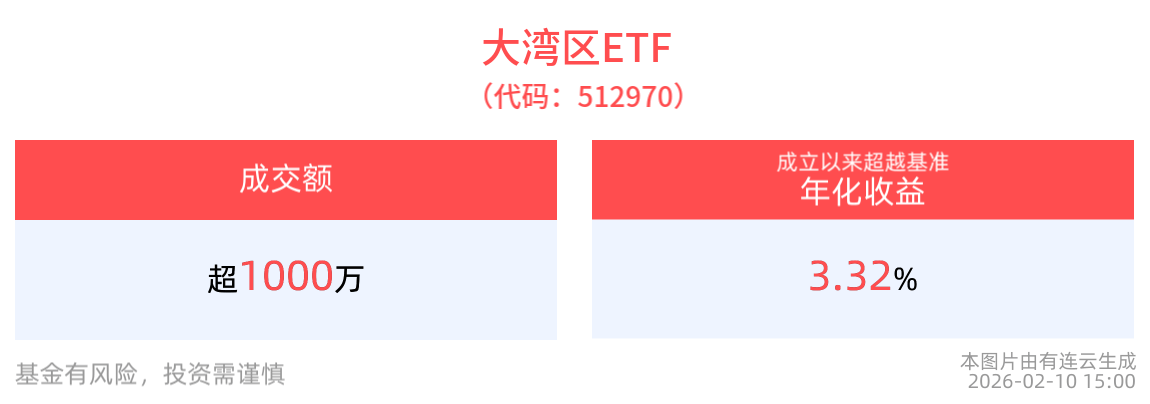
成交额超1000万元,大湾区ETF(512970)成立以来超越基准年化收益达3.32%
Sou Hu Cai Jing· 2026-02-11 01:46
Core Viewpoint - The performance of the China Securities Guangdong-Hong Kong-Macao Greater Bay Area Development Theme Index and its related ETF reflects the market dynamics and investment opportunities within the Greater Bay Area, with notable fluctuations in constituent stocks and trading activity [2][3]. Group 1: Index Performance - As of February 10, 2026, the China Securities Guangdong-Hong Kong-Macao Greater Bay Area Development Theme Index (931000) decreased by 0.01% [2]. - The Greater Bay Area ETF (512970) also saw a decline of 0.13%, with the latest price at 1.52 yuan [2]. - Over the past week, the Greater Bay Area ETF has accumulated a rise of 0.93% [2]. Group 2: Stock Movements - Among the constituent stocks, Zhao Chi Co. led with a gain of 9.96%, followed by Xinlitai with an increase of 6.88%, and Huitai Medical up by 5.15% [2]. - Conversely, Mingyang Smart Energy experienced the largest drop at 4.34%, followed by Xinwei Communication down 4.08%, and Jiejia Weichuang down 3.45% [2]. Group 3: Trading Activity - The trading volume for the Greater Bay Area ETF was active, with a turnover rate of 14.53% and a transaction value of 11.4673 million yuan [2]. - The average daily trading volume over the past week was 2.6276 million yuan [2]. Group 4: Risk and Return Metrics - The maximum drawdown for the Greater Bay Area ETF this year was 5.52%, with a relative benchmark drawdown of 0.02% [2]. - The Sharpe ratio for the Greater Bay Area ETF over the past year was reported at 1.41 as of February 6, 2026 [2]. Group 5: Fee Structure - The management fee for the Greater Bay Area ETF is set at 0.15%, while the custody fee is 0.05% [2]. Group 6: Index Composition - The index closely tracks companies benefiting from the Greater Bay Area's development, with the top ten weighted stocks accounting for 44.55% of the index [3]. - The top ten stocks include China Ping An, Luxshare Precision, BYD, and others, with varying weight percentages [4].
“津关24条”新版发布 支持在京津冀开展保税展示交易
Zhong Guo Jing Ying Bao· 2026-02-07 12:53
Core Viewpoint - The Tianjin Customs is set to implement the "Tianjin Customs 24 Measures (2026 Version)" to enhance the city's high-level opening-up and support foreign trade development, following the successful implementation of the previous version [1][2]. Group 1: Policy Implementation - The "Tianjin Customs 24 Measures" will be officially released in early 2024, serving as a key driver for high-quality foreign trade development in Tianjin [1]. - In 2025, Tianjin's total import and export value reached 835.87 billion, with a year-on-year growth of 2.8%, and exports exceeded 400 billion for the first time, reaching 430.94 billion, a 10.1% increase [1]. Group 2: Focus Areas of the New Measures - The new measures will focus on five key areas, including the implementation of national strategies, development of new productive forces, construction of a pioneering reform and opening-up zone, building a modern socialist metropolis, and safeguarding national security [2][3][4]. Group 3: Specific Initiatives - The measures include support for technological innovation tax incentives, expansion of customs clearance for high-tech equipment, and facilitation of cross-border e-commerce [2][3]. - Initiatives to enhance the import and export processes for agricultural products, medical health industries, and high-end manufacturing sectors are also outlined [2][3]. - The establishment of a green channel for the Shanghai Cooperation Organization countries and the promotion of the Belt and Road Initiative are part of the strategic focus [1][2]. Group 4: Security and Safety Measures - The measures emphasize strengthening border security, enhancing the ability to manage public health emergencies, and ensuring food safety at entry points [4].
深圳上市公司达600家,截至1月末总市值超19万亿元稳居全国大中城市第二位
Jin Rong Jie· 2026-02-06 02:46
Core Viewpoint - Shenzhen's listing companies have officially surpassed 600, marking a significant milestone in the city's financial landscape and showcasing its strong innovation and manufacturing capabilities [1] Group 1: Company Listings - On February 6, Zhuozheng Medical and Dazhu CNC were listed on the Hong Kong Stock Exchange, contributing to Shenzhen's total of 600 listed companies [1] - Among these, there are 426 domestic listed companies and 174 overseas listed companies [1] Group 2: Market Capitalization - As of the end of January 2026, the total market capitalization of Shenzhen's listed companies exceeds 19 trillion yuan, ranking second among major cities in China [1] Group 3: Growth and Innovation - During the "14th Five-Year Plan" period, the number of domestic listed companies in Shenzhen has grown by over 35% [1] - Notable new entrants include Beixin Life and Dapu Micro, along with industry leaders in niche sectors such as Yingshi Innovation and Woan Robotics, illustrating Shenzhen's high-tech and innovative industrial landscape [1] Group 4: Overseas Listings - In the past three years, 38 new companies have been added to the overseas market, with the Hong Kong market performing particularly well [1] - 27 newly listed companies in Hong Kong raised a total of 29.573 billion HKD, with over 70% of these companies experiencing stock price increases on their first trading day, averaging a rise of 26.22% [1] Group 5: Financing Performance - The Hong Kong market has shown strong refinancing performance, with a total refinancing amount of 55.466 billion HKD in 2025, a significant year-on-year increase of 4710.58% [1] - BYD alone accounted for over 43.509 billion HKD in refinancing, representing more than 78.44% of the total, marking it as the largest equity refinancing in the global automotive industry in nearly a decade [1] Group 6: Innovation and Financial Ecosystem - The increase in the number and quality of listed companies reflects the competition between urban innovation dynamics and financial ecosystems [1] - The achievement of 600 listed companies in Shenzhen is not just a numerical milestone but also a vivid practice of the efficient cycle among technology, industry, and finance, providing a valuable model for urban development in China [1]
申万期货品种策略日报——股指-20260203
Shen Yin Wan Guo Qi Huo· 2026-02-03 02:29
1. Report Industry Investment Rating - Not provided in the report 2. Core Viewpoints of the Report - The stock market has been continuously improving since 2026, driven by the resonance of the technology cycle, the release of policy dividends, the recovery of the economy, and the return of overseas funds. In February, the market is expected to continue its phased upward trend, benefiting from the "Spring Market" window period, the release of policy dividends in the "14th Five - Year Plan", clear profit expectations for AI and overseas expansion themes, and the seasonal recovery of the consumer sector and the implementation of investment projects. However, potential disturbances from overseas capital market fluctuations during the Spring Festival holiday, especially geopolitical risks, should be watched out for [2] 3. Summary by Relevant Catalogs 3.1 Stock Index Futures Market - **IF Contracts**: The previous day's closing prices were 4582.20 (current month), 4577.40 (next month), 4540.00 (next quarter), and 4491.80 (next - to - next quarter), with declines of 136.20, 142.20, 167.60, and 170.60 respectively, and volume - weighted average price (VWAP) declines of 2.89%, 3.01%, 3.56%, and 3.66%. The trading volumes were 34422.00, 110802.00, 33589.00, and 12595.00, and the open interests were 37542.00, 174613.00, 75115.00, and 26611.00, with changes of - 2648.00, - 11760.00, - 4210.00, and - 145.00 respectively [1] - **IH Contracts**: The previous day's closing prices were 3003.60 (current month), 3004.20 (next month), 2986.00 (next quarter), and 2963.60 (next - to - next quarter), with declines of 70.40, 71.60, 92.40, and 90.20 respectively, and VWAP declines of 2.29%, 2.33%, 3.00%, and 2.95%. The trading volumes were 16229.00, 53829.00, 13294.00, and 5931.00, and the open interests were 16983.00, 66246.00, 25931.00, and 10144.00, with changes of 829.00, - 4197.00, - 695.00, and 1001.00 respectively [1] - **IC Contracts**: The previous day's closing prices were 7951.00 (current month), 7903.20 (next month), 7765.20 (next quarter), and 7647.00 (next - to - next quarter), with declines of 434.60, 475.20, 558.00, and 593.00 respectively, and VWAP declines of 5.18%, 5.67%, 6.70%, and 7.20%. The trading volumes were 43997.00, 151002.00, 69294.00, and 24711.00, and the open interests were 43403.00, 153481.00, 93095.00, and 38790.00, with changes of - 3591.00, - 10216.00, - 7752.00, and 869.00 respectively [1] - **IM Contracts**: The previous day's closing prices were 7910.00 (current month), 7871.80 (next month), 7701.60 (next quarter), and 7548.60 (next - to - next quarter), with declines of 367.80, 387.60, 434.80, and 444.40 respectively, and VWAP declines of 4.44%, 4.69%, 5.34%, and 5.56%. The trading volumes were 46878.00, 173821.00, 60249.00, and 26152.00, and the open interests were 61033.00, 194848.00, 107833.00, and 50536.00, with changes of 2761.00, 3050.00, - 3441.00, and 3040.00 respectively [1] - **Inter - month Spreads**: The current inter - month spreads of IF (next month - current month), IH (next month - current month), IC (next month - current month), and IM (next month - current month) were - 4.80, 0.60, - 47.80, and - 38.20 respectively, compared with the previous values of 1.00, 5.80, - 14.80, and - 21.80 [1] 3.2 Stock Index Spot Market - **Major Indexes**: The previous day's closing values of the CSI 300, SSE 50, CSI 500, and CSI 1000 were 4605.98, 3003.14, 8037.05, and 7975.43 respectively, with declines of 2.13%, 2.07%, 3.98%, and 3.39%. The trading volumes (in billions of lots) were 304.77, 80.80, 299.65, and 308.32, and the total trading amounts (in billions of yuan) were 7259.20, 2081.53, 5460.56, and 4989.41 [1] - **Industry Indexes**: Among different industries, the energy, raw materials, industrial, and optional consumer sectors had declines of 4.44%, 7.74%, 0.96%, and 1.14% respectively. The major consumer sector had an increase of 1.12%, while the pharmaceutical, real - estate and finance, information technology, telecommunications, and public utility sectors had declines of 2.05%, 0.53%, 2.85%, 3.36%, and 0.81% respectively [1] 3.3 Futures - Spot Basis - The previous day's basis values of IF (current month - CSI 300), IF (next month - CSI 300), IF (next quarter - CSI 300), and IF (next - to - next quarter - CSI 300) were - 23.78, - 28.58, - 65.98, and - 114.18 respectively, compared with the previous two - day values of 3.66, 4.66, - 6.54, and - 51.34 [1] - The previous day's basis values of IH (current month - SSE 50), IH (next month - SSE 50), IH (next quarter - SSE 50), and IH (next - to - next quarter - SSE 50) were 0.46, 1.06, - 17.14, and - 39.54 respectively, compared with the previous two - day values of 1.70, 7.50, 13.50, and - 13.30 [1] - The previous day's basis values of IC (current month - CSI 500), IC (next month - CSI 500), IC (next quarter - CSI 500), and IC (next - to - next quarter - CSI 500) were - 86.05, - 133.85, - 271.85, and - 390.05 respectively, compared with the previous two - day values of 6.68, - 8.12, - 70.52, and - 160.52 [1] - The previous day's basis values of IM (current month - CSI 1000), IM (next month - CSI 1000), IM (next quarter - CSI 1000), and IM (next - to - next quarter - CSI 1000) were - 65.43, - 103.63, - 273.83, and - 426.83 respectively, compared with the previous two - day values of 27.54, 5.74, - 111.06, and - 258.26 [1] 3.4 Other Domestic and Overseas Indexes - **Domestic Indexes**: The previous day's closing values of the Shanghai Composite Index, Shenzhen Component Index, Small and Medium - Sized Board Index, and ChiNext Index were 4015.75, 13824.35, 8344.38, and 3264.11 respectively, with declines of 2.48%, 2.69%, 2.37%, and 2.46% [1] - **Overseas Indexes**: The previous day's closing values of the Hang Seng Index, Nikkei 225, S&P 500, and DAX Index were 26775.57, 52655.18, 6976.44, and 24806.10 respectively, with changes of - 2.23%, - 1.25%, 0.54%, and 1.09% [1] 3.5 Macro Information - The Asia - Pacific financial markets experienced a "Black Monday" due to the uncertainty of the Fed's policy, leading to sell - offs. The South Korean Composite Index fell 5.26%, the Indonesian Composite Index fell 4.88%, and both triggered circuit breakers during the session. A - shares and Hong Kong stocks' three major indexes all fell more than 2%. Resource stocks were severely hit, and more than 10 commodity futures in the domestic market hit the daily limit down. Thailand's gold online futures trading was temporarily suspended [2] - On February 2, after the resumption of trading, the net asset value of SDIC Silver LOF was adjusted to 2.2494 yuan, with a single - day decline of 31.5%, setting a record for the largest single - day decline in public funds. The current secondary - market price premium rate is 109.92% [2] - Shanghai launched a program to purchase second - hand housing for affordable rental housing, with Pudong New Area, Jing'an District, and Xuhui District as the first - batch pilot areas [2] - The CPC Central Committee and the State Council approved the "Spatial Coordination Plan for the Modern Capital Metropolitan Area (2023 - 2035)", aiming to build a world - class metropolitan area centered around the capital and a leading area for demonstrating Chinese - style modernization [2] - Nine government departments, including the Ministry of Commerce, launched the "Happy Shopping for Chinese New Year" special event in 2026, which will run from February 15 to 23 and cover six aspects: "delicious food", "good accommodation", "convenient travel", "pleasant tourism", "satisfactory shopping", and "fun entertainment" [2] 3.6 Industry Information - In January, the second - hand housing markets in several key cities recovered. Beijing and Shanghai had 15,000 and 23,000 second - hand housing transactions respectively, both with year - on - year growth of over 20%. Shenzhen had 5,000 transactions, with a month - on - month increase of 16% and a year - on - year increase of 7%. Hangzhou also saw a significant increase in transactions both month - on - month and year - on - year. The new - housing markets in key cities were relatively dull due to factors such as the market supply rhythm [2] - Ten government departments issued a document to promote the construction of a standard system for the low - altitude economy, aiming to establish a "four - dimensional integrated" standard supply system by 2027, focusing on five core areas: low - altitude aircraft, low - altitude infrastructure, low - altitude air traffic management, safety supervision, and application scenarios [2] - The National Healthcare Security Administration announced that this year's medical insurance fund supervision will conduct on - site inspections across all provinces in China, focusing on key areas such as orthopedics, oncology, laboratory tests, ophthalmology, stomatology, general surgery, and neurology [2] - The mandatory national standard "Safety Technical Requirements for Automobile Door Handles" will be implemented next year, requiring each door (excluding the rear door) to be equipped with a mechanical external door handle and a mechanical internal door handle, which will bring major changes to the popular hidden - door - handle design [2]
资金跟踪系列之三十一:机构ETF延续大幅净赎回,北上转向净流出
SINOLINK SECURITIES· 2026-02-02 08:56
Macroeconomic Liquidity - The US dollar index continued to decline, and the degree of "inversion" in the China-US interest rate spread deepened. The nominal and real interest rates of 10Y US Treasuries rose and fell respectively, indicating a rebound in inflation expectations [1][15]. - Offshore dollar liquidity tightened marginally, while the domestic interbank funding remained balanced. The yield spread between 10Y and 1Y bonds narrowed [1][22]. Market Trading Activity, Volatility, and Liquidity - Market trading activity has rebounded, with trading heat in sectors such as non-ferrous metals, media, military industry, chemicals, and steel exceeding the 90th percentile [2][26]. - The volatility of major indices has increased, with the military sector's volatility reaching above the 80th percentile [2][33]. - Market liquidity indicators have improved, although all sectors remain below the 60th historical percentile [2][37]. Institutional Research - The banking, electronics, machinery, computing, and automotive sectors are leading in research activity, with a rising trend in research heat for banking, petrochemicals, machinery, non-ferrous metals, and building materials [3][44]. Analyst Forecasts - Analysts have raised net profit forecasts for the entire A-share market for 2026/2027. The proportion of stocks with upward revisions in net profit forecasts has continued to increase [4][17]. - Specific sectors such as non-ferrous metals, telecommunications, retail, home appliances, and real estate have also seen upward adjustments in their 2026/2027 net profit forecasts [4][21]. - Major indices including the ChiNext Index, CSI 300, and SSE 50 have had their 2026/2027 net profit forecasts raised, while the CSI 500 saw a decrease in its forecasts [4][23]. Northbound Trading Activity - Northbound trading activity has increased, although there has been a continued net sell-off of A-shares. The ratio of buy/sell totals in sectors like non-bank financials, non-ferrous metals, and food and beverage has risen [5][31]. - For stocks with northbound holdings of less than 30 million shares, there were significant net purchases in sectors such as food and beverage, electricity, and public utilities, while net sales were observed in computing, pharmaceuticals, and machinery [5][33]. Margin Financing Activity - Margin financing activity has continued to decline, reaching its lowest level since mid-July 2025. The net purchases were mainly in non-ferrous metals, finance, and food and beverage sectors, while net sales were seen in electronics, military, and computing sectors [6][35]. Long-Short Trading Activity - Long-short trading activity has continued to rise, with sectors like non-ferrous metals, agriculture, forestry, animal husbandry, and food and beverage showing relatively high trading volumes [7][41]. Active Equity Fund Positions - Active equity funds have increased their positions in sectors such as non-ferrous metals, petrochemicals, and electronics, while reducing positions in pharmaceuticals, media, and food and beverage sectors [8][46]. - The correlation between active equity funds and small-cap growth, as well as large/mid-cap value, has increased, while the correlation with large/mid-cap growth and small-cap value has decreased [8][48].
策略周末谈(0201):大炼化,下一个有色
Western Securities· 2026-02-01 03:18
Group 1 - The underlying logic of the non-ferrous metals, liquor, and large refining sectors is interconnected, driven by the anticipated liquidity from the Federal Reserve's QE in 2026, which is expected to enhance the super cycle of commodities [1][10] - The current investment in the large refining sector is likened to the investment in non-ferrous metals last year, with expectations of a significant price increase in oil and chemical products by 2026, following the patterns observed in the non-ferrous sector [2][14] - The "anti-involution" trend in China is contributing to the upward momentum in the large refining sector, as capital expenditure is being restrained, leading to a significant slowdown in new capacity additions and a clearing of inventories, which supports future price elasticity [3][16] Group 2 - The large refining sector is still at a low valuation level, with significant room for valuation recovery compared to the non-ferrous sector, which has already experienced a systematic valuation increase [4][21] - Recent inflows from public funds, foreign investments, and ETFs into the large refining sector indicate a timely opportunity for investment, as the sector is positioned for a major upward trend [6][27] - The upcoming Federal Reserve QE in 2026 is expected to create a favorable environment for the large refining sector, alongside the anticipated recovery in consumer demand and high-end manufacturing sectors [7][37]