
产能治理政策

Search documents
2025年CPI数据发布
Di Yi Cai Jing Zi Xun· 2026-01-09 02:08
Core Viewpoint - In December 2025, the Consumer Price Index (CPI) increased by 0.8% year-on-year, with urban areas rising by 0.9% and rural areas by 0.6%, indicating a steady increase in consumer prices driven by food and non-food price changes [1][4][6]. CPI Summary - The CPI rose by 0.2% month-on-month in December, reversing a previous decline of 0.1% [5]. - Core CPI, excluding food and energy, increased by 1.2% year-on-year, maintaining a growth rate above 1% for four consecutive months [6]. - Food prices rose by 1.1% year-on-year, with significant increases in fresh vegetables (18.2%) and fresh fruits (4.4%), contributing to the overall CPI increase [6][8]. - Energy prices decreased by 3.8% year-on-year, with gasoline prices dropping by 8.4% [6]. PPI Summary - The Producer Price Index (PPI) increased by 0.2% month-on-month, marking three consecutive months of growth [8]. - Year-on-year, the PPI decreased by 1.9%, but the decline was less severe than in previous months, indicating some stabilization in industrial prices [9]. - Key industries such as coal mining and lithium-ion battery manufacturing saw price increases, reflecting improved supply-demand dynamics [8][9]. - Input factors like international commodity prices influenced the price trends in domestic industries, with non-ferrous metal prices rising due to global market conditions [8][9].

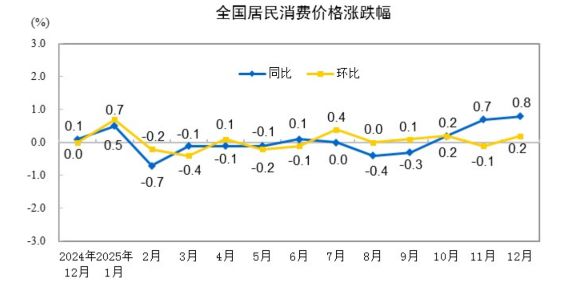
国家统计局:2025年12月份CPI同比涨幅继续扩大 PPI同比降幅收窄
智通财经网· 2026-01-09 01:43
Group 1: CPI Analysis - The Consumer Price Index (CPI) increased by 0.2% month-on-month and 0.8% year-on-year in December 2025, with the core CPI (excluding food and energy) rising by 1.2% year-on-year [1][2][3] - The month-on-month increase in CPI was primarily driven by rising prices of industrial consumer goods, which increased by 0.6%, contributing approximately 0.16 percentage points to the CPI [2] - Food prices rose by 1.1% year-on-year, significantly impacting the CPI, with fresh vegetables and fruits seeing price increases of 18.2% and 4.4%, respectively [3] Group 2: PPI Analysis - The Producer Price Index (PPI) rose by 0.2% month-on-month, marking the third consecutive month of increases, with the year-on-year decline narrowing to 1.9% [1][4][5] - Key industries such as coal mining and lithium-ion battery manufacturing saw price increases, with coal mining prices rising by 1.3% and lithium-ion battery prices by 1.0% [4] - The year-on-year decline in PPI was mitigated by improved market conditions and the implementation of macroeconomic policies, with certain sectors like coal mining and battery manufacturing experiencing reduced price declines [5]
0.7%
Shang Hai Zheng Quan Bao· 2025-12-10 04:32
Group 1 - In November, the Consumer Price Index (CPI) increased by 0.7% year-on-year, marking the highest level since March 2024, with a 0.5 percentage point increase from October [1][3] - The rise in CPI was primarily driven by a turnaround in food prices, which shifted from a 2.9% decline in October to a 0.2% increase in November, positively impacting the CPI by 0.04 percentage points [3] - Fresh vegetable prices saw a significant increase, rising by 14.5% year-on-year in November after nine consecutive months of decline, while pork and poultry prices experienced a narrowing of their decline [3] Group 2 - The Producer Price Index (PPI) rose by 0.1% month-on-month in November, continuing the upward trend for the second consecutive month, driven by seasonal demand increases in coal and gas [5][6] - The PPI year-on-year decreased by 2.2%, with the decline slightly widening compared to October, primarily due to high comparison bases from the previous year [6] - Key industries such as coal mining, photovoltaic equipment manufacturing, and lithium-ion battery manufacturing saw a narrowing of their year-on-year price declines, indicating effective capacity management policies [7] Group 3 - The core CPI, excluding food and energy, rose by 1.2% year-on-year, maintaining a level above 1% for three consecutive months, with service prices and industrial consumer goods prices also showing positive growth [3][4] - Seasonal factors led to a decrease in service prices, with significant declines observed in accommodation, airfares, and travel-related costs [4] - Emerging industries are experiencing rapid growth, with notable year-on-year price increases in sectors such as external storage devices (13.9%), graphite and carbon products (3.8%), and integrated circuit manufacturing (1.7%) [7][8]
产能治理政策预期仍存 多晶硅下方受到刚性支撑
Jin Tou Wang· 2025-08-14 06:05
Core Viewpoint - The main focus of the news is the significant decline in the futures price of polysilicon, which dropped to a low of 49,300 yuan, reflecting a decrease of 4.41% as of the latest report. Group 1: Market Performance - On August 14, the main contract for polysilicon futures experienced a rapid decline, reaching a low of 49,300 yuan, and closing at 49,740 yuan, down 4.41% [1]. - The futures market is currently characterized by a cautious approach, with various institutions providing differing outlooks on future price movements [2][3][4]. Group 2: Institutional Insights - Guotou Anxin Futures suggests a cautious short position at the lower end of the polysilicon price range, with expectations for the PS2511 contract to operate between 48,000 and 53,000 yuan per ton [2]. - Jianxin Futures indicates that polysilicon is expected to maintain a wide range of fluctuations, with production in August significantly increased to 125,000 tons, which can meet downstream demand of 56.82 GW [3]. - Donghai Futures anticipates a short-term high-level fluctuation in polysilicon prices, supported by the current spot prices, while downstream silicon wafers and battery cells are successfully increasing prices [4].